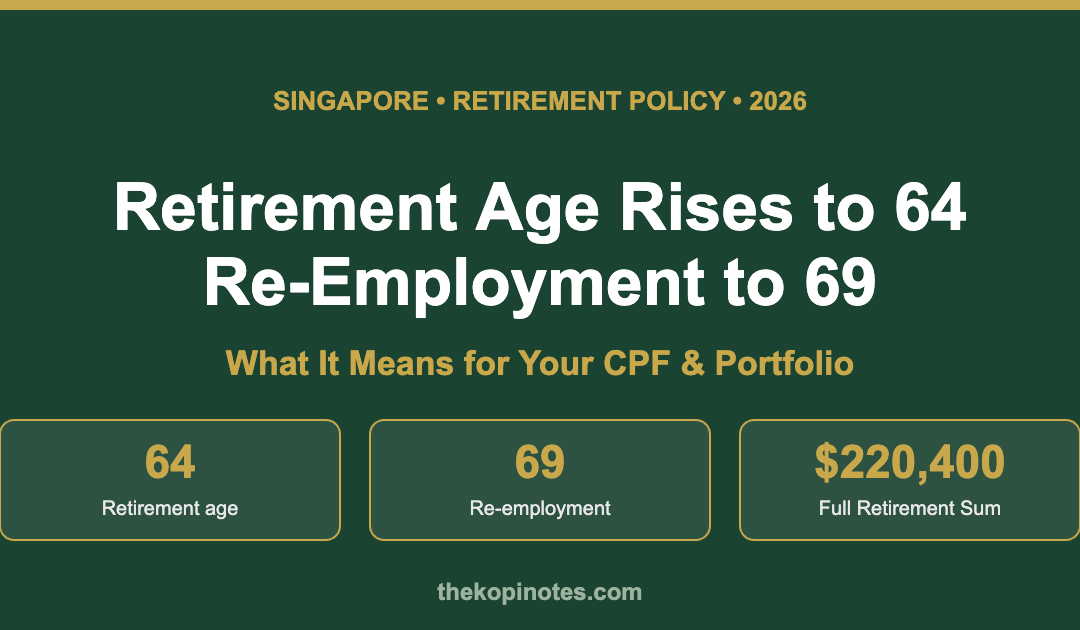
From today, 1 July 2026, Singapore’s statutory retirement age rises to 64 and the re-employment age to 69 — the second-last step toward the 2030 target of 65 and 70. Paired with 2026’s higher CPF contribution rates for senior workers and a larger Full Retirement Sum, the message for retail investors is blunt: the runway to build your nest egg just got longer, and the system expects you to use it.
This is an editorial analysis. Not financial advice.
What Actually Changed on 1 July 2026
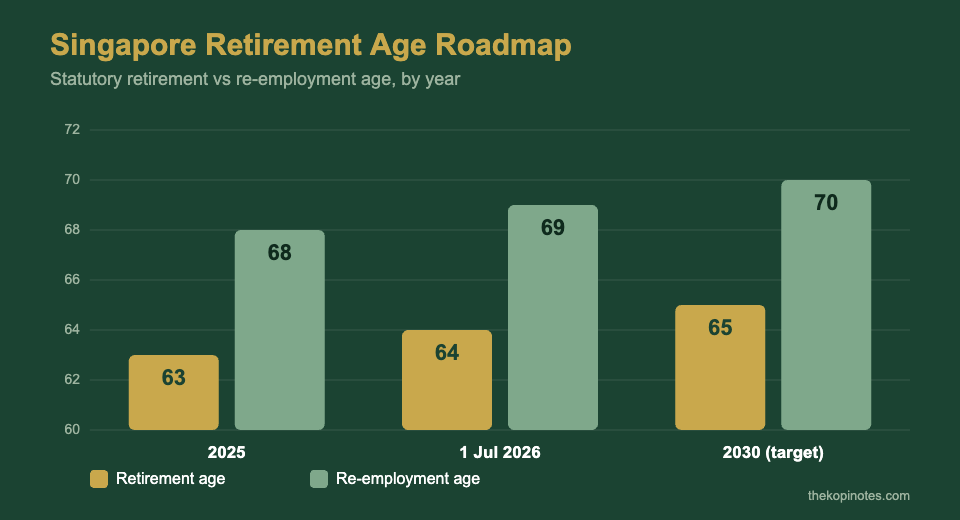
Two statutory thresholds moved up by one year each. The minimum retirement age — the age below which an employer cannot dismiss you on grounds of age — increased from 63 to 64. The re-employment age — the age up to which employers must offer eligible workers continued employment — rose from 68 to 69.
The new retirement age of 64 applies to Singapore Citizens and Permanent Residents born on or after 1 July 1962. The new re-employment age of 69 applies to those born on or after 1 July 1957. Foreigners on work passes are not covered by these thresholds. This is part of a phased roadmap first signalled in 2019, and the government has reaffirmed the endpoint: a retirement age of 65 and re-employment age of 70 by 2030.
Critically for planning, one number did not move: the CPF payout eligibility age stays at 65. That gap — you can now be legally protected in your job until 69, but CPF LIFE payouts still start at 65 — is where the real financial-planning opportunity sits.
What This Means for Singapore Retail Investors
The headline isn’t really about labour law. It’s about the arithmetic of your retirement. A longer protected working life means more years of earned income, more years of CPF contributions flowing into your Retirement Account, and — for those who choose it — more years to let invested capital compound before you draw it down. For anyone who has been quietly worried they are behind on retirement savings, the state has just handed you extra time to catch up.
But time is only an advantage if you deploy it. Working to 64 or 69 while leaving cash idle in a low-interest account wastes the runway. The investors who benefit most will be those who treat the extra years as additional contribution and compounding years, not merely additional working years.
The CPF Changes Stacking On Top
The age change doesn’t arrive in isolation. Several CPF adjustments took effect in 2026 that reshape how much goes into your retirement pot, especially for older workers.
From 1 January 2026, the CPF Ordinary Wage monthly salary ceiling rose from S$7,400 to S$8,000. For someone earning S$8,000 or more, that adds roughly S$222 in combined employee-and-employer contributions each month, or about S$2,664 a year. The Full Retirement Sum for the cohort turning 55 in 2026 climbed to S$220,400, up from S$213,000 in 2025 — a 3.5% increase.
Most relevant to this age change: CPF contribution rates for senior workers went up in 2026. Workers aged above 55 to 60 now face a total contribution rate of 34%, and those above 60 to 65 sit at 25%. The entire increase is channelled into the Retirement Account up to the Full Retirement Sum — so the “cost” of a slightly smaller take-home pay is, in effect, forced retirement saving.
2026 Retirement & CPF Changes at a Glance
| Measure | Before (2025) | From 2026 | 2030 Target |
|---|---|---|---|
| Statutory retirement age | 63 | 64 (from 1 Jul) | 65 |
| Re-employment age | 68 | 69 (from 1 Jul) | 70 |
| CPF payout eligibility age | 65 | 65 (unchanged) | 65 |
| CPF monthly salary ceiling | S$7,400 | S$8,000 | S$8,000 |
| Full Retirement Sum (turning 55) | S$213,000 | S$220,400 | — |
| Total CPF rate, age 55–60 | ~32.5% | 34% | 37% |
| Total CPF rate, age 60–65 | ~23.5% | 25% | 26% |
For a deeper breakdown of the ceiling change, see our guide on the CPF salary ceiling of S$8,000 and what it means for your take-home pay, and our explainer on the 2026 CPF wage ceiling and contributions.
The Real Decision: Work Longer, or Invest Harder?
Here is the strategic fork this policy creates. The state is nudging Singaporeans toward longer working lives to shore up retirement adequacy. That is a reasonable public-policy answer to rising longevity. But it is not automatically the right personal answer.
Consider two paths for a 55-year-old today. Path A: rely on the extended runway, keep working to 64 or beyond, and lean on CPF LIFE plus continued contributions. Path B: use the same extra years to aggressively build a private investment portfolio — broad-market ETFs and dividend-paying assets — so that financial independence, not statutory protection, dictates when you stop working.
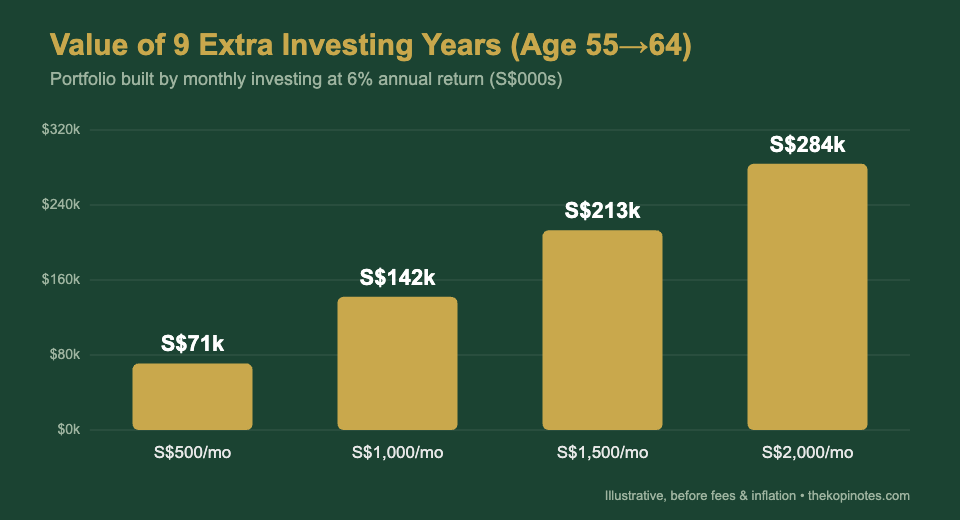
The two are not mutually exclusive, and the best plans blend them. But the policy change quietly rewards Path B for those with the discipline to execute it. Every additional protected working year is a year you can max out CPF and funnel surplus income into markets. Someone who invests an extra S$1,500 a month for the nine years between 55 and 64 — at a 6% annual return — accumulates over S$210,000 on top of their CPF. That is a second Full Retirement Sum, built privately, entirely from the time this policy just granted.
Illustrative: The Value of Nine Extra Investing Years
| Monthly Investment | Years (Age 55→64) | At 4% Return | At 6% Return | At 8% Return |
|---|---|---|---|---|
| S$500 | 9 | ~S$65,000 | ~S$71,000 | ~S$78,000 |
| S$1,000 | 9 | ~S$130,000 | ~S$142,000 | ~S$156,000 |
| S$1,500 | 9 | ~S$195,000 | ~S$213,000 | ~S$234,000 |
| S$2,000 | 9 | ~S$260,000 | ~S$284,000 | ~S$312,000 |
Figures are rounded illustrations of monthly compounding, before fees and inflation. Actual returns vary and are not guaranteed.
For investors thinking through exactly this trade-off, our companion piece on how the retirement age of 64 changes your investment strategy is worth reading alongside this. If you want to know your own target, the Asia-Pacific FIRE Number Index 2026 puts a number on how much you actually need.
Where Income Investors Fit In
A longer working horizon also changes how you think about income assets. If your CPF LIFE payouts don’t begin until 65 but you may keep working to 69, you have a window where earned income can be paired with a growing stream of investment distributions — without needing to touch principal.
This is where Singapore’s income staples earn their keep. A diversified basket of S-REITs, several of which now yield above 6%, can supplement earned income during the working-to-69 years and become a core payout engine afterward. Our rundown of the best REITs in Singapore for 2026 and the Lion-Phillip S-REIT ETF distribution guide lay out the options for building that income layer.
The employer side matters too. The Senior Employment Credit has been extended, offering employers a wage offset of up to 7%, with the top tier now covering workers aged 69 and above. Practically, that support makes it more likely employers will keep older staff on — which strengthens the assumption behind Path A and gives Path B investors the earned-income cushion to keep investing.
Bottom Line for SG Investors
The 1 July 2026 age change is not just an HR footnote — it is a signal about the shape of retirement in Singapore. The state is buying you time and, through higher senior CPF rates, quietly forcing more of your income into the Retirement Account. The smart move is to treat that extra time as a gift to be invested, not merely worked through.
Three concrete takeaways. First, map the gap: your job is now protected potentially to 69, but CPF payouts still start at 65 — plan how you bridge and stack those years. Second, use the extra contribution years to max CPF top-ups (which now compound over a longer horizon) while simultaneously building a private ETF-and-REIT portfolio. Third, decide deliberately whether you are on Path A (rely on longer work plus CPF) or Path B (invest hard enough that work becomes optional) — and let that choice, not the statutory calendar, drive your savings rate. The policy just handed every Singaporean worker under 55 an extra year of runway. Whether it becomes a bigger nest egg or a longer commute is up to how you invest it.
When exactly did Singapore's retirement age rise to 64?
Does the higher retirement age change when CPF LIFE payouts start?
What is the difference between the retirement age and the re-employment age?
How much more will go into my CPF because of the 2026 changes?
What is the Full Retirement Sum for 2026?
Should I keep working longer or invest more aggressively instead?
What support is there for employers to keep older workers?
This article was researched with the help of AI. While we strive to keep all information accurate and up to date, there may be errors. If you notice any discrepancies, please contact us.