MediShield Life vs CareShield Life: What’s the Difference? (2026)
Two government health schemes. One covers hospital bills. The other covers long-term disability. Singapore investors often mix them up — but they do very different jobs.
MediShield Life covers you for hospitalisation and major surgery bills — it reimburses a portion of what you pay at a public hospital. CareShield Life is completely separate: it pays you a monthly cash payout if you become severely disabled and can no longer perform basic daily activities. Every Singapore Citizen and PR has both, but they serve entirely different needs and can be upgraded in different ways.
Not financial advice. All figures are for educational reference only. Data as at June 2026 unless noted.
- MediShield Life = hospital bills. CareShield Life = disability income. Different problems, different solutions.
- Both are mandatory for Singapore Citizens and PRs — premiums come out of your Medisave automatically.
- You can upgrade MediShield Life with an Integrated Shield Plan (ISP) for private hospital coverage; you can upgrade CareShield Life with a private supplement for higher disability payouts.
Table of Contents
Quick Answer: The Core Difference
Think of it this way. You fall and break your hip and end up in the hospital for a week. MediShield Life kicks in to help cover that hospital bill. You recover, go home, and life continues.
Now imagine a different scenario. A stroke leaves you unable to dress yourself, bathe, or move around without help — permanently. That’s not a hospital bill problem anymore. That’s a monthly income problem that lasts years or decades. CareShield Life is designed for exactly this.
Both are run by the CPF Board. Both are funded from your Medisave. But they protect you against completely different risks — and both gaps are real.
What Is MediShield Life?
MediShield Life is Singapore’s universal basic health insurance scheme. It was launched in November 2015, replacing the old MediShield scheme, and it covers all Singapore Citizens and Permanent Residents from birth — for life.
The scheme reimburses a portion of large hospital bills at public hospitals (B2 and C class wards). It does not cover the full bill — there’s a deductible you pay first, and then co-insurance on top. But it caps your out-of-pocket exposure so you’re never hit with a catastrophic bill alone.
Key things MediShield Life covers:
- Inpatient hospitalisation (including day surgery)
- Selected outpatient treatments for serious conditions like chemotherapy, dialysis, and immunosuppressants
- Psychiatric hospitalisation (since 2021)
MediShield Life does not cover outpatient GP visits, dental, spectacles, or routine health check-ups. For those, you’re on your own — or you use MediSave for approved outpatient treatments.
If you want coverage for private hospitals or private specialist wards, you need to upgrade MediShield Life with an Integrated Shield Plan (ISP) — a top-up product sold by private insurers like AIA, Prudential, Great Eastern, Singlife, and NTUC Income.
What Is CareShield Life?
CareShield Life is Singapore’s severe disability insurance scheme. It launched in October 2020 and replaced the older ElderShield scheme for younger cohorts. It pays you a monthly cash payout if you become severely disabled — defined as being unable to perform at least 3 out of 6 Activities of Daily Living (ADLs): washing, dressing, feeding, toileting, walking/moving around, and transferring in and out of a bed or chair.
The minimum payout starts at SGD 600 per month (as at 2026) and increases by 2% every year you don’t make a claim, and continues increasing during the claim period. Payouts are for life — they never stop as long as you remain severely disabled.
Who’s automatically enrolled:
- Singapore Citizens and PRs born in 1980 or later are automatically covered from age 30 onwards (or from age 30 if you turned 30 after October 2020)
- Those born between 1970–1979 could opt into CareShield Life from October 2020 onwards
- Those born before 1970 remain on the older ElderShield scheme
The need for this coverage is real. According to MOH Singapore, about 1 in 2 Singaporeans aged 65 today is expected to need some form of long-term care in their lifetime. Without CareShield Life, a severely disabled person relying on family caregivers faces enormous financial pressure.
If you want higher payouts — SGD 600/month might not stretch far in Singapore — you can top up with a CareShield Life supplement from an approved private insurer.
Key Differences at a Glance
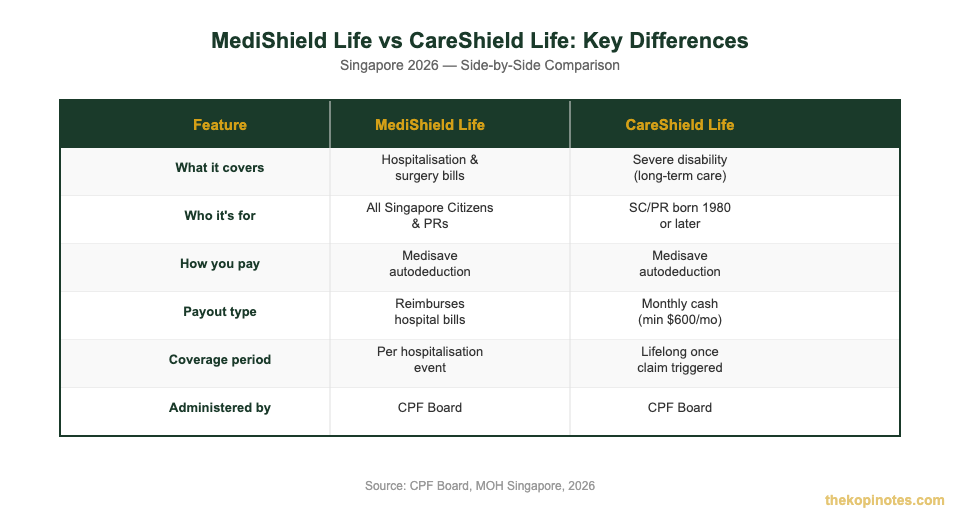
Here’s a side-by-side comparison so you can see exactly how the two schemes differ:
| Feature | MediShield Life | CareShield Life |
|---|---|---|
| What it covers | Hospital bills and surgery | Severe disability — monthly cash |
| Trigger for payout | Hospitalisation or approved outpatient treatment | Unable to perform ≥3 of 6 ADLs |
| Payout type | Reimburses actual bill (after deductible + co-insurance) | Monthly cash — min $600/mo, increases over time |
| Payout duration | Per hospitalisation event | Lifelong (as long as severely disabled) |
| Who’s covered | All SC and PRs, from birth | SC/PR born 1980 or later (auto-enrolled at age 30) |
| How premiums are paid | Medisave autodeduction (annual) | Medisave autodeduction (annual, until 67) |
| Premium payment period | Lifelong (premiums due every year) | Until age 67 — then coverage continues for free |
| Can you opt out? | No — mandatory for all SC/PRs | No — mandatory for eligible cohorts |
| Private top-up available? | Yes — Integrated Shield Plans (ISP) | Yes — CareShield Life Supplement plans |
Source: CPF Board, MOH Singapore, June 2026
Premiums and How You Pay
Both schemes deduct premiums automatically from your Medisave account — you don’t need to do anything or write any cheques. But the premium structures are quite different.
MediShield Life Premiums
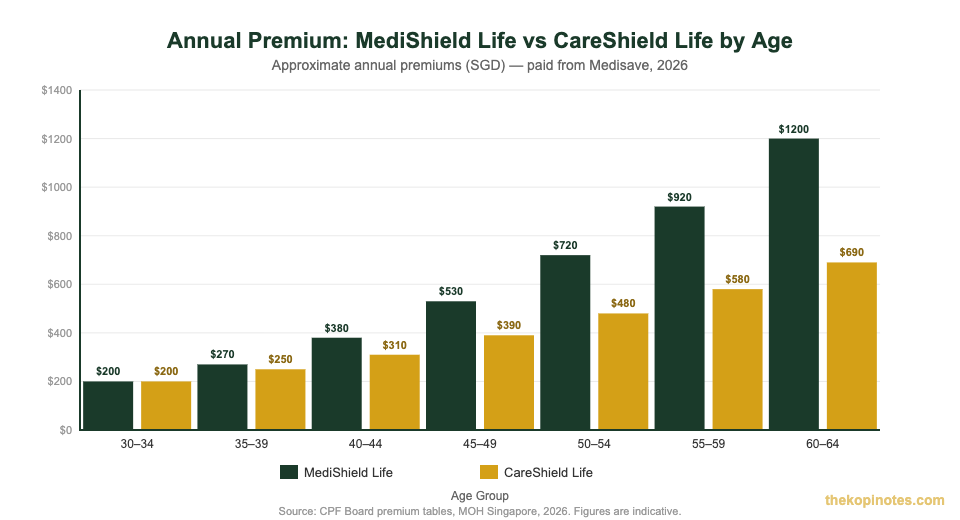
MediShield Life premiums are age-banded and increase as you get older. A 30-year-old pays around SGD 200 per year. By the time you’re 60–64, you’re paying roughly SGD 1,200 per year. Premiums are payable for life.
If your Medisave balance is insufficient, you can top up with cash. Singaporean households that need help with premiums can apply for MediShield Life subsidies through CPF Board — these are means-tested and can cover 20–60% of premiums for lower-income households.
CareShield Life Premiums
CareShield Life premiums are also age-banded but stop at age 67. After 67, your coverage continues for life with no further premium payments. A 30-year-old pays roughly SGD 200 per year; by 50–54, you’re paying around SGD 480 per year.
Premiums also increase by 2% annually to keep pace with the rising payout amounts. The good news: once you stop paying at 67, you’re covered for life — and the monthly payout you’d receive keeps growing as long as you haven’t claimed.
For a worked example: imagine you’re 35 years old. You pay roughly SGD 270/year for MediShield Life and SGD 250/year for CareShield Life — about SGD 520/year total, or SGD 43/month, all deducted from Medisave. That’s the base government layer of protection. Most Singaporeans then decide whether to top either or both up.
How to Upgrade Each Scheme
The base government schemes are intentionally lean — they cover the basics but not everything. Here’s how to upgrade each one if you want more comprehensive coverage.
Upgrading MediShield Life: Integrated Shield Plans (ISPs)
An Integrated Shield Plan (ISP) is a private insurance top-up that rides on top of your MediShield Life base layer. ISPs are sold by five approved insurers in Singapore: AIA, Great Eastern, Prudential, Singlife, and NTUC Income.
An ISP upgrades your coverage to include private hospital wards or restructured hospital A/B1 class wards — depending on the plan tier you choose. The private insurers pay their portion after MediShield Life pays its portion.
ISP premiums are partially payable from Medisave (up to the Additional Withdrawal Limits set by MOH), with any excess payable in cash. If you want a detailed breakdown of how ISPs work and which insurer offers the best value, the integrated shield plan comparison 2026 guide covers every major plan side by side.
Important ISP rider change (2021 and April 2026): Since 2021, all new ISP riders must include co-payment — meaning you pay at least 5–10% of any claim out of pocket. MOH tightened this further in April 2026, removing the deductible waiver component from existing riders. This was designed to reduce unnecessary hospitalisation claims. Before buying an ISP rider, understand that you will always pay something when you make a claim — there’s no more “full coverage” rider available.
For a full guide on what changed and which riders are still worth buying, read the new ISP rider rules 2026 explainer.
Upgrading CareShield Life: Supplement Plans
If SGD 600/month sounds too low for your lifestyle — and for most Singaporeans it likely is — you can buy a CareShield Life Supplement from an approved private insurer. These supplements top up your monthly payout to a higher amount, often SGD 3,000–5,000/month depending on the plan.
Approved supplement providers as at 2026 include Great Eastern, Aviva (Singlife), and NTUC Income. Supplement premiums can be paid from Medisave under the CareShield Life and MediShield Life Act.
Whether you need a supplement depends on your expected retirement expenses. Use the Singapore retirement calculator to stress-test whether SGD 600/month would cover your care costs if you became severely disabled today.
Who Needs What?
Both schemes are mandatory — you can’t opt out. But you can decide how much to top up. Here’s a simple framework.
You need an ISP top-up for MediShield Life if:
- You want to be treated at a private hospital without a massive bill
- You want a choice of specialist or surgeon (not just whoever is rostered)
- You’re self-employed and have no employer-provided group hospitalisation insurance
- You have dependants whose hospital care you want to control
You may not need an ISP if:
- Your employer already provides group hospitalisation insurance that covers private hospital stays
- You’re happy being treated in a restructured hospital B2/C ward (good quality care, just less choice)
- You’re a PR planning to return home eventually and won’t be in Singapore long-term
You need a CareShield Life supplement if:
- SGD 600/month would not cover your daily care expenses in retirement
- You have no family members to provide free caregiving support
- You have significant monthly fixed expenses (mortgage, car, dependants) that would continue even if you were disabled
You may be fine without a CareShield Life supplement if:
- You have substantial savings and investments that would cover long-term care costs
- You have family support and a paid-off home you could sell or rent if needed
- You’re nearing 67 and have already accumulated significant CPF Life payouts that complement the $600/month base
If you’re building a more comprehensive financial plan, combining health insurance planning with a solid investment portfolio makes sense. Many Singaporeans pair ISP coverage with regular ETF investing — a CPF investment strategy can help ensure your savings grow enough to cover gaps no insurance product will fill.
You might also consider whether platforms like Endowus (referral code: 2V343) or Syfe (referral code: SRPRFFFCD) are good fits for putting your long-term savings to work alongside your insurance coverage — both allow CPF-OA and SRS investing in diversified funds.
For a complete picture of how your passive income streams might support you in retirement, check out the passive income Singapore 2026 guide.
Disclaimer: This article is for educational purposes only. It does not constitute financial, insurance, or medical advice. Please consult a licensed financial adviser or insurance agent before making decisions about your health insurance coverage.
Frequently Asked Questions
What is the main difference between MediShield Life and CareShield Life?
MediShield Life covers your hospitalisation and surgery bills at public hospitals — it reimburses a portion of what you owe after your deductible and co-insurance. CareShield Life is completely different: it pays you a monthly cash payout (starting from SGD 600/month in 2026) if you become severely disabled and cannot perform at least 3 of 6 basic daily activities. Think of MediShield Life as your hospital bill safety net and CareShield Life as your disability income safety net.
Is CareShield Life the same as MediShield Life?
No, they are two completely separate government insurance schemes. MediShield Life (launched 2015) covers hospitalisation costs. CareShield Life (launched 2020) covers long-term severe disability. Both are mandatory for eligible Singapore Citizens and PRs, and both deduct premiums from your Medisave — but they protect against different risks and trigger under different conditions.
Do I need both MediShield Life and CareShield Life?
If you’re a Singapore Citizen or PR born in 1980 or later, you are automatically enrolled in both — you don’t have a choice. Premiums for both are deducted from your Medisave automatically each year. The two schemes complement each other: MediShield Life protects you during medical events (hospitalisation), while CareShield Life protects you if you suffer a long-term or permanent disability that requires ongoing care.
Can I use MediShield Life for long-term care or nursing home stays?
No. MediShield Life does not cover long-term nursing home stays or home caregiving costs. It only covers hospitalisation at acute hospitals and selected outpatient treatments for serious conditions. If you need long-term care support — for example, staying at a community hospital for rehabilitation or a nursing home — you would use MediSave under the Chronic Disease Management Programme, or rely on CareShield Life payouts and your own savings.
What happens to MediShield Life and CareShield Life if I become a PR or give up citizenship?
MediShield Life coverage ends if you cease to be a Singapore Citizen or PR — but you remain insured until the end of the policy year in which you lose your status. CareShield Life works similarly: coverage is tied to your status as a Singapore Citizen or PR. If you become a foreigner, you are no longer covered, and any premiums paid are not refunded. This is an important consideration for people who may eventually emigrate or give up PR status.
How do I upgrade beyond the basic MediShield Life and CareShield Life coverage?
To upgrade MediShield Life, you buy an Integrated Shield Plan (ISP) from one of five approved private insurers: AIA, Great Eastern, Prudential, Singlife, or NTUC Income. An ISP adds coverage for private hospitals or A/B1 class wards in restructured hospitals. To upgrade CareShield Life, you buy a CareShield Life Supplement from an approved insurer to receive higher monthly disability payouts beyond the base SGD 600/month. Both types of top-ups have premiums partially payable from Medisave.
What is the CareShield Life payout amount in 2026?
The minimum CareShield Life payout starts at SGD 600 per month in 2026 for new claimants. However, if you enrolled before 2026 and have not made a claim, your payout amount has been growing by 2% annually since enrolment — so earlier enrollees receive higher monthly payouts than SGD 600 when they eventually claim. The payout continues for life as long as you remain severely disabled.
Build Your Financial Safety Net
Good health coverage is just one layer. Pair it with smart investing to grow wealth alongside your protection plan.
Get Free Insurance Advice
Speak with a licensed insurance advisor. No obligation, no cost.
By submitting this form, you agree to our Privacy Policy.
This article was researched with the help of AI. While we strive to keep all information accurate and up to date, there may be errors. If you notice any discrepancies, please contact us.