REITs in Singapore 2026: Complete Investor Guide
Everything you need to know about S-REITs — from how they work to which ones to buy for dividend income.📋 Table of Contents
REITs in Singapore (S-REITs) are investment trusts that own income-producing properties — from malls and data centres to hospitals and logistics warehouses. Listed on the SGX, they must pay out at least 90% of taxable income as dividends. For Singapore investors, S-REITs offer 5–7% annual yields, quarterly income, and access to commercial real estate without buying physical property.
Not financial advice. All figures are for educational reference only. Data as at June 2026 unless noted.
- S-REITs deliver 5–7% dividend yields — 2x to 3x better than bank fixed deposits
- They are CPF-OA investable (selected trusts), making them powerful for retirement planning
- You can start with as little as $200 via platforms like Syfe or FSMOne — no need to buy 100-unit lots
What Is a REIT and How Does It Work in Singapore?
A Real Estate Investment Trust (REIT) pools money from investors to buy and manage income-producing properties. Think of it like a unit trust — but instead of holding stocks or bonds, it holds real estate assets that generate rental income.
In Singapore, REITs are regulated by the Monetary Authority of Singapore (MAS) under the Code on Collective Investment Schemes. To qualify as a REIT, a trust must:
- Distribute at least 90% of taxable income to unitholders each year
- Invest at least 75% of assets in income-producing real estate
- Limit gearing (borrowing) to 50% of total assets
- Be listed on an approved exchange — in Singapore’s case, the SGX
Because of the mandatory 90% payout rule, S-REITs are one of the most reliable income instruments available to Singapore retail investors. You get paid quarterly (sometimes semi-annually) simply by holding units.
How Are S-REIT Returns Taxed?
This is where Singapore investors get a major advantage. Dividend distributions from S-REITs are tax-exempt for individual investors. You keep 100% of what the REIT pays you — no dividend tax, no capital gains tax. This is significantly better than holding US stocks, where dividends attract 30% withholding tax at source.
The REIT itself pays corporate tax on retained earnings, but since it distributes 90%+ of income, the effective tax drag on investors is minimal.
Types of S-REITs: Sectors Explained
Singapore has one of Asia’s most diverse REIT markets. There are over 40 S-REITs and property trusts listed on SGX, spanning six major property sectors. Here’s what each sector means for you as an investor:
| Sector | What They Own | Key Examples | Avg Yield |
|---|---|---|---|
| Industrial | Warehouses, factories, business parks | Mapletree Industrial Trust, Ascendas REIT | ~6.8% |
| Retail | Shopping malls, retail podiums | Frasers Centrepoint Trust, Starhill Global | ~6.2% |
| Office | Grade A CBD offices, business hubs | Keppel REIT, CapitaLand Ascendas | ~5.9% |
| Hospitality | Hotels, serviced residences | Far East Hospitality Trust, CDL Hospitality | ~7.1% |
| Healthcare | Hospitals, nursing homes, medical centres | Parkway Life REIT, First REIT | ~5.4% |
| Data Centre | Server farms, colocation facilities | Keppel DC REIT, Digital Core REIT | ~5.2% |
Source: SGX, individual REIT annual reports. Yields are distribution yield based on trailing 12-month DPU and unit price as at June 2026. Past distributions not indicative of future performance.
S-REIT Yield Comparison by Sector (2026)
One of the most common questions Singapore investors ask is: which REIT sector pays the most? The answer depends on what you value — raw yield, stability, or growth potential.
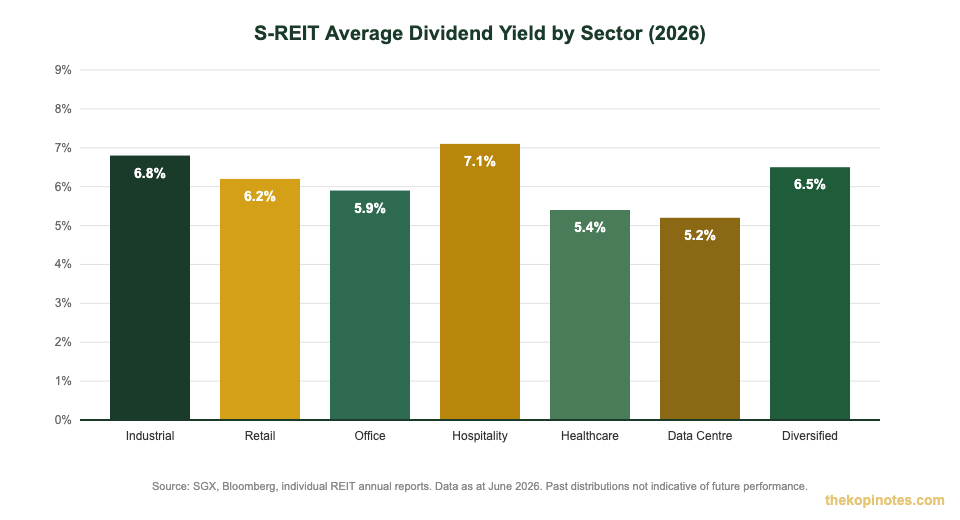
Hospitality REITs offer the highest headline yields (~7.1%) but are more cyclical — their income swings with tourism and business travel. Industrial and diversified REITs sit in the sweet spot: 6.5–6.8% yields with more stable rental income from long-term leases.
Healthcare REITs like Parkway Life REIT trade at lower yields (~5.4%) precisely because investors are willing to accept less income for the stability of healthcare tenants on long, triple-net leases. Data centre REITs are similar — the secular growth story commands a premium valuation.
For most Singapore income investors, industrial and retail REITs offer the best risk-adjusted yield. They have diversified tenant bases, proven track records through multiple economic cycles, and many are CPF-OA investable.
How to Invest in S-REITs in Singapore
You have three main ways to invest in S-REITs. Each suits a different investor profile.
1. Buy Individual S-REITs via a Brokerage
The traditional route: open a CDP-linked brokerage account, fund it, and buy units on SGX. Minimum lot size is 100 units. At $1.50 per unit, that’s $150 for one lot of a lower-priced REIT, or several thousand dollars for premium REITs like Parkway Life.
Best for: investors who want to hand-pick specific REITs, control their exact allocation, and accumulate units over time. Use platforms like FSMOne referral code (low commission) or Interactive Brokers for cost efficiency.
2. Invest via a REIT-Focused Robo or Fund Platform
If you don’t want to pick individual REITs, platforms like Syfe referral code and sign-up bonus offer REIT-specific portfolios (Syfe REIT+) that automatically rebalance across multiple S-REITs. You can start from $1 and invest fractional amounts.
Similarly, Endowus referral code lets you access diversified REIT funds using cash, SRS, or CPF OA funds — a powerful option for retirement-focused investors.
3. Buy a Singapore REIT ETF
If you want broad exposure with one trade, consider the Lion-Phillip S-REIT ETF or the NikkoAM-STC Asia REIT ETF. These hold a basket of S-REITs and trade on SGX like any stock. For a deeper breakdown, check our Singapore REIT ETF guide.
| Method | Min. Investment | Best Platform | CPF Usable? |
|---|---|---|---|
| Individual REITs (SGX) | ~$100–$500 (1 lot) | FSMOne, IBKR | Selected REITs only |
| Robo (Syfe REIT+) | $1 | Syfe | No |
| Endowus REIT Fund | $1,000 | Endowus | Yes (OA + SRS) |
| S-REIT ETF | ~$200 (100 units) | FSMOne, Syfe | Selected ETFs |
Source: Platform websites, CPF Board approved investment list. Data as at June 2026.
S-REITs vs Other Income Assets
How do S-REITs stack up against other popular income options in Singapore? Here’s the comparison that matters most for your portfolio.
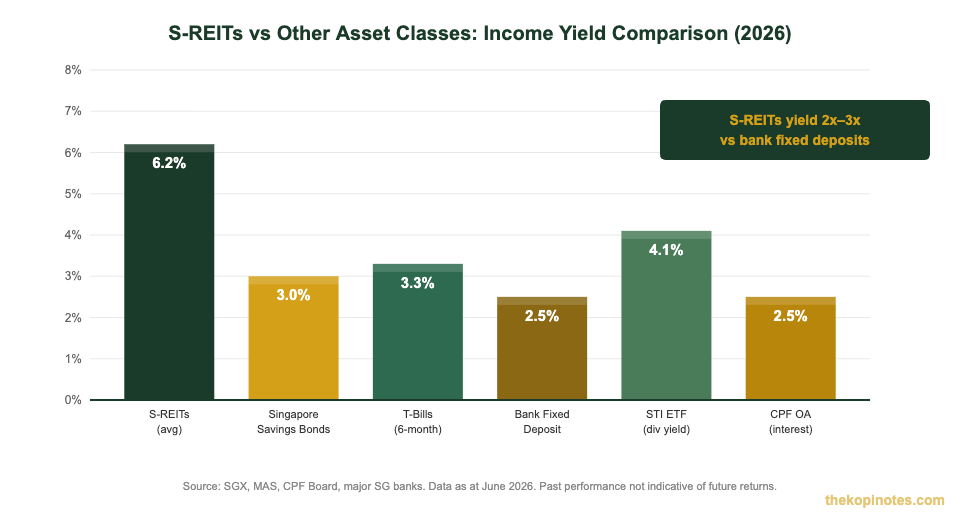
The chart above tells the story clearly. At ~6.2% average yield, S-REITs pay more than double what bank fixed deposits offer. Even Singapore Savings Bonds (SSBs) and T-bills — both risk-free government instruments — pay only 3.0–3.3% in June 2026.
That yield gap matters. On a $100,000 portfolio, the difference between 6.2% (S-REITs) and 3.0% (SSBs) is $3,200 more income per year. Over 10 years with reinvestment, that compounds into a substantial difference in retirement wealth.
Of course, S-REITs carry more risk than SSBs or T-bills. Interest rate risk is the biggest one — when rates rise, REIT unit prices tend to fall. But for long-term income investors willing to hold through cycles, the yield premium has historically been worth it. For planning your income retirement strategy, try our Singapore retirement calculator.
For more ideas on building passive income streams beyond S-REITs, see our guide on passive income Singapore options for 2026.
Top S-REITs to Watch in 2026
These are not buy recommendations — they are the S-REITs that frequently appear on Singapore investors’ watchlists based on size, liquidity, yield track record, and analyst coverage. Always do your own due diligence before investing.
| REIT | Sector | Approx Yield | Notable Factor |
|---|---|---|---|
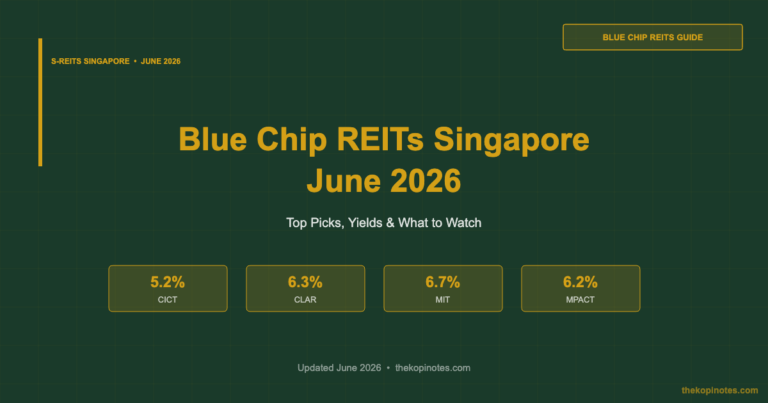
| CapitaLand Ascendas REIT | Industrial | 5.8% | Largest S-REIT by assets; global diversification |
| Mapletree Industrial Trust | Industrial / Data Centre | 6.9% | Strong US data centre exposure; near 5-year low |
| Frasers Centrepoint Trust | Retail | 6.3% | Suburban mall focus; resilient to e-commerce |
| Keppel DC REIT | Data Centre | 5.1% | AI/cloud demand tailwind; pure-play data centre |
| Parkway Life REIT | Healthcare | 5.3% | 17-year unbroken DPU growth track record |
| Suntec REIT | Office + Retail | 7.2% | High yield; office headwinds but recovery expected |
| Mapletree Logistics Trust | Logistics | 7.0% | Pan-Asia logistics network; near multi-year low |
Source: SGX, Bloomberg, REIT manager investor relations pages. Yield figures based on trailing 12-month DPU and indicative unit prices as at June 2026. Not a buy/sell recommendation.
For a broader look at how blue-chip S-REITs are performing relative to historical prices, see our analysis of best S-REITs in Singapore 2026.
Key Risks of Investing in S-REITs
S-REITs are not risk-free. Understanding these risks is essential before you put your money in.
Interest Rate Risk: This is the biggest one. When interest rates rise, two things happen: REIT borrowing costs increase (reducing distributable income) and competing fixed-income yields become more attractive (causing investors to sell REIT units). The 2022–2024 rate hiking cycle saw many S-REITs drop 20–40% in unit price. REITs that entered 2025 with high gearing ratios suffered most.
Gearing Risk: REITs borrow to buy more properties. Singapore REITs can borrow up to 50% of total assets. A highly-geared REIT near the 50% limit has little room to refinance or acquire new assets. Always check the gearing ratio before buying — under 35% is conservative, 40%+ warrants extra scrutiny.
Currency Risk: Many S-REITs own properties in Australia, Japan, Europe, or the US. Their distributions are collected in foreign currencies and converted to SGD. A strengthening SGD reduces the SGD-equivalent DPU even if the underlying properties perform well.
Manager Quality: A REIT is only as good as its manager. Look for managers with a track record of growing DPU, conservative capital management, and alignment with unitholders (e.g. managers who reinvest in the REIT themselves).
Tenant Concentration: If a REIT has one or two major tenants that make up 30%+ of rental income, losing that tenant is devastating. Check the tenant diversification table in every REIT’s annual report.
Frequently Asked Questions
Are REITs a good investment in Singapore 2026?
What is the minimum investment for S-REITs in Singapore?
Can I use CPF to invest in S-REITs?
How often do S-REITs pay dividends?
Are S-REIT dividends taxable in Singapore?
What is a good REIT yield in Singapore?
What is the difference between a REIT and a property trust in Singapore?
This article was researched with the help of AI. While we strive to keep all information accurate and up to date, there may be errors. If you notice any discrepancies, please contact us.