Integrated Shield Plan Premium Singapore 2026: Costs, Medisave Limits & How to Save
A complete guide to ISP premiums in Singapore — what you pay, how much Medisave covers, and how to reduce your out-of-pocket costs.
Integrated Shield Plan (ISP) premiums in Singapore range from around S$300 to over S$5,000 per year depending on your age, the ward class you choose, and the insurer. The good news: you can use Medisave to pay most or all of the base premium portion, with a cash top-up required for the private insurer’s additional coverage. Here’s exactly what you’ll pay in 2026 and how to keep costs manageable.
Not financial advice. All figures are for educational reference only. Data as at June 2026 unless noted.
- ISP premiums rise sharply with age — from under S$500/year at age 30 to over S$5,000/year at age 70 for Class A cover.
- Medisave pays up to S$1,730/year (age 70+) of your ISP premium; anything above that is a cash top-up.
- Rider premiums cannot be paid from Medisave at all — they are 100% cash.
Table of Contents
Contents — Click to expand
What Makes Up Your ISP Premium?
Your Integrated Shield Plan premium has two parts. First, there’s the MediShield Life base premium — the mandatory national health insurance portion every Singapore resident and PR pays. Second, there’s the additional premium charged by your private insurer (AIA, Great Eastern, Prudential, Singlife, or Income) for coverage above what MediShield Life provides.
Your total premium depends on three things: your age (premiums increase by 5-year age band), the ward class you want (Community Hospital/B2, B1, A, or Private), and whether you’ve added an optional rider to cover your deductible and co-insurance.
Both portions can be paid using Medisave — up to the annual Medisave withdrawal limit for your age. Anything above that limit must be paid in cash. This is the “cash top-up” you may have heard about. Rider premiums are different: they cannot be paid from Medisave at all and must be paid entirely in cash.
2026 ISP Premium Tables by Insurer and Ward Class
The table below shows approximate annual premiums for a non-smoker at selected age bands, combining both the MediShield Life base premium and the insurer’s additional premium. Actual premiums vary slightly between insurers and by exact age within each band.
| Age Band | Class B1 (approx.) | Class A (approx.) | Private Ward (approx.) |
|---|---|---|---|
| Age 1–20 | S$280–S$320 | S$400–S$480 | S$680–S$800 |
| Age 31–35 | S$580–S$640 | S$880–S$980 | S$1,400–S$1,600 |
| Age 41–45 | S$880–S$1,050 | S$1,350–S$1,650 | S$2,100–S$2,600 |
| Age 51–55 | S$1,300–S$1,600 | S$2,000–S$2,500 | S$3,200–S$4,000 |
| Age 61–65 | S$2,000–S$2,500 | S$3,200–S$3,900 | S$5,200–S$6,500 |
| Age 71–75 | S$2,800–S$3,500 | S$4,500–S$5,500 | S$7,500–S$9,500 |
Source: AIA, Great Eastern, Prudential, Singlife premium schedules, June 2026. Ranges reflect variation across insurers. Premiums are for non-smokers without riders.
Premiums roughly double every decade. A 30-year-old paying S$600/year for Class A cover will pay over S$3,000/year for the same cover by age 60. This is why choosing the right ward class early — and understanding your Medisave limits — matters so much.
How Much Medisave Can You Use?
The CPF Board sets annual Medisave withdrawal limits for Integrated Shield Plans. These limits increase as you get older — because premiums also rise with age. Medisave covers both the MediShield Life base premium AND part of the insurer’s additional premium in one combined withdrawal. You don’t have to separate them.
| Age | Annual Medisave Withdrawal Limit | Rider Premium Payment |
|---|---|---|
| Below 30 | S$300 | Cash only — no Medisave |
| 30–39 | S$600 | Cash only — no Medisave |
| 40–49 | S$900 | Cash only — no Medisave |
| 50–59 | S$1,050 | Cash only — no Medisave |
| 60–69 | S$1,380 | Cash only — no Medisave |
| 70 and above | S$1,730 | Cash only — no Medisave |
Source: CPF Board, Medisave withdrawal limits for Integrated Shield Plans, 2026. Rider premiums must be paid fully in cash per MOH regulations.
Note the right column. Rider premiums cannot be paid from Medisave — a rule MOH introduced to make policyholders more cost-conscious about riders. This matters because riders can add S$400 to over S$1,500 per year in pure cash costs on top of your regular cash top-up.
Cash Top-Up: What You Pay Out of Pocket
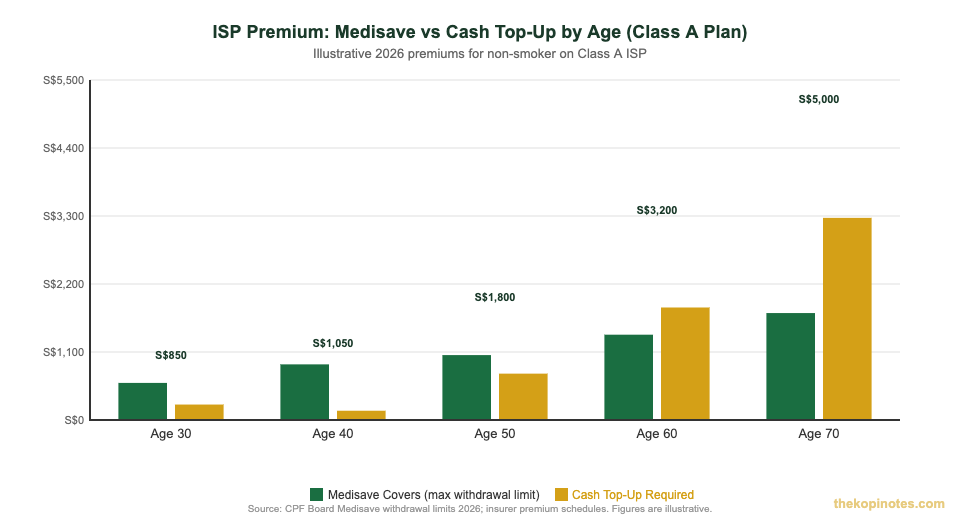
Once Medisave covers its share, the remaining ISP premium is a cash top-up. For younger policyholders on Class A plans, the cash top-up can be small. But it grows sharply with age — and the gap widens fastest in your 50s and 60s.
Here’s a worked example for a 45-year-old on a Class A ISP:
Total annual ISP premium: approximately S$1,550
Medisave withdrawal (age 40–49 limit): S$900
Cash top-up for base ISP: S$650
If you also have a rider (e.g. AIA Max VitalHealth A): add approximately S$800 in cash
Total annual cash outlay: S$1,450
This surprises many policyholders who assumed Medisave would cover most of it. At 45, you’re already paying S$650 in cash just for the ISP itself — and if you have a rider, that doubles to over S$1,400. By age 60, even the base ISP cash top-up exceeds S$1,800 for a Class A plan.
For a full side-by-side comparison of what each insurer charges, including long-term cost projections, the shield plan comparison Singapore 2026 guide walks through the numbers across all five insurers.
ISP Rider Premiums: The Hidden Cost
A rider is an optional add-on that covers your deductible and co-insurance — so you pay very little out of pocket when hospitalised. Since April 2021, MOH requires you to pay at least 5% of your hospital bill even with a rider (10% for private wards). So riders no longer give 100% coverage. But they still reduce your bill significantly.
The catch: riders are entirely cash-funded. No Medisave allowed. Here are approximate 2026 rider premiums for a 45-year-old:
| Rider Plan | Ward Covered | Annual Cash Premium (Age 45) |
|---|---|---|
| AIA Max VitalHealth A | Class A | ~S$750–S$950 |
| AIA Max VitalHealth | Private | ~S$1,100–S$1,400 |
| GE SupremeHealth P Plus Rider | Private | ~S$1,050–S$1,350 |
| Prudential PruExtra Premier | Private | ~S$1,000–S$1,300 |
Source: AIA, Great Eastern, Prudential premium schedules, June 2026. All rider premiums payable in cash only — Medisave cannot be used per MOH policy.
Whether to buy a rider depends on your emergency savings and risk appetite. If a S$3,000–S$5,000 deductible would cause financial stress, a rider is worth the cash outlay. If you have solid savings — say, 6–12 months of expenses set aside — skipping the rider and investing the premium difference may make more sense. For more on the 2026 rule changes, see the new ISP rider rules 2026 Singapore guide.
How to Reduce Your ISP Premium
You don’t have to accept your premium as fixed. These five strategies can meaningfully cut your costs:
1. Choose Class A instead of Private Ward. Dropping from Private to Class A typically saves 30–40% on your annual premium. For most Singaporeans, Class A wards in restructured hospitals offer high-quality care. Private ward coverage is worth paying for if you need guaranteed single rooms or access to specific private specialists — otherwise, Class A is usually enough.
2. Skip the rider or downgrade it. If you have solid emergency savings, go without a rider. Or choose a lower-tier rider that covers Class A instead of Private. This alone can save S$500–S$1,000+ per year in pure cash.
3. Don’t over-insure when young. A 25-year-old doesn’t need Private ward coverage. Start with Class A, build your savings, and consider upgrading only if your needs change. Upgrading later may involve health underwriting, so don’t wait too long — but there’s no rush to start with the highest tier.
4. Review your plan every few years. New plans launch, pricing changes, and your needs evolve. Running an integrated shield plan comparison every 3–5 years ensures you’re not paying a premium that a competitor now undercuts.
5. Optimise your overall financial picture. ISP premiums are just one piece of your financial health. The Singapore retirement calculator lets you model how insurance costs fit into your long-term savings and retirement plan — useful when deciding how much to allocate to coverage versus investments. Your CPF investment strategy also deserves a look alongside your insurance planning, since Medisave comes from CPF.
Which ISP Gives the Best Value for Your Premium?
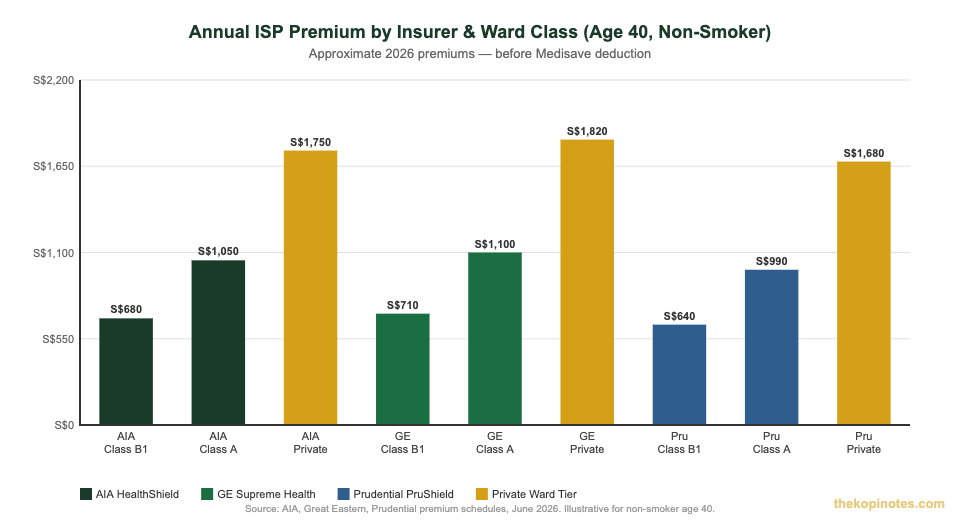
At Class A level, premiums across the five ISP providers are fairly close — usually within S$100–S$150/year of each other at the same age. Where they differ is in pre- and post-hospitalisation coverage windows, specialist panels, and claims experience.
| Plan | Annual Premium (Class A, Age 40) | Cash Top-Up (after Medisave) | Key Strength |
|---|---|---|---|
| AIA HealthShield Gold Max A | ~S$1,050 | ~S$150 | Strong panel hospital access |
| GE Supreme Health A Plus | ~S$1,100 | ~S$200 | Broad pre/post-hospitalisation cover |
| Prudential PruShield A Premier | ~S$990 | ~S$90 | Competitive pricing for younger policyholders |
| Singlife Shield Plan 2 | ~S$1,000 | ~S$100 | Digital-first, straightforward claims |
| Income Shield Enhanced A | ~S$1,020 | ~S$120 | Cooperative-backed, strong service |
Source: Insurer premium schedules, June 2026. Indicative for non-smoker, age 40, Class A ward without rider. Cash top-up = premium minus S$900 Medisave limit. Verify direct with each insurer.
For a 40-year-old, the cash top-up at Class A level can be as low as S$90–S$200/year — very manageable. The real decision point is whether to add a rider (another S$700–S$950 in cash) and whether to stay at Class A or upgrade to Private later in life.
For individual plan deep-dives, see the AIA integrated shield plan review and the Prudential integrated shield plan Singapore guide.
Not financial advice. Always get a personalised quote and speak to a licensed financial adviser before purchasing or switching insurance plans. Premiums and product features change regularly.
Frequently Asked Questions
How much does an Integrated Shield Plan cost per year in Singapore?
ISP premiums range from around S$280/year for a young child on Class B1 coverage, to over S$9,500/year for a senior aged 70+ on Private ward coverage. For most working adults in their 30s and 40s, a Class A plan without a rider costs S$800–S$1,650/year in total — most of which can be offset by Medisave up to the applicable annual withdrawal limit for your age group.
How much Medisave can I use to pay my integrated shield plan premium?
The annual Medisave withdrawal limit for ISPs depends on your age: below 30 — S$300; ages 30–39 — S$600; ages 40–49 — S$900; ages 50–59 — S$1,050; ages 60–69 — S$1,380; ages 70 and above — S$1,730. These limits cover both the MediShield Life base premium and the private insurer’s additional premium combined. Rider premiums cannot be paid from Medisave at all — they must be paid in cash.
Do integrated shield plan premiums increase every year?
ISP premiums don’t increase every calendar year, but they do increase when you move into a higher 5-year age band — at age 30, 35, 40, 45, 50, and so on. Insurers can also revise their premium tables, so even within an age band your premium may change at renewal. It’s worth reviewing your plan annually. If you find your premiums have risen significantly, compare them against what other insurers charge for the same coverage.
Can I use Medisave to pay my ISP rider premium?
No. Since 2021, MOH has prohibited the use of Medisave for rider premiums. All rider premiums must be paid fully in cash by GIRO, credit card, or cheque. This is a deliberate MOH policy to make policyholders more cost-conscious when choosing riders. If you’re on a tight monthly budget, this cash obligation is worth factoring in before adding a rider to your plan.
Is there a big premium difference between AIA, GE, Prudential, and other ISP providers?
For the same ward class and age group, ISP premiums across the five providers (AIA, Great Eastern, Prudential, Singlife, and Income) are typically within 5–15% of each other. Prudential tends to be slightly cheaper for younger policyholders; AIA and GE have wider specialist panel access. Premium differences narrow further when you factor in Medisave — since Medisave covers the same amount regardless of which insurer you choose, the cash top-up difference between providers can be very small. Focus on coverage scope and claims service, not just the premium.
What happens if I can't afford my ISP premium?
If you stop paying your ISP premium, your private insurer’s additional coverage lapses — but your MediShield Life base coverage continues automatically, as it is maintained separately via CPF. You won’t be left without any hospital coverage. However, you’ll lose enhanced benefits like higher claim limits and private hospital access. If affordability is a concern, speak to your insurer about downgrading your ward class rather than letting the policy lapse, since re-applying later may involve health underwriting that could exclude pre-existing conditions.
Protect Your Health Without Breaking the Bank
Compare ISP options, plan your retirement budget, and build a financial safety net.
Get Free Insurance Advice
Speak with a licensed insurance advisor. No obligation, no cost.
By submitting this form, you agree to our Privacy Policy.
This article was researched with the help of AI. While we strive to keep all information accurate and up to date, there may be errors. If you notice any discrepancies, please contact us.