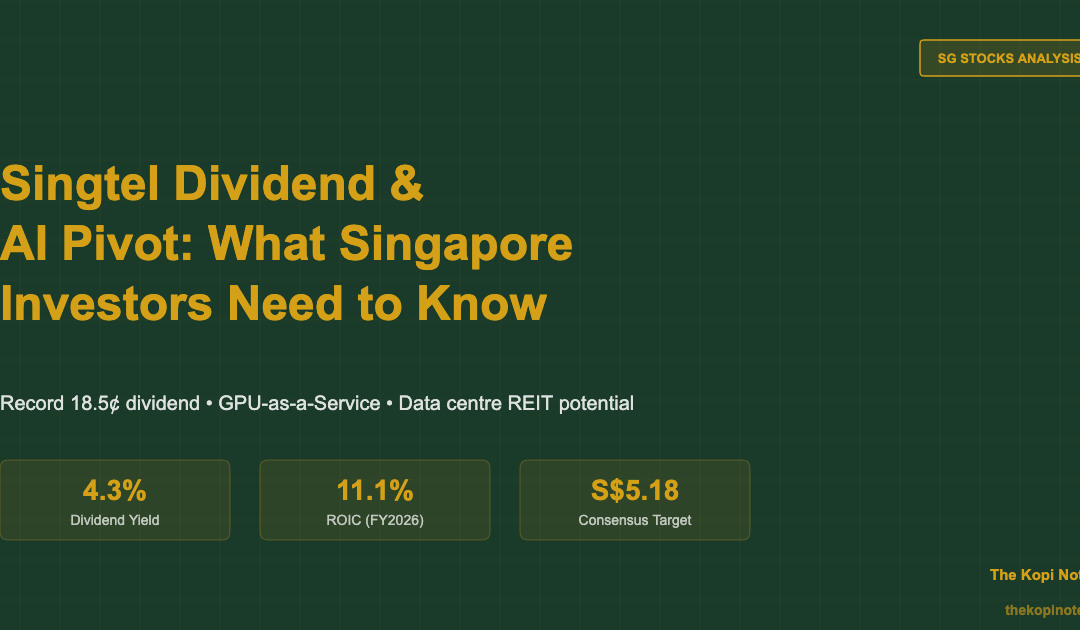
Singtel Dividend & AI Pivot: What Singapore Investors Need to Know (2026)
Record dividends, GPU-as-a-Service, data centre spin-offs â Singtel isn’t the boring telco stock anymore. Here’s the full breakdown for your portfolio.
Singtel (SGX: Z74) just posted its highest-ever ordinary dividend of 18.5 cents per share â a 9% year-on-year increase and the fifth consecutive year of dividend growth. But the bigger story? Management is pivoting hard into AI infrastructure: data centres, GPU-as-a-Service, and subsea cables. With a 4.3% dividend yield, a consensus target of S$5.18, and AI growth engines ramping up, Singtel is quietly becoming Singapore’s most interesting dividend-plus-growth play.
Not financial advice. All figures are for educational reference only. Data as at June 2026 unless noted. Source: Singtel FY2026 results, Beansprout podcast interview with Singtel Group CFO Arthur Lang (June 2026).
- Singtel’s FY2026 ordinary dividend hit a record 18.5 cents/share. Underlying profit grew 12% to S$2.77 billion, and ROIC improved from ~7% to 11.1% in four years.
- The growth story is now AI infrastructure â data centres (Tuas, NexGen with KKR), GPU-as-a-Service (~S$300M capex, 6â12 month payback), and NCS enterprise tech. Management is exploring a REIT or IPO for mature assets.
- At ~S$4.27, Singtel trades at a 4.3% yield with ~17% upside to the S$5.18 consensus target. It’s worth a fresh look if you’re building a Singapore dividend + growth portfolio.
Table of Contents
Contents â Click to expand
- Singtel FY2026 Financial Highlights
- The 3 Growth Engines: Digital InfraCo, GPU-as-a-Service, NCS
- The REIT or IPO Angle â Unlocking Hidden Value
- Singtel Dividend Sustainability & ROIC Improvement
- Current Valuation: What the Market Is Missing
- How Singtel Fits in a Singapore Dividend + Growth Portfolio
- Risks to Watch
- Frequently Asked Questions
Singtel FY2026 Financial Highlights
Let’s start with the numbers. Singtel’s FY2026 results (year ended March 2026) were solid across the board. Underlying profit grew 12% to S$2.77 billion, while operating company (OpCo) EBIT â which strips out associate contributions â rose 10%.
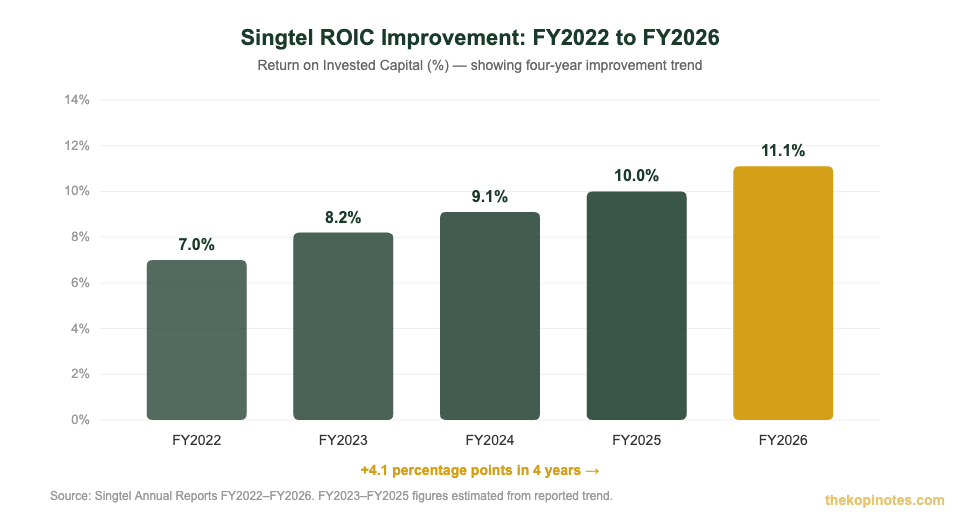
The standout figure? Return on Invested Capital (ROIC) hit 11.1%, up from roughly 7% back in FY2022. That’s a meaningful improvement for a company this size, and it tells you management is allocating capital more effectively than it has in years.
| Metric | FY2026 | YoY Change |
|---|---|---|
| Underlying Profit | S$2.77 billion | +12% |
| OpCo EBIT | Improved | +10% |
| Ordinary Dividend | 18.5 cents/share | +9% |
| ROIC | 11.1% | Up from ~7% in FY2022 |
| Payout Ratio | ~80% | Headroom remains |
| Enterprise Revenue Share (SG) | >50% of SG revenue | Milestone crossed |
| FY2027 Guidance | Mid-to-low single-digit OpCo EBIT growth | Conservative |
Source: Singtel FY2026 Annual Results, March 2026. Beansprout podcast interview with Singtel Group CFO Arthur Lang, June 2026.
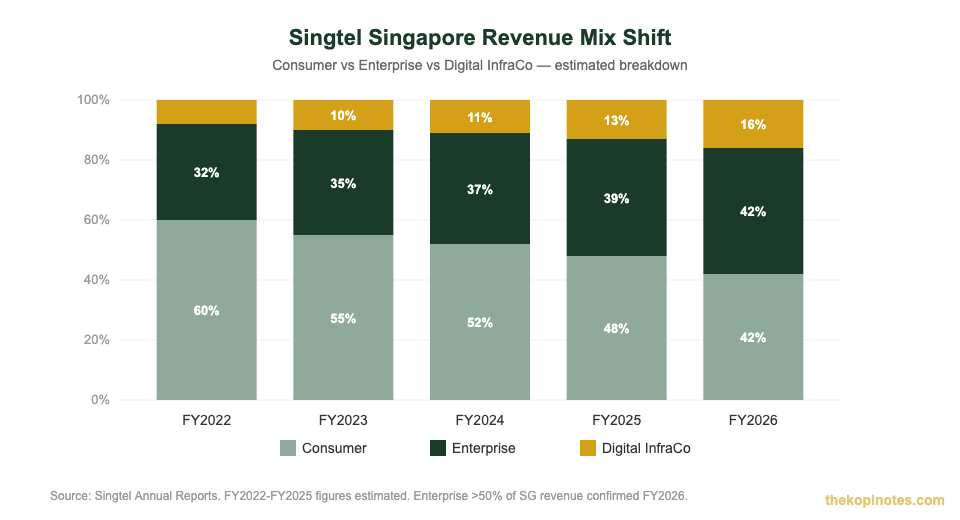
Here’s the key shift most investors miss: enterprise revenue now makes up more than 50% of Singtel Singapore’s total revenue. That’s a structural change. Singtel is no longer primarily a consumer mobile company â it’s increasingly a B2B digital infrastructure provider.
For FY2027, management guided for mid-to-low single-digit OpCo EBIT growth. That sounds conservative. But as Group CFO Arthur Lang explained in a recent Beansprout podcast interview, this reflects management’s preference for under-promising and over-delivering â a pattern they’ve maintained for five straight years of dividend increases.
The 3 Growth Engines: Digital InfraCo, GPU-as-a-Service, and NCS
This is where the Singtel story gets genuinely interesting for growth-oriented investors. Management has identified three pillars that move Singtel beyond its traditional telco business.
1. Digital InfraCo â Data Centres and Subsea Cables
Singtel’s Digital InfraCo houses the company’s “hard” digital infrastructure: data centres, subsea cables, and 5G network assets. The centrepiece is new data centre capacity in Tuas, Singapore, plus the NexGen partnership with global private equity firm KKR.
Why does this matter? Singapore is one of Asia’s most important data centre hubs. With AI workloads exploding, demand for data centre capacity in Singapore is outstripping supply â and the government lifted its moratorium on new data centres in 2022, opening the door for operators like Singtel to build.
The subsea cable network is another quietly valuable asset. Singtel operates one of the largest submarine cable networks in Asia. As AI training requires massive data transfer between regions, these cables become critical infrastructure â not just a legacy telco asset.
2. GPU-as-a-Service (REAI)
This is the most exciting â and highest-risk â growth bet. Singtel’s REAI (Regional AI) platform offers GPU computing capacity as a service to enterprises that need AI training and inference power but don’t want to build their own GPU clusters.
The numbers are compelling: roughly S$300 million in capital expenditure, with contracts already secured and a projected payback period of just 6 to 12 months. If those payback timelines hold, this is an exceptionally high-return investment by any standard.
However, the GPU-as-a-Service market is competitive and evolving fast. Singtel is essentially betting that regional enterprises â particularly in Southeast Asia â will prefer a local provider with data sovereignty compliance over global hyperscalers like AWS, Azure, or Google Cloud. That’s a reasonable bet, but execution will matter enormously.
3. NCS â The Enterprise Tech Arm
NCS is Singtel’s enterprise IT and consulting arm, with a growing focus on AI integration for government and large enterprise clients. Think of it as Singtel’s version of an Accenture or Infosys, but regionally focused.
NCS is pivoting toward AI-powered solutions: helping organisations deploy large language models, automate workflows, and build AI-native applications. As Singapore’s Smart Nation initiative accelerates, NCS is well-positioned to capture government IT modernisation contracts.
Together, these three engines represent a genuine structural shift. Singtel isn’t just milking its consumer mobile business and paying dividends â it’s reinvesting in high-growth digital infrastructure while maintaining its dividend commitment. If you’re investing in passive income Singapore strategies, this combination of yield plus growth optionality is unusual in the local market.
The REIT or IPO Angle â Unlocking Hidden Value
This is arguably the most interesting part of the Singtel story for Singapore investors, and one that hasn’t gotten enough attention.
In the Beansprout podcast interview, Group CFO Arthur Lang confirmed that Singtel is actively exploring capital recycling structures for its mature infrastructure assets. Translation: they’re looking at spinning off data centres or other infrastructure into a REIT or taking them public via an IPO.
Why is this a big deal? Because Singapore investors have seen how much value can be unlocked through infrastructure REITs. Look at the precedents:
| Data Centre REIT | Market Cap | Yield | Key Angle |
|---|---|---|---|
| Keppel DC REIT | ~S$4.5B | ~4.0% | Asia-Pacific data centre pure play, AI tailwind |
| Digital Core REIT | ~US$1.2B | ~5.5% | US/Europe data centres, Digital Realty sponsor |
| Singtel InfraCo (potential) | TBC | TBC | Southeast Asia data centres + subsea cables |
Source: SGX market data, June 2026. Singtel REIT structure is speculative â not yet confirmed.
A Singtel data centre REIT could be massive. Here’s the logic: Singtel’s data centres are mature, cash-generating assets with long-term contracts. Packaging them into a REIT would crystallise their value at data centre multiples â which trade at a premium to telco multiples. Singtel shareholders could benefit from both the valuation uplift and the dividend income from the REIT.
For context, Keppel DC REIT trades at roughly 20â22x price-to-funds-from-operations (P/FFO), while Singtel itself trades at around 13â14x earnings. A REIT spin-off could effectively re-rate a portion of Singtel’s assets from telco multiples to infrastructure multiples.
If you’re tracking the best S-REITs in Singapore 2026, a potential Singtel data centre REIT would be one to watch closely. It wouldn’t exist yet, but the fact that management is publicly discussing it signals serious intent.
Singtel Dividend Sustainability & ROIC Improvement
Can Singtel keep growing its dividend? The evidence suggests yes â for at least the next two to three years.
Three factors support this view. First, the ROIC trajectory. Singtel’s ROIC has improved from roughly 7% in FY2022 to 11.1% in FY2026. That’s not a one-off â it’s a four-year trend driven by better capital allocation, asset recycling, and the shift toward higher-margin enterprise and digital infrastructure revenue.
Second, the payout ratio. At roughly 80%, Singtel has headroom. Many mature Singapore dividend stocks run payout ratios of 90% or higher (some REITs distribute close to 100% of distributable income). An 80% payout ratio means management can grow the dividend organically from earnings growth without stretching.
Third, the revenue mix shift. With enterprise now exceeding 50% of Singapore revenue, Singtel’s earnings base is more stable and higher-margin than the old consumer-dominated model. Enterprise contracts tend to be multi-year, reducing revenue volatility. This makes the dividend more predictable.
That said, the ~S$300 million GPU-as-a-Service capex is a near-term cash outflow. If the 6â12 month payback materialises, it’s accretive almost immediately. If it takes longer or contracts don’t ramp as expected, there could be short-term pressure. However, management has been conservative with guidance and has a track record of under-promising â five years of consecutive dividend growth speaks for itself.
For investors building a dividend-focused portfolio, Singtel offers something different from REITs. REITs distribute most of their income and grow mainly through acquisitions. Singtel retains 20% of earnings for reinvestment, giving it organic growth optionality that most income stocks lack. If you’re using a Singapore retirement calculator to plan your income needs, a position in Singtel could complement your REIT holdings nicely.
Current Valuation: What the Market Is Missing
Here’s where it gets interesting for value-conscious investors. Singtel’s share price dropped roughly 9â10% after its FY2026 results were released â it closed around S$4.54 post-results and has since drifted to roughly S$4.27â4.30.
The selloff appears driven by the conservative FY2027 guidance (mid-to-low single-digit OpCo EBIT growth) and broader market weakness. But the fundamentals tell a different story:
| Valuation Metric | Current (June 2026) |
|---|---|
| Share Price | ~S$4.27â4.30 |
| Dividend Yield (Ordinary) | ~4.3% |
| Consensus Price Target | ~S$5.18 |
| Implied Upside | ~17â21% |
| Post-Results Drop | ~9â10% from ~S$4.54 |
Source: SGX, analyst consensus data, June 2026. Not a price prediction â past consensus targets are not guarantees of future performance.
What’s the market potentially missing? In our view, two things. First, the AI infrastructure optionality isn’t fully priced in. The market still values Singtel primarily as a telco â not as a data centre and AI infrastructure company. If even a portion of the GPU-as-a-Service and data centre REIT optionality materialises, the stock could re-rate meaningfully.
Second, the conservative guidance pattern. Management has under-promised and over-delivered for five consecutive years. There’s a reasonable probability that the “mid-to-low single-digit” FY2027 guidance will be beaten, just as prior guidance periods were.
That said, consensus targets are averages â some analysts are more bullish, others less so. The 9â10% post-results drop could simply reflect profit-taking after a strong run, or genuine concerns about execution risk on the AI capex. You should form your own view.
How Singtel Fits in a Singapore Dividend + Growth Portfolio
Most Singapore investors think of their portfolio in buckets: REITs for income, STI ETFs for broad market exposure, bonds and T-bills for stability. Singtel fits awkwardly into this framework â it’s not a pure income stock, not a pure growth stock, and not a pure value stock. It’s a bit of everything.
Here’s one way to think about it: Singtel gives you 4.3% yield today (comparable to many S-REITs) plus AI infrastructure growth optionality that REITs simply don’t offer. If the REIT/IPO angle plays out, you could see both capital appreciation and a potential special dividend or distribution.
In a model portfolio, Singtel could sit alongside your REIT allocation as a “dividend + growth kicker”. For example, if you hold Keppel DC REIT for pure data centre exposure and an STI ETF like ES3 or G3B for broad market beta, Singtel adds AI optionality with downside protection from its yield. You can compare Singtel’s yield to the broader market via our Singapore REIT ETF guide.
If you’re building your portfolio through a robo-advisor or brokerage, platforms like Syfe or Endowus offer curated Singapore equity portfolios that include Singtel as a core holding. For direct stock purchases, any Singapore brokerage account will give you access to SGX-listed Singtel shares.
Risks to Watch
No analysis is complete without the bear case. Here are the key risks to monitor:
1. Singapore consumer competition. The consumer mobile market in Singapore is mature and competitive. MVNOs and aggressive pricing from StarHub and M1 continue to pressure consumer ARPU. However, this risk is partially mitigated by the enterprise shift â consumer is now less than 50% of Singapore revenue.
2. Regional associates volatility. Singtel has significant stakes in regional telcos (Airtel in India, AIS in Thailand, Telkomsel in Indonesia, Globe in the Philippines). These associates contribute meaningfully to group profit but introduce currency risk, regulatory risk, and earnings volatility. Airtel in particular can swing results â India’s telecom market is enormous but unpredictable.
3. AI capex execution risk. The GPU-as-a-Service bet is concentrated â roughly S$300 million in capex with a promised 6â12 month payback. If demand doesn’t materialise as quickly as expected, or if GPU prices fall sharply (making ownership cheaper than renting), the payback period could extend. Management has hedged this with pre-secured contracts, but the AI infrastructure market is moving fast.
4. REIT/IPO timing uncertainty. The potential data centre REIT or IPO is still exploratory. Market conditions, regulatory approvals, and structural complexity could delay or derail the process. Don’t price in the REIT as a certainty â treat it as a potential catalyst.
5. Interest rate sensitivity. Like all yield stocks, Singtel’s share price is partly driven by interest rates. If Singapore’s risk-free rate remains elevated (T-bill yields above 3%), Singtel’s 4.3% yield looks less compelling on a risk-adjusted basis. However, if rates decline, Singtel’s yield becomes more attractive relative to fixed income alternatives like Singapore T-bills or Singapore Savings Bonds.
Not financial advice. Singtel is a single stock and carries concentration risk. Always consider your own financial situation, risk tolerance, and investment horizon. Consider consulting a licensed financial adviser for personalised guidance.
Frequently Asked Questions
What is Singtel's dividend for FY2026?
Singtel declared a record ordinary dividend of 18.5 cents per share for FY2026 (year ended March 2026), representing a 9% increase year-on-year. This is the fifth consecutive year of dividend growth. At a share price of ~S$4.27, that translates to a dividend yield of approximately 4.3%.
Is Singtel pivoting away from being a telco?
Not entirely â Singtel still operates Singapore’s largest mobile network and consumer broadband business. However, management is strategically shifting toward digital infrastructure: data centres, GPU-as-a-Service, subsea cables, and enterprise IT via NCS. Enterprise revenue now accounts for more than 50% of Singtel Singapore’s revenue, signalling a structural transformation from a consumer-focused telco to a digital infrastructure provider.
What is Singtel's GPU-as-a-Service (REAI) business?
REAI is Singtel’s regional AI platform that provides GPU computing capacity to enterprises for AI training and inference workloads. Singtel has committed roughly S$300 million in capex and has already secured contracts with a projected payback period of 6 to 12 months. It targets Southeast Asian enterprises that prefer a local provider with data sovereignty compliance over global hyperscalers.
Could Singtel launch a data centre REIT?
Singtel Group CFO Arthur Lang confirmed in a June 2026 Beansprout podcast interview that the company is actively exploring capital recycling structures, including a potential REIT or IPO for mature infrastructure assets like data centres. No timeline or structure has been confirmed. If it proceeds, a Singtel data centre REIT could unlock value by re-rating these assets from telco multiples to higher infrastructure/REIT multiples.
Is Singtel a good dividend stock for Singapore investors?
Singtel offers a current dividend yield of approximately 4.3% with five consecutive years of dividend growth. Its ~80% payout ratio provides headroom for further increases. Compared to S-REITs, Singtel retains more earnings for reinvestment, offering organic growth optionality alongside income. However, it’s a single stock with concentration risk â consider your overall portfolio balance and risk tolerance.
What is Singtel's share price target for 2026?
As at June 2026, the analyst consensus price target for Singtel is approximately S$5.18, which implies roughly 17â21% upside from the current share price of ~S$4.27â4.30. Individual analyst targets vary. Consensus targets are averages and are not guarantees of future performance â they represent analyst expectations based on current information.
How does Singtel compare to Keppel DC REIT for data centre exposure?
Keppel DC REIT is a pure-play data centre REIT â you get direct, high-yield exposure to data centre assets with no telco or associate earnings mixed in. Singtel gives you data centre exposure as part of a larger, diversified business that also includes mobile, enterprise IT, GPU-as-a-Service, and regional associates. If you want pure data centre yield, Keppel DC REIT is more direct. If you want data centre growth optionality bundled with dividend income and AI upside, Singtel offers a differentiated play.
What are the main risks of investing in Singtel?
Key risks include: (1) execution risk on the ~S$300M GPU-as-a-Service capex if demand or payback timelines disappoint, (2) regional associate volatility, particularly Airtel in India, (3) competitive pressure on Singapore consumer mobile ARPU, (4) interest rate sensitivity â at 4.3% yield, Singtel competes with risk-free alternatives like T-bills and SSBs, and (5) uncertainty around the timing and structure of any potential REIT or IPO spin-off.
Build Your Singapore Investment Portfolio
Start investing in Singapore stocks, ETFs, and REITs with these platforms. Use our referral links for exclusive sign-up bonuses.
This article was researched with the help of AI. While we strive to keep all information accurate and up to date, there may be errors. If you notice any discrepancies, please contact us.