
YouTrip vs Revolut Singapore (2026): Which Travel Card Wins?
An honest comparison of fees, FX rates, ATM limits and features — so you can pick the right card before your next trip.YouTrip and Revolut are the two most popular travel cards for Singapore residents — both charge zero annual fees, both offer inter-bank FX rates on weekdays, and both give you free ATM withdrawals abroad up to a monthly limit. The key difference? Revolut adds a 0.5%–1% weekend FX markup on its Standard plan, while YouTrip charges zero markup 24/7. For most travellers spending below S$2,000 a trip, YouTrip wins on simplicity and cost. Revolut pulls ahead if you want extra features like crypto, savings vaults, or international bank transfers.
Not financial advice. All figures are for educational reference only. Data as at June 2026 unless noted.
- YouTrip: simplest card, 0% FX markup any day, no annual fee — great for pure travel spending
- Revolut Standard: more features (crypto, vaults, transfers) but watch the 0.5%–1% weekend FX markup
- Many Singaporeans keep both — YouTrip for overseas spending, Revolut for its banking-lite features
YouTrip vs Revolut: Quick Overview
Both cards are e-wallet prepaid cards — not traditional credit or debit cards issued by banks. You top them up in Singapore dollars, and they convert to the local currency when you spend abroad. Neither charges a foreign transaction fee, which is usually 2–3.5% on most Singapore bank cards.
Here’s the big picture at a glance:
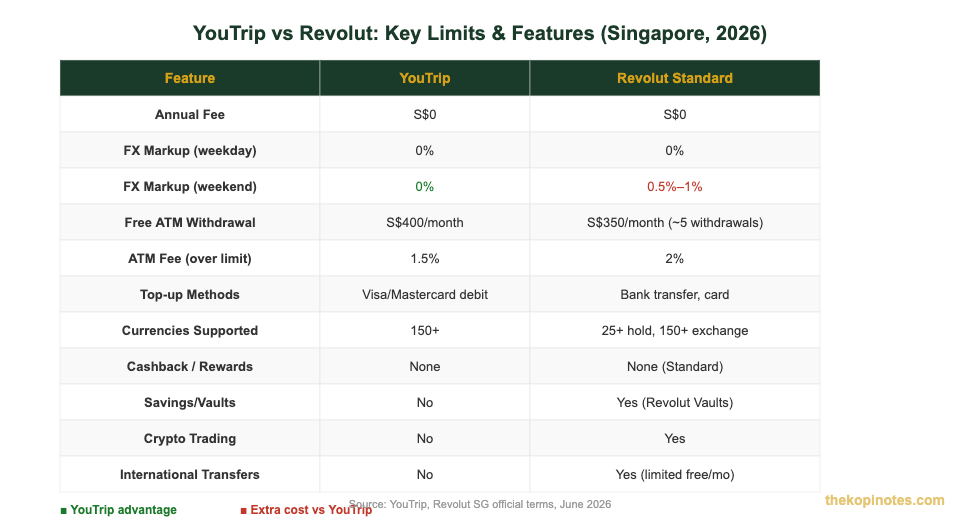
| Feature | YouTrip | Revolut Standard |
|---|---|---|
| Annual Fee | S$0 | S$0 |
| FX Markup (weekday) | 0% | 0% |
| FX Markup (weekend) | 0% | 0.5%–1% |
| Free ATM Limit/month | S$400 | S$350 (~5 withdrawals) |
| Over-limit ATM Fee | 1.5% | 2% |
| Currencies Supported | 150+ | 25+ hold, 150+ convert |
| Crypto Trading | No | Yes |
| International Transfers | No | Yes (limited free) |
Source: YouTrip, Revolut SG official fee schedules, June 2026
FX Rates and the Weekend Markup Problem
Both YouTrip and Revolut claim to use the “inter-bank rate” or “mid-market rate” — essentially the wholesale rate banks use among themselves. During weekdays, that’s accurate for both cards. You get a rate very close to what you’d find on Google Finance or XE.com.
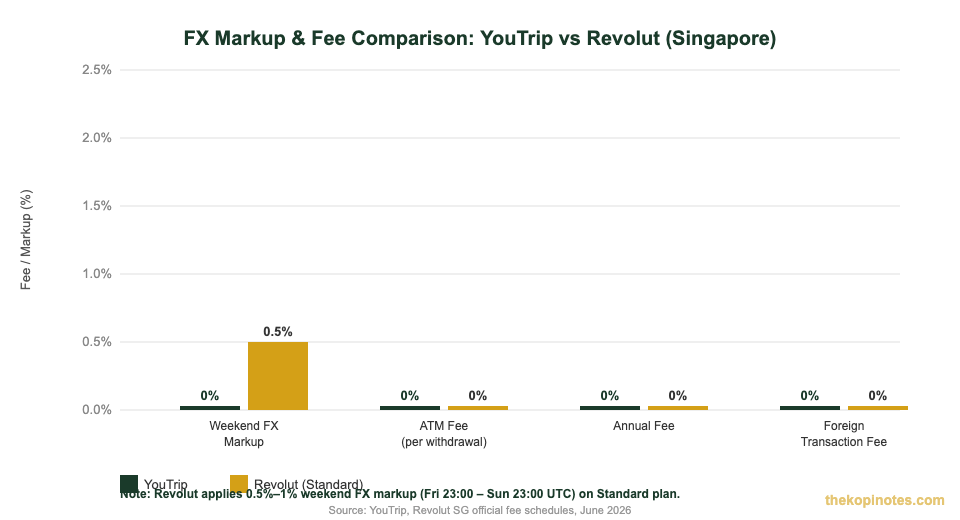
The difference kicks in on weekends. Foreign exchange markets close on Friday evening (around 11pm Singapore time) and reopen Sunday night. During this window, currency rates can’t be settled in real time — so Revolut applies a markup of 0.5% for major currency pairs and up to 1% for exotic currencies on its Standard plan. YouTrip does not apply any weekend markup.
In practice, how much does the weekend markup cost you? On a S$1,000 overseas spend over a weekend, Revolut’s 0.5% markup adds S$5. For a family trip spending S$5,000 on a long weekend, that’s S$25–S$50 in hidden fees. Not catastrophic — but avoidable with YouTrip.
Revolut Premium and Metal plans remove the weekend markup entirely, but those plans cost S$10.99–S$22.99 per month. For occasional travellers, the Standard plan is usually the better deal despite the weekend fee.
Fees Compared: Annual, ATM, and Top-Up
Both cards have zero annual fees — which puts them miles ahead of traditional bank travel cards that often charge S$192–S$300 per year. But there are other fees to know about.
Top-up Fees
YouTrip lets you top up with any Visa or Mastercard debit card at no charge. Revolut accepts bank transfers (PayNow, FAST) for free, and card top-ups may attract a fee depending on the card type. Both support PayNow top-ups instantly.
Inactivity Fees
Revolut charges an inactivity fee if your account has been dormant for 12+ months — currently €2 per month (around S$3). YouTrip does not charge an inactivity fee. If you only travel once a year, keep this in mind.
Card Replacement
YouTrip charges S$10 to replace a lost or damaged card. Revolut’s replacement fee depends on your plan — Standard users pay a replacement fee too. Neither is particularly expensive, but it’s a cost to factor in.
| Fee Type | YouTrip | Revolut Standard |
|---|---|---|
| Annual Fee | S$0 | S$0 |
| Top-up (debit card) | Free | Free (bank transfer) |
| Inactivity Fee | None | €2/month after 12 months |
| Card Replacement | S$10 | Varies by plan |
| Weekend FX Markup | None | 0.5%–1% |
Source: YouTrip, Revolut SG terms and conditions, June 2026
Features: Where Revolut Pulls Ahead
YouTrip does one thing and does it well: spend abroad cheaply. Revolut does that too — but adds a whole suite of financial features that go beyond travel. Here’s what you get with Revolut that YouTrip doesn’t offer:
Savings Vaults
Revolut lets you create separate “Vaults” within the app — essentially savings pockets where you can stash money for a specific goal (holiday fund, emergency fund, etc.) and earn a small amount of interest. YouTrip has no equivalent savings feature.
Crypto Trading
Revolut lets you buy and sell cryptocurrencies directly in the app — Bitcoin, Ethereum, and more. For Singaporeans who want a simple entry point to crypto without opening a separate exchange account, this is a genuine convenience. YouTrip has no crypto feature.
International Bank Transfers
Revolut allows international money transfers to bank accounts in 30+ countries. Standard plan users get a limited number of free transfers per month. This makes Revolut more useful for expats or anyone who regularly sends money overseas. YouTrip is purely a spending card — it can’t send money to bank accounts.
Bill Splitting and Group Expenses
Revolut has built-in bill splitting — useful for group holidays where you want to track who owes what. YouTrip lacks this feature entirely.
Disposable Virtual Cards
Revolut offers disposable virtual card numbers for online purchases — a useful security feature if you’re buying from unfamiliar websites. YouTrip gives you a virtual card number but it’s not disposable.
ATM Withdrawals Abroad: YouTrip vs Revolut
Cash is still king in many parts of Asia — particularly in Japan, Vietnam, Indonesia, and parts of Malaysia. Knowing your ATM limits before you travel can save you from nasty fees.
YouTrip gives you S$400 free ATM withdrawals per month. After that, a 1.5% fee applies. There’s no limit on the number of withdrawals — just the total amount. So five S$80 withdrawals still falls within your free limit.
Revolut Standard gives you S$350 free per month (approximately 5 withdrawals, as they also cap by transaction count). Over the limit, they charge 2%. Revolut Premium and Metal bump this free limit significantly — up to S$700 and S$1,400 respectively.
Both cards work at any ATM displaying the Mastercard logo (YouTrip) or Visa/Mastercard (Revolut). In Japan, 7-Eleven ATMs and Japan Post Bank ATMs are reliable options. In Europe, avoid ATMs operated by standalone operators — use bank-branded ATMs for the best rates.
Who Should Pick Which Card?
The honest answer is: most Singaporeans should have both. They’re free to hold, so there’s no downside to keeping both cards active. But if you want a primary recommendation:
Pick YouTrip if you:
- Travel mainly for holidays and want the simplest, lowest-cost card
- Often travel over long weekends (avoid Revolut’s weekend markup)
- Don’t need extra features like crypto or international transfers
- Want a card that’s easy to top up with your DBS/OCBC/UOB debit card
- Are new to multi-currency cards and want something with minimal complexity
Pick Revolut if you:
- Travel frequently and want more banking-lite features in one app
- Want to trade crypto casually without opening a separate account
- Send money internationally to family or friends
- Want savings vaults and bill-splitting for group travel
- Spend mostly on weekdays and can avoid the weekend FX markup
For pure overseas spending efficiency — especially on weekends — YouTrip is the winner. For an all-in-one financial tool with travel as one of several use cases, Revolut edges ahead.
If you want to compare YouTrip with other cards, check out our guide to the YouTrip card review and our Wise card Singapore review for another strong alternative. You might also find our Singapore retirement calculator useful if you’re thinking about long-term financial planning beyond travel.
Sign-Up Bonuses and Referral Codes
If you’re signing up for either card, use a referral code to get a welcome bonus:
- YouTrip: Sign up via our YouTrip referral code page for the latest sign-up bonus (typically S$5–S$10 credit for new users)
- Trust Bank: Use code HTWYQP95 when signing up for a Trust Bank account — one of the best high-yield savings accounts in Singapore to park your travel fund
- GXS Bank: Use code YONG477 for a GXS sign-up bonus — another solid savings option for Singaporeans
- Google Pay: Use code d10dl1s for Google Pay rewards when you link your card
TKN may receive a referral benefit when you use these codes. This does not affect our editorial opinions — we recommend cards based on merit.
Frequently Asked Questions
Is YouTrip or Revolut better for Singapore?
Does YouTrip charge a weekend fee?
Can I use YouTrip and Revolut at the same time?
Does Revolut work in Singapore?
What is the ATM withdrawal limit for YouTrip vs Revolut?
Is there a YouTrip referral code I can use?
Which card is better for Japan travel?
Does Revolut have a referral code for Singapore?
Disclaimer: The Kopi Notes is not a licensed financial adviser. The information above is for educational purposes only and does not constitute financial advice. Always verify current fee schedules with the card issuers directly before making decisions. Data current as at June 2026.
This article was researched with the help of AI. While we strive to keep all information accurate and up to date, there may be errors. If you notice any discrepancies, please contact us.