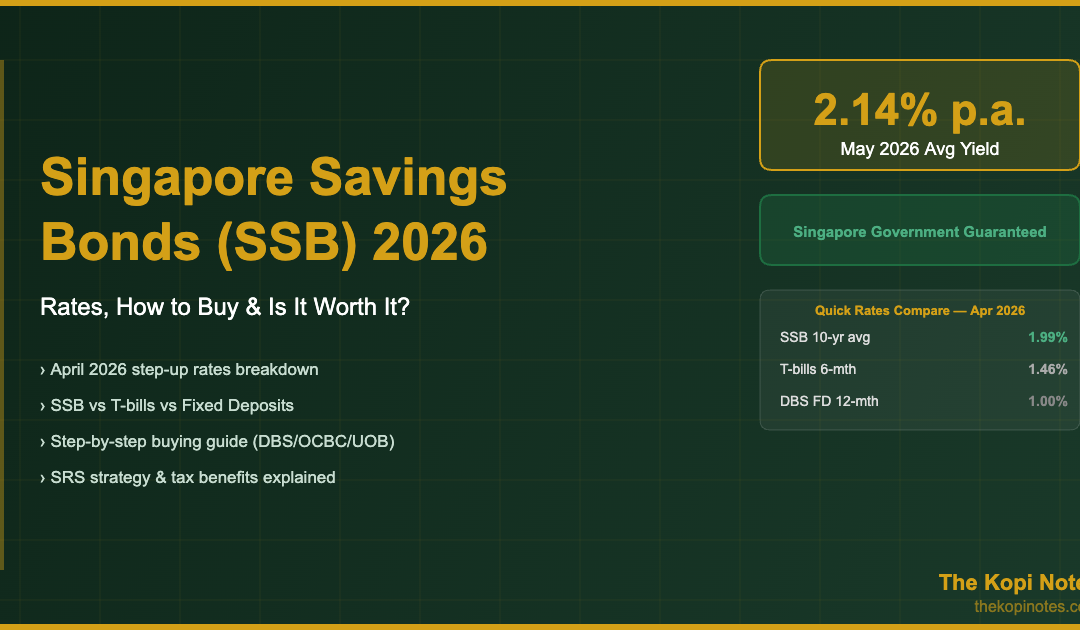
Singapore Savings Bonds (SSB) 2026: Complete Guide to Rates, How to Buy & Is It Worth It?
Current April 2026 rates, step-by-step buying guide & SSB vs T-bills vs fixed deposit comparison — everything Singapore investors need to know.
Singapore Savings Bonds (SSBs) have long been a favourite low-risk option for Singapore retail investors — and in 2026, they’re back in the spotlight. With major bank fixed deposit rates now as low as 1.00–1.25% p.a. and 6-month T-bill cut-off yields hovering around 1.39–1.46%, the SSB’s 10-year average return of 1.99–2.14% p.a. (as at April–May 2026) is once again looking competitive — especially when you factor in the flexibility to redeem anytime without penalty.
This guide covers everything you need to know: current rates, how SSBs work, a full comparison with T-bills and fixed deposits, step-by-step buying instructions via DBS, OCBC, and UOB, and how to use your SRS account for tax benefits.
This article is for informational purposes only and does not constitute financial advice. Always do your own research before investing.
Table of Contents
Contents — Click to expand
- What Are Singapore Savings Bonds?
- April 2026 SSB Rates — What You Get
- SSB vs T-Bills vs Fixed Deposits: Full Comparison
- Key Features: Step-Up Structure, Flexibility & Government Guarantee
- How to Buy Singapore Savings Bonds (Step-by-Step)
- Using Your SRS Account to Buy SSBs
- Who Should (and Shouldn’t) Buy SSBs?
- Common Mistakes to Avoid
- Frequently Asked Questions
What Are Singapore Savings Bonds?
Singapore Savings Bonds are a special type of Singapore Government Securities (SGS) issued monthly by the Monetary Authority of Singapore (MAS). Introduced in October 2015, they give retail investors a safe, flexible way to earn returns on their savings.
Unlike regular bonds, SSBs have a unique step-up interest structure — the longer you hold, the higher the interest you earn each year. You can redeem SSBs at any time with no penalty, receiving your full principal plus accrued interest. This makes SSBs fundamentally different from fixed deposits, which typically lock your funds and charge penalties for early withdrawal.
Key facts at a glance (as at April 2026):
- Issued by the Singapore Government — zero credit risk
- Step-up interest rates over up to 10 years
- Redeem anytime — full capital returned, no penalties
- Minimum investment: S$500, in multiples of S$500
- Maximum individual holding: S$200,000 (combined cash + SRS)
- S$2 transaction fee per application
- Available via DBS/POSB, OCBC, UOB internet banking or ATM
- Can be purchased using SRS funds (but not CPF OA)
April 2026 SSB Rates — What You Get
The April 2026 issue (SBAPR26, bond code GX26040E), issued 1 April 2026, carries these step-up interest rates for S$10,000 invested over the full 10-year term:
| Year | Interest Rate (p.a.) | Interest Earned (S$10,000) | Cumulative Interest |
|---|---|---|---|
| Year 1 | 1.36% | S$136 | S$136 |
| Year 2 | 1.36% | S$136 | S$272 |
| Year 3 | 1.59% | S$159 | S$431 |
| Year 4 | 1.78% | S$178 | S$609 |
| Year 5 | 1.94% | S$194 | S$803 |
| Year 6 | 2.18% | S$218 | S$1,021 |
| Year 7 | 2.40% | S$240 | S$1,261 |
| Year 8 | 2.55% | S$255 | S$1,516 |
| Year 9 | 2.70% | S$270 | S$1,786 |
| Year 10 | 2.82% | S$282 | S$2,068 |
| 10-Year Average | 1.99% p.a. | Total: S$2,068 on S$10,000 | |
Source: MAS SSB issuance page. Rates as at April 2026.
Note: The May 2026 SSB (SBMAY26) has a higher 10-year average of 2.14% p.a. (Year 1: 1.40%). Applications close in late April 2026 — check the MAS SSB portal for the latest issuance calendar.
SSB Yield Trend: From Peak to Present
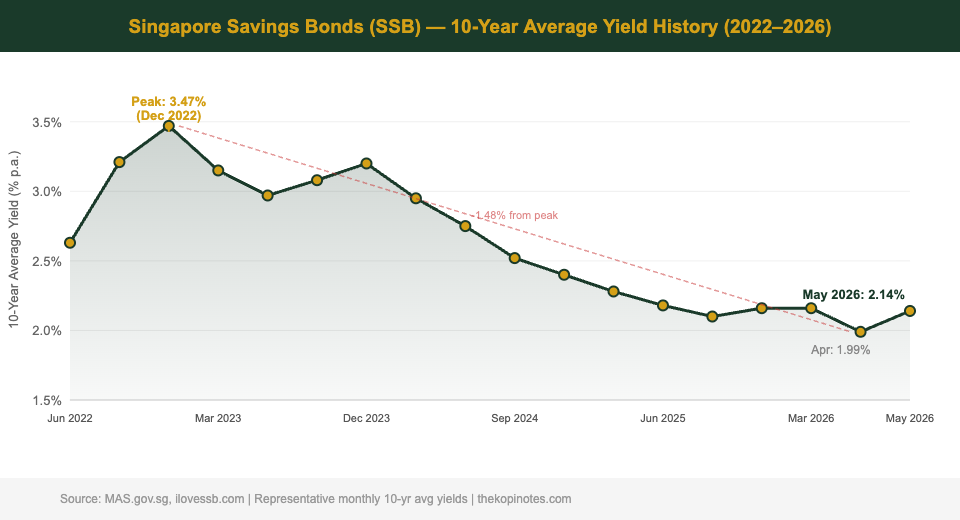
SSB yields peaked at 3.47% (10-year average) in December 2022, driven by the global rate hike cycle. Since then, as Singapore’s interest rate environment eased — most visibly seen in SORA dropping to ~1.07% — SSB rates have gradually declined. The April 2026 rate of 1.99% represents a trough, with May 2026 ticking back up to 2.14%.
SSB vs T-Bills vs Fixed Deposits: Full Comparison
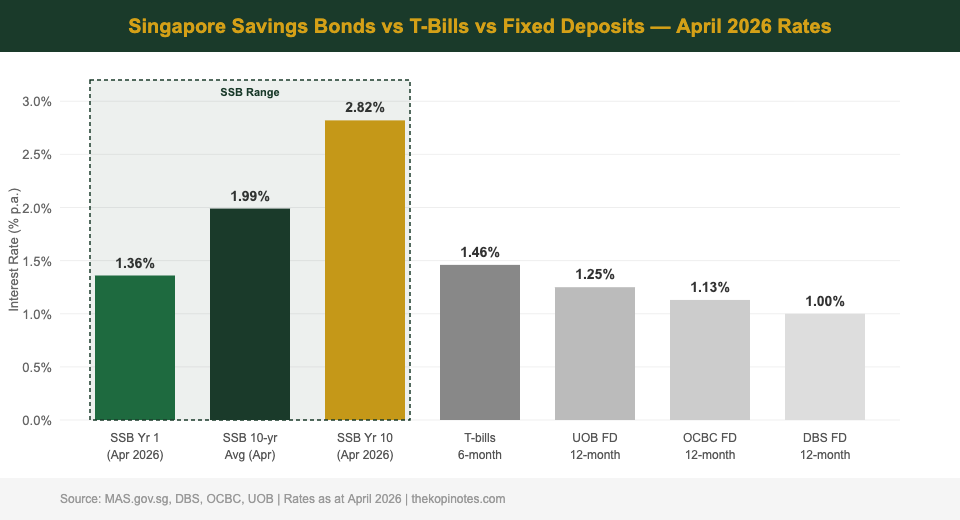
The core question for Singapore investors: where should you park your cash in 2026? Here’s how SSBs stack up against 6-month T-bills and the best fixed deposit rates as at April 2026:
| Product | Rate (p.a.) | Tenor | Capital Guarantee | Flexibility | CPF/SRS |
|---|---|---|---|---|---|
| SSB (Apr 2026) — 1-yr hold | 1.36% | Up to 10 yrs | ✅ Singapore Govt | Redeem anytime, no penalty | SRS only |
| SSB (Apr 2026) — 10-yr hold | 1.99% avg / 2.82% yr 10 | 10 yrs | ✅ Singapore Govt | Redeem anytime, no penalty | SRS only |
| 6-month T-bill (Mar 2026) | ~1.39–1.46% | 6 months | ✅ Singapore Govt | Tradeable (secondary mkt) | CPF OA + SRS |
| DBS Fixed Deposit (12-mth) | ~1.00% | Fixed | SDIC (up to S$100k) | Early withdrawal penalty | No |
| OCBC Fixed Deposit (12-mth) | ~1.10–1.15% | Fixed | SDIC (up to S$100k) | Early withdrawal penalty | No |
| UOB Fixed Deposit (12-mth) | ~1.20–1.25% | Fixed | SDIC (up to S$100k) | Early withdrawal penalty | No |
| Best Promotional FD (Apr 2026) | Up to 2.90% | Fixed (shorter tenors) | SDIC (up to S$100k) | Early withdrawal penalty | No |
Rates as at April 2026. FD rates from major banks are promotional — verify directly with your bank.
The Verdict
For most Singapore investors in April 2026: if you can access best promotional FD rates (up to 2.90%) from smaller licensed banks, those win on pure yield for short-term cash. However, for government-backed security with flexibility to redeem anytime, SSBs are significantly better than DBS/OCBC/UOB standard FD rates and better than T-bills for medium-to-long time horizons. SSBs make particularly compelling sense for SRS investors seeking to maximise tax-deferred returns on retirement savings.
Key Features: Step-Up Structure, Flexibility & Government Guarantee
1. Step-Up Interest Structure
SSBs use a step-up rate schedule, meaning your annual interest rate increases the longer you hold the bond. If you hold to Year 10, you earn 2.82% p.a. on the April 2026 issue — significantly more than the Year 1 rate of 1.36%. The step-up structure is linked to the Singapore Government Securities (SGS) yield curve at the time of each monthly issuance, which is why rates vary from month to month.
2. Redeem Anytime — Zero Penalty
This is SSBs’ most powerful feature. Unlike fixed deposits or standard bonds, you can submit a redemption request through your bank’s internet banking at any time. MAS processes redemptions monthly, and you receive your full principal plus all accrued interest. Redemption requests must be submitted by the 4th last business day of the month. Proceeds are credited the following month.
3. Singapore Government Guarantee
SSBs are direct obligations of the Singapore Government — the same credit that backs SGS bonds and T-bills. Singapore holds AAA ratings (S&P, Moody’s Aaa), making SSBs virtually risk-free. Unlike fixed deposits, which are covered by SDIC up to S$100,000, SSBs carry no coverage cap — the full principal is guaranteed regardless of amount.
4. Individual Holding Limit: S$200,000
Each Singapore resident can hold a maximum of S$200,000 in SSBs across all bonds (combined cash and SRS accounts). This is per-person — a couple can hold up to S$400,000 collectively. If near the limit and wanting a newer tranche, you’ll need to redeem older bonds first.
5. Tax-Free Interest
Interest earned on SSBs is exempt from Singapore income tax for individual investors. The effective post-tax yield equals the stated rate — particularly advantageous for high-income earners in higher tax brackets.
How to Buy Singapore Savings Bonds (Step-by-Step)
What You Need (Cash Applications)
- A bank account with DBS/POSB, OCBC, or UOB
- A CDP Securities account linked to your bank account
- At least S$500 in available cash funds
Step-by-Step: Applying via Internet Banking
- Log in to your DBS/POSB, OCBC, or UOB internet banking portal or mobile app.
- Navigate to “Invest” → “Singapore Government Securities” or “Bonds & T-Bills”.
- Select the current SSB issue — each month’s issue has a unique bond code (e.g., SBAPR26 for April 2026). Check application window dates.
- Enter your application amount in multiples of S$500 (minimum S$500, subject to remaining S$200,000 individual limit).
- Confirm the application. A non-refundable S$2 transaction fee is charged per application.
- If allotted, bonds appear in your CDP account and interest payments begin on the first payment date.
Application window timing: Opens on the first business day of each month, closes 4 business days before month end.
Allotment: If total applications exceed the issue size, applications may be partially or fully unfilled. The S$2 fee is charged regardless of allotment outcome.
What Is a CDP Account?
The Central Depository (CDP) account is Singapore’s central securities depository, operated by SGX. SSB holdings are recorded in your CDP account. You can apply through SGX’s website or at any major bank branch. For SRS applications, a CDP account is not required — SSBs purchased via SRS are held under your SRS account.
Using Your SRS Account to Buy SSBs
The Supplementary Retirement Scheme (SRS) is Singapore’s voluntary retirement savings scheme that offers tax relief on contributions. Buying SSBs via SRS is one of the safest strategies for SRS funds — capital guaranteed, flexible, government-backed.
Why SSBs Are Ideal for SRS
- Capital guaranteed — your SRS principal is fully protected
- Government-backed — zero counterparty risk
- Flexible redemption — accessible if needed (though early SRS withdrawal before statutory retirement age of 63 incurs a 5% penalty tax on the SRS withdrawal)
- Tax-deferred growth — interest earned within SRS grows tax-free until withdrawal
How to Buy SSBs via SRS
- Open an SRS account with DBS/POSB, OCBC, or UOB (the three SRS operators)
- Log in to internet banking and navigate to your SRS section
- Select “Buy SSB” under your SRS account
- Enter the amount (minimum S$500, multiples of S$500)
- Confirm — the S$2 fee applies
The maximum SRS contribution is S$15,300/yr for Singapore citizens/PRs and S$35,700/yr for foreigners. SSB holdings via SRS count toward your total S$200,000 individual limit.
For broader CPF and SRS planning, see our CPF investment strategy guide. Use our Singapore retirement planning calculator to model how SSBs fit into your retirement income plan.
Who Should (and Shouldn’t) Buy SSBs?
Good Candidates for SSBs
- Conservative investors who prioritise capital preservation over growth
- SRS account holders looking for capital-guaranteed returns on retirement savings
- Investors with a 3–10 year time horizon who can benefit from the step-up structure (Year 10 rate of 2.82% is competitive)
- High-income earners who have maximised CPF voluntary contributions — SSBs offer a tax-efficient complement
- Retirees or near-retirees seeking stable, government-backed income as part of a passive income strategy
- Those wanting a flexible emergency fund overlay earning more than a regular savings account
Who Should Look Elsewhere
- Short-term investors (under 1 year) — at 1.36% Year 1, promotional FDs or high-yield savings accounts may be more competitive
- CPF OA investors — SSBs cannot be purchased with CPF OA. T-bills and SGS bonds are CPF-compatible under CPFIS
- Growth-oriented investors — S-REITs (5–7% yields) or ETFs may deliver superior returns. See our Best S-REITs Singapore 2026 guide
- Investors already at S$200,000 SSB limit — explore SGS bonds, T-bills, or other asset classes
5 Common Mistakes Singapore Investors Make with SSBs
- Missing the application window. Each SSB issue has a narrow window (roughly 3–4 weeks each month). Bookmark the MAS SSB portal and set calendar reminders for application deadlines.
- Not accounting for the S$2 fee on small amounts. On a S$500 application, the S$2 fee noticeably reduces effective yield. Consolidate applications into larger amounts where possible.
- Redeeming early unnecessarily. SSBs are designed for patient holding. Cashing out during minor market events means missing higher step-up rates in later years. Only redeem if you genuinely need the liquidity.
- Forgetting the S$200,000 individual limit. SSBs are tracked across all your accounts. Applying beyond S$200,000 results in automatic rejection — but the S$2 fee is still charged. Track your total holdings before applying.
- Confusing SSB with other government securities. T-bills are short-term (6 months), discounted, and tradeable. SSBs are long-term, step-up, and redeemable. See our Singapore T-bills complete guide for the full breakdown.
Frequently Asked Questions — Singapore Savings Bonds
Can I buy Singapore Savings Bonds with my CPF?
What is the minimum and maximum I can invest in SSBs?
How is SSB interest paid?
How do I redeem my SSBs?
Are SSBs suitable for the SRS account?
Can foreigners buy Singapore Savings Bonds?
Is the SSB rate fixed or does it change each month?
What happens if I miss the allotment?
Conclusion: Are SSBs Worth It in 2026?
In a world where DBS fixed deposits pay just 1.00% p.a. and 6-month T-bills yield ~1.39–1.46%, the SSB’s 10-year average return of 1.99–2.14% p.a. is genuinely competitive for the risk-free tier — especially given the flexibility to exit at any time without penalty.
SSBs aren’t a replacement for growth assets like S-REITs (yielding 5–7%) or ETFs. But as the safe, liquid portion of a diversified Singapore investor’s portfolio — particularly for SRS funds or a medium-term cash reserve — they remain one of the best risk-free tools available in 2026.
Track the monthly SSB issuance calendar closely: if yields tick higher (as May 2026’s 2.14% shows), it’s worth topping up. If you’re looking to pair SSBs with higher-yield passive income strategies, explore our guides below.
This article was researched with the help of AI. While we strive to keep all information accurate and up to date, there may be errors. If you notice any discrepancies, please contact us.