Retirement Planning Singapore 2026: The Complete Guide
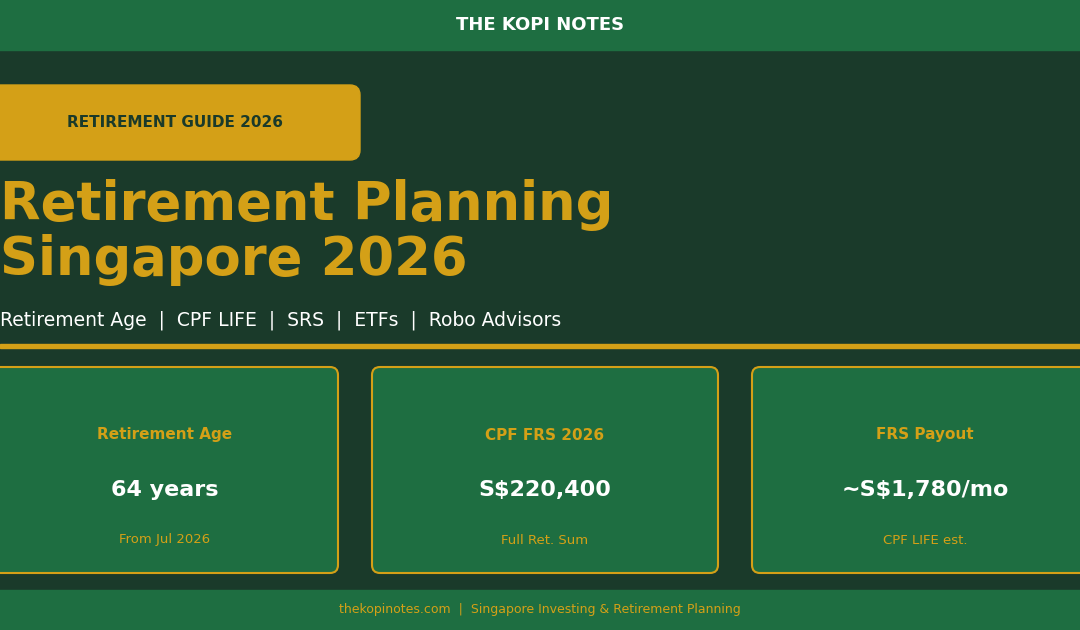
Singapore’s retirement age rises to 64 years on 1 July 2026. CPF LIFE payouts at FRS now reach ~S$1,780/month. If you haven’t reviewed your retirement plan this year, now is the time. This guide covers every key pillar — CPF LIFE, SRS, T-bills, ETFs, dividend stocks and robo advisors — so you can build a retirement income strategy that actually works in 2026.
Not financial advice. Data as at May 2026. Always verify figures with CPF Board and MOM before making decisions.
Singapore is undergoing the most significant retirement policy shift in years. From 1 July 2026, the statutory retirement age rises from 63 to 64, and the re-employment age rises from 68 to 69 — stepping closer to the national target of 65 and 70 by 2030. For investors and workers alike, this changes the retirement planning calculus: you may work longer, contribute more to CPF, and have more time to grow your nest egg before drawdown.
At the same time, CPF LIFE payout estimates have increased for 2026 cohorts: a male member setting aside the Full Retirement Sum (S$220,400) can now expect approximately S$1,780/month from age 65. And with SRS contribution limits at S$15,300, T-bill yields settling around 3–3.5%, and robo advisors like Endowus and Syfe offering CPF/SRS-eligible portfolios, the toolkit available to Singapore retirees has never been broader.
This guide walks through every pillar of a robust Singapore retirement plan — step by step.
Free download: The Singapore Money Playbook — 7 money mindset shifts written for Singapore, with the CPF-adjusted retirement number most guides get wrong (PDF + Notion).
Table of Contents
Contents — Click to expand
- Singapore Retirement Age 2026: What Changed?
- CPF LIFE Payouts: BRS, FRS & ERS Explained
- CPF Retirement Sums 2026: BRS, FRS & ERS Amounts
- SRS: Tax Savings & Retirement Income
- T-Bills, SSBs & Fixed Deposits for Retirement
- ETFs & Dividend Stocks for Passive Income
- Robo Advisors for CPF & SRS Investing
- Your 2026 Retirement Action Plan
- Frequently Asked Questions
1. Singapore Retirement Age 2026: What Changed?
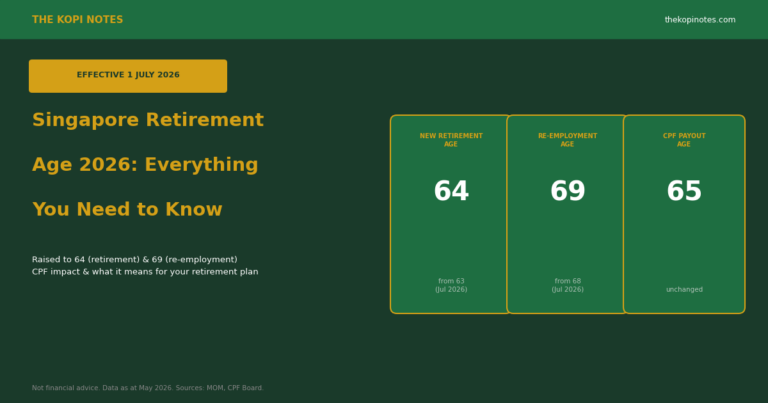
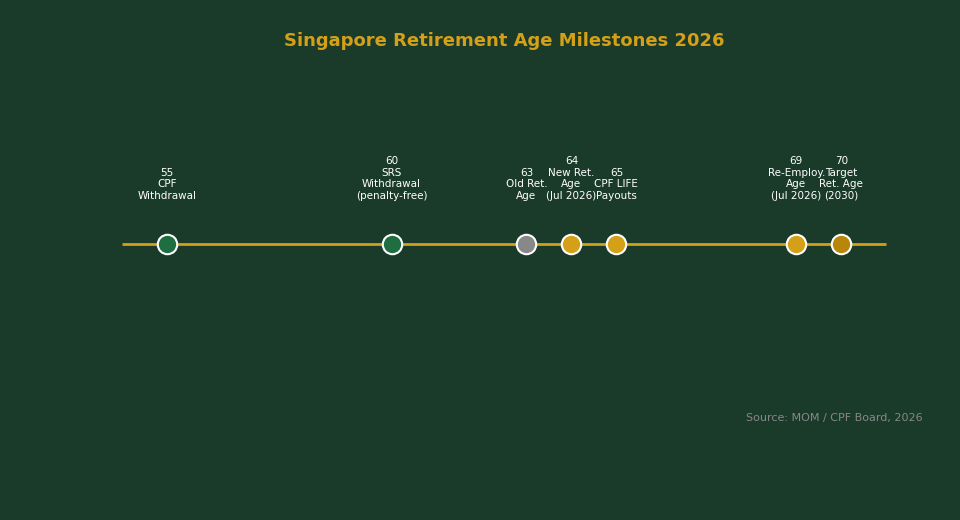
Singapore’s Ministry of Manpower (MOM) announced in the 2026 Committee of Supply debates that the statutory retirement age will rise to 64 from 1 July 2026, up from the current 63. The re-employment age simultaneously rises to 69 (from 68). These changes are legally mandated — employers cannot terminate employees solely on the grounds of reaching retirement age before they hit the new threshold.
| Milestone | Before Jul 2026 | From Jul 2026 | Target 2030 |
|---|---|---|---|
| Statutory Retirement Age | 63 | 64 | 65 |
| Re-Employment Age | 68 | 69 | 70 |
| CPF LIFE Payout Start Age | 65 | 65 (unchanged) | 65 (unchanged) |
| CPF Withdrawal Age (55+ lump sum) | 55 | 55 (unchanged) | 55 (unchanged) |
Key point: The retirement age change does not affect the CPF payout eligibility age (still 65) or the CPF withdrawal-at-55 rules. What changes is how long employers are legally obligated to continue employing you — and how long you can keep contributing to CPF at full rates.
For retirement planners, this is actually a net positive: more years of CPF contributions mean a higher Retirement Account balance at 55, translating to higher CPF LIFE payouts from 65.
2. CPF LIFE Payouts: Understanding the Annuity System
CPF LIFE (Lifelong Income For the Elderly) is Singapore’s national annuity scheme. Once you turn 55, the CPF Board creates a Retirement Account (RA) from your Ordinary and Special Accounts. At 65, your RA balance is used to fund monthly CPF LIFE payouts for life — no matter how long you live.
There are three CPF LIFE plan options to choose from, each with slightly different monthly payout and bequest characteristics:
| CPF LIFE Plan | Monthly Payout (FRS) | Bequest | Best For |
|---|---|---|---|
| Standard Plan | ~S$1,780/mo | Lower | Maximise monthly income |
| Escalating Plan | ~S$1,490/mo (rising 2%/yr) | Lower | Inflation hedge |
| Basic Plan | ~S$1,670/mo | Higher | Leave more to beneficiaries |
Most Singaporeans opt for the Standard Plan as it delivers the highest monthly payout, which is ideal for covering daily living expenses. The default plan if you don’t make an active selection is the Standard Plan.
Pro tip: Use the CPF LIFE Payout Calculator on our tools hub to model your exact monthly income at different retirement sum levels.
3. CPF Retirement Sums 2026: BRS, FRS & ERS Amounts
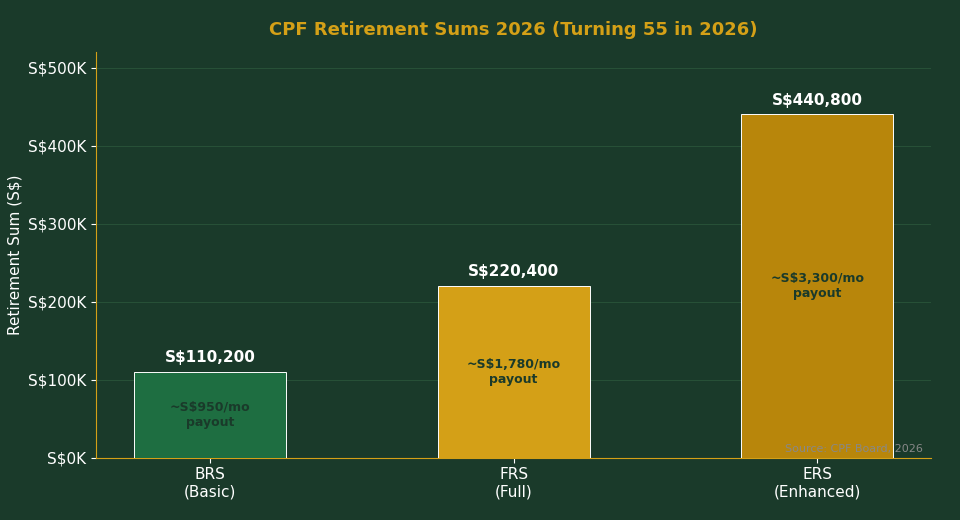
For members turning 55 in 2026, the CPF Board has set the following retirement sum benchmarks. These sums are the target balances in your Retirement Account at 55 — they determine your CPF LIFE payout level from 65.
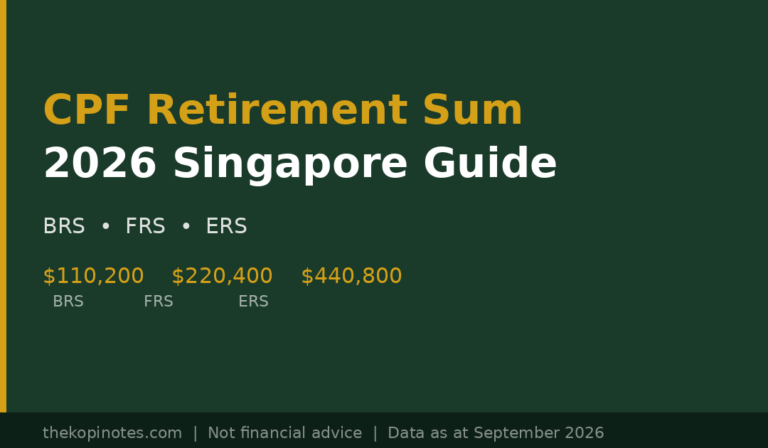
| Retirement Sum | Amount (2026) | Est. Monthly Payout (age 65) | Notes |
|---|---|---|---|
| BRS — Basic Retirement Sum | S$110,200 | ~S$950/mo | Requires a pledged property |
| FRS — Full Retirement Sum | S$220,400 | ~S$1,780/mo | CPF Board benchmark; 2× BRS |
| ERS — Enhanced Retirement Sum | S$440,800 | ~S$3,300/mo | 4× BRS; voluntary top-up only |
The ERS was raised to 4× BRS (up from 3×) from 2025 onwards, giving members who have built up large CPF balances the option to top up further and receive higher guaranteed monthly income. If you’re approaching 55 with a substantial CPF balance, seriously consider whether topping up to ERS makes sense — the guaranteed ~S$3,300/month from age 65 is hard to beat on a risk-adjusted basis.
The CPF OA earns 2.50% p.a., the SA/RA earns 4.00% p.a. (with an extra 1% on the first S$60,000 of combined balances). With the CPF Wage Ceiling now at S$8,000/month, contributions are higher than ever for those in the upper-income bracket.
4. SRS: Tax Savings & Retirement Income
The Supplementary Retirement Scheme (SRS) is Singapore’s voluntary, tax-incentivised retirement savings programme. Contributions are deductible from your taxable income — up to S$15,300 per year for Singapore citizens and PRs (S$35,700 for foreigners). Over a working career, SRS contributions can generate tens of thousands in income tax savings.
| SRS Feature | Details |
|---|---|
| Annual Contribution Cap (SC/PR) | S$15,300 |
| Penalty-Free Withdrawal Age | 62 (statutory retirement age at time of first contribution) |
| Withdrawal Tax Treatment | 50% of withdrawal amount taxable as income (spread over 10 years) |
| Investable in | SGX-listed stocks, ETFs, unit trusts, insurance products, T-bills (partial) |
The real power of SRS lies in the tax arbitrage: you contribute at your marginal tax rate today (potentially 11.5–22%) and pay tax on only 50% of withdrawals in retirement — when your income and tax bracket will be much lower. At a 15.5% marginal rate, a S$15,300 annual contribution saves roughly S$2,370 in tax immediately.
For SRS investing, consider Singapore REIT ETFs (CSOP iEdge S-REIT Leaders ETF, Nikko AM-Straits Trading Asia Ex Japan REIT ETF) for dividend income, or use robo advisors like Endowus or Syfe which accept SRS funds directly. Use our SRS Tax Savings Calculator to model your exact annual savings.
5. T-Bills, SSBs & Fixed Deposits for Retirement
Fixed-income instruments are the conservative backbone of any retirement portfolio. In 2026, Singapore’s risk-free rate environment remains reasonable, with 6-month T-bill yields hovering around 3.0–3.2%. Here’s how the main options compare:
| Instrument | Yield (May 2026) | Tenure | CPF OA Eligible? | SRS Eligible? |
|---|---|---|---|---|
| 6-Month T-Bill | ~3.2% | 6 months | Yes (via CPF OA) | Yes |
| 1-Year T-Bill | ~3.0% | 12 months | Yes (via CPF OA) | Yes |
| Singapore Savings Bonds (SSB) | ~2.7–3.0% (10-yr avg) | Up to 10 years | No | No |
| CPF OA | 2.50% p.a. | Ongoing | — | — |
| Best Fixed Deposit (major banks) | ~2.8–3.3% | 3–12 months | No | No |
Note that T-bill yields have compressed from the 3.7–4.0% peaks of 2023–2024, as MAS followed the Fed’s rate cut cycle. With the 6-month T-bill now yielding around 3.2%, it beats CPF OA (2.5%) on a cash basis but lags behind CPF SA/RA (4%). The decision of whether to invest CPF OA in T-bills depends on whether your OA funds are earmarked for housing — if not, T-bills via CPFIS can be a useful alternative.
For a detailed analysis, see our T-Bill vs CPF OA 2026 guide. Use our T-Bill, SSB & FD Comparison Calculator to model different scenarios.
6. ETFs & Dividend Stocks for Passive Income in Retirement
For the growth and income engine of your retirement portfolio, equities remain essential. Two popular approaches for Singapore retirees are S-REIT investing (for locally-sourced dividend income at 5–7%) and global ETFs (for long-term capital growth).
S-REITs for retirement income: Singapore REITs pay out at least 90% of their distributable income as distributions, resulting in yields typically in the 5–7% range (as at May 2026). They are CPF and SRS-eligible via CPFIS, and many pay quarterly distributions — making them an attractive supplemental income layer on top of CPF LIFE payouts. Our Best S-REITs Singapore 2026 guide covers the top picks across industrial, retail, and healthcare sectors.
Dividend ETFs: For diversification without stock-picking, the SPDR STI ETF (ES3) and NikkoAM-STI ETF (G3B) track the Straits Times Index and yield around 3.5–4%. Ireland-domiciled UCITS ETFs like VWRA (Vanguard FTSE All-World) are popular for global exposure with reduced US dividend withholding tax (15% vs 30%).
CPF Investment Scheme (CPFIS): You can invest your CPF OA funds (above the first S$20,000) and SA funds (above S$40,000) in approved instruments via CPFIS. S-REITs and ETFs on SGX are eligible. This strategy makes sense only if you can reasonably expect returns exceeding CPF OA’s guaranteed 2.5% — which blue-chip S-REITs have consistently done over rolling 5-year periods. Read our full CPF Investment Guide for the full framework.
7. Robo Advisors for CPF & SRS Investing
Robo advisors have become a core part of Singapore’s retirement planning landscape. They offer low-cost, diversified portfolios that can be funded directly from CPF OA, SRS, or cash — making them particularly powerful for retirement savers who want a hands-off approach.
| Robo Advisor | CPF OA | SRS | Annual Fee | Referral |
|---|---|---|---|---|
| Endowus | Yes | Yes | 0.25–0.60% | Get S$20 fee credit |
| Syfe | No | Yes | 0.35–0.65% | Get S$10–S$50 bonus |
| FSMOne | Yes (CPFIS) | Yes | 0.08% (brokerage only) | Code: P0544985 |
Endowus remains the only Singapore robo advisor that accepts all three funding sources — CPF OA, SRS, and cash. This makes it particularly powerful for a unified retirement investment strategy. Its Income portfolios (targeting 4–6% annual distributions) are especially popular with retirees seeking regular cash flow on top of CPF LIFE.
Syfe’s Income+ portfolio offers SGD-focused bond and REIT exposure with target annual distributions of 4–6%, funded via SRS or cash. It’s a strong option for those who want a managed, diversified income stream without stock-picking.
8. Your 2026 Retirement Action Plan
Based on the data above, here is a practical action checklist for Singapore investors at different life stages:
| Life Stage | Priority Actions |
|---|---|
| Age 25–40 | Maximise CPF contributions, start SRS at 30+, invest CPF OA surplus in S-REITs/ETFs via CPFIS, set up robo advisor (Endowus/Syfe) |
| Age 40–50 | Max out SRS every year (S$15,300), voluntary CPF top-ups to SA for 4% interest, shift toward dividend income from S-REITs |
| Age 50–55 | Review CPF RA projection, consider CPF top-up to FRS or ERS, reduce equity risk, build T-bill / SSB ladder for near-term income |
| Age 55–64 | RA formed at 55 — decide CPF LIFE plan, begin SRS drawdown planning (spread over 10 years from 62), maintain dividend portfolio for income supplementation |
| Age 65+ | CPF LIFE payouts begin — supplement with S-REIT dividends, SRS drawdowns, and SSB interest; review spending vs income annually |
Use the Retirement Planning Calculator and CPF Retirement Sum Calculator on our tools hub to model your personal retirement income at different saving rates and investment returns.
Frequently Asked Questions
What is the retirement age in Singapore in 2026?
How much CPF LIFE payout will I get at FRS in 2026?
What is the CPF Full Retirement Sum (FRS) for 2026?
Is it worth topping up my CPF to the Enhanced Retirement Sum?
How much can I contribute to SRS per year?
Can I use my CPF to invest in S-REITs?
What is the best retirement planning strategy in Singapore for 2026?
Does the new retirement age 64 affect when I can withdraw CPF?
Start Planning Your Retirement Today
Use the free calculators below to model your retirement numbers:
This article was researched with the help of AI. While we strive to keep all information accurate and up to date, there may be errors. If you notice any discrepancies, please contact us.