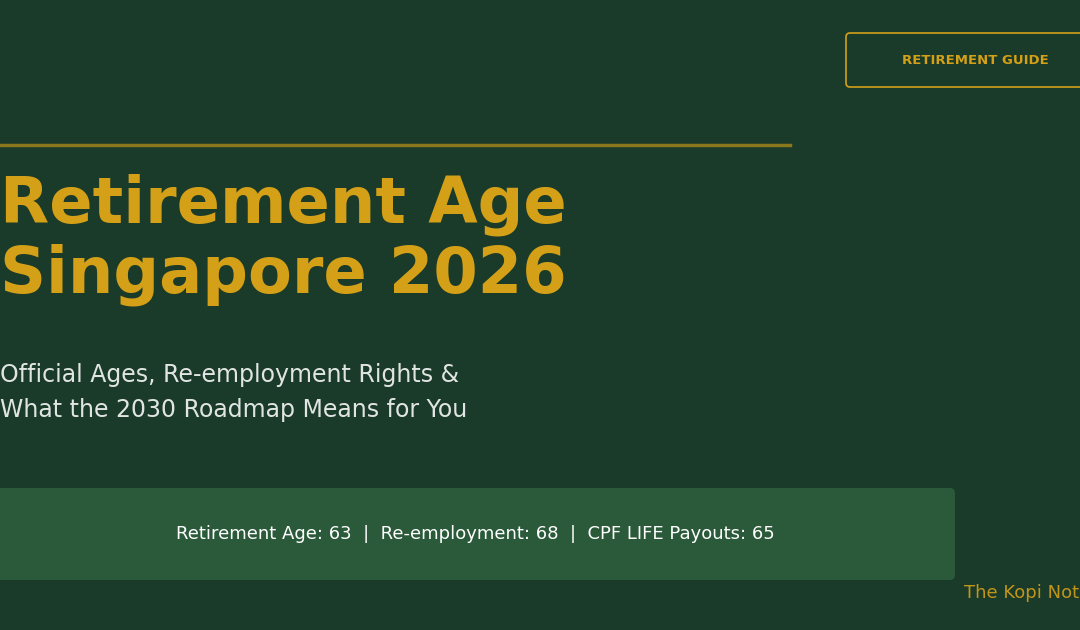
Retirement Age Singapore 2026: Official Ages, Re-employment & What Changes for You
Singapore raised its retirement and re-employment ages in 2022 — with another increase planned for 2030. Here’s exactly where the ages stand in 2026 and how to plan around them.
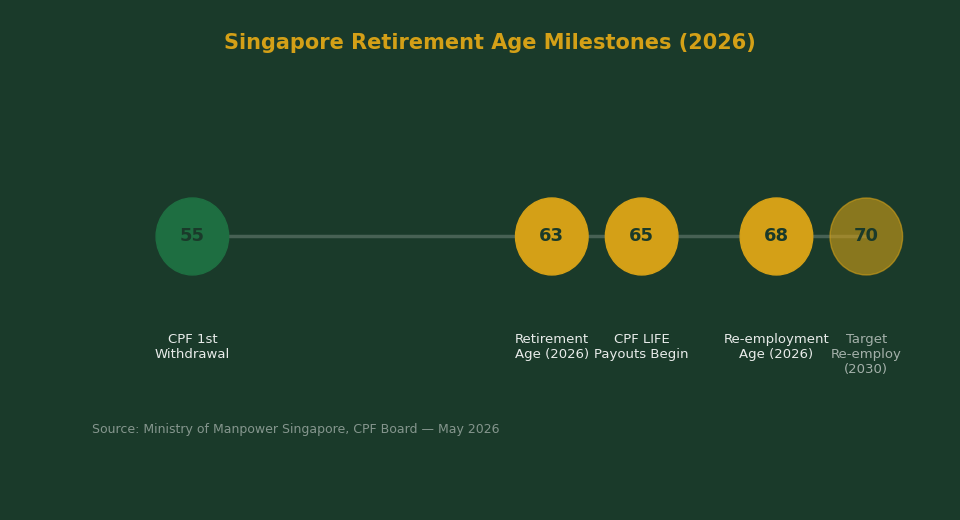
The official retirement age in Singapore is 63 years old as of 2026, while the re-employment age — the age until which employers must offer continued work to eligible employees — is 68. Both ages are legislated under the Retirement and Re-employment Act (RRA). Singapore has a phased roadmap to raise these to 65 (retirement) and 70 (re-employment) by 2030, giving workers and employers time to plan ahead. CPF withdrawals, however, follow a separate schedule: members can make their first CPF withdrawal at age 55, and CPF LIFE payouts begin from age 65.
Not financial advice. All figures are for educational reference only. Data as at May 2026 unless noted. Always verify at mom.gov.sg and cpf.gov.sg.
Table of Contents
Jump to a section
- What Are the Retirement & Re-employment Ages in 2026?
- The 2030 Roadmap: When Do the Ages Change Next?
- CPF Withdrawal Age vs Retirement Age: Key Differences
- Your Re-employment Rights as an Employee
- Employer Obligations Under the RRA
- Financial Planning Around Singapore’s Retirement Age
- CPF LIFE Payouts: What to Expect at 65
- Frequently Asked Questions
What Are the Retirement & Re-employment Ages in 2026?
As of 2026, Singapore has two legally defined age thresholds under the Retirement and Re-employment Act (RRA), administered by the Ministry of Manpower (MOM):
| Age Threshold | Current Age (2026) | What It Means |
|---|---|---|
| Retirement Age | 63 | Employer cannot compulsorily retire you before this age |
| Re-employment Age | 68 | Employer must offer re-employment to eligible workers up to this age |
| CPF Withdrawal Age | 55 | First CPF withdrawal possible (above FRS savings) |
| CPF LIFE Payout Age | 65 | Monthly CPF LIFE annuity payments begin |
Source: Ministry of Manpower Singapore, CPF Board, May 2026
The retirement age of 63 means your employer cannot force you to retire before you turn 63. Once you reach 63, your employer is not automatically obligated to keep you — but they must offer re-employment until you turn 68, provided you meet the eligibility criteria.
It’s important to distinguish the legal retirement age from your personal financial retirement. Many Singaporeans choose to stop working earlier — using CPF savings, investments, S-REITs, or passive income streams — while the statutory ages only govern what employers must do.
The 2030 Roadmap: When Do the Ages Change Next?
Singapore’s government announced a phased increase plan to raise both the retirement and re-employment ages progressively toward 65 and 70 respectively by 2030. Here is the full timeline:
| Year | Retirement Age | Re-employment Age |
|---|---|---|
| 2019 (Before changes) | 62 | 67 |
| 2022 (Implemented) | 63 | 68 |
| 2026 (Current) | 63 | 68 |
| 2026–2030 (Planned) | 65 (target) | 70 (target) |
| 2030 (Target) | 65 | 70 |
Source: Ministry of Manpower Singapore — Retirement and Re-employment Act roadmap
The exact dates for the next increment (to 64/69) have not been officially announced as at May 2026, but the direction is clear. Workers in their 50s today should plan their finances on the assumption that they may be working — or at least eligible to work — until 65 or beyond.
This has significant implications for CPF savings accumulation. Every year you continue working past 55 is an additional year of CPF contributions compounding at 4–6% per annum — potentially adding tens of thousands to your retirement sum.
CPF Withdrawal Age vs Retirement Age: Key Differences
One of the most common points of confusion is mixing up the retirement age with CPF-related ages. These are governed by completely separate legislation:
Age 55 — CPF Retirement Account Created
When you turn 55, CPF Board automatically creates a Retirement Account (RA) for you. Savings from your Special Account and Ordinary Account are swept into the RA up to the Full Retirement Sum (FRS), which is S$213,000 in 2026. Any savings above the FRS can be withdrawn in cash. This is your first point of access to your CPF savings — but it does not mean you have to stop working.
Age 63 — Statutory Retirement Age
This is the legal protection age: your employer cannot compulsorily retire you before age 63. If your employer attempts to retire you earlier, they are in breach of the RRA and you can file a claim with the Ministry of Manpower’s Tripartite Alliance for Dispute Management (TADM).
Age 65 — CPF LIFE Payouts Begin
This is the Payout Eligibility Age (PEA) — the age at which your CPF LIFE monthly annuity payments start. You can defer payouts up to age 70 to receive a higher monthly amount (payouts increase approximately 6–7% for each year deferred). A Singapore worker who tops up to the Enhanced Retirement Sum (S$426,000 in 2026) and defers to age 70 could receive S$4,200–S$4,800/month from CPF LIFE alone.
Age 68 — Re-employment Age
Your employer’s obligation to offer you re-employment expires when you turn 68. After this age, continued employment is entirely at the employer’s discretion. Workers who reach 68 and are not retained by their employer may receive an Employment Assistance Payment (EAP) if they are not offered re-employment.
Your Re-employment Rights as an Employee
Under the RRA, employees who reach the statutory retirement age of 63 have the right to be offered re-employment by the same employer, provided they meet these eligibility criteria:
- You are a Singapore Citizen or Permanent Resident
- You have been employed by your employer for at least 2 years before turning 63
- You are medically fit to continue working
- You have satisfactory work performance (as assessed by employer)
If you meet all criteria, your employer must offer you re-employment — though the terms (role, salary, hours) may be adjusted to reflect a suitable position. If your employer genuinely cannot offer a suitable role, they may transfer your re-employment obligation to another employer, or pay you an Employment Assistance Payment (EAP) of between 3.5 to 6.5 months of your last drawn salary (capped at S$13,000).
Key protection: If your employer refuses to re-employ you without valid reason, you can lodge a dispute with TADM. MOM takes RRA violations seriously and employers can face fines for non-compliance.
Employer Obligations Under the RRA
For Singapore employers, the rising retirement and re-employment ages require proactive workforce planning. Here is a summary of what employers must do:
| Obligation | Details |
|---|---|
| No early compulsory retirement | Cannot dismiss employees solely due to age before they turn 63 |
| Offer re-employment at 63 | Must offer suitable re-employment to eligible employees up to age 68 |
| Re-employment terms in writing | Must offer re-employment contract at least 3 months before the employee turns 63 |
| EAP if re-employment not offered | Pay 3.5–6.5 months salary (capped S$13,000) if no suitable role exists |
| Age discrimination prohibited | Cannot advertise jobs with age requirements that exclude older workers without valid reason |
Source: Ministry of Manpower Singapore — Retirement and Re-employment Act (Cap. 274A)
Financial Planning Around Singapore’s Retirement Age
Knowing the legal ages is only half the picture. The more important question is: what does your income look like from age 63 to 65 — the gap between when you might stop work and when CPF LIFE begins?
The Age 63–65 Income Gap
Many Singaporeans face a 2-year income gap between stopping full-time work at 63 and CPF LIFE payouts starting at 65. For a worker living on S$3,500/month, this gap requires approximately S$84,000 in bridging income. Sources to plug this gap include:
- CPF OA savings: Any OA balance above the amount transferred to RA at 55 can be withdrawn freely
- S-REIT dividends: A S$300,000 S-REIT portfolio at 6% yield generates ~S$1,500/month in passive income
- Singapore Savings Bonds (SSB): Low-risk, ladder-able income with no price risk
- Part-time or freelance work: Re-employment eligibility extends to 68, so phased retirement is fully supported by law
- SRS drawdowns: Withdrawals from your Supplementary Retirement Scheme account are taxed at 50% of the withdrawal — attractive if your income tax rate in retirement is low
Using the Retirement Planning Calculator
To see if your current savings, CPF balance, and investment portfolio can support your target retirement lifestyle, use the Singapore retirement calculator — it factors in CPF LIFE projections, investment returns, and inflation to give you a personalised retirement readiness score.
Building Passive Income Before Retirement
The most financially resilient Singaporean retirees we profile on The Kopi Notes typically have three income pillars: CPF LIFE, passive investment income (S-REITs or dividend stocks), and either part-time work or rental income. If you are in your 40s or 50s, the time to build that second pillar is now.
Platforms like Syfe and Endowus let you build a diversified dividend and S-REIT portfolio on autopilot, which can generate the monthly passive income you need during the retirement gap years. Both offer referral bonuses for new account openings.
For a deeper dive into which S-REITs offer the best risk-adjusted yields for retirement income, see our guide to the best S-REITs in Singapore 2026.
CPF LIFE Payouts: What to Expect at 65
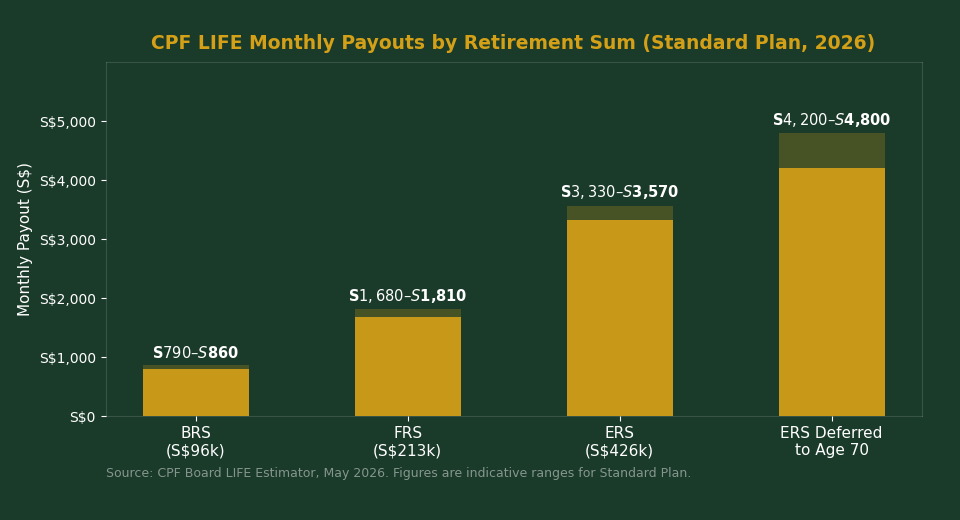
CPF LIFE is Singapore’s national longevity annuity — it pays a guaranteed monthly income for life starting at age 65 (or later, if deferred). Your payout depends on how much is in your Retirement Account when CPF LIFE starts. Below are CPF Board’s indicative 2026 monthly payout ranges for the Standard Plan:
| RA Balance at 65 | Monthly Payout (Standard Plan) | Notes |
|---|---|---|
| S$96,000 (BRS × 0.5) | ~S$790–S$860/month | Basic Retirement Sum |
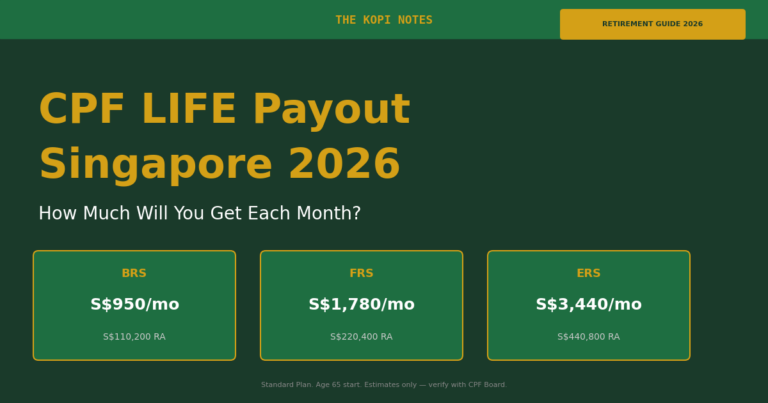
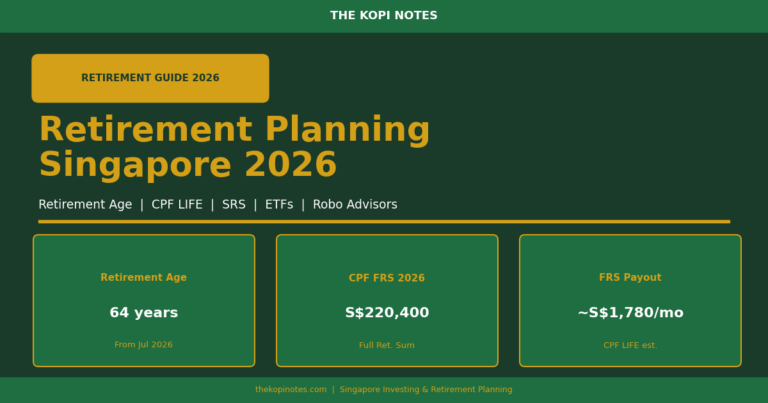
| S$213,000 (FRS 2026) | ~S$1,680–S$1,810/month | Full Retirement Sum |
| S$426,000 (ERS 2026) | ~S$3,330–S$3,570/month | Enhanced Retirement Sum (top-up required) |
| S$426,000 (ERS, deferred to 70) | ~S$4,200–S$4,800/month | Deferral bonus ~6–7%/year |
Source: CPF Board LIFE estimator, May 2026. Figures are indicative and depend on interest credited and plan choice.
For the vast majority of Singaporeans, CPF LIFE alone will not replace a full working income. That is why building supplementary passive income through dividends, S-REITs, SSBs, or a robo-advisor portfolio matters so much in the years before you reach retirement age. Our passive income Singapore guide walks through the most practical strategies for building that second income pillar before 63.
For a detailed breakdown of CPF LIFE plans, payout tables by retirement sum level, and strategies to maximise your payout, read our CPF investment strategy guide.
Frequently Asked Questions
What is the retirement age in Singapore in 2026?
Will the retirement age in Singapore increase in 2026?
Is CPF withdrawal age the same as retirement age?
Can my employer force me to retire before 63?
What happens when I turn 63 in Singapore?
What is the difference between retirement age and re-employment age?
What is the best retirement plan for Singapore workers?
This article is for educational purposes only and does not constitute financial or legal advice. Retirement and employment laws may change — always verify the latest rules at mom.gov.sg and cpf.gov.sg. The Kopi Notes may earn referral fees from linked platforms.
This article was researched with the help of AI. While we strive to keep all information accurate and up to date, there may be errors. If you notice any discrepancies, please contact us.