What Is a UCITS ETF? Singapore Investor’s Complete Guide (2026)
Understanding UCITS ETFs — and why they matter more than most Singapore investors realise.
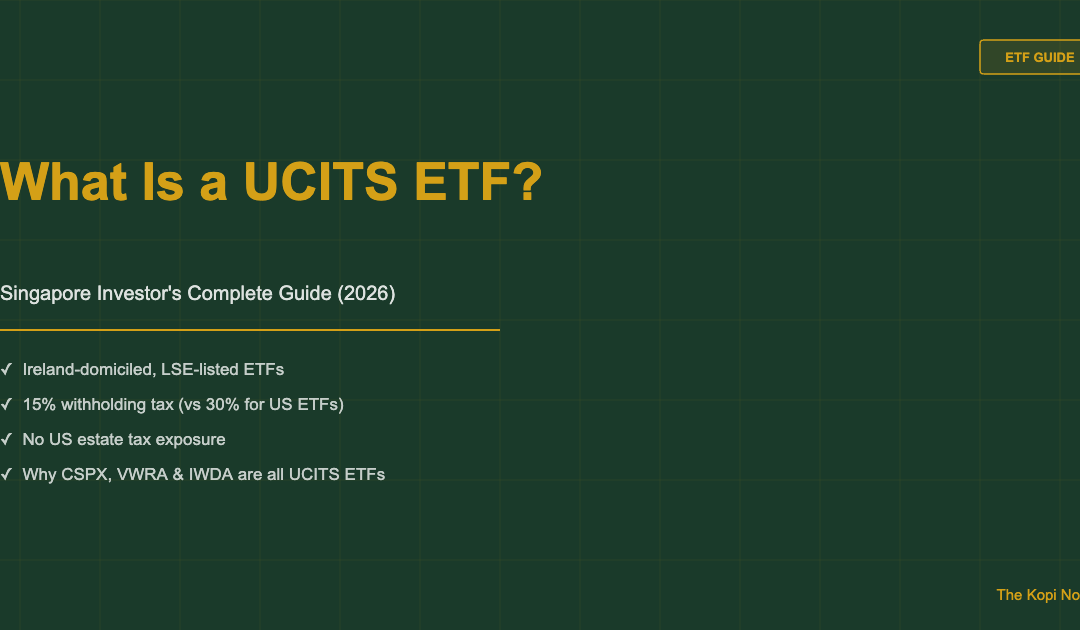
A UCITS ETF (Undertakings for Collective Investment in Transferable Securities) is a type of ETF regulated under EU law, typically domiciled in Ireland and listed on the London Stock Exchange (LSE). For Singapore investors, UCITS ETFs like CSPX, VWRA, and IWDA are the tax-smart choice: they attract only 15% US dividend withholding tax (versus 30% for US-domiciled ETFs) and carry no US estate tax risk — a critical advantage for non-US investors.
Not financial advice. All figures are for educational reference only. Data as at May 2026 unless noted.
Table of Contents
Contents — Click to expand
What Is a UCITS ETF?
UCITS stands for Undertakings for Collective Investment in Transferable Securities — a regulatory framework established by the European Union to govern collective investment funds. A UCITS ETF is simply an exchange-traded fund that complies with UCITS regulations.
In practical terms, UCITS ETFs are:
- Domiciled in Ireland or Luxembourg — the vast majority of LSE-listed UCITS ETFs are incorporated in Ireland, which has a favourable tax treaty with the United States
- Listed on European exchanges — primarily the London Stock Exchange (LSE), Euronext, or Xetra (Germany)
- Heavily regulated — UCITS rules mandate diversification (no single holding can exceed 10% of fund assets), daily liquidity, and investor protections such as mandatory fund auditing and segregated custody
- Globally accessible — because UCITS is an internationally recognised standard, Singapore brokers like Interactive Brokers (IBKR), Saxo, and MooMoo all provide access to LSE-listed UCITS ETFs
The most well-known UCITS ETFs for Singapore investors include iShares Core S&P 500 UCITS ETF (CSPX), Vanguard FTSE All-World UCITS ETF (VWRA), and iShares Core MSCI World UCITS ETF (IWDA) — all listed on the LSE and domiciled in Ireland.
UCITS ETFs are not to be confused with SGX-listed ETFs (such as the Nikko AM STI ETF or Lion-Phillip S-REIT ETF), which are listed locally on the Singapore Exchange and operate under MAS regulations rather than EU UCITS rules.
Why UCITS ETFs Matter for Singapore Investors
The single most important reason Singapore investors prefer UCITS ETFs over US-domiciled alternatives comes down to two connected tax issues: withholding tax on dividends and US estate tax exposure.
1. Lower Withholding Tax on US Dividends
When a US company pays a dividend, the IRS withholds a portion before the payment reaches the fund. The rate depends on where the fund is domiciled:
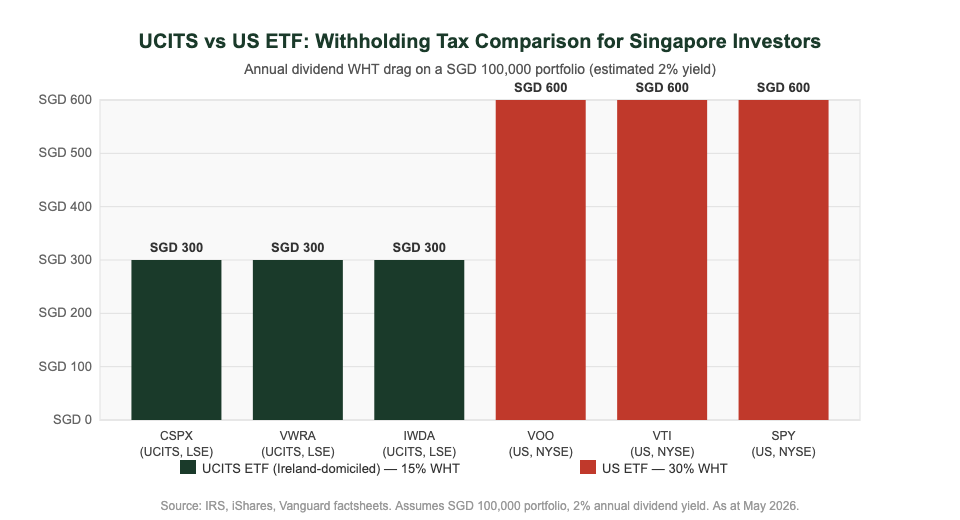
- US-domiciled ETFs (e.g. VOO, SPY, VTI): 30% withholding tax on US dividends for non-US investors
- Ireland-domiciled UCITS ETFs (e.g. CSPX, VWRA): 15% withholding tax, thanks to the Ireland–USA Double Taxation Treaty
This 15 percentage point difference compounds significantly over time. Consider a Singapore investor with a SGD 100,000 portfolio in a fund yielding 2% per year (SGD 2,000 in dividends annually):
- Holding CSPX (UCITS): pays SGD 300 in withholding tax (15% of SGD 2,000)
- Holding VOO (US-domiciled): pays SGD 600 in withholding tax (30% of SGD 2,000)
- Annual saving: SGD 300 per SGD 100,000 invested
Over 20 years, with portfolio growth factored in, this difference can compound to tens of thousands of dollars. For retirement planning purposes, this is a material drag. You can estimate how these savings compound using the Singapore retirement calculator at The Kopi Notes.
Note: Singapore itself imposes no withholding tax on dividend income received by Singapore investors. The 15% or 30% referred to above is a US-side deduction applied at the fund level before dividends are distributed.
2. No US Estate Tax Exposure
US estate tax is a wealth transfer tax levied on US-situs assets (including US-listed securities) when the owner passes away. For non-US residents, the exemption threshold is just USD 60,000 — compared to USD 13.6 million for US citizens in 2024.
This means a Singapore investor holding more than USD 60,000 (approximately SGD 80,000) in US-listed ETFs like VOO or SPY technically faces US estate tax on the excess at rates up to 40%. In practice, enforcement for foreign holders is uneven, but the legal exposure is real and increasingly discussed in estate planning circles.
Ireland-domiciled UCITS ETFs are not considered US-situs assets. An Irish fund holding US stocks is an Irish fund — it is not a US asset. So a Singapore investor holding SGD 500,000 in CSPX has zero US estate tax exposure, even though CSPX tracks the S&P 500.
This is a particularly important consideration for Singapore investors building substantial portfolios for passive income in Singapore or retirement. Once your US-listed holdings cross the USD 60,000 threshold, the estate tax question becomes material.
UCITS ETF vs US-Domiciled ETF: Key Differences
The table below summarises the key structural differences between UCITS ETFs and their US-domiciled equivalents. For Singapore investors tracking the S&P 500 or global equities, CSPX and VOO are the most direct comparison:
| Feature | UCITS ETF (e.g. CSPX) | US ETF (e.g. VOO) |
|---|---|---|
| Domicile | Ireland | USA |
| Primary Exchange | London Stock Exchange (LSE) | NYSE / Nasdaq |
| US Dividend WHT Rate | 15% | 30% |
| US Estate Tax Risk | None | Yes (above USD 60k) |
| Regulatory Framework | EU UCITS Directive | SEC / US Investment Company Act |
| Typical TER (S&P 500) | 0.03%–0.20% p.a. | 0.03%–0.09% p.a. |
| Currency Traded | GBP or USD (LSE) | USD |
| Eligible for CPF Investment | No | No |
| SRS Compatible | Yes (via eligible brokers) | Yes (via eligible brokers) |
Source: iShares, Vanguard factsheets; IRS Publication 559; as at May 2026.
Popular UCITS ETFs Available in Singapore
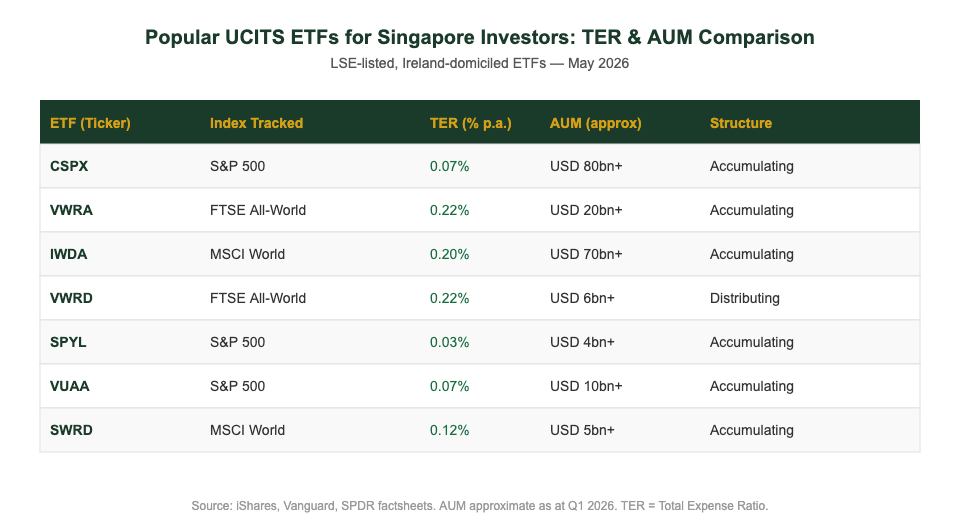
Singapore investors buying ETFs through brokers like IBKR, Saxo, or MooMoo have access to a wide range of UCITS ETFs on the LSE. The most popular among local retail investors are concentrated in a handful of broad-market funds. Here is an overview of the most widely held options as at May 2026:
| ETF (Ticker) | Full Name | Index | TER | Structure | AUM |
|---|---|---|---|---|---|
| CSPX | iShares Core S&P 500 UCITS ETF | S&P 500 | 0.07% | Accumulating | USD 80bn+ |
| VWRA | Vanguard FTSE All-World UCITS ETF (Acc) | FTSE All-World | 0.22% | Accumulating | USD 20bn+ |
| IWDA | iShares Core MSCI World UCITS ETF | MSCI World | 0.20% | Accumulating | USD 70bn+ |
| VWRD | Vanguard FTSE All-World UCITS ETF (Dist) | FTSE All-World | 0.22% | Distributing | USD 6bn+ |
| SPYL | SPDR S&P 500 UCITS ETF (Acc) | S&P 500 | 0.03% | Accumulating | USD 4bn+ |
| VUAA | Vanguard S&P 500 UCITS ETF (Acc) | S&P 500 | 0.07% | Accumulating | USD 10bn+ |
| SWRD | SPDR MSCI World UCITS ETF | MSCI World | 0.12% | Accumulating | USD 5bn+ |
Source: iShares, Vanguard, SPDR factsheets. AUM approximate as at Q1 2026. All ETFs listed on London Stock Exchange, domiciled in Ireland.
For Singapore investors focused solely on US large-cap equities, CSPX and SPYL are the main choices. SPYL has the lower TER (0.03%) but is newer and has significantly less AUM than CSPX — which matters for liquidity and bid-ask spreads. VWRA and IWDA are preferred by those seeking broader global diversification. You can explore how these ETFs fit into your retirement strategy using our Singapore retirement calculator.
Total Expense Ratio and Hidden Costs
The TER (Total Expense Ratio) is the annual fee charged by the fund manager, expressed as a percentage of your investment. It is deducted daily from the fund’s NAV — you never receive an invoice; it is simply reflected in slightly lower returns. The TER covers fund management, administration, custody, and regulatory costs.
For most popular UCITS ETFs, the TER is very low: CSPX charges 0.07% p.a., meaning a SGD 100,000 investment pays approximately SGD 70 per year in fund management costs. SPYL is even cheaper at 0.03%, or SGD 30 per year.
However, the TER is not the only cost. Singapore investors should also factor in:
- Brokerage commission: IBKR charges approximately USD 1.70 per trade for LSE stocks; Saxo charges a minimum of GBP 5 per trade; MooMoo charges approximately SGD 2.99 per trade
- FX conversion spread: Buying LSE-listed ETFs requires converting SGD to GBP or USD. Most brokers charge 0.2%–0.6% on the currency conversion
- Bid-ask spread: The difference between the buy and sell price. For liquid ETFs like CSPX, this is typically 0.01%–0.03% and negligible for long-term holders
For long-term buy-and-hold investors making lump-sum purchases, transaction costs matter less than TER. For those investing smaller monthly amounts (e.g. SGD 500/month), the minimum commission and FX spread can be proportionally significant. In such cases, platforms like Syfe offer fractional ETF investing with no commission, which can reduce cost drag for smaller portfolios.
The withholding tax advantage of UCITS ETFs (15% vs 30%) typically far outweighs the slightly higher TER compared to US equivalents. For example, CSPX has a TER of 0.07% vs VOO’s 0.03% — a difference of 0.04% p.a. But the WHT saving on dividends for a SG investor is approximately 15% × 2% yield = 0.30% p.a. — seven times larger than the TER gap. Net-net, CSPX is significantly cheaper for Singapore investors on a total cost basis.
How to Buy UCITS ETFs in Singapore
UCITS ETFs are not traded on the Singapore Exchange (SGX). To buy them, you need a brokerage account that provides access to the London Stock Exchange. The three most commonly used platforms by Singapore retail investors are:
1. Interactive Brokers (IBKR)
IBKR is widely regarded as the most cost-effective platform for LSE-listed ETFs. Commission is approximately USD 1.70 per trade for UK-listed shares, with no account minimum and no inactivity fee. The platform supports both USD and GBP settlement. IBKR is most suitable for investors making larger lump-sum purchases (SGD 10,000+) where the commission is proportionally small. You can search for CSPX or VWRA on IBKR by ticker symbol, then select “LSE” as the exchange.
2. Saxo Markets Singapore
Saxo offers LSE-listed ETF trading with a minimum commission of GBP 5 per trade. The platform is more user-friendly than IBKR for beginners and offers an SGD-denominated account. Saxo is a regulated MAS-licensed broker. Commission costs make it less efficient for very small trades but reasonable for SGD 3,000+ purchases.
3. MooMoo Singapore
MooMoo provides access to LSE-listed ETFs at approximately SGD 2.99 per trade. The app interface is intuitive for newer investors. MooMoo also runs frequent promotions for new account holders — see the moomoo Singapore review for the latest offers.
4. Syfe Brokerage
Syfe offers commission-free ETF investing with fractional shares, which makes it particularly suitable for smaller regular investment amounts. If you are investing SGD 200–500 per month into VWRA or CSPX, Syfe’s zero-commission model is more cost-efficient than paying fixed minimum commissions at IBKR or Saxo. Sign up via our Syfe referral code for a sign-up bonus.
Step-by-step to buy CSPX on IBKR:
- Open and fund your IBKR account in SGD (IBKR auto-converts to GBP/USD at competitive rates)
- In the trading platform, search for ticker “CSPX”
- Select the LSE (London Stock Exchange) exchange — not any OTC version
- Choose order type: Limit Order for price control, or Market Order for immediate execution during market hours (LSE is open 9am–5:30pm UK time, which is 5pm–1:30am SGT)
- Enter the number of shares and review the total cost including commission
- Submit the order
For FSMOne users, UCITS ETFs are also available via their Regular Savings Plan (RSP) at low minimums — see the FSMOne referral code page for current promotions.
CPF and SRS Compatibility
This is one of the most frequently asked questions about UCITS ETFs, and the answer is nuanced:
CPF Investment Scheme (CPFIS): LSE-listed UCITS ETFs are not eligible for investment under the CPFIS. Only SGX-listed instruments (such as ES3 — the Nikko AM STI ETF — or selected unit trusts on the CPFIS-approved list) qualify. If CPF investing is a priority, refer to the CPF investment strategy Singapore guide for eligible options.
Supplementary Retirement Scheme (SRS): UCITS ETFs can be purchased using SRS funds, provided your broker supports SRS account investing. IBKR does not currently support SRS accounts directly. Saxo and FSMOne do support SRS investment in LSE-listed ETFs. This makes Saxo or FSMOne the preferred brokers for SRS investors wanting UCITS ETF exposure.
For investors building a tax-efficient retirement portfolio that combines CPF optimisation with UCITS ETF exposure, the best S-REITs in Singapore 2026 guide also covers dividend-generating options that are SGX-listed and CPF-eligible — a useful complement to a UCITS ETF core portfolio.
Disclaimer: This article is for educational purposes only and does not constitute financial advice. Past performance is not indicative of future results. Always conduct your own research or consult a licensed financial adviser before making investment decisions. Tax rules are subject to change.
Frequently Asked Questions
What does UCITS stand for and what does it mean?
UCITS stands for Undertakings for Collective Investment in Transferable Securities. It is an EU regulatory framework for collective investment funds that sets strict rules on diversification, liquidity, disclosure, and investor protection. For Singapore investors, the most important implication is that UCITS ETFs are typically domiciled in Ireland, which grants them access to a favourable tax treaty with the United States — reducing withholding tax on US dividends from 30% to 15%.
Is CSPX a UCITS ETF?
Yes. CSPX — the iShares Core S&P 500 UCITS ETF — is a UCITS-compliant fund domiciled in Ireland and listed on the London Stock Exchange. It tracks the S&P 500 index with a TER of 0.07% p.a. and is structured as an accumulating ETF, meaning dividends are reinvested rather than distributed to investors. It is one of the most popular UCITS ETFs among Singapore retail investors due to its low cost, high liquidity, and tax efficiency.
Is VWRA a UCITS ETF?
Yes. VWRA — the Vanguard FTSE All-World UCITS ETF Accumulating share class — is a UCITS ETF domiciled in Ireland and listed on the LSE. It tracks the FTSE All-World Index, which includes approximately 4,200 stocks across developed and emerging markets. Its TER is 0.22% p.a. VWRA is often chosen by Singapore investors who want a single-fund global equity portfolio without the need to rebalance between developed and emerging market funds.
Can I buy UCITS ETFs using my CPF savings?
No. LSE-listed UCITS ETFs are not eligible for the CPF Investment Scheme (CPFIS). CPFIS only allows investment in SGX-listed instruments, MAS-approved unit trusts, and certain bonds. If you want to invest your CPF OA savings in equities, you are limited to SGX-listed ETFs such as the Nikko AM STI ETF (ES3) or the ABF Singapore Bond Index Fund. For a full overview of your CPF investing options, refer to the CPF investment strategy Singapore guide at The Kopi Notes.
What is the difference between a UCITS ETF and a regular ETF?
The term “ETF” broadly describes any exchange-traded fund. A UCITS ETF is specifically one that complies with EU UCITS regulations. Not all ETFs are UCITS — for example, US-listed ETFs like VOO and SPY operate under US SEC regulations, not EU UCITS rules. SGX-listed ETFs like the STI ETF operate under MAS regulations. The practical distinction for Singapore investors is primarily about domicile and the tax treatment of dividends: UCITS (Ireland-domiciled) ETFs benefit from a lower withholding tax rate on US dividends under the Ireland–USA tax treaty.
Which broker is best for buying UCITS ETFs in Singapore?
For most Singapore investors, Interactive Brokers (IBKR) offers the lowest transaction costs for buying LSE-listed UCITS ETFs — approximately USD 1.70 per trade with no minimum account balance. MooMoo Singapore is a user-friendly alternative at approximately SGD 2.99 per trade, suitable for smaller portfolios. For investors wanting to use SRS funds to buy UCITS ETFs, Saxo Markets and FSMOne are better choices as they support SRS account investing in LSE-listed securities. For very small regular investments (under SGD 500/month), Syfe’s commission-free fractional ETF investing may offer the best overall cost efficiency.
Ready to Start Investing in UCITS ETFs?
Open a brokerage account and buy your first UCITS ETF today. Use our referral links for exclusive sign-up bonuses.
This article was researched with the help of AI. While we strive to keep all information accurate and up to date, there may be errors. If you notice any discrepancies, please contact us.