S-REIT Dividend Yield vs T-Bill 2026: Which Gives Better Returns?
T-bill cut-off yields are falling in Q2 2026 — here's how S-REITs compare on real after-tax returns.
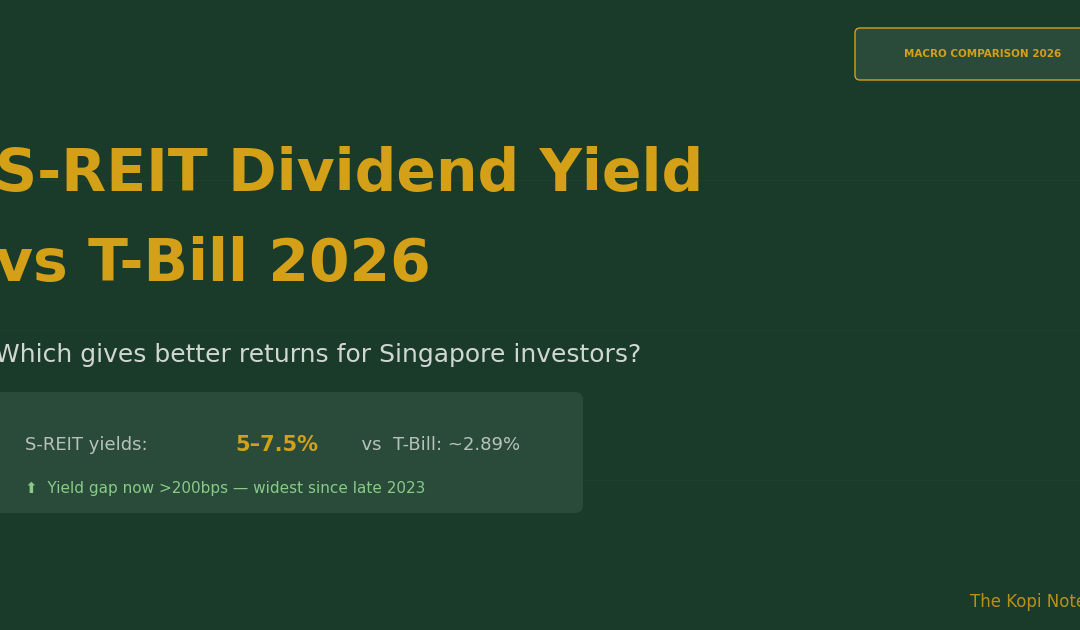
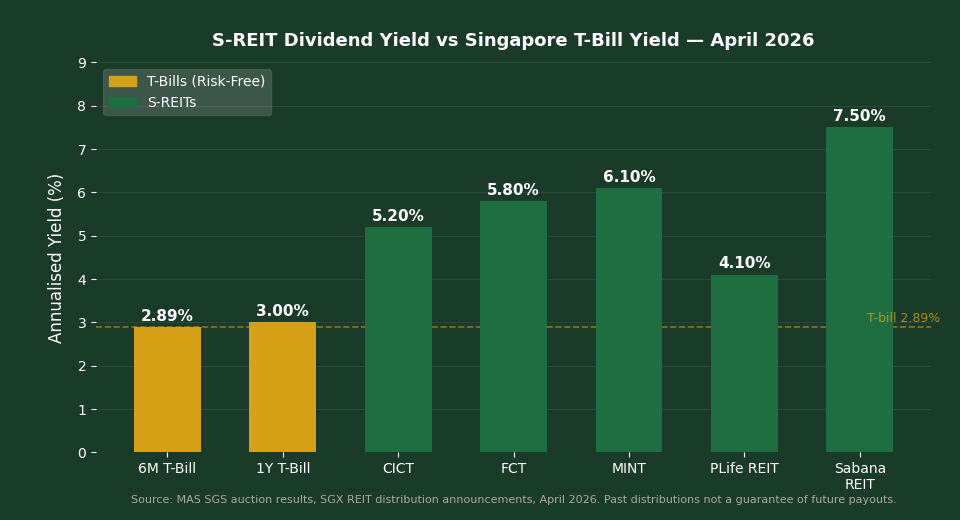
For Singapore investors weighing S-REIT dividend yield vs T-bills in 2026, the landscape has shifted: the latest 6-month T-bill cut-off yield has dropped to approximately 2.89% (April 2026 auction), while leading S-REITs such as Mapletree Industrial Trust, Frasers Centrepoint Trust, and CapitaLand Integrated Commercial Trust continue to offer distribution yields of 5.0–7.5%. That yield gap — now exceeding 2 percentage points — makes the comparison more compelling than at any point since late 2023.
Not financial advice. All figures are for educational reference only. Data as at April 2026 unless noted.
Table of Contents
Contents — Click to expand
- The 2026 Yield Gap: Where Things Stand Now
- What Are Singapore T-Bills? (Quick Recap)
- What Are S-REITs and How Are Dividends Taxed?
- Side-by-Side Comparison: S-REIT Yields vs T-Bill Yield 2026
- Real After-Tax Return Scenarios (SGD 50,000 Portfolio)
- When T-Bills Make More Sense
- When S-REITs Make More Sense
- The Hybrid Approach: Holding Both
- Frequently Asked Questions
The 2026 Yield Gap: Where Things Stand Now
Throughout 2023 and early 2024, Singapore T-bills offered cut-off yields of 3.7–4.0%, narrowing the traditional yield advantage of S-REITs to near zero on a risk-adjusted basis. Many retail investors rationally parked cash in T-bills rather than taking on REIT volatility for a modest incremental yield. That era is ending.
By Q2 2026, the Monetary Authority of Singapore's latest 6-month T-bill auctions have priced in a significantly lower rate environment. The April 2026 auction cleared at approximately 2.89%, and the 1-year T-bill yield sits around 2.95–3.05%. Meanwhile, the best S-REITs in Singapore 2026 continue to distribute yields in the 5.0–7.5% range — a spread of over 200 basis points on a headline basis.
This shift matters because the “risk-free rate” is the baseline against which all investments are judged. When T-bill yields were at 3.8%, a S-REIT yielding 5.5% offered only 170 bps of excess return for considerably more risk — capital volatility, interest rate sensitivity, and management execution risk. At today's T-bill yields of ~2.9%, that same 5.5%-yielding REIT now offers 260 bps of excess return. The math has improved materially in REITs' favour.
For more context on how T-bill rates have moved through 2026, see our detailed Singapore T-bills 2026 guide, including auction results and yield forecasts.
What Are Singapore T-Bills? (Quick Recap)
Singapore Government Securities (SGS) Treasury Bills — commonly called “T-bills” — are short-term government debt instruments issued by the Singapore Government and auctioned by the MAS on behalf of the Government. They come in two tenors: 6-month (26 weeks) and 1-year (52 weeks). T-bills are sold at a discount and redeemed at face value — the difference is your return.
Key characteristics for Singapore retail investors as at April 2026:
- Minimum purchase: SGD 1,000 (in multiples of SGD 1,000)
- Accessible via: DBS/POSB, OCBC, UOB iBanking; CPF-OA funds (non-competitive bids only); SRS funds
- Taxation: Interest income from Singapore Government T-bills is exempt from Singapore income tax for individuals
- Risk: Effectively zero — backed by the full faith and credit of the Singapore Government (AAA-rated)
- Liquidity: Can be sold on the secondary market before maturity, but at market price (which may be above or below par)
- Latest 6-month cut-off yield: ~2.89% p.a. (April 2026 auction)
- Latest 1-year cut-off yield: ~2.95–3.05% p.a. (as at April 2026)
Source: MAS SGS auction results, April 2026. MAS T-bill information page.
The tax exemption is a genuine advantage: a T-bill yielding 2.89% is equivalent to a taxable instrument yielding ~3.6% for an investor in the 20% income tax bracket. This makes T-bills particularly attractive for higher-income earners.
What Are S-REITs and How Are Dividends Taxed?
Singapore Real Estate Investment Trusts (S-REITs) are listed vehicles on the Singapore Exchange (SGX) that pool investor capital to own income-generating real estate — from shopping malls and logistics warehouses to data centres and healthcare facilities. By law, S-REITs must distribute at least 90% of their taxable income as dividends to enjoy tax transparency.
For Singapore individual investors, S-REIT distributions are received tax-free at the investor level — the REIT pays tax at the trust level (or qualifies for tax transparency), and no further personal income tax is levied on distributions received by individuals. This is a critical advantage.
For a deeper dive into building a passive income portfolio with S-REITs, see our guide to passive income Singapore strategies.
Key risk factors that differentiate S-REITs from T-bills:
- Capital risk: REIT unit prices fluctuate — you can lose capital, unlike T-bills held to maturity
- Distribution variability: Unlike a T-bill's guaranteed yield, REIT distributions can be cut if rental income falls or interest costs rise
- Interest rate sensitivity: REIT prices tend to fall when interest rates rise (and vice versa)
- Gearing (leverage): S-REITs typically carry debt (average ~37% gearing) — rising refinancing costs compress distribution yields
- Manager execution risk: Acquisitions, asset enhancement initiatives, and overseas expansion all affect long-term returns
Side-by-Side Comparison: S-REIT Yields vs T-Bill Yield 2026
The table below compares the headline distribution yields of selected S-REITs against the current 6-month and 1-year T-bill cut-off yields as at April 2026. Note that REIT yields shown are trailing 12-month distribution yields (annualised) based on the most recent distribution announcements.
| Instrument | Yield (Apr 2026) | Tax (Individual) | Capital Risk | Liquidity |
|---|---|---|---|---|
| 6-Month T-Bill | ~2.89% | Tax-exempt | None (held to maturity) | Secondary market |
| 1-Year T-Bill | ~3.00% | Tax-exempt | None (held to maturity) | Secondary market |
| CapitaLand Integrated Commercial Trust (CICT) | ~5.2% | Tax-transparent | Yes — price volatility | SGX listed, daily |
| Mapletree Industrial Trust (MINT) | ~6.1% | Tax-transparent | Yes — price volatility | SGX listed, daily |
| Frasers Centrepoint Trust (FCT) | ~5.8% | Tax-transparent | Yes — price volatility | SGX listed, daily |
| Parkway Life REIT (PREIT) | ~4.1% | Tax-transparent | Yes — price volatility | SGX listed, daily |
| Sabana Industrial REIT | ~7.5% | Tax-transparent | Yes — price volatility | SGX listed, daily |
Source: SGX announcements, MAS auction results, individual REIT distribution announcements as at April 2026. Yields are indicative and change with unit price movements. Past distributions are not a guarantee of future payouts.
Real After-Tax Return Scenarios (SGD 50,000 Portfolio)
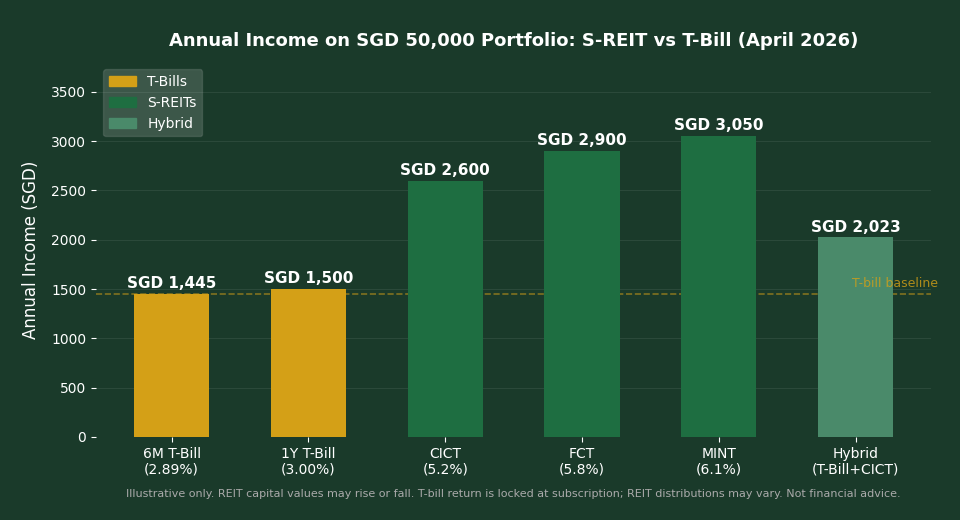
The headline yield comparison is useful, but real-world returns depend on entry price, reinvestment assumptions, and — crucially — what happens to capital. The table below models three scenarios for a Singapore individual investor deploying SGD 50,000 over a 12-month horizon, as at April 2026. All income figures assume no capital gain or loss for simplicity.
| Scenario | Instrument | Gross Yield | Tax (Indiv.) | Annual Income (SGD 50k) | Capital Risk |
|---|---|---|---|---|---|
| A — Capital safety priority | 6-Month T-Bill | 2.89% | Nil | SGD 1,445 | None |
| B — Balanced income + growth | CICT (est. 5.2% yield) | 5.20% | Nil | SGD 2,600 | Price volatility ±10–20% |
| C — Higher yield, higher risk | MINT (est. 6.1% yield) | 6.10% | Nil | SGD 3,050 | Price volatility ±15–25% |
| D — Hybrid (50/50 split) | 50% T-Bill + 50% CICT | ~4.05% | Nil | SGD 2,023 | Partial — 50% capital protected |
Illustrative only. REIT capital values may rise or fall. T-bill return is locked in at subscription; REIT distributions may vary. Not financial advice.
The income differential between Scenario A (T-bills) and Scenario B (CICT) is SGD 1,155 per year on SGD 50,000 — or roughly SGD 96 per month. Whether that incremental income justifies the capital risk depends entirely on your investment horizon, liquidity needs, and risk tolerance. To model how these returns fit into your long-term retirement plan, try our free Singapore retirement calculator.
When T-Bills Make More Sense
T-bills are not inferior instruments — they serve a specific role in a Singapore investor's portfolio that S-REITs cannot replicate. Consider T-bills if:
- You have a short investment horizon (under 12 months): If you need the money within 6–12 months for a property purchase, emergency fund replenishment, or specific goal, a T-bill locks in a guaranteed return with zero capital risk.
- You are risk-averse and cannot tolerate capital loss: A 10% decline in REIT unit prices can wipe out multiple years of yield advantage over T-bills. If portfolio drawdowns cause you distress, the guaranteed nature of T-bills has real psychological and financial value.
- You are using CPF-OA funds: T-bills are eligible for CPF-OA investment (non-competitive bids). CPF-OA earns 2.5% p.a. baseline — a 1-year T-bill at ~3.0% provides a modest uplift over the CPF floor rate. Check our CPF investment strategy Singapore guide before deploying CPF funds.
- Interest rates are expected to rise further: If rates move materially higher from here, REIT prices would face headwinds. T-bills let you earn a market rate while waiting for better REIT entry points.
- You are building an emergency fund or cash management position: T-bills and Singapore Savings Bonds serve as high-quality, liquid short-term parking spots. See our Singapore Savings Bonds guide for an alternative.
When S-REITs Make More Sense
With the yield gap at its widest since 2023, S-REITs are more compelling relative to T-bills than they have been in over two years. Consider S-REITs if:
- You have a long investment horizon (5+ years): Over the long run, S-REITs have delivered total returns — income plus capital appreciation — that significantly outpace short-term government bonds. The reinvestment of distributions compounds meaningfully over time.
- You seek inflation-linked income: Quality S-REITs with rent escalation clauses (especially industrial and data centre REITs) offer distributions that can grow with inflation, unlike a T-bill's fixed yield.
- You want portfolio diversification: S-REITs provide exposure to real assets — office, retail, industrial, hospitality, healthcare, data centres — with returns driven by fundamentals distinct from Singapore equity or bond markets.
- You are building passive income for retirement: The quarterly or semi-annual distribution cadence of S-REITs provides regular cash flow well-suited to retirement income planning. Combined with CPF LIFE payouts, S-REIT income can form a diversified income base.
- You can tolerate short-term price volatility: REIT unit prices fluctuate — sometimes significantly — with interest rate expectations and property market sentiment. Investors who can sit through 15–20% drawdowns without panic-selling can capture the full yield advantage.
For a curated selection of S-REITs across sub-sectors with current yield data, see our best S-REITs in Singapore 2026 guide.
The Hybrid Approach: Holding Both
Many experienced Singapore investors do not choose between S-REITs and T-bills — they hold both, each serving a distinct role in the portfolio. A common framework used by dividend investors in Singapore:
- Emergency fund / short-term reserves (6–12 months of expenses): 6-month T-bills or Singapore Savings Bonds — capital guaranteed, tax-free, liquid
- Medium-term savings (1–3 years): Mix of 1-year T-bills and lower-risk S-REITs like Parkway Life REIT or CapitaLand Integrated Commercial Trust
- Long-term wealth building (5+ years): Diversified S-REIT portfolio across sub-sectors — industrial, retail, data centres, healthcare — plus global ETFs for equity exposure
This “cash ladder” approach ensures you are never forced to sell S-REIT units at depressed prices during a market downturn because you have T-bills maturing for near-term cash needs. It also allows you to deploy T-bill proceeds into S-REITs opportunistically when prices fall and yields rise.
If you want to model exactly how this allocation strategy plays out for your retirement, our Singapore retirement calculator lets you input different yield assumptions and asset allocations. You can also explore platforms like Syfe (which offers both REIT+ portfolios and cash management products) to implement a hybrid strategy in a single account.
Disclaimer: This article is for educational purposes only and does not constitute financial advice. S-REIT unit prices and T-bill cut-off yields change with market conditions. Past distributions are not a guarantee of future payouts. Consider consulting a licensed financial adviser before making investment decisions.
Frequently Asked Questions
Are S-REIT dividends taxed in Singapore?
For Singapore individual investors, S-REIT distributions are generally received tax-free at the investor level. S-REITs that qualify for tax transparency status under the Income Tax Act distribute income that has already been subjected to tax at the trust level (or is exempt). Individual unit holders do not pay additional personal income tax on distributions received. However, corporate investors or foreign investors may face different tax treatment — always check the REIT's distribution announcement for specific guidance on the applicable tax rate.
Is T-bill interest taxable in Singapore?
Interest income from Singapore Government Securities T-bills is exempt from Singapore income tax for individuals. This means a 2.89% T-bill yield is a true 2.89% return for retail investors — unlike corporate bonds or bank fixed deposits (which may be subject to income tax in certain circumstances). The tax exemption applies to both 6-month and 1-year T-bills, and applies whether you buy through DBS, OCBC, UOB, or via CPF/SRS funds.
Which is safer — S-REITs or T-bills for a Singapore investor?
T-bills are meaningfully safer in terms of capital preservation. Singapore Government T-bills are backed by the Singapore Government (AAA-rated) — if held to maturity, you receive exactly the face value back with no capital risk. S-REIT unit prices fluctuate daily and can fall 20–30% or more during market corrections (as seen in 2020 and during the 2022–2023 rate hike cycle). The trade-off for T-bills' safety is a significantly lower yield — currently around 2.89% vs 5–7% for many S-REITs. The right choice depends on your investment horizon, risk tolerance, and cash flow needs.
Can I buy T-bills and S-REITs with my CPF funds?
T-bills can be purchased using CPF-OA funds via a non-competitive bid through DBS, OCBC, or UOB. The 6-month and 1-year T-bill yields have generally exceeded the CPF-OA's base interest rate of 2.5% p.a., making this a useful way to earn a slightly higher return on CPF-OA savings. Most S-REITs listed on SGX are also eligible for purchase using CPF-OA funds under the CPF Investment Scheme (CPFIS), though you must maintain a minimum of SGD 20,000 in your CPF-OA before investing and a minimum balance of SGD 20,000 must remain after. Check our CPF investment strategy guide for the full rules and eligibility list.
What is the yield spread between S-REITs and T-bills in 2026?
As at April 2026, the yield spread between S-REITs and Singapore 6-month T-bills has widened to approximately 200–480 basis points (2.0–4.8 percentage points), depending on the specific REIT. For example, CICT yields approximately 5.2% vs the T-bill's ~2.89%, a spread of ~231 bps. Mapletree Industrial Trust at ~6.1% implies a spread of ~321 bps. This spread is the widest it has been since late 2023, driven by falling T-bill cut-off yields and relatively stable REIT unit prices and distributions. A wider spread generally makes S-REITs more attractive on a relative value basis.
Should I switch from T-bills to S-REITs now that yields are falling?
This is a personal decision that depends on your financial situation, investment horizon, and risk tolerance — and is not financial advice. What we can say factually: the yield advantage of S-REITs over T-bills has increased meaningfully in Q2 2026, and historically, periods of falling short-term rates have tended to be supportive of REIT valuations (as their borrowing costs fall and their yield premium over risk-free rates expands). A gradual reallocation — moving a portion of maturing T-bill proceeds into quality S-REITs over several tranches — is a strategy used by some Singapore investors to average into REIT positions without committing all capital at once. Consider consulting a licensed financial adviser before making significant portfolio changes.
Ready to Build Your Singapore Income Portfolio?
Start investing in S-REITs or T-bills today. Use our referral links for exclusive sign-up bonuses.
This article was researched with the help of AI. While we strive to keep all information accurate and up to date, there may be errors. If you notice any discrepancies, please contact us.