Endowment Plan for Young Professionals Singapore 2026: Is It Worth It?
Table of Contents
- What Is an Endowment Plan?
- Why Young Professionals Consider Endowment Plans
- 5 Pros for Young Professionals
- 5 Cons and Risks
- Endowment Plan vs Alternatives (Full Comparison Table)
- When Does It Make Sense?
- Top Endowment Plans in Singapore 2026
- Where to Invest: Smarter Alternatives
- Verdict
- Frequently Asked Questions
Not financial advice. All figures are for educational reference only. Data verified as at November 2026 unless noted.
An endowment plan is a life insurance savings policy that pays a lump sum at maturity. For Singapore’s young professionals aged 25–35, it offers capital discipline and returns of 2.5–3.56% p.a. guaranteed (non-par plans) or illustrated total returns of around 3.5–4% p.a. (par plans), all shielded from market volatility. The critical trade-off is a 10–25 year lock-in period that creates significant opportunity cost versus CPF SA top-ups or globally diversified ETFs over the same horizon.
If you are in your mid-20s or early 30s and have been offered an endowment plan by a bank or financial adviser, this guide breaks down the numbers, compares the alternatives, and tells you exactly when an endowment plan makes sense — and when you should walk away.
What Is an Endowment Plan?
An endowment plan is a type of life insurance policy that combines a savings element with a life protection element. You pay regular premiums for a fixed term, and in return the insurer pays out a maturity benefit when the policy term ends. If you pass away during the policy term, your beneficiaries receive a death benefit — typically equal to or greater than the maturity sum.
In Singapore, there are two main types:
Participating (par) plans: Your premiums go into a pooled “par fund” invested by the insurer. Returns consist of a small guaranteed component (IRR typically 0.5–1%) plus non-guaranteed reversionary and terminal bonuses that depend on the par fund’s investment performance. MAS requires insurers to illustrate returns at both a lower (3.25%) and higher (4.25%) scenario — but these are projections, not promises.
Non-participating (non-par) plans: All returns are fully guaranteed from day one. These are simpler savings-insurance hybrids. Current 2026 rates for 2–5 year non-par plans range from approximately 2.5% to 3.56% p.a. guaranteed.
Why Young Professionals Consider Endowment Plans
Endowment plans appeal to young professionals for three primary reasons. First, they enforce a savings discipline through GIRO premiums — money leaves your account before lifestyle inflation can claim it. Second, entering a par plan at 25 means lower premiums for the same coverage than entering at 35, and your terminal bonus accumulates over a longer period. Third, the guaranteed component provides capital certainty that helps when planning for specific future goals — a property down payment, a wedding fund, or retirement capital at an exact future date.
5 Pros of Endowment Plans for Young Professionals
1. Compounding head start: Starting at 25 versus 35 means 10 more years of compounding inside the par fund. Each year’s declared reversionary bonus is locked in and cannot be taken away, so starting early maximises the terminal bonus at maturity.
2. Automatic savings discipline: GIRO premiums are set-and-forget. For young professionals managing lifestyle inflation, rent, and social spending simultaneously, the forced commitment removes the need for monthly self-discipline. The ~3.5% return you actually receive via an endowment plan beats the ~0% return on money you would otherwise have spent.
3. Capital protection from volatility: Unlike REITs or ETFs, your committed capital does not fall in a market crash. For the specific portion of your savings earmarked for a date-certain goal — property down payment in 2036, for instance — capital certainty has genuine financial planning value.
4. Life cover inclusion: Par endowment plans include a death benefit during the policy term, typically equal to or greater than the guaranteed maturity sum. For young professionals with dependants, a mortgage, or aging parents, this dual purpose (savings plus protection) is a cost-efficiency compared to buying term life and investing separately.
5. SRS double-benefit: Regular premium endowment plans can be funded from your Supplementary Retirement Scheme (SRS) account. This gives you upfront income tax relief on SRS contributions (up to S$15,300/year for citizens and PRs) in addition to the plan’s return. At the top SRS contribution, the annual tax saving is S$1,758–S$3,672 depending on your bracket — a meaningful boost to effective after-tax returns for professionals in the 11.5% or higher tax bracket.
5 Cons and Risks of Endowment Plans for Young Professionals
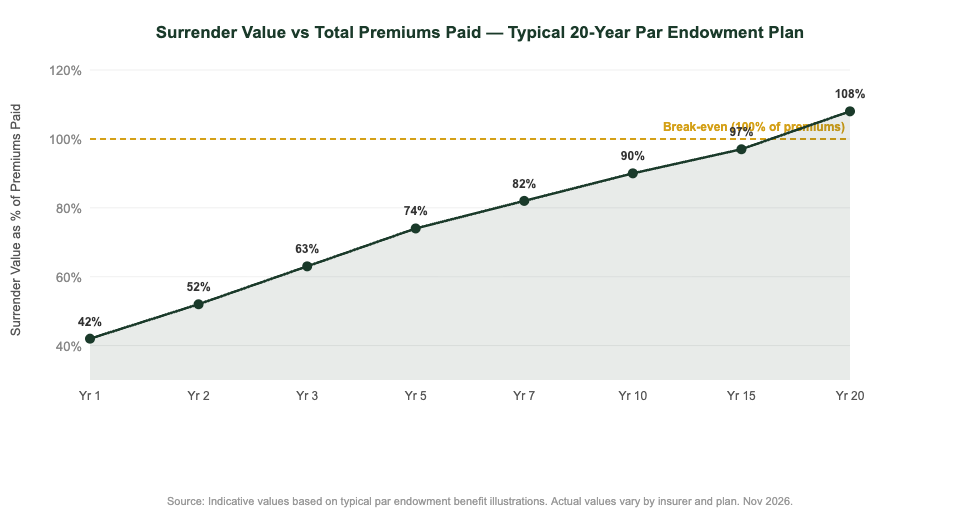
1. Severe liquidity lock-in: The surrender value table (see chart below) tells the full story. In years 1–3, typical surrender values are only 42–65% of premiums paid. This is a critical risk for a 25-year-old whose financial situation — career, family, housing — will change dramatically over the policy term.
2. Opportunity cost versus equities: A broadly diversified ETF (such as an MSCI World or S&P 500 fund) has historically returned ~8–10% p.a. over 20+ year horizons. At a 20-year horizon, the gap between ~3.5% (endowment illustrated) and ~8% (equity index) compounds to a staggering difference. On S$50,000 invested at 25, the difference between 3.5% and 8% over 20 years is approximately S$99,000 versus S$233,000 in ending value — a S$134,000 gap.
3. Non-guaranteed bonuses carry real risk: Par plan illustrations are projections at MAS-mandated rates. Actual declared bonuses depend on the par fund’s investment performance. If equity markets underperform for a decade, your bonus rate can drop materially. What was illustrated at 3.5% may deliver 2.5% in reality.
4. Inflation erosion over long terms: Even at a 3.5% illustrated return, your real purchasing power gain after Singapore’s average CPI of ~2–3% is negligible over 20 years. CPF SA’s floor rate of 4% (and additional 1% interest on the first S$60,000) makes CPF a stronger guaranteed real-return vehicle for most young professionals.
5. Inflexibility for life changes: Illness, retrenchment, overseas relocation, or a business opportunity — any major event that disrupts your ability to pay premiums leads to either policy lapse and surrender value loss, or a reduced paid-up conversion at lower coverage. This inflexibility is unusually costly during the wealth-accumulation phase of a career.
Endowment Plan vs Alternatives: Full Comparison Table
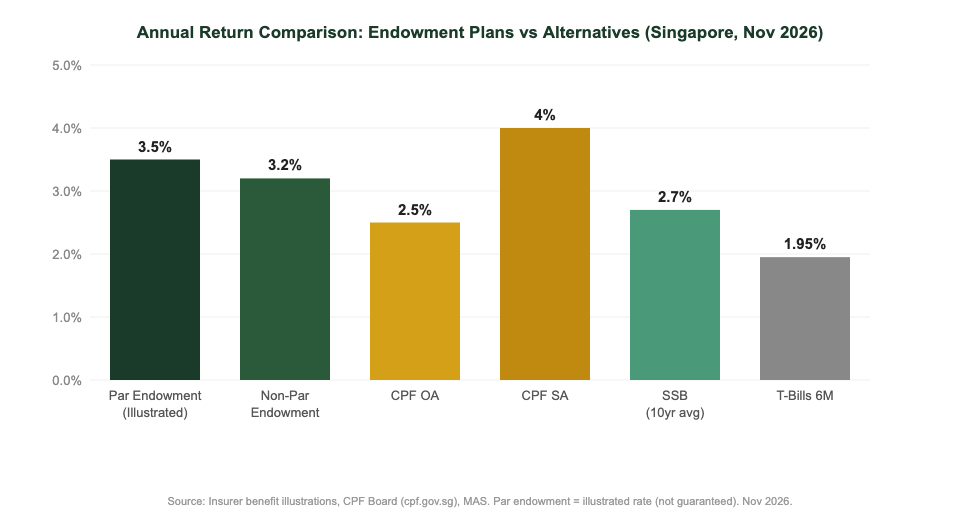
Use this table to benchmark an endowment plan against the most common savings and investment options available to Singapore residents in 2026:
| Product | Annual Return | Guaranteed? | Liquidity | Capital Risk | Best For |
|---|---|---|---|---|---|
| Par Endowment Plan | ~3.5% (illustrated) | Partially (bonuses non-guaranteed) | Low (10–25yr lock-in) | Low | Disciplined savings, life cover |
| Non-Par Endowment | 2.5–3.56% p.a. | Yes (100% guaranteed) | Low (2–5yr) | None | Short-term capital deployment |
| CPF OA Top-Up | 2.5% (floor) | Yes (government-backed) | Very Low | None | HDB mortgage, retirement |
| CPF SA / RA Top-Up | 4.0% (floor) | Yes (government-backed) | Very Low (until 55) | None | Retirement savings, tax relief |
| Singapore Savings Bonds | ~2.70% (10yr avg, Nov 2026) | Yes (backed by SG government) | High (redeem anytime) | None | Flexible safe-haven savings |
| S&P 500 / MSCI World ETF | ~8–10% (historical, variable) | No | High (trade any day) | Yes (market risk) | Long-term wealth building |
| T-Bills (6-Month) | ~1.95% p.a. (Nov 2026) | Yes (backed by SG government) | Medium (6-month term) | None | Short-term cash parking |
Source: CPF Board (cpf.gov.sg), MAS, insurer benefit illustrations, TKN data. Rates as at November 2026. Historical ETF returns based on 20-year MSCI World and S&P 500 CAGR. Past performance is not indicative of future results.
When Does an Endowment Plan Make Sense?
Yes — in these three scenarios:
✅ You have a fixed financial goal with a known date. If you need S$80,000 in exactly 10 years for a property down payment or business seed capital, a non-par endowment giving a fully guaranteed maturity value is a rational choice for that specific slice of your savings. Use our Singapore retirement planning calculator to map the numbers for your own goal date and amount.
✅ You struggle with investment discipline. If you have tried and failed to invest via a brokerage account consistently, the structural GIRO nudge of an endowment plan has real psychological value. The ~3.5% return you actually receive almost always beats the ~0% you would get from spending the same amount on lifestyle inflation.
✅ You are in the 11.5%+ tax bracket and use SRS. Funding a regular premium endowment plan via SRS gives you upfront tax relief worth 11.5–24% on the contribution, stacked on top of the plan’s guaranteed return. At the top SRS contribution of S$15,300/year, the annual tax saving is S$1,758–S$3,672 depending on your bracket.
No — in these three scenarios, consider alternatives:
❌ You have a 20+ year horizon and can tolerate market volatility. Over 20 years, a low-cost ETF via a platform like Syfe or Endowus will almost certainly outperform by a wide margin. The compounding difference between 3.5% and 8% over two decades on a S$50,000 sum is roughly S$99K versus S$233K in ending value.
❌ Your CPF SA has not yet reached the Full Retirement Sum. At 4% guaranteed with tax relief on cash top-ups, CPF SA delivers a better guaranteed return than any endowment plan in 2026. See our guide on CPF investment strategy for Singapore investors for the optimal top-up sequence.
❌ Your emergency fund is below 6 months of expenses. An endowment plan’s lock-in makes it structurally unsuitable as a liquidity buffer. If you face a financial emergency and need to surrender early, you will almost certainly receive back less than what you paid in.
Top Endowment Plans for Young Professionals in Singapore 2026
If you have assessed your situation and decided an endowment plan fits your goals, here are the main options available in Singapore in 2026. Always request a formal Benefit Illustration (BI) from a licensed adviser before purchasing:
| Plan | Type | Indicative Return | Term | Key Feature |
|---|---|---|---|---|
| Great Eastern short-term single premium | Non-par | ~3.5% p.a. | 2–3 years | Single premium, fully guaranteed |
| Manulife Goal (via DBS/POSB) | Non-par | 1.60–1.88% p.a. | 2 years | Bank-distributed, low entry amount, fully guaranteed |
| OCBC short-term endowment products | Non-par | ~2.5% p.a. | 2–3 years | OCBC exclusive, capital guaranteed |
| AIA / Prudential / Great Eastern par plans | Participating | ~3.5% (illustrated, non-guaranteed) | 10–25 years | Life cover + long-term wealth accumulation |
Source: Insurer websites, DBS/OCBC product pages, benefit illustrations (Oct–Nov 2026). Rates are indicative. MAS-mandated illustration rates for par plans are 3.25% and 4.25%. Always request a formal Benefit Illustration before purchasing.
Endowment plans are protected under Singapore’s Policy Owners’ Protection (PPF) Scheme, administered by SDIC. As of 2026, guaranteed benefits are covered up to S$500,000 of guaranteed sum assured and S$100,000 of guaranteed surrender value per life assured per insurer. Non-guaranteed bonuses are not covered. For full details, see the SDIC website.
Where to Invest: Smarter Alternatives for Young Professionals
For most young professionals in Singapore with a 15–30 year investment horizon, these platforms are worth considering before committing to an endowment plan’s lock-in:
Endowus: Invest via CPF OA/SA, SRS, or cash into globally diversified funds at institutional pricing (no sales charge). One of the most effective ways to put CPF and SRS to work in equities. Use our Endowus referral code (2V343) for S$20 access fee credit on first investment.
Syfe: Automated portfolios including Core Equity100 (100% global equities) and Income+. No lock-in, low fees, and autopilot investing. Use our Syfe referral code (SRPRFFFCD) for a fee waiver on the first S$30,000 for 6 months.
For the guaranteed, fully liquid portion of your portfolio, see our Singapore Savings Bonds 2026 guide — SSBs offer ~2.70% (10-year average, Nov 2026), are redeemable any month without penalty, and are backed by the Singapore government. For a head-to-head comparison between SSB and endowment plans, see our earlier deep-dive: Endowment Plan vs Singapore Savings Bonds 2026.
Verdict: Should Young Professionals Buy an Endowment Plan in 2026?
For most young professionals aged 25–35 in Singapore, an endowment plan should be a small, targeted allocation — not the default savings vehicle.
The correct sequence is: build a 6-month emergency fund first, then maximise CPF SA top-ups (4% guaranteed, tax-deductible), then invest the remainder via low-cost global ETFs through Endowus or Syfe. An endowment plan enters the picture only when you have a specific, date-certain financial goal and cannot tolerate any capital risk on that specific sum.
The sweet spot: a non-par short-term endowment (2–3 years, fully guaranteed) for idle cash you will need at a known date, or a par endowment funded via SRS for a young professional in the 11.5%+ tax bracket who wants to maximise the tax relief stack. Outside these scenarios, the opportunity cost of a 10–25 year lock-in at 3.5% is too high for someone whose prime compounding years lie ahead.
Frequently Asked Questions
Is an endowment plan a good investment for someone aged 25 in Singapore?
At 25, your investment horizon before retirement is 35–40 years. An endowment plan’s ~3.5% illustrated return is significantly below the historical long-run return of globally diversified equities (~8–10% p.a.). Unless you have a specific, date-certain goal and genuinely cannot tolerate any capital risk, most financial planners would suggest prioritising CPF SA top-ups (4% guaranteed) and low-cost ETF investing before committing to a 10–25 year endowment plan lock-in.
What happens if I stop paying endowment premiums early?
If you stop premiums within the first 3–5 years of a par endowment plan, your policy will likely lapse and you will receive only the surrender value — typically 42–65% of premiums paid in the early years. After a sufficient number of years (varies by plan, usually around year 3–5), most policies can be converted to a reduced paid-up status, meaning no future premiums are required but your coverage and eventual maturity benefit are reduced proportionally.
How much of an endowment plan is protected by SDIC?
Endowment plans in Singapore are protected under the Policy Owners’ Protection (PPF) Scheme, administered by SDIC. As of 2026, the coverage limits are S$500,000 of guaranteed sum assured and S$100,000 of guaranteed surrender value per life assured per insurer. Non-guaranteed bonuses (reversionary and terminal bonuses) are not covered. This protection applies if your insurer becomes insolvent — it does not guarantee investment returns.
Can I use my SRS to fund an endowment plan?
Yes. Many regular premium endowment plans are eligible for SRS funding, giving you upfront income tax relief on SRS contributions (up to S$15,300/year for Singapore citizens and PRs) in addition to the plan’s return. This SRS double-benefit is particularly compelling for professionals in the 11.5% or higher income tax bracket. Note: not all endowment plans accept SRS — confirm eligibility with your insurer or adviser before purchasing.
What is the difference between a par and non-par endowment plan?
A participating (par) plan pools your premiums with other policyholders and shares investment profits as reversionary and terminal bonuses. The upside is higher potential total returns (~3.5–4% illustrated) with life cover included, but bonuses are non-guaranteed. A non-participating (non-par) plan offers fully guaranteed returns (~2.5–3.56% for 2–5 year plans in Nov 2026) with no bonus uncertainty. For a 25-year-old, par plans make more sense over 15–25 year horizons; short-term non-par plans are better for deploying idle cash over 2–5 years without accepting any performance risk.
Is an endowment plan better than Singapore Savings Bonds for a young professional?
Singapore Savings Bonds (SSB) currently offer ~2.70% average yield over 10 years (Nov 2026 issuance), are fully guaranteed by the Singapore government, and can be redeemed any month without penalty. For a young professional prioritising flexibility, SSB is a more liquid and equally safe option versus a 2–3 year non-par endowment. For longer horizons (10+ years) where you are comfortable with the lock-in, par endowment plans may deliver higher total illustrated returns. For a full side-by-side analysis, see our endowment plan vs SSB 2026 comparison.
Get Free Insurance Advice
Speak with a licensed insurance advisor. No obligation, no cost.
By submitting this form, you agree to our Privacy Policy.
This article was researched with the help of AI. While we strive to keep all information accurate and up to date, there may be errors. If you notice any discrepancies, please contact us.