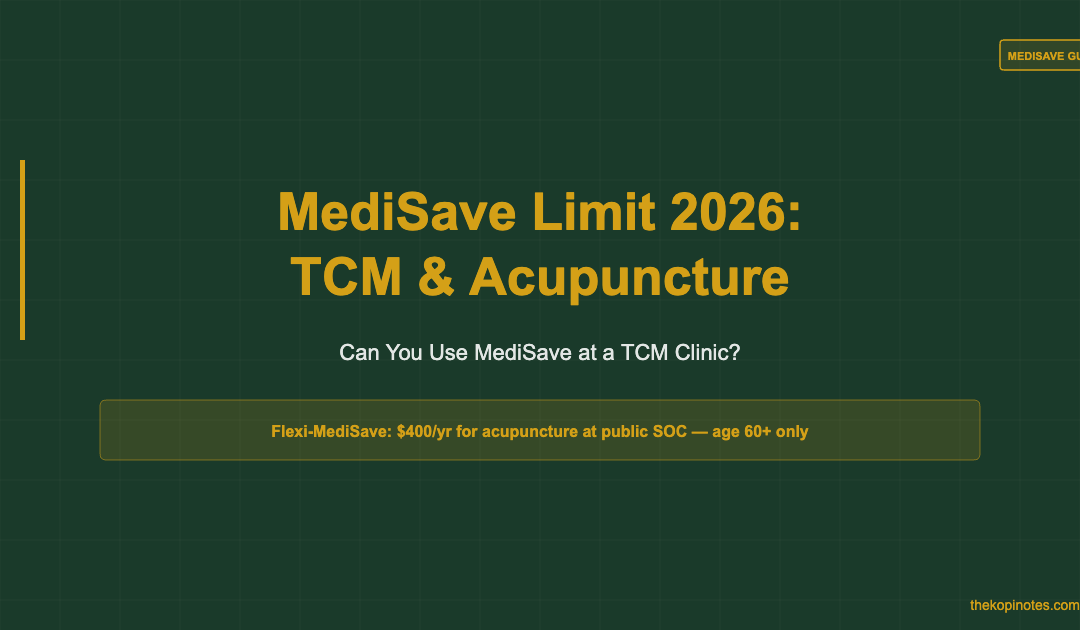
MediSave Limit 2026: TCM and Acupuncture — Can You Use MediSave at a TCM Clinic?
Most Singaporeans assume MediSave cannot be used at any TCM clinic — and they are largely right. Standard TCM consultations, herbal medicine, and tui na massage are not MediSave-claimable. However, one narrow exception exists: if you are aged 60 or above, you can withdraw up to $400 per year under the Flexi-MediSave scheme for acupuncture treating lower back pain or neck pain, but only at specialist outpatient clinics in public hospitals.
Not medical or financial advice. All figures are for educational reference only. Data as at November 2026 unless noted.
In This Article
Table of Contents
- The Big Misconception About MediSave and TCM
- The One Exception: Flexi-MediSave for Acupuncture
- TCM MediSave Coverage at a Glance
- Does Your Integrated Shield Plan Cover TCM?
- MediShield Life and TCM
- How to Reduce TCM Costs Without MediSave
- What Is Changing: MOH 2025 Proposals
- Frequently Asked Questions
The Big Misconception About MediSave and TCM
Many Singaporeans believe their MediSave account can be used freely for traditional Chinese medicine. This misconception is understandable — TCM is deeply woven into Singapore’s healthcare culture, and thousands of registered TCM practitioners operate island-wide under the Ministry of Health’s regulatory framework.
But MediSave is not a general healthcare wallet. It is a ring-fenced savings scheme designed primarily for hospital stays, approved outpatient procedures, and specific chronic disease management. The CPF Board sets strict rules about what qualifies, and routine TCM services — including consultation fees, herbal prescriptions, tui na, and cupping — fall entirely outside those rules.
Believing otherwise can lead to a nasty surprise at the billing counter, or worse, an attempt to claim reimbursement that the CPF Board will reject. If you have been setting money aside in your MediSave expecting to use it at your neighbourhood TCM clinic, you need to know the actual rules before that appointment.
For a broader overview of what MediSave can and cannot pay for in outpatient settings, see our Flexi-MediSave outpatient care guide.
The One Exception: Flexi-MediSave for Acupuncture
There is one narrow — and often overlooked — scenario where MediSave can be used for TCM services. This exception is called the Flexi-MediSave scheme.
The Flexi-MediSave scheme was originally introduced to help seniors manage outpatient costs at public hospitals. As of 2026, the scheme has been expanded to cover acupuncture for specific conditions, but the eligibility criteria are strict:
| Eligibility Criterion | Requirement |
|---|---|
| Age | Aged 60 and above (you or your spouse can pay from either account) |
| Treatment type | Acupuncture only — no other TCM services qualify |
| Medical condition | Lower back pain or neck pain only |
| Facility | Specialist outpatient clinics (SOCs) at public hospitals only — not private TCM clinics |
| Annual limit | Up to $400 per calendar year per patient |
Source: CPF Board FAQ (accessed November 2026); MOH press release, 29 December 2020
The pilot for acupuncture under Flexi-MediSave started on 29 December 2020, following an MOH study that validated acupuncture as an effective complementary treatment for lower back and neck pain when delivered by trained practitioners at accredited public facilities.
Critically, this scheme applies only at public hospital SOCs. The acupuncture departments at Singapore General Hospital, National University Hospital, Tan Tock Seng Hospital and other restructured hospitals are the qualifying venues. Your local private TCM clinic — however reputable — does not qualify, even if the practitioners there are equally skilled.
Patients at these public SOCs may also benefit from means-tested government subsidies of up to 70% off their bill. Pioneer Generation cardholders receive an additional 50% off the remaining bill after the base subsidy, while Merdeka Generation cardholders receive an additional 25%. Combined with the Flexi-MediSave withdrawal, a qualified senior’s out-of-pocket cost can be very modest.
See our full guide to MediSave approved treatments for other outpatient procedures covered by MediSave in 2026.
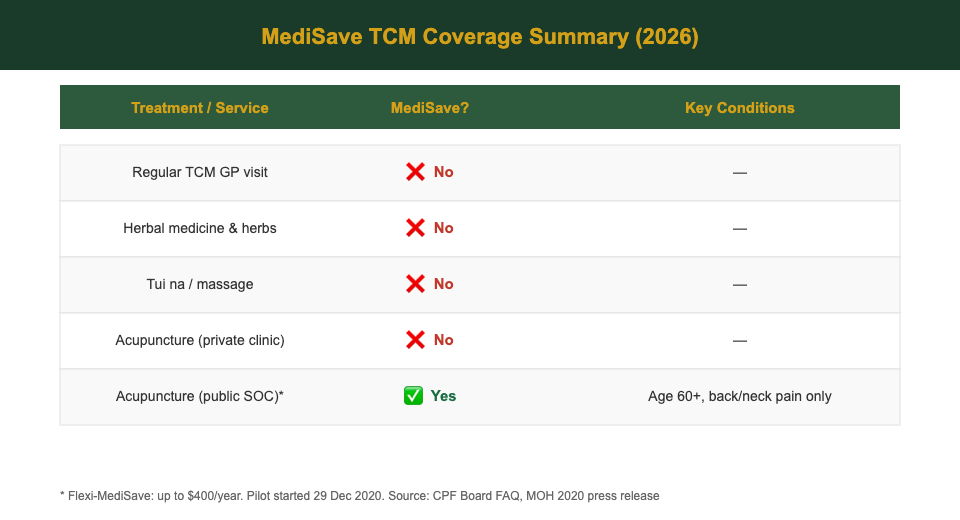
TCM MediSave Coverage at a Glance
The chart above captures the landscape. The vast majority of TCM services are not MediSave-claimable. The single eligible service — acupuncture at a public SOC — is a narrow carve-out, not a broad endorsement of TCM within the MediSave framework. Here is a quick summary to share with family members who may be confused:
- TCM GP consultation: Not covered
- Herbal medicine and prescriptions: Not covered
- Tui na, cupping, gua sha: Not covered
- Acupuncture at a private TCM clinic: Not covered
- Acupuncture for lower back or neck pain at a public hospital SOC: Covered via Flexi-MediSave, $400/year, age 60+ only
Does Your Integrated Shield Plan Cover TCM?
Integrated Shield Plans (ISPs) are private insurance policies layered on top of MediShield Life. They cover hospitalisation and, depending on the rider, some outpatient specialist treatments. A common question is whether upgrading to a better ISP tier unlocks TCM coverage.
The short answer is no. All ISPs in Singapore — regardless of insurer or plan tier — explicitly exclude alternative and complementary medicine in their policy terms. This category typically includes TCM, homeopathy, chiropractic (unless specifically added), and naturopathy. The exclusions exist because these treatments generally fall outside the evidence-based framework that the Life Insurance Association of Singapore (LIA) and MOH use to benchmark ISP coverage.
| ISP Insurer | TCM Coverage? | Note |
|---|---|---|
| AIA HealthShield Gold Max | No | Alternative medicine excluded |
| Prudential PRUShield | No | Complementary therapies excluded |
| NTUC Income IncomeShield | No | Alternative/traditional medicine excluded |
| AXA Shield | No | TCM not an eligible expense |
| Great Eastern Supreme Health | No | Non-conventional medicine excluded |
Source: Individual insurer policy documents, as at November 2026. Always verify with your insurer directly.
If you are deciding whether to upgrade your ISP rider, TCM coverage is not a factor — no current ISP in Singapore covers it. For guidance on when your Integrated Shield Plan actually pays out, see our detailed breakdown of ISP claim triggers.
MediShield Life and TCM
MediShield Life is Singapore’s mandatory national health insurance scheme, administered by CPF. It covers large hospitalisation bills and selected outpatient treatments for serious conditions. Like ISPs, MediShield Life does not cover TCM services.
MediShield Life’s benefit schedule is aligned with restructured hospital class B2/C ward treatments. TCM — being a complementary system — is not part of this schedule. Even if a doctor at a public hospital recommends acupuncture alongside conventional treatment, the MediShield Life claim covers only the conventional component; the acupuncture component is claimed separately via Flexi-MediSave (if the patient is 60+ and meets the criteria).
Patients with pre-existing conditions excluded from their ISP who rely on TCM for management of those conditions should plan for full out-of-pocket expenses, as neither MediShield Life nor any ISP will contribute.
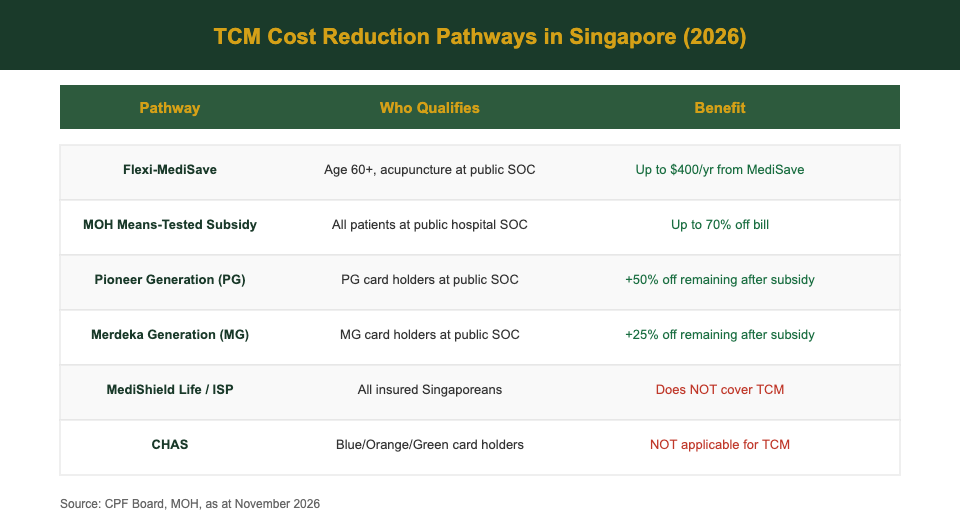
How to Reduce TCM Costs Without MediSave
If you are outside the narrow Flexi-MediSave eligibility window — younger than 60, or seeking TCM services beyond acupuncture for back and neck pain — you are paying out of pocket. Here are legitimate ways to reduce that cost:
1. Use Community Health Assist Scheme (CHAS) — but check the scope. CHAS subsidises GP and dental care at participating clinics. TCM clinics are not covered by CHAS as of November 2026. However, if your condition can be managed by a GP alongside TCM, the GP component (medication, consultation) may still qualify for CHAS, reducing total out-of-pocket spending.
2. Visit public hospital TCM departments. Even without Flexi-MediSave eligibility, patients at public hospital SOCs benefit from means-tested government subsidies of up to 70%. For a Singaporean earning below the subsidy threshold, a session that costs $80 at a private clinic may cost $24–$40 at a public SOC after subsidy.
3. Consider insurance riders with TCM add-ons. Some private integrated health plans (outside the MediShield Life framework) and employer group health policies include TCM riders as optional add-ons. These are entirely separate from ISPs and not regulated the same way. Check your employer’s group insurance policy — many include a small TCM benefit of $300–$600 per year.
4. Time your visits strategically. If you qualify for the Flexi-MediSave scheme, the $400 annual limit resets on 1 January each year. Timing your treatment sessions around this reset — booking the final sessions in December and the first sessions in January — can effectively double the accessible amount in a short window.
What Is Changing: MOH 2025 Proposals
Singapore’s healthcare landscape for TCM may change significantly in the coming years. In July 2025, MOH announced it was studying 18 proposals to better integrate TCM into the public healthcare system. These proposals came from an MOH workgroup that included TCM practitioners, conventional doctors, and healthcare administrators.
While the specific proposals have not been made public in full, the direction of travel suggests closer integration of TCM services into restructured hospitals and potentially expanded MediSave coverage beyond the current Flexi-MediSave scope. The acupuncture pilot that started in December 2020 itself began as a targeted evidence-gathering exercise before benefits were formalised — a similar process may now be underway for a broader range of TCM services.
For now, nothing has changed from the 2026 MediSave rules described in this article. This section will be updated as MOH announces formal policy changes. Bookmark this page or sign up for The Kopi Notes newsletter to stay informed.
Frequently Asked Questions
Can I use MediSave at a TCM clinic in 2026?
Generally no. MediSave cannot be used at private TCM clinics for standard consultations, herbal medicine, or other TCM services. The only exception is the Flexi-MediSave scheme, which allows Singaporeans aged 60 and above to withdraw up to $400 per year for acupuncture treating lower back pain or neck pain — but only at specialist outpatient clinics (SOCs) in public hospitals, not at private TCM clinics.
How much MediSave can I use for TCM acupuncture?
Under the Flexi-MediSave scheme, you can withdraw up to $400 per calendar year from your own or your spouse’s MediSave account for eligible acupuncture treatments. This limit covers only acupuncture for lower back pain or neck pain at a public hospital SOC, and only applies to patients aged 60 and above. The $400 limit resets on 1 January each year.
Does my Integrated Shield Plan cover TCM?
No. All Integrated Shield Plans in Singapore — regardless of insurer or plan tier — exclude alternative and complementary medicine, which includes TCM services such as acupuncture, herbal medicine, and tui na. If you are unsure about your policy’s exact exclusions, check the policy document under “General Exclusions” or contact your insurer directly.
What TCM conditions qualify for MediSave?
As of 2026, only acupuncture for lower back pain and neck pain qualifies for MediSave withdrawal under Flexi-MediSave. No other TCM conditions or treatments are covered. The treatment must be performed at a specialist outpatient clinic in a public hospital by a qualified TCM practitioner registered with the Traditional Chinese Medicine Practitioners Board (TCMPB).
Can I use my child's or parent's MediSave for TCM?
Under Flexi-MediSave, eligible patients aged 60 and above may use their own MediSave account or their spouse’s account. You cannot use a child’s or parent’s MediSave account for TCM treatment. The standard MediSave family withdrawal rules (which allow using family members’ accounts for certain hospitalisation expenses) do not apply to Flexi-MediSave acupuncture claims.
Will MediSave ever cover all TCM treatments?
There are no announced plans to extend MediSave coverage to all TCM treatments. However, MOH announced in July 2025 that it is studying 18 proposals to better integrate TCM into Singapore’s public healthcare system. Any policy changes would likely follow a phased pilot approach similar to the acupuncture scheme that started in December 2020. This page will be updated when formal announcements are made.
Plan Your Healthcare and Retirement Finances
Understanding what MediSave covers is just one piece of the puzzle. Use our tools to plan smarter.
Get Free Insurance Advice
Speak with a licensed insurance advisor. No obligation, no cost.
By submitting this form, you agree to our Privacy Policy.
This article was researched with the help of AI. While we strive to keep all information accurate and up to date, there may be errors. If you notice any discrepancies, please contact us.