VWRA Expense Ratio Cut to 0.14%: What It Means for Singapore Investors (2026)
Vanguard quietly slashed the ongoing charges on its flagship global ETF in July 2026 — here’s what the lower cost actually saves you.
Vanguard cut the ongoing charges figure (OCF) on the Vanguard FTSE All-World UCITS ETF (VWRA) from 0.19% to 0.14% per year, effective 28 July 2026 — confirmed on Vanguard’s official factsheet dated 30 September 2026. For a Singapore investor holding SGD 100,000 in VWRA, that works out to roughly SGD 50 in extra savings per year, on top of VWRA’s existing tax advantages over US-listed alternatives.
Not financial advice. All figures are for educational reference only. Data verified as at 2 November 2026 against Vanguard’s official factsheet (30 September 2026) unless otherwise noted.
Table of Contents
What Changed: Vanguard’s Fee Cut Explained
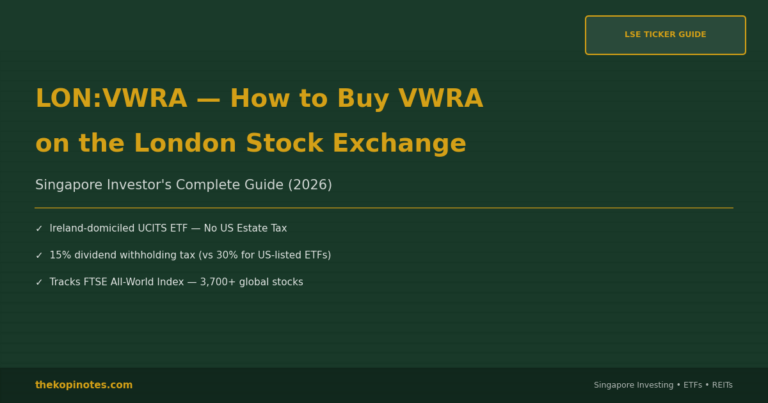
The Vanguard FTSE All-World UCITS ETF (USD) Accumulating — ticker VWRA on the London Stock Exchange — is the single most popular globally diversified ETF among Singapore investors buying on the LSE. On 28 July 2026, Vanguard reduced the fund’s Ongoing Charges Figure (OCF, the UCITS equivalent of a US expense ratio or TER) from 0.19% per year to 0.14% per year. Vanguard’s official factsheet, dated 30 September 2026, confirms the new OCF of 0.14% and shows total fund assets of USD 87.3 billion, with the USD Accumulating share class alone holding USD 60.2 billion. This was Vanguard’s second fee reduction on the fund within twelve months, and reporting at the time estimated the move would save global VWRA investors a combined figure in the tens of millions of US dollars annually.
If you read our VWRA ETF Singapore guide before July 2026, it — and most other guides online, including ours until this update — will still quote the older 0.19% figure. That number is now out of date. 0.14% is the correct, current OCF as at November 2026.
Why Vanguard Cut VWRA’s Fees
Vanguard is structurally different from most asset managers: it is owned by its own funds, which are in turn owned by investors, so there is no external shareholder extracting profit margin. As VWRA’s assets under management have grown — now over USD 87 billion, making it comfortably the largest FTSE All-World tracker in Europe — the fund’s fixed operating costs (custody, administration, index licensing, audit) are spread across a larger asset base. Vanguard has historically passed these scale economies back to unitholders as lower fees rather than retaining them as extra profit, and the July 2026 cut is a continuation of that pattern, which has also seen Vanguard reduce fees on related share classes of the same index.
For Singapore investors, the practical takeaway is that VWRA’s running cost has now fallen below the level of several competing world-index products for the first time, reversing what was previously one of its few disadvantages versus narrower, single-region alternatives.
What This Saves You: SGD Worked Examples
The OCF is deducted daily from the fund’s net asset value, so you never see a separate bill — the saving shows up as slightly better long-term performance versus the old fee level, all else being equal. Here is the approximate annual saving at different portfolio sizes, assuming the full 0.05 percentage point reduction (0.19% minus 0.14%) and ignoring compounding for simplicity:
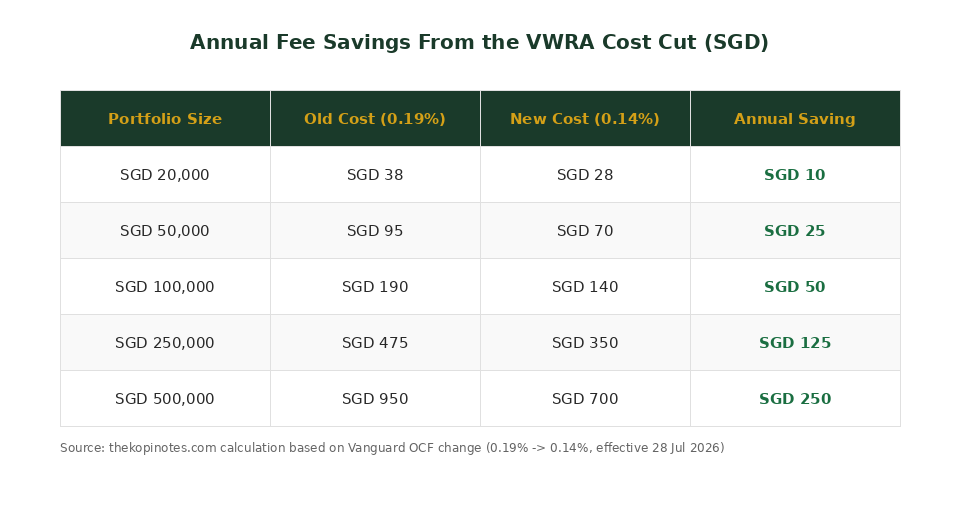
On a SGD 100,000 VWRA position, the lower OCF saves approximately SGD 50 a year compared to the pre-July 2026 fee level. That is a modest figure in isolation, but it compounds: over a 20-year holding period with the position growing at a typical long-term equity return, the cumulative saving from a 0.05 percentage point lower annual drag is meaningfully larger than the simple arithmetic above, because the saved fee itself continues to grow inside the portfolio rather than being extracted each year.
VWRA’s Expense Ratio vs Alternatives After the Cut
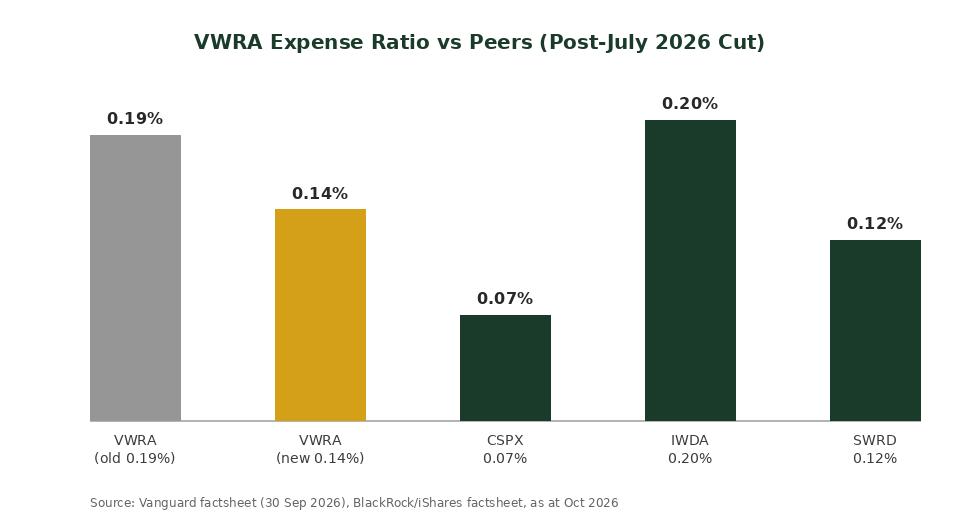
At 0.14%, VWRA now sits closer to — though still above — narrower, single-region trackers, and it has pulled ahead of IWDA, the developed-markets-only alternative that many Singapore investors compare it against. The chart below updates the cost comparison using confirmed figures from each provider’s current factsheet.
| ETF | OCF / TER | Index | Holdings | AUM |
|---|---|---|---|---|
| VWRA (new, from 28 Jul 2026) | 0.14% | FTSE All-World | 3,821 | USD 87.3bn |
| VWRA (old, pre-Jul 2026) | 0.19% | FTSE All-World | 3,821 | — |
| CSPX (factsheet) | 0.07% | S&P 500 | ~500 | USD ~160bn |
| IWDA | 0.20% | MSCI World (developed only) | ~1,300 | — |
| SWRD | 0.12% | MSCI World (developed only) | ~1,300 | — |
Source: Vanguard FTSE All-World UCITS ETF factsheet, 30 September 2026; iShares Core MSCI World / S&P 500 UCITS ETF factsheets, as at October 2026.
Two things stand out. First, VWRA is now cheaper than IWDA (0.14% vs 0.20%) despite covering a much broader universe that includes emerging markets — the fee differential that used to justify choosing IWDA on cost grounds alone has effectively disappeared. Second, VWRA is still more expensive than CSPX (0.07%) and SWRD (0.12%), both of which track narrower, developed-market-only indices. That gap reflects the genuinely higher cost of holding and periodically rebalancing nearly 3,800 stocks across more than 40 countries, including less liquid emerging-market names, versus a concentrated 500-stock US index. For investors who specifically want one fund covering the entire global equity market, including the currency exposure considerations that come with it, VWRA’s remaining fee premium over single-region trackers buys genuine diversification, not just higher cost for its own sake.
What Didn’t Change (And Still Matters More)
A 0.05 percentage point fee cut is a real, verifiable improvement, but Singapore investors should keep it in perspective against the factors that drive the bulk of VWRA’s cost and tax advantage over US-listed alternatives such as VT or VTI, none of which were affected by this announcement:
- Withholding tax stays at 15%. Because VWRA is domiciled in Ireland and structured under the US-Ireland tax treaty, US-sourced dividends inside the fund are still taxed at 15% rather than the 30% non-treaty rate that applies to US-domiciled ETFs held by Singapore residents. This differential is worth far more than the recent 0.05% OCF cut for most portfolios.
- US estate tax exposure is still zero. VWRA remains outside the scope of US federal estate tax because it is an Irish-domiciled fund, not a US-situs asset. A Singapore investor holding a US-listed ETF above the USD 60,000 non-resident exemption threshold could face estate tax exposure on death; VWRA does not carry this risk regardless of position size.
- FX conversion and brokerage commissions are unchanged. Converting SGD to USD or GBP to fund a VWRA purchase, and the per-trade commission charged by your broker, remain separate costs layered on top of the OCF — and for smaller, more frequent purchases, these can easily exceed the entire annual fund management fee.
- Tracking difference can vary from the stated OCF. Vanguard’s own factsheet shows VWRA’s 1-year net return (16.71%) was marginally ahead of its benchmark (16.66%) as at 30 September 2026, partly offset by securities-lending income — a reminder that the published OCF is an input to cost, not a guarantee of the fund’s realised tracking difference in any given year.
Do You Need to Do Anything?
No action is required from existing VWRA holders — the lower OCF applies automatically to all existing and new units of the fund; there is nothing to switch, sell, or re-register. If you are funding a new position or making a regular contribution via Syfe, Interactive Brokers, Saxo, or another broker with LSE access, you will simply benefit from the lower running cost going forward without any extra step. The one thing worth checking is whether any comparison tables, spreadsheets, or retirement projections you built using the old 0.19% figure should be updated — the difference is small per year but compounds meaningfully over a multi-decade holding period, particularly if you are using our retirement planning calculator to model long-term outcomes. Investors who also hold S-REITs alongside VWRA for income may want to revisit our passive income Singapore breakdown to see how the two fit together in a single portfolio.
Frequently Asked Questions
What is VWRA's expense ratio now, in 2026?
VWRA’s Ongoing Charges Figure (OCF) is 0.14% per year, confirmed on Vanguard’s official factsheet dated 30 September 2026. This was reduced from the previous 0.19% rate, effective 28 July 2026. Always check Vanguard’s current factsheet before relying on an expense ratio figure quoted elsewhere, as fee changes are not always promptly reflected in third-party sources.
Do I need to do anything after VWRA's fee cut?
No. The lower 0.14% OCF applies automatically to all existing and new VWRA units — there is nothing to sell, switch, or re-register. Singapore investors holding VWRA through Interactive Brokers, Saxo, Syfe, or any other broker with London Stock Exchange access simply benefit from the lower running cost going forward.
Is VWRA now cheaper than IWDA?
Yes. After the July 2026 cut, VWRA’s OCF of 0.14% is lower than IWDA’s 0.20%, even though VWRA tracks a much broader index that includes emerging markets alongside developed markets. The fee differential that previously made IWDA the cheaper developed-markets choice has widened in VWRA’s favour on headline cost, though IWDA still excludes emerging-market volatility if that is your priority.
Why is CSPX still cheaper than VWRA if Vanguard cut fees?
CSPX tracks a concentrated 500-stock US index at a 0.07% TER, while VWRA tracks a much broader index of roughly 3,800 stocks across over 40 countries, including less liquid emerging markets, at 0.14%. The extra cost reflects genuinely higher operational complexity — more holdings to buy, sell, and rebalance — not simply a pricing difference between providers. Many Singapore investors still choose VWRA over CSPX for the broader diversification despite the higher fee.
Does the fee cut affect VWRA's withholding tax or estate tax treatment?
No. The OCF change only affects the fund’s annual running cost. VWRA’s tax treatment is unchanged: US-sourced dividends inside the fund are still taxed at 15% withholding tax under the US-Ireland treaty (versus 30% for US-domiciled ETFs), and VWRA remains outside the scope of US federal estate tax because it is domiciled in Ireland rather than the United States.
How much will I actually save from the VWRA fee cut?
The saving is 0.05 percentage points per year, applied to your VWRA holding value. On a SGD 50,000 position, that is approximately SGD 25 a year; on SGD 100,000, approximately SGD 50 a year; on SGD 250,000, approximately SGD 125 a year. The saving compounds over time since it is no longer deducted from your returns each year, so the cumulative effect over a multi-decade holding period is larger than the simple annual figure suggests.
Where can I verify VWRA's current expense ratio myself?
Check Vanguard’s official factsheet for the Vanguard FTSE All-World UCITS ETF (USD) Accumulating, available on Vanguard’s institutional website, which is updated monthly and clearly states the current Ongoing Charges Figure. Third-party comparison sites and older articles — including some previously published on this site — may lag behind the official factsheet after a fee change.
Ready to Start Investing in Global ETFs?
Open a brokerage account and buy VWRA or CSPX today. Use our referral links for exclusive sign-up bonuses.
This article was researched with the help of AI. While we strive to keep all information accurate and up to date, there may be errors. If you notice any discrepancies, please contact us.