POSB Fixed Deposit Rate Singapore: November 2026 Complete Guide
Current rates, tenor breakdown, and how POSB compares to every other bank in Singapore.
POSB fixed deposit rates in Singapore currently reach a maximum of 1.00% p.a. for tenors of 8 to 12 months — but only on deposits between S$1,000 and S$9,999. Place S$10,000 or more, and the rate drops to just 0.05% p.a. regardless of tenor. Compared to the market best of 2.10% p.a. (RHB, CIMB, Maybank), POSB’s FD is among the lowest in the country, making it a poor choice for most savers with larger amounts.
Not financial advice. All figures are for educational reference only. Data verified against POSB official rates and market research as at November 2026.
Table of Contents
Contents — Click to expand
- POSB Fixed Deposit Rates: Full Rate Table (November 2026)
- How POSB Fixed Deposit Tiers Work
- Best POSB Fixed Deposit Tenors in 2026
- POSB vs Other Banks: Fixed Deposit Rate Comparison
- How to Open a POSB Fixed Deposit
- Better Alternatives to POSB Fixed Deposits
- Who Should Still Use POSB FD?
- Frequently Asked Questions
POSB Fixed Deposit Rates: Full Rate Table (November 2026)
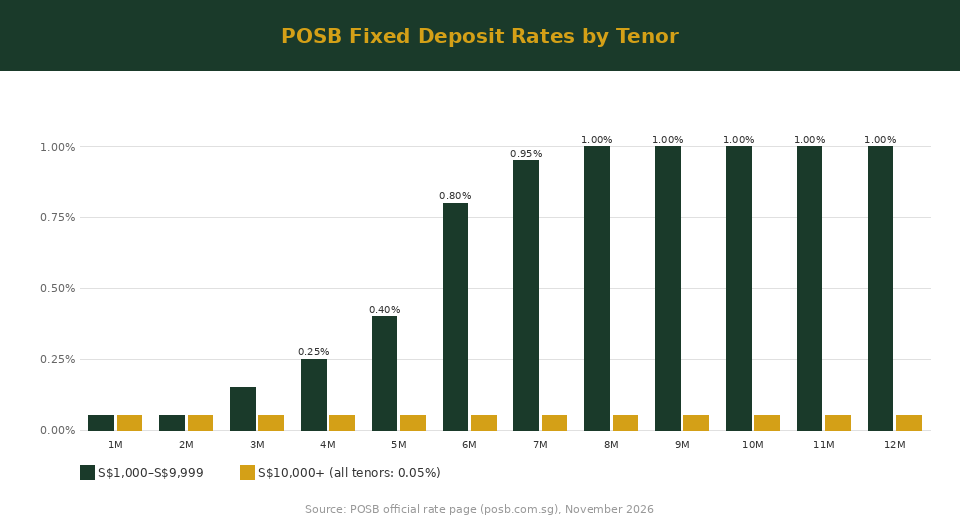
POSB, which operates under DBS Bank, publishes its SGD fixed deposit rates on the POSB website. Rates are tiered by deposit size and vary significantly depending on how much you place. Here is the complete rate structure for new placements as at November 2026:
| Tenor | S$1,000–S$9,999 | S$10,000 and above |
|---|---|---|
| 1 month | 0.05% p.a. | 0.05% p.a. |
| 2 months | 0.05% p.a. | 0.05% p.a. |
| 3 months | 0.15% p.a. | 0.05% p.a. |
| 4 months | 0.25% p.a. | 0.05% p.a. |
| 5 months | 0.40% p.a. | 0.05% p.a. |
| 6 months | 0.80% p.a. | 0.05% p.a. |
| 7 months | 0.95% p.a. | 0.05% p.a. |
| 8 months | 1.00% p.a. | 0.05% p.a. |
| 9 months | 1.00% p.a. | 0.05% p.a. |
| 10 months | 1.00% p.a. | 0.05% p.a. |
| 11 months | 1.00% p.a. | 0.05% p.a. |
| 12 months | 1.00% p.a. | 0.05% p.a. |
Source: POSB official rate page (posb.com.sg), rates as at November 2026. New placements accepted for tenors up to 12 months only.
The most important takeaway from this table: POSB fixed deposit rates only make sense for deposits under S$10,000. Place S$10,000 or more, and you earn the same 0.05% p.a. regardless of whether you lock in for one month or 12 months. At that point, you are better off looking elsewhere — a Singapore T-bill, a savings account, or another bank’s FD will almost certainly beat this.
How POSB Fixed Deposit Tiers Work
POSB calculates your interest tier based on your total SGD fixed deposit balance across all existing POSB placements, not on each individual new placement in isolation. This is a critical point that catches many depositors off guard.
For example, if you currently hold S$8,000 in a POSB FD and place an additional S$3,000 new placement, your total POSB FD balance becomes S$11,000. That puts you in the S$10,000 and above tier — where the rate drops to 0.05% p.a. Your new S$3,000 placement earns 0.05%, not 1.00%.
This aggregation rule makes POSB FDs uniquely tricky for customers who may have existing POSB FD balances they have forgotten about. Before placing a new POSB fixed deposit, check your existing FD balance via the DBS/POSB digibank app, and confirm your combined total stays under S$10,000 if you want the higher tier rate.
The minimum placement amount is S$1,000. The maximum tenor for new placements is 12 months. POSB does not accept new placements for 18-month or longer tenors — those rates, when they appear on the website, apply only to rollovers of existing placements that were originally placed at those tenors.
Best POSB Fixed Deposit Tenors in 2026
If you have decided to use POSB for a fixed deposit on a balance under S$10,000, the 8–12 month tenors offer the best rate at 1.00% p.a. Here is a worked example to illustrate the return:
| Scenario | Amount | Tenor | Rate | Interest Earned |
|---|---|---|---|---|
| A — Best POSB tenor (small deposit) | S$9,000 | 12 months | 1.00% | S$90.00 |
| B — Large deposit, wrong tier | S$20,000 | 12 months | 0.05% | S$10.00 |
| C — Short tenor, small deposit | S$5,000 | 3 months | 0.15% | S$1.88 |
| D — Best market rate (RHB/CIMB/Maybank) | S$20,000 | 12 months | 2.10% | S$420.00 |
Source: The Kopi Notes calculations based on POSB official rates and market rates, November 2026.
Scenario B is the cautionary tale. A S$20,000 12-month POSB FD earns just S$10 in interest. Compare Scenario D: the same S$20,000 at CIMB or RHB earns S$420. That S$410 gap is significant. To build meaningful passive income in Singapore, a POSB FD for amounts above S$10,000 is one of the least efficient vehicles available.
POSB vs Other Banks: Fixed Deposit Rate Comparison
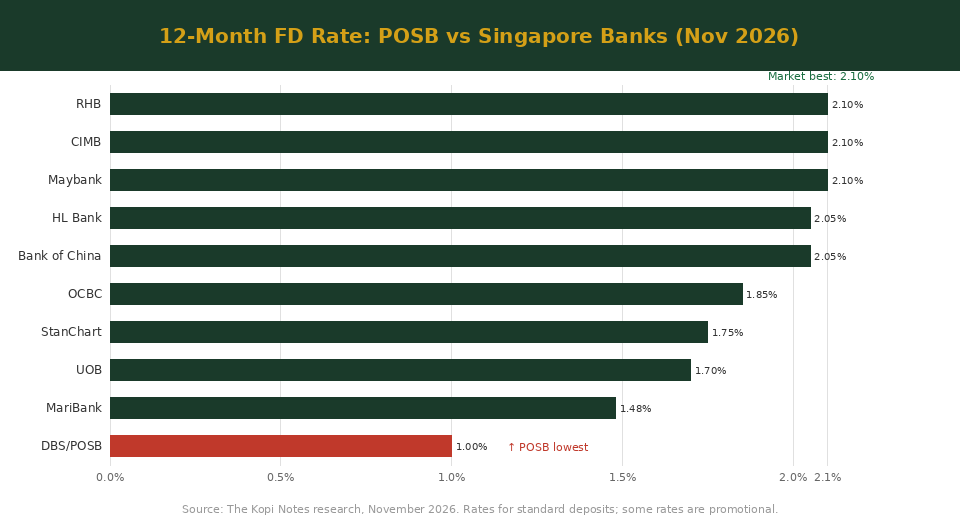
POSB sits near the bottom of the Singapore FD rate league table. Here is how it compares to every major bank as of November 2026, ranked by their best available rate:
| Bank | Best Rate | Best Tenor | Min. Deposit |
|---|---|---|---|
| RHB | 2.10% | 12 months | S$20,000 |
| CIMB | 2.10% | 12 months | S$10,000 |
| Maybank | 2.10% | 6 months | S$20,000 |
| HL Bank / HL Finance | 2.05% | 12 months | S$20,000 |
| Bank of China | 2.05% | 12 months | S$500 |
| Singapura Finance | 1.98% | 12 months | S$10,000 |
| OCBC | 1.85% | 12 months | S$20,000 |
| Standard Chartered | 1.75% | 6 months | S$25,000 |
| UOB | 1.70% | 12 months | S$10,000 |
| MariBank (digital bank) | 1.48% | Flexible savings | S$1 |
| GXS Bank (digital bank) | ~1.20%+ | Flexible savings | S$1 |
| DBS / POSB | 1.00% | 8–12 months | S$1,000 (under S$10k only) |
Source: The Kopi Notes research, November 2026. All rates subject to change. Check each bank’s website for the latest figures. MariBank and GXS rates are for flexible savings accounts, not fixed-term FDs.
The gap between POSB (1.00%) and the market leaders (2.05–2.10%) is significant. On a S$9,000 deposit for 12 months, you earn S$90 with POSB versus S$184.50 with RHB or CIMB — a difference of nearly S$95. That said, for amounts under S$10,000 where POSB does deliver 1.00%, the smaller minimum deposit requirement (S$1,000 vs S$20,000 at RHB or Maybank) makes POSB more accessible to smaller savers. For a full ranked comparison, see our highest fixed deposit rate Singapore 2026 guide.
How to Open a POSB Fixed Deposit
Opening a POSB fixed deposit is straightforward for existing POSB/DBS customers. Here is the step-by-step process:
Via the DBS/POSB digibank App (Recommended)
- Open the DBS/POSB digibank app on your phone and log in.
- Tap “More” at the bottom of the screen, then select “Apply”.
- Under “Deposits”, select “Fixed Deposit”.
- Choose SGD Fixed Deposit and tap “Apply Now”.
- Enter the amount (minimum S$1,000), select your preferred tenor, and confirm the rate shown.
- Confirm the debit account and tap “Submit”.
- Your FD placement is confirmed immediately and will appear under your accounts.
Via POSB/DBS iBanking (Online Banking)
- Log in at internet-banking.dbs.com.sg.
- Navigate to Invest → Fixed Deposit → Apply for Fixed Deposit.
- Fill in the placement amount, tenor, and debit account.
- Review the rate and submit.
New-to-POSB Customers
You must open a POSB Savings or POSB Everyday Account first. This can be done via the digibank app with MyInfo (SingPass). Once your current account is active, you can open the fixed deposit immediately from the same app. New customer FD rates are the same as existing customer rates — there is no new-to-bank promotional FD rate at POSB at the time of writing.
Better Alternatives to POSB Fixed Deposits
If you have more than S$10,000 to park — or simply want a higher rate than 1.00% p.a. — POSB is not the right answer. Here are the best alternatives to consider in November 2026:
1. Singapore T-Bills (up to ~1.90% p.a.)
Singapore T-bills are 6-month or 12-month instruments issued by the Singapore Government. They are effectively risk-free (backed by MAS), and current cut-off yields are around 1.80–1.95% p.a. — significantly better than POSB’s 1.00%. The minimum is S$1,000, and they are available through DBS/POSB digibank or SRS. For a full breakdown of how to apply and current cut-off yields, see our Singapore T-bills 2026 guide.
2. Singapore Savings Bonds (up to ~2.00% p.a. average)
Singapore Savings Bonds (SSBs) are 10-year instruments with flexible early redemption — no penalty if you need your money back within one month’s notice. The 10-year average return for recent issuances is typically around 2.00% p.a. They are ideal for savings you do not need to touch for 6–12 months but want the option to exit early without penalty. See our Singapore Savings Bonds guide for current rates and how to apply.
3. Digital Banks: MariBank and GXS
Digital banks like MariBank (backed by Sea Group) and GXS Bank (backed by Grab and Singtel) offer competitive savings rates with no lock-in period — making them strictly better than a POSB FD for most savers who want flexibility. MariBank currently offers 1.48% p.a. on its savings product with full flexibility. Both carry SDIC deposit insurance up to S$100,000, matching the same protection POSB offers. To open MariBank, use referral code 2DCT80WQ. For GXS Bank, use referral code YONG477.
4. Other Banks’ FDs (2.05–2.10% p.a.)
If you specifically want a fixed deposit — perhaps for the psychological discipline of locking money away — RHB, CIMB, and Maybank all currently offer around 2.10% p.a. on 12-month FDs, with minimum deposits of S$10,000–S$20,000. Bank of China offers 2.05% p.a. with a much lower minimum of S$500. All of these are MAS-regulated and SDIC-insured. A useful tool for modelling how this extra return compounds over time is our Singapore retirement calculator.
5. Investment Platforms: Endowus, Syfe Cash+
For savers who want to stay liquid while earning more than savings account rates, platforms like Endowus Cash Smart and Syfe Cash+ Guaranteed offer returns in the 1.50–1.80% p.a. range through MAS bills and T-bills. Syfe Cash+ Guaranteed offers a fixed-rate return with a 6-month lock-in. Use Syfe referral code SRPRFFFCD or Endowus referral code 2V343 for sign-up bonuses on those platforms.
Who Should Still Use POSB Fixed Deposits?
POSB FDs are not the right choice for most savers seeking to maximise returns. However, there are specific scenarios where using POSB makes practical sense:
- Amounts under S$10,000 where you already bank with POSB: If you have S$5,000–S$9,000 in a POSB account and want a no-hassle 12-month lock-in with the bank you already use, 1.00% p.a. is accessible and low-effort. There are no transfer fees, no new account setup, and you stay within your existing banking relationship.
- You value the SDIC protection and brand trust of DBS/POSB: POSB/DBS is Singapore’s largest bank. The S$100,000 SDIC protection covers POSB FDs, identical to any other SDIC-member bank. For some savers — particularly those less comfortable with newer banks or digital-only platforms — the familiarity and branch access matter.
- You value the digibank app experience: DBS/POSB digibank is widely regarded as one of the best banking apps in the region. If you manage all your finances within digibank, keeping FDs there reduces app switching and simplifies your financial picture.
- Short-term parking for future expenditures: For amounts of S$1,000–S$5,000 that you plan to use in 6–12 months (for a holiday, a renovation deposit, an insurance premium), a POSB FD provides a modest return within a bank you already actively use. The convenience factor is real — the rate disadvantage matters less when the amount is small and the use case is near-term.
Always verify current rates at posb.com.sg before placing your deposit, as rates can change without notice. Not financial advice.
Frequently Asked Questions
What is the current POSB fixed deposit rate in Singapore?
Does POSB offer promotional or special fixed deposit rates?
Is POSB fixed deposit safe? Is it SDIC-insured?
Can I break a POSB fixed deposit early?
What happens when my POSB fixed deposit matures?
What is the minimum deposit for a POSB fixed deposit?
How do POSB fixed deposit rates compare to digital banks?
This article was researched with the help of AI. While we strive to keep all information accurate and up to date, there may be errors. If you notice any discrepancies, please contact us.