Term Life Insurance for Self-Employed Singapore 2026: Complete Coverage Guide
No employer benefits, no group cover — here’s exactly how to protect yourself and your family.
Self-employed Singaporeans — freelancers, sole proprietors, business owners, and gig workers — have no employer group insurance to fall back on. If you die, become terminally ill, or suffer total permanent disability, your family gets nothing from a workplace policy that doesn’t exist. Term life insurance fills that gap directly: you pay a monthly premium, and your beneficiaries receive the agreed sum assured if the worst happens. For most self-employed Singaporeans, a S$500,000–S$1.5 million term policy covering 20–30 years costs less than a daily kopi habit.
Not financial advice. All figures are illustrative and for educational reference only. Premiums are indicative based on published insurer data as at Oct 2026. Always verify with your insurer or a licensed financial adviser. Data verified as at 31 October 2026.
Why Self-Employed Singaporeans Need Term Life More Urgently
When you work for an employer in Singapore, you typically receive a baseline level of group insurance as part of your employment benefits. Group term life, group hospitalisation, and sometimes group personal accident coverage are standard at many companies. The moment you go self-employed, those benefits vanish — and you become solely responsible for protecting your income and your dependants.
The stakes are high. According to the Life Insurance Association of Singapore (LIA), the average Singaporean is underinsured by roughly 2–3 times their annual income for death coverage alone. For the self-employed, who have no employer safety net, this gap is even more dangerous.
Here’s what self-employed Singaporeans are missing without term life insurance:
| Risk | Employed Person | Self-Employed Person |
|---|---|---|
| Death / Terminal Illness | Group Term Life (employer-paid) | No coverage unless self-arranged |
| Total Permanent Disability | Group TPD (some employers) | No coverage unless self-arranged |
| CPF-linked DPS | Auto-enrolled (S$70,000 cover) | Opt-in only (requires voluntary CPF contributions) |
| Income replacement | Partial: salary continues briefly | Zero — income stops immediately |
Source: LIA Singapore, CPF Board. Oct 2026.
Beyond protecting your family, if you have taken out business loans or a mortgage, a term life policy can also be structured to cover those liabilities — ensuring your business or property doesn’t become a burden on your spouse or next of kin.
How Much Term Life Coverage Do Self-Employed Singaporeans Need?
There’s no universal answer, but there are two widely-used frameworks: the LIA benchmark of 9–10× your annual income, and the more detailed DIME method which accounts for your specific financial obligations.
The LIA 9–10× Income Rule
The Life Insurance Association recommends aiming for 9–10 times your gross annual income as a baseline for death coverage. For a self-employed person earning S$7,000/month (S$84,000/year), this translates to S$756,000–S$840,000 in sum assured. Round up to S$1 million for a clean policy with some buffer for income growth.
The DIME Method (More Precise)
DIME stands for: Debt + Income (10 years) + Mortgage + Education. Add these four components together to get your target sum assured.
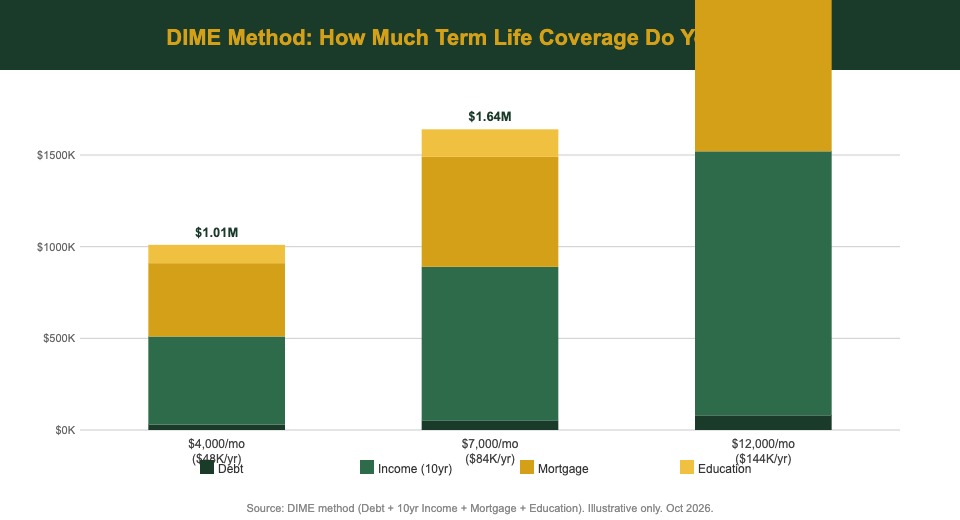
Chart: DIME method coverage needs at three income levels. All figures illustrative; actual needs vary. Oct 2026.
For a self-employed person earning S$7,000/month with a S$600,000 mortgage, S$50,000 in business debts, and two school-age children, the DIME calculation might look like:
| Component | Calculation | Amount |
|---|---|---|
| Debt (personal + business) | Car loan + credit card + business loan | S$50,000 |
| Income (10 years) | S$7,000 × 12 × 10 | S$840,000 |
| Mortgage (outstanding) | Remaining home loan balance | S$600,000 |
| Education (2 children) | Poly + local university × 2 | S$150,000 |
| TOTAL COVERAGE NEEDED | S$1,640,000 |
Source: DIME framework (standard financial planning methodology). Illustrative example only. Oct 2026.
After subtracting existing assets (savings, investments, CPF OA/SA), you arrive at your net coverage needed. Many self-employed Singaporeans end up targeting S$800,000–S$2 million in sum assured when using the DIME approach. Use our Singapore retirement calculator to stress-test how your dependants would fare if your income stopped today.
Self-Employed-Specific Considerations for Term Life
1. Variable Income & Income Declaration
Insurers will ask for proof of income during underwriting — typically your IRAS Notice of Assessment (NOA) for the last 1–2 years. If your income varies significantly year-to-year (common for freelancers), use a 2-year average. A very new business (less than 2 years old) may face higher scrutiny, and some insurers may cap the sum assured or request additional documentation.
2. Business Loan Coverage
If your business has taken loans — from banks, SPRING/Enterprise Singapore schemes, or private investors — your personal estate may be liable if you are a sole proprietor or a partner. A separate term policy equal to the outstanding loan balance (keyman insurance or personal cover) ensures the business debt doesn’t fall on your family.
3. Premium Affordability & Cash Flow
Self-employed income is irregular. Choose a policy where annual premium payment is available (often 2–5% cheaper than monthly) and budget for it in your lean months. Monthly premiums offer more flexibility but cost slightly more. Set up a GIRO deduction from a dedicated business account so premiums never lapse due to cash flow timing.
4. Riders Worth Adding
For self-employed individuals, three riders deserve serious consideration:
- Critical Illness (CI) Rider — pays a lump sum if you’re diagnosed with cancer, heart attack, stroke, or other major CI. Self-employed have no paid medical leave, so a CI payout replaces lost income during recovery. Learn more in our guide on life insurance in Singapore.
- Waiver of Premium (WOP) Rider — if you suffer TPD or a specified CI, future premiums are waived and your coverage continues. This is especially valuable for the self-employed who have no employer to continue paying any form of group cover.
- Total & Permanent Disability (TPD) Rider — pays the sum assured early if you become permanently disabled and unable to work. Effective as a standalone income replacement layer if you don’t have a separate disability income insurance policy.
Best Term Life Plans for Self-Employed Singaporeans (2026)
All six major insurers below are MAS-licensed and offer pure term life plans suitable for the self-employed. Premiums below are indicative for a 30-year-old male non-smoker applying for S$500,000 sum assured over a 30-year term. Get actual quotes via MAS CompareFIRST or a licensed financial adviser before purchasing.
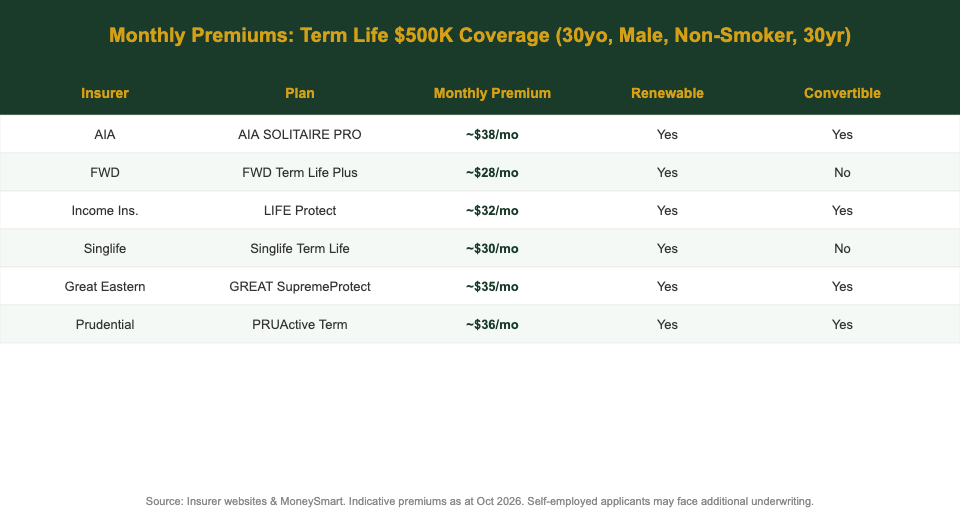
Source: Insurer websites, MAS CompareFIRST. Indicative premiums, Oct 2026. Actual premiums depend on health, occupation, and underwriting.
| Insurer | Plan | Indicative Premium (30yo, M, NS) | Key Feature |
|---|---|---|---|
| AIA | AIA SOLITAIRE PRO | ~S$38/mo | Convertible to whole life; strong brand for self-employed underwriting |
| FWD | FWD Term Life Plus | ~S$28/mo | Most affordable entry point; online application friendly |
| Income Insurance | LIFE Protect | ~S$32/mo | Local cooperative insurer; strong CI rider options |
| Singlife | Singlife Elite Term II | ~S$30/mo | Digital-first; easy online quotes; good for freelancers |
| Great Eastern | GREAT SupremeProtect | ~S$35/mo | Established network; administers DPS for CPF Board |
| Prudential | PRUActive Term | ~S$36/mo | Convertible; comprehensive rider menu for self-employed needs |
Source: Insurer product pages. Indicative only. Verify on MAS CompareFIRST before purchasing. Oct 2026.
Which plan to choose? For pure cost minimisation, FWD and Singlife typically come in lowest. If you want convertibility (option to switch to whole life later as your business grows) or a robust CI rider, AIA, Prudential, and Income Insurance are worth the small premium uplift. All plans above include terminal illness acceleration — the sum assured is paid out early upon a terminal illness diagnosis, which is critical if you have business liabilities.
If you’re building long-term wealth alongside your protection, consider routing your savings component through an investment platform like Endowus or Syfe — keeping your insurance (pure term) and investments separate is generally the most cost-efficient approach.
How to Apply for Term Life as a Self-Employed Singaporean
The application process is similar to any individual policy, with a few extra documentation requirements due to your self-employed status:
Step 1: Calculate Your Coverage Need
Use the DIME method or the LIA 9–10× rule above. Be honest about your business liabilities — sole proprietors carry full personal liability for business debts.
Step 2: Compare Quotes
Visit MAS CompareFIRST for side-by-side regulated comparisons. You can also approach an independent financial adviser (IFA) who can access multiple insurer quotes simultaneously — this is often more efficient for the self-employed who need tailored underwriting guidance.
Step 3: Prepare Your Documents
Typically required: NRIC, IRAS Notice of Assessment (last 2 years), business registration (ACRA, if applicable), and a health declaration form. For large sum assured (usually above S$1.5–2 million), a medical examination may be required.
Step 4: Nomination of Beneficiary
Under Singapore’s Insurance Act, you can make a statutory nomination (direct to named beneficiaries, bypasses estate) or a trust nomination (beneficiaries hold the proceeds as trustees). Self-employed individuals with business debts should use a trust nomination structure to protect the payout from creditor claims — consult a lawyer or IFA before deciding.
Step 5: Review Annually
Your income and liabilities change as your business grows. Review your sum assured every 1–2 years, especially after a major business expansion, property purchase, or the birth of a child.
DPS and CPF for Self-Employed: What You Need to Know
The Dependants’ Protection Scheme (DPS) is a CPF-linked term life product administered by Great Eastern Life. For salaried employees, enrolment is automatic upon a valid CPF contribution. For self-employed Singaporeans, DPS is opt-in — you must make voluntary CPF MediSave contributions first, after which you can apply to join DPS.
DPS provides S$70,000 in coverage (reducing to S$55,000 from age 60, and ceasing at 65), covering death, terminal illness, and total permanent disability. Annual premiums are paid from your CPF OA/SA and start from around S$18/year for those aged 21–34, rising to S$298/year at age 55–59 (check the CPF Board website for current premium tables as these are updated periodically).
The critical point: S$70,000 is not enough on its own. It covers roughly 2–4 months of income replacement for most self-employed Singaporeans, not the 9–10 years recommended by the LIA. DPS is a supplement — a good starting floor — but it must be paired with a private term life policy sized to your actual DIME needs.
For more on optimising your financial planning as a self-employed Singaporean, our Singapore retirement planning calculator can help you model how much passive income you need to build alongside your insurance safety net.
Frequently Asked Questions
Can self-employed Singaporeans buy term life insurance?
How much term life insurance should a self-employed person buy in Singapore?
Is term life insurance tax deductible for self-employed in Singapore?
Do I need a financial adviser to buy term life, or can I buy directly?
What happens to my term life policy if my income drops significantly?
Should I use CPF to pay term life premiums?
Get Free Insurance Advice
Speak with a licensed insurance advisor. No obligation, no cost.
By submitting this form, you agree to our Privacy Policy.
This article was researched with the help of AI. While we strive to keep all information accurate and up to date, there may be errors. If you notice any discrepancies, please contact us.