INTEGRATED SHIELD PLANS · MEDISAVE GUIDE 2026
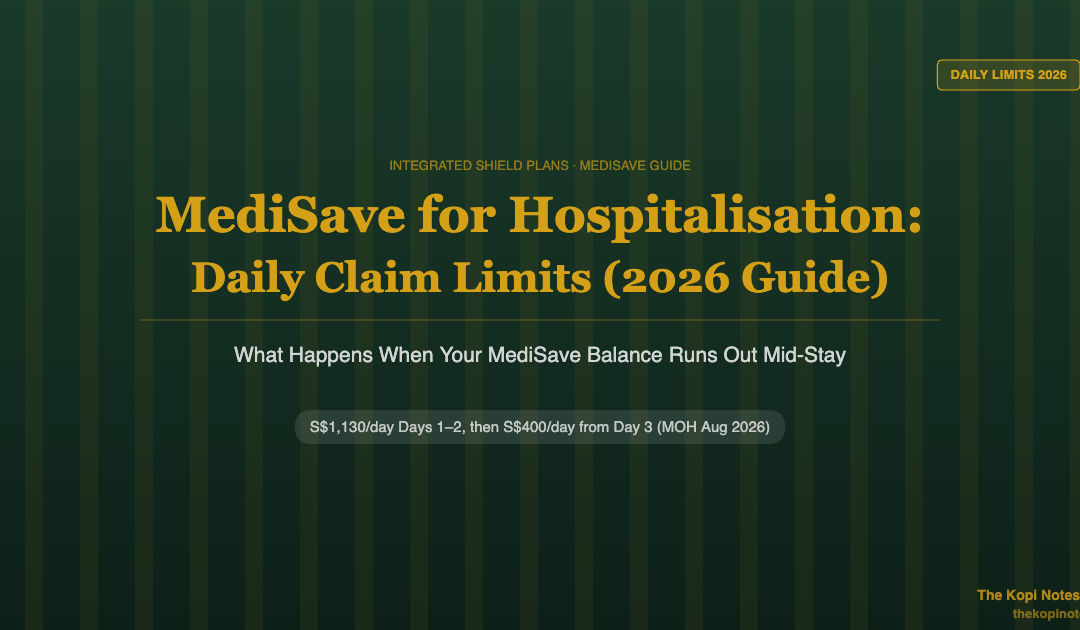
MediSave for Hospitalisation: Daily Claim Limits and What Happens If Your Balance Runs Out (2026 Guide)
Updated October 2026 · Data verified from MOH, August 2026
MediSave covers inpatient hospital stays at S$1,130 per day for the first two days, dropping to S$400 per day from day three onwards. A 7-day acute hospital admission draws up to S$4,260 total from your MediSave. If your balance runs short mid-stay, you can use an approved dependant's MediSave, draw on future MediSave contributions (B2/C ward, public hospital only, active account required), or settle the balance in cash at discharge. Data verified as at October 2026 from MOH.
Not financial advice. All figures are for educational reference only. Consult a licensed adviser for personal guidance.
What Are MediSave's Daily Claim Limits for Hospitalisation? (2026)
Under the current MediSave framework, your MediSave Account (MA) can be used to pay inpatient hospital bills at two distinct daily rates, depending on how long you have been admitted:
| Day of Stay | MediSave Daily Claim Limit | Cumulative Total |
|---|---|---|
| Day 1 | S$1,130 | S$1,130 |
| Day 2 | S$1,130 | S$2,260 |
| Day 3 | S$400 | S$2,660 |
| Day 4 | S$400 | S$3,060 |
| Day 5 | S$400 | S$3,460 |
| Day 6 | S$400 | S$3,860 |
| Day 7+ | S$400/day | S$4,260 after 7 days |
Source: CPF Board / MOH MediSave for hospitalisation, August 2026. Limits apply per admission per Medisave account.
The higher rate for Days 1 and 2 (S$1,130/day) reflects the heavier cost of acute admission — initial diagnostic workup, surgery, or intensive monitoring. From Day 3 onward, the lower rate of S$400/day kicks in. This cliff is the reason many Singaporeans unexpectedly discover their MediSave balance runs short mid-stay.
Key point: These are claim limits, not entitlements. You can only claim up to S$400/day from Day 3 regardless of your ward class or how high the actual daily rate is. The actual hospital rate — especially Class A or private wards — can far exceed this limit.
7-Day Stay: A Worked Example
To see how the daily limits play out in practice, consider a 7-day Class B1 hospital stay at a public hospital in Singapore. Assume your MediSave Account balance is S$3,500 before admission.
| Day | Daily Hospital Bill | MediSave Limit | MediSave Used | Balance Remaining |
|---|---|---|---|---|
| 1 | S$900 | S$1,130 | S$900 | S$2,600 |
| 2 | S$900 | S$1,130 | S$900 | S$1,700 |
| 3 | S$500 | S$400 | S$400 | S$1,300 |
| 4 | S$500 | S$400 | S$400 | S$900 |
| 5 | S$500 | S$400 | S$400 | S$500 |
| 6 | S$500 | S$400 | S$400 | S$100 |
| 7 | S$500 | S$400 | S$100 | S$0 |
Illustrative example. Actual bill depends on ward class, hospital, treatment. MediSave cannot be used once balance hits zero.
By Day 7, the MediSave is exhausted — and there's still S$300 left unpaid on Day 7 alone (S$500 bill minus the S$100 remaining). This shortfall must be covered by another MediSave account (if applicable), MediShield Life or your Integrated Shield Plan, or out-of-pocket cash.
What Happens When Your MediSave Balance Runs Out?
If your MediSave Account reaches zero mid-admission, you have three main options:
Option 1: Use an Approved Dependant’s MediSave
You may tap the MediSave of an immediate family member — your spouse, children, parents, or parents-in-law — subject to their own daily limits. This is often the first line of defence for married couples or those with working children. The same S$400/day (or S$1,130/day for Days 1–2) limit applies per dependant account used.
Option 2: Draw on Future MediSave Contributions
For patients staying in Class B2 or Class C wards at public hospitals only, with an active MediSave account, you may arrange with the hospital to use future MediSave contributions to pay the shortfall. This is administered directly by CPF Board and the hospital; you do not need to initiate it separately. Note: this option is not available for Class A or B1 wards, private hospitals, or community hospitals.
Option 3: Pay Out of Pocket at Discharge
The remaining balance is settled in cash (Medisave tops up what it can, then you pay the rest). Depending on your ward class and length of stay, this can range from a few hundred to several thousand dollars. Having an Integrated Shield Plan dramatically reduces or eliminates this cash outflow — see below.
Using a Dependant’s MediSave: Who Qualifies?
You can tap the MediSave Accounts of the following immediately family members to supplement your own hospitalisation claims:
- Spouse — no restriction on living arrangement
- Children — must have an active MediSave account (employed or self-employed)
- Parents and parents-in-law — parents must be Singapore Citizens or Permanent Residents
- Siblings — only if they are financially dependent on you and you are already paying for their hospitalisation
Each dependant's MediSave account is subject to its own daily claim limits. You cannot “pool” multiple dependant accounts to exceed the cap on any single day — the daily limit applies per account used per day. However, you may use multiple accounts on the same day by splitting the daily claim across accounts (e.g. S$200 from your own account and S$200 from your spouse's account to meet the S$400/day cap in full from two sources).
Before discharge, the hospital will usually request a CPF MediSave withdrawal authorisation. You or your next-of-kin will sign a form allowing the hospital to deduct from the nominated accounts.
The Future Contributions Option (B2/C Wards, Public Hospital Only)
If you are in a Class B2 or Class C ward at a public hospital and your MediSave balance is insufficient, the hospital can arrange to deduct future contributions from your MediSave account as they come in, post-discharge. This is administered through CPF Board as a short-term arrangement. Key conditions:
- Patient must be a Singapore Citizen or Permanent Resident
- The patient must have an active CPF Medisave account (i.e. they are working and still making CPF contributions, or are self-employed making Medisave contributions)
- Available only for Class B2 and Class C wards in public hospitals (SGH, NUH, TTSH, CGH, KTPH, AH, SKH, NCC, NCIS, etc.)
- Not available for Class A, B1, community hospitals, private hospitals, or specialist outpatient clinics
This option is less well known and not widely promoted — many patients in eligible wards don't use it simply because they aren't told about it. If you're in a B2/C ward and your balance is running short, ask the hospital social worker or billing department about the future contributions arrangement.
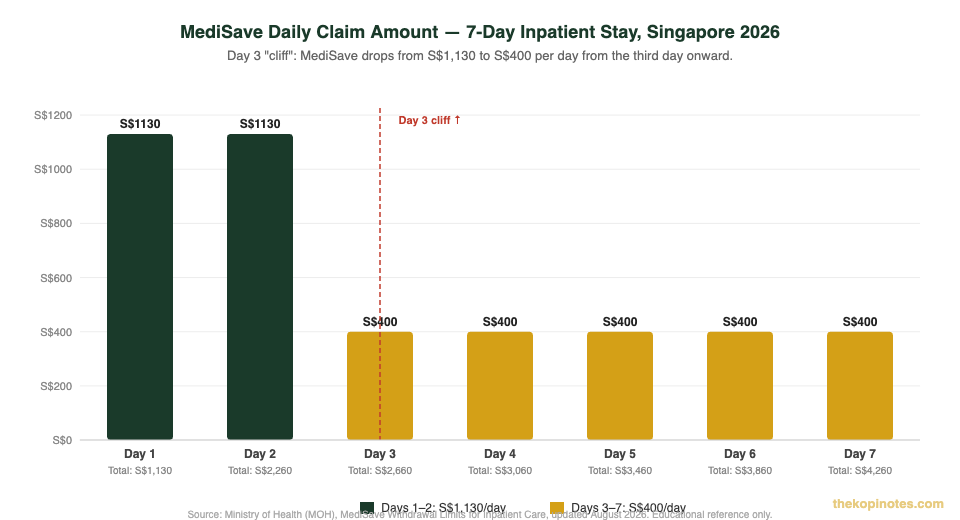
Chart: MediSave drawdown over a 7-day hospital stay. Note the “cliff” drop from S$1,130/day to S$400/day at Day 3. Source: CPF Board / MOH, August 2026.
ISP and MediShield Life as Your Backstop
Once your MediSave and any dependant MediSave accounts are exhausted, two other safety nets kick in — MediShield Life (the compulsory national insurance scheme) and, if you have one, an Integrated Shield Plan (ISP).
MediShield Life pays a portion of your hospital bill above your deductible, subject to claim limits. It is designed for Class B2/C ward bills; claim limits are lower for higher ward classes. For a long or serious stay, MediShield Life alone often leaves a significant gap.
Integrated Shield Plans (ISPs) are optional top-up plans sold by AIA, Aviva/Singlife, Great Eastern, NTUC Income, and Prudential. They extend your coverage to Class A wards or private hospitals, and pick up a large share of what MediShield Life does not cover. Most ISPs pay over and above your MediSave and MediShield Life benefits — reducing your cash out-of-pocket to a small co-payment or zero, depending on the rider you hold.
For a practical comparison, see the chart below showing the difference in cash outlay with and without a Class A ISP for a 14-day private hospital stay:
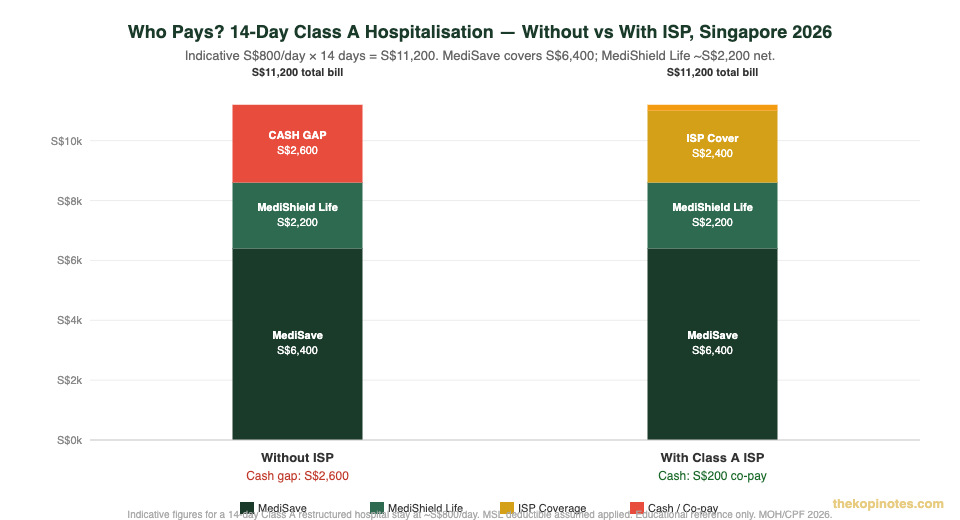
Illustrative example: 14-day Class A private hospital stay. Values are approximate. ISP premiums and co-pay vary by plan and rider. Figures for educational reference only.
| Scenario | Total Bill (14 days) | MediSave + MediShield Life | ISP Pays | Your Cash |
|---|---|---|---|---|
| No ISP (Class A) | S$11,200 | S$8,600 | — | S$2,600 |
| With Class A ISP | S$11,200 | S$8,600 | S$2,400 | ~S$200 |
Illustrative only. Actual coverage depends on plan type, deductible, co-insurance, and specific claim. Source: TKN modelling based on MOH/insurer data, October 2026.
If you don’t have an ISP yet, or want to review your current coverage, see our guide on Integrated Shield Plans in Singapore. Premiums can be paid fully from your MediSave Account (for the base shield plan), with any rider premium paid in cash.
7 Practical Tips for Managing MediSave Hospitalisation Claims
- Know your balance before elective surgery. Log into CPF Online Services to check your MediSave balance before any planned admission. If it’s low, top up (up to the Basic Healthcare Sum) before you go in.
- Ask about ward class options early. Choosing a lower ward class (B2 or C) reduces the daily bill significantly and makes your MediSave stretch further — and MediShield Life pays a higher proportion of those bills.
- Nominate dependant accounts before discharge. Don’t wait until the bill is presented. Tell the hospital billing team on Day 2 or Day 3 that you'd like to add a dependant’s MediSave account to cover the shortfall.
- Check if future contributions apply. If you’re in B2/C at a public hospital and still working, ask the billing department about CPF future MediSave contributions before signing a cash payment plan.
- Review your ISP annually. Your coverage needs change as you age. An ISP that worked at 35 may not be sufficient at 55 for a longer or more complex stay.
- Keep a “hospitalisation reserve” in cash. Even with an ISP, some plans have a co-payment of 5–10% or a rider that requires cash. Having 2–3 months of estimated hospital bills in liquid savings prevents scrambling at discharge.
- Understand what your ISP does not cover. Pre-existing conditions at the time of application, cosmetic procedures, and some psychiatric treatments are typically excluded. Read the exclusion list in your policy document.
Frequently Asked Questions
What is the MediSave hospitalisation daily limit in 2026?
What happens if my MediSave runs out while I'm in hospital?
Can I use my children's or spouse's MediSave for my hospital bills?
Why does the daily limit drop so sharply from Day 3?
Does an Integrated Shield Plan pay over and above MediSave?
Can I use future MediSave contributions if my balance is low?
How do I check my MediSave balance before a planned admission?
Stay Covered. Plan Before You Need It.
MediSave covers a meaningful chunk of your hospitalisation bill — but the Day 3 cliff and a low balance can leave you with a surprising cash shortfall. Reviewing your ISP coverage now, while you are healthy, costs far less than settling a large bill at discharge.
Not financial advice. All figures are for educational reference only. Data verified as at October 2026.
Get Free Insurance Advice
Speak with a licensed insurance advisor. No obligation, no cost.
By submitting this form, you agree to our Privacy Policy.
This article was researched with the help of AI. While we strive to keep all information accurate and up to date, there may be errors. If you notice any discrepancies, please contact us.