SRS Account Early Withdrawal Singapore 2026: Penalties, Rules & Exceptions
What every Singapore investor must know before withdrawing from their SRS account ahead of retirement age — and when the rules may be waived.
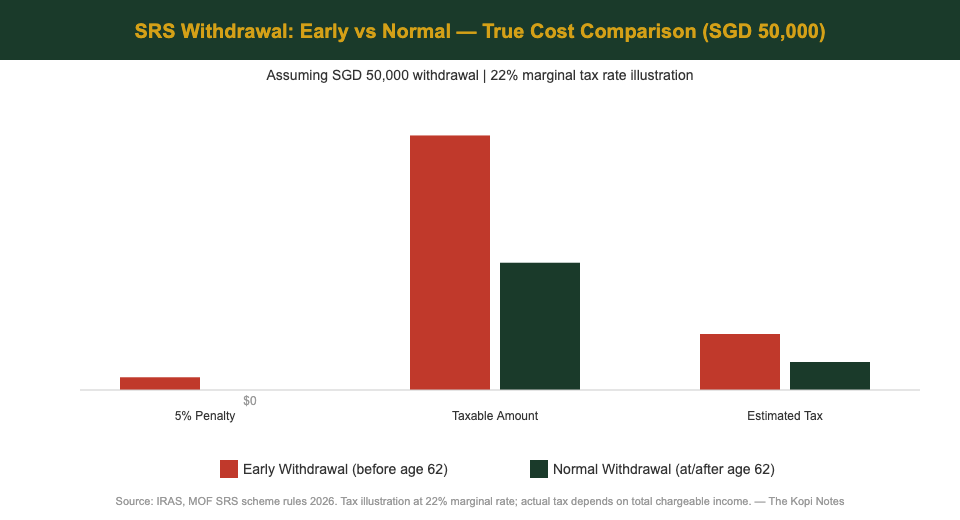
Withdrawing from your SRS account before your statutory retirement age (62 for most existing account holders) triggers a 5% penalty on the withdrawal amount and removes your 50% tax exemption — making the entire amount taxable as income. Normal SRS withdrawals at or after your SRS withdrawal age attract no penalty and only 50% of each withdrawal counts as taxable income. Understanding this double hit is essential before you decide to access SRS funds early.
Not financial or tax advice. All figures are for educational reference only. Rules are based on IRAS and MOF SRS guidelines as at October 2026. Verify with your SRS operator or a licensed financial adviser before making any withdrawal decision.
Table of Contents
Contents — Click to expand
- What Is SRS and When Can You Withdraw?
- The 5% Early Withdrawal Penalty Explained
- Tax Treatment: Early vs Normal Withdrawal
- Worked Example: The True Cost of Early Withdrawal
- Exceptions: When the 5% Penalty Is Waived
- Should You Ever Withdraw Early from SRS?
- How to Minimise the Cost If You Must Withdraw Early
- Frequently Asked Questions
What Is SRS and When Can You Withdraw?
The Supplementary Retirement Scheme (SRS) is a voluntary savings programme run by the Ministry of Finance and administered by IRAS in Singapore. It was designed to encourage Singaporeans, PRs, and foreign nationals working in Singapore to save for retirement beyond what CPF alone provides. SRS contributions are made into an account held with one of three approved SRS operators: DBS Bank, OCBC Bank, or UOB Bank. Once contributed, the funds can be invested in a wide range of instruments — unit trusts, Singapore Savings Bonds, T-bills, fixed deposits, and certain SGX-listed shares and ETFs.
The key tax benefit of SRS is that contributions reduce your taxable income in the year they are made. If you contribute SGD 15,300 to your SRS account (the maximum for Singapore citizens and PRs as at 2026), that amount is deducted from your chargeable income before income tax is assessed. For someone in the 22% tax bracket, that alone saves SGD 3,366 in tax — an instant return on contribution.
However, the deferred tax element means that when you eventually withdraw, the funds become taxable again. The key question is: under what conditions, and how much of the withdrawal is counted as income?
SRS Withdrawal Age — It Depends on When You First Contributed
Your SRS withdrawal age is not fixed at 62 for everyone. It is locked at the statutory retirement age that was in effect in Singapore when you first opened your SRS account and made your first contribution. As Singapore’s statutory retirement age has risen over the years, newer account holders face a higher withdrawal age:
| When You First Contributed to SRS | Your SRS Withdrawal Age |
|---|---|
| Before 1 July 2022 | 62 |
| 1 July 2022 to 30 June 2026 | 63 |
| From 1 July 2026 onwards | 64 |
| From 1 July 2030 onwards (planned) | 65 |
Source: Ministry of Finance, SRS scheme rules. Statutory retirement age milestones as at 2026.
If you contribute to SRS for the first time today (October 2026), your SRS withdrawal age is 64. If you opened your account and contributed before July 2022, your withdrawal age remains 62 — this is your right and is grandfathered in. Withdrawing before that locked age triggers early withdrawal consequences.
The 5% Early Withdrawal Penalty Explained
If you withdraw from your SRS account before reaching your SRS withdrawal age, the bank (SRS operator) will deduct a 5% penalty from the gross withdrawal amount and remit it to the government. This happens automatically — you do not have the option to pay it separately or defer it.
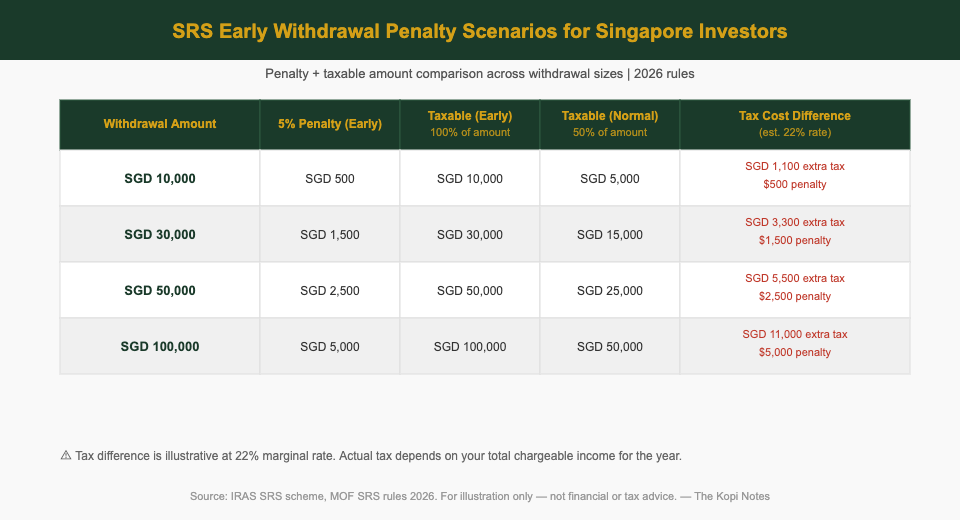
On a SGD 50,000 early withdrawal, the 5% penalty amounts to SGD 2,500. You receive SGD 47,500 in your hands, and SGD 2,500 goes to IRAS as a penalty charge. The penalty is non-recoverable and not tax-deductible.
The 5% may seem modest in isolation, but it compounds with the tax consequence below to create a significant drag on early withdrawals. For Singapore investors who have been using SRS to build a passive income Singapore portfolio for retirement, accessing these funds early can meaningfully undermine decades of compounding.
Tax Treatment: Early vs Normal Withdrawal
Beyond the 5% penalty, the biggest financial impact of early SRS withdrawal is the loss of the 50% tax exemption. Under normal circumstances — withdrawing at or after your SRS withdrawal age over a 10-year window — only 50% of each withdrawal is counted as taxable income. The other 50% is exempt from income tax entirely. This is an extremely valuable concession that dramatically reduces the tax burden on your SRS nest egg at retirement.
When you withdraw early, this 50% exemption is forfeited. The entire withdrawal amount — 100% — is added to your chargeable income for that tax year. Combined with the 5% cash penalty, early withdrawal can cost substantially more than most investors expect.
| Comparison | Early Withdrawal (Before SRS Age) | Normal Withdrawal (At/After SRS Age) |
|---|---|---|
| 5% Penalty | Yes — deducted at source | No |
| Taxable Portion | 100% of withdrawal | 50% of withdrawal |
| 50% Tax Exemption | No | Yes |
| 10-Year Spread Option | Not applicable | Yes — can spread over 10 years to stay in lower tax bracket |
Source: IRAS, SRS scheme rules, October 2026.
The 10-year spread option available at normal withdrawal is also lost for early withdrawals. At retirement, a savvy Singapore investor can withdraw their SRS balance in annual tranches over up to 10 years, keeping each year’s taxable income (50% of each tranche) within the zero or lower tax bands. This strategy — explained in detail in the SRS withdrawal strategy Singapore 2026 guide — can result in paying near-zero tax on the full SRS balance if planned correctly. Early withdrawal destroys this option entirely.
Worked Example: The True Cost of Early Withdrawal
Let us put real numbers to a realistic scenario. Mr Tan opened his SRS account in 2015 (before July 2022) so his SRS withdrawal age is 62. He is currently 50 years old and has accumulated SGD 120,000 in his SRS account. He faces a significant financial need and is considering withdrawing SGD 50,000 to cover it. Here is what the early withdrawal actually costs him:
| Item | Early Withdrawal (Now, Age 50) | Normal Withdrawal (Age 62) |
|---|---|---|
| Gross Withdrawal | SGD 50,000 | SGD 50,000 |
| 5% Penalty | SGD 2,500 | SGD 0 |
| Taxable Amount | SGD 50,000 (100%) | SGD 25,000 (50%) |
| Estimated Income Tax (at 22% marginal rate) | ~SGD 11,000 | ~SGD 5,500 |
| Total Cost (Penalty + Extra Tax) | SGD 13,500 | SGD 5,500 |
| Net Cash Received | ~SGD 36,500 | ~SGD 44,500 |
Illustration only. Tax estimate at 22% marginal rate; actual tax depends on Mr Tan’s total chargeable income. Source: IRAS SRS rules, October 2026.
By withdrawing early, Mr Tan effectively loses SGD 8,000 more than if he had waited until 62 — that is a 16% haircut on his intended withdrawal amount. Additionally, the SGD 70,000 remaining in SRS loses 12 more years of compounding at his chosen investment rate. The opportunity cost of early withdrawal is substantial.
To better plan your retirement timeline and understand how your SRS balance will grow, use the Singapore retirement calculator on The Kopi Notes to model different scenarios.
Exceptions: When the 5% Penalty Is Waived
Not all early SRS withdrawals carry the 5% penalty. The Ministry of Finance has carved out specific circumstances under which the penalty is waived entirely. These exceptions reflect genuine hardship or life events that make it inappropriate to penalise the account holder for accessing their funds:
1. Terminal Illness or Total Permanent Disability
If an SRS account holder is diagnosed with a terminal illness, or suffers total permanent disability (TPD) that prevents them from working, they may apply to withdraw from their SRS account without incurring the 5% penalty. Crucially, the 50% tax exemption is also retained for these withdrawals — meaning only half the withdrawal amount counts as taxable income. Medical certification from a licensed doctor is required, and the SRS operator must be notified with supporting documentation.
2. Death of the Account Holder
Upon the death of an SRS account holder, the balance is paid out to the legal estate (executor or administrator) without any 5% penalty. The 50% tax exemption also applies, so only half the SRS balance is subject to income tax in the deceased’s final tax assessment. Beneficiaries do not pay personal income tax on the SRS payout they receive from the estate.
3. Foreigners and PRs Permanently Departing Singapore
Foreign nationals or permanent residents who are permanently departing Singapore may be eligible to close their SRS account and withdraw the balance without the 5% penalty under certain conditions. The specific eligibility criteria — including minimum holding periods and the requirement to demonstrate permanent departure — should be verified directly with your SRS operator (DBS, OCBC, or UOB) and IRAS, as the rules have specific conditions that vary by circumstance. Note that even if the penalty is waived, income tax on the withdrawal amount may still apply depending on your tax residency status and the applicable tax treatment.
For those who have used their SRS funds to invest via platforms like Endowus (referral code: 2V343) — which offers SRS-compatible investment portfolios — it is worth speaking to their client services team about the process for liquidating SRS investments before closing the account.
Summary of Exceptions
| Exception | 5% Penalty Waived? | 50% Tax Exemption Retained? |
|---|---|---|
| Terminal illness / TPD | Yes | Yes |
| Death of account holder | Yes | Yes |
| Foreigner/PR departing permanently | Possibly (conditions apply) | Generally No |
| All other early withdrawals | No — 5% deducted | No — 100% taxable |
Source: IRAS, Ministry of Finance SRS scheme rules, October 2026. Always verify current rules with your SRS operator.
Should You Ever Withdraw Early from SRS?
The short answer for most people: almost never. The double penalty — a cash charge plus full income tax — makes early SRS withdrawal one of the most expensive financial moves available to Singapore investors. The scheme is explicitly designed to lock funds away until retirement, and the deterrent effect is intentional.
That said, there are edge cases where early withdrawal might be the least-bad option:
- Absolute financial emergency with no alternatives: If you face a severe liquidity crisis and have exhausted all other sources of funds, early SRS withdrawal may be a last resort. In this case, withdraw only the minimum needed.
- Very low income year: If you are in a year with minimal other income (unpaid leave, sabbatical, retrenchment), the tax impact of an early SRS withdrawal is significantly reduced. Adding SGD 20,000 of SRS funds to a year where you have little other income may push you into a zero or very low tax bracket, reducing the tax cost substantially.
- Near your SRS withdrawal age: If you are just one or two years away from 62 (or your applicable SRS withdrawal age), it is almost always better to wait. The financial benefit of avoiding the penalty and retaining the 50% exemption will outweigh nearly any short-term need.
Before making any decision, consider speaking to an independent financial adviser or reviewing your CPF investment strategy to ensure you have properly optimised all avenues before touching SRS funds early. SRS is also complementary to other retirement planning tools — understanding where it fits within your broader portfolio, including S-REITs and ETFs, is important for the best S-REITs in Singapore 2026 for income-focused investors.
How to Minimise the Cost If You Must Withdraw Early
If early withdrawal is unavoidable, here are steps to reduce the total damage:
1. Withdraw Only the Minimum Amount Necessary
The penalty and tax apply to every dollar withdrawn. A SGD 20,000 early withdrawal costs far less than a SGD 100,000 early withdrawal. Keep the amount to the absolute minimum required to address your immediate need.
2. Time It to a Low-Income Year
Singapore income tax is assessed annually on chargeable income. If you can time your early SRS withdrawal to a year when your other income is lower than usual — perhaps a year when you take extended leave, between jobs, or have significant reliefs — you will be in a lower tax bracket and the tax on the 100% taxable withdrawal will be proportionally lower.
3. Consider Partial Withdrawal
Rather than closing the SRS account entirely, consider withdrawing only a portion early. The remaining balance continues to compound within SRS — invested in Singapore Savings Bonds, T-bills, or SRS-compatible unit trusts — and is preserved for penalty-free, 50%-exempt withdrawal at retirement. Refer to the SRS year-end deadline 2026 article for context on how continued SRS contributions can rebuild the balance quickly with tax benefits.
4. Do Not Stop Contributing After an Early Withdrawal
One common mistake is abandoning SRS contributions after an early withdrawal due to frustration with the scheme. Future contributions still earn the full income tax deduction in the year contributed, and the funds will eventually qualify for the 50% exemption at your SRS withdrawal age. Keep contributing what you can afford — even a modest annual top-up compounds significantly over a decade.
Frequently Asked Questions
What is the penalty for early SRS withdrawal in Singapore?
The penalty for withdrawing from your SRS account before your SRS withdrawal age (62 for most existing account holders, 63 for those who first contributed between July 2022 and June 2026) is 5% of the gross withdrawal amount. This is deducted by the SRS operator (DBS, OCBC, or UOB) at the time of withdrawal and is non-recoverable. On top of the penalty, the full 100% of the withdrawal amount is subject to income tax, compared to just 50% for normal withdrawals at retirement age.
Can I withdraw from SRS before 62 without penalty?
Yes, but only in specific exceptional circumstances. The 5% early withdrawal penalty is waived for terminal illness, total permanent disability, and death. In these cases, the 50% tax exemption is also retained. Foreigners and PRs permanently departing Singapore may also be eligible for a penalty waiver under certain conditions — check with your SRS operator or IRAS for the specific requirements. All other early withdrawals incur the full 5% penalty with no exemptions.
Is SRS early withdrawal amount fully taxable?
Yes. When you withdraw from your SRS account before your SRS withdrawal age, 100% of the withdrawal amount is added to your chargeable income for that tax year and taxed at your marginal rate. This is in contrast to normal SRS withdrawals at or after your SRS withdrawal age, where only 50% of each withdrawal is taxable. The loss of the 50% exemption is typically the larger financial cost of early SRS withdrawal compared to the 5% cash penalty itself, especially for investors in higher income tax brackets.
What is the SRS withdrawal age in Singapore?
Your SRS withdrawal age is locked at the statutory retirement age that applied when you first opened your SRS account and made your first contribution. If you first contributed before 1 July 2022, your SRS withdrawal age is 62. If you first contributed between 1 July 2022 and 30 June 2026, it is 63. For first contributions from 1 July 2026, it is 64. This age is permanently fixed for your account regardless of any future increases to Singapore’s statutory retirement age after your first contribution.
Should I close my SRS account if I need money urgently?
No — closing your SRS account is rarely the right choice even in an urgent financial situation. You can make a partial early withdrawal and keep the account open, preserving the remaining balance for penalty-free, tax-advantaged withdrawal at retirement. Closing the account entirely means withdrawing the full balance early, incurring the 5% penalty on everything and losing the 50% exemption on the full amount. If you need liquidity urgently, exhaust all other options first — personal savings, bank loans, or even CPF-approved withdrawals for specific purposes — before touching your SRS balance.
How do I withdraw from my SRS account in Singapore?
To make an SRS withdrawal, you need to submit a withdrawal request to your SRS operator — DBS, OCBC, or UOB — depending on which bank holds your account. For withdrawals at or after your SRS withdrawal age, you can typically initiate this online or in-branch. For early withdrawals or withdrawals under exceptional circumstances (terminal illness, etc.), additional documentation may be required. The bank will process the withdrawal, deduct any applicable 5% penalty at source, and transfer the net amount to your linked bank account. Withdrawal proceeds are reported to IRAS and included in your income tax assessment for that year.
Maximise Your SRS Returns Before You Retire
Keep your SRS funds invested — avoid early withdrawal where possible. Use referral codes below for SRS-compatible robo-advisers with exclusive bonuses.
This article was researched with the help of AI. While we strive to keep all information accurate and up to date, there may be errors. If you notice any discrepancies, please contact us.