Singapore T-Bill Guide 2026: Current Yields, How to Buy & Best Strategy
Updated October 2026 | Savings & Deposits | 8 min read
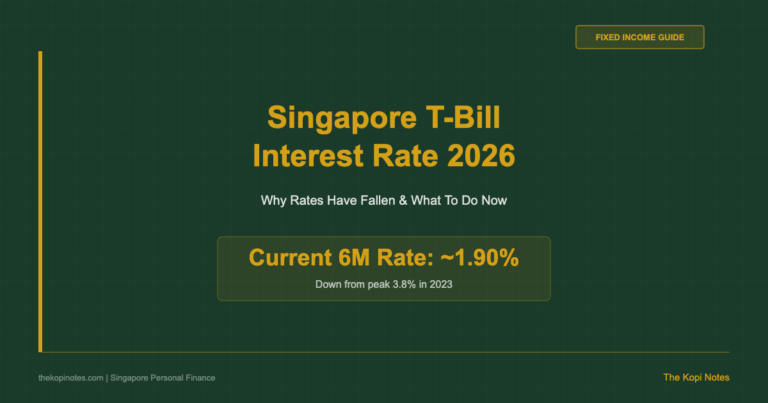
Singapore T-bills (Treasury Bills) are short-term government securities issued by the Monetary Authority of Singapore (MAS) with tenures of 6 months or 1 year. Singaporeans can apply through DBS/POSB, OCBC, UOB, or through CPF-OA and SRS accounts. As at October 2026, the 6-month T-bill cut-off yield is approximately 2.80% p.a. — offering a competitive, risk-free return on idle cash with no withholding tax.
Not financial advice. All figures are for educational reference only. Data as at October 2026 unless noted.
| 6-M Yield | Min. Investment | Auctions | Withholding Tax | CPF / SRS |
|---|---|---|---|---|
| ~2.80% p.a. | SGD 1,000 | 2× per month | 0% | ✅ Both |
Source: MAS T-bill results, October 2026. Yields are indicative and vary by auction.
📋 Table of Contents
What Is a Singapore T-Bill?
A Singapore Treasury Bill (T-bill) is a short-term debt instrument issued by the Singapore Government through the Monetary Authority of Singapore (MAS). Unlike bonds that pay periodic interest, T-bills are sold at a discount to face value — you receive the full face value at maturity, and the difference is your return.
Key characteristics of Singapore T-bills:
- Tenures: 6 months (most popular) and 1 year
- Minimum investment: SGD 1,000, in multiples of SGD 1,000
- Maximum per application: SGD 1,000,000
- Issuer: Singapore Government (AAA-rated)
- Risk level: Risk-free (backed by the Singapore Government)
- Withholding tax: 0% for Singaporeans and Singapore PRs
- Eligible accounts: Cash (via ATM/bank), CPF Ordinary Account, SRS
T-bills are auctioned approximately twice a month for the 6-month tenure, and once a month for the 1-year tenure. The cut-off yield (the minimum accepted yield at each auction) is determined by market demand — higher demand means lower yields, and vice versa.
T-bills are an excellent option for Singaporeans who want to park emergency funds, short-term savings, or idle CPF-OA money in a completely risk-free instrument with better-than-savings-account returns. For a deeper look at the T-bill application process via CPF-OA and SRS, see our detailed T-bill CPF-OA and SRS application guide.
Current Singapore T-Bill Yields (October 2026)
Singapore T-bill yields have moderated from their 2023 peak of ~3.9% as the US Federal Reserve completed its rate-cutting cycle in 2025. As at October 2026, the 6-month T-bill yields approximately 2.75–2.85% p.a., while the 1-year T-bill tracks slightly higher at around 2.80–2.90% p.a.
| T-Bill Tenor | Last Cut-Off Yield | Subscription Rate | Next Auction |
|---|---|---|---|
| 6-Month | ~2.80% p.a. | ~2.1× | 22 Oct 2026 |
| 1-Year | ~2.85% p.a. | ~1.8× | 29 Oct 2026 |
Source: MAS T-bill auction results, October 2026. Yields and dates are indicative — always check the MAS official T-bill page for the latest confirmed results.
The chart below shows how Singapore 6-month T-bill yields have trended since 2023, reflecting the global rate cycle:
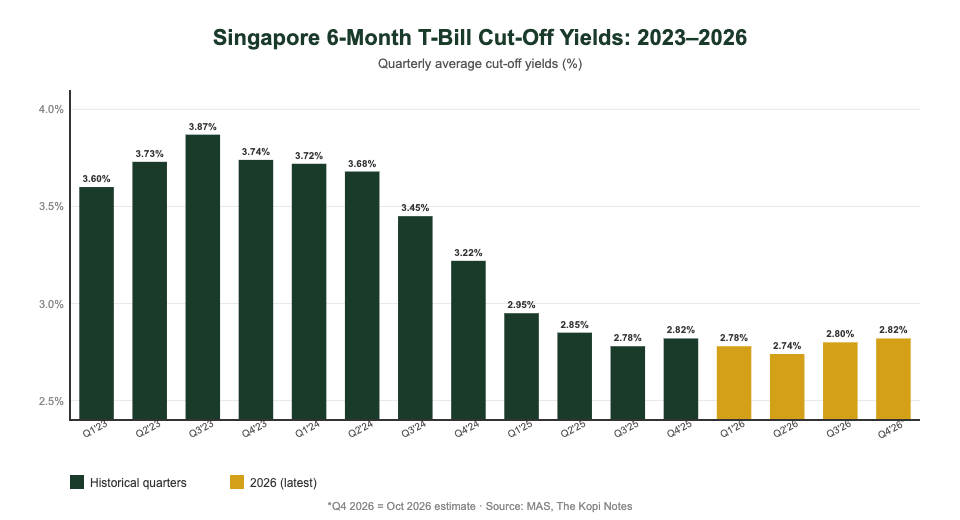
Chart: Singapore 6-Month T-Bill Cut-Off Yield by Quarter, 2023–2026. Source: MAS. Yields moderated from ~3.9% peak (2023) to ~2.80% (Oct 2026) as the Fed cut rates.
What’s driving T-bill yields in 2026? After the Fed’s 2024–2025 rate-cutting cycle lowered the US federal funds rate from 5.25–5.50% to around 3.25–3.50%, Singapore short-term rates followed suit. MAS’s monetary policy — which targets the Singapore Dollar Nominal Effective Exchange Rate (S$NEER) rather than interest rates directly — means local rates are influenced heavily by global USD rates. Investors should expect T-bill yields to remain in the 2.50–3.00% range through 2026, barring any major global shocks.
To track the latest Singapore T-bill rates and understand why yields move, see our October 2026 T-bill auction preview.
How to Buy Singapore T-Bills (Step-by-Step)
Buying T-bills in Singapore is straightforward — you apply through your bank or CPF/SRS account before the auction’s application deadline. Here’s how:
Option 1: Cash Application via Internet Banking
- Check the auction schedule on the MAS website. Applications typically close the evening before the auction date.
- Log in to your bank’s internet banking — DBS/POSB, OCBC, or UOB all support T-bill applications via their investment portals.
- Navigate to “Bonds & T-bills” (the exact menu varies by bank). Select “Apply for T-bill” or equivalent.
- Choose the tenor (6-month or 1-year) and enter your bid amount (minimum SGD 1,000).
- Select bid type: Most retail investors should use a non-competitive bid — you accept whatever cut-off yield the auction determines. A competitive bid requires you to specify a yield, and your application is rejected if the market cut-off is lower than your bid. Unless you have specific views on the cut-off yield, non-competitive is safer.
- Confirm & submit before the deadline. Funds are held in your linked bank account until the auction.
- Receive result on auction day. If successful, the T-bill is credited to your CDP account and funds are debited from your bank.
Option 2: ATM Application
DBS/POSB, OCBC, and UOB ATMs also support T-bill applications. Navigate to “More Services” → “Investment” → “T-Bills / Bonds” on the ATM screen. The process mirrors internet banking — select tenor, amount, and bid type.
Option 3: Via CPF-OA or SRS
If you want to use your CPF Ordinary Account or Supplementary Retirement Scheme (SRS) funds to buy T-bills, the process differs slightly. See our dedicated T-bill CPF-OA and SRS guide for step-by-step screenshots and common pitfalls to avoid.
💡 Pro Tip: For CPF-OA applications, always submit at least 2–3 business days before the auction deadline. CPF processes T-bill applications separately, and late submissions are not processed.
T-Bill vs Fixed Deposit, SSB & CPF-OA Compared
Singapore T-bills are just one of several risk-free options for parking short-term savings. Here’s how they compare on the metrics that matter most to retail investors:
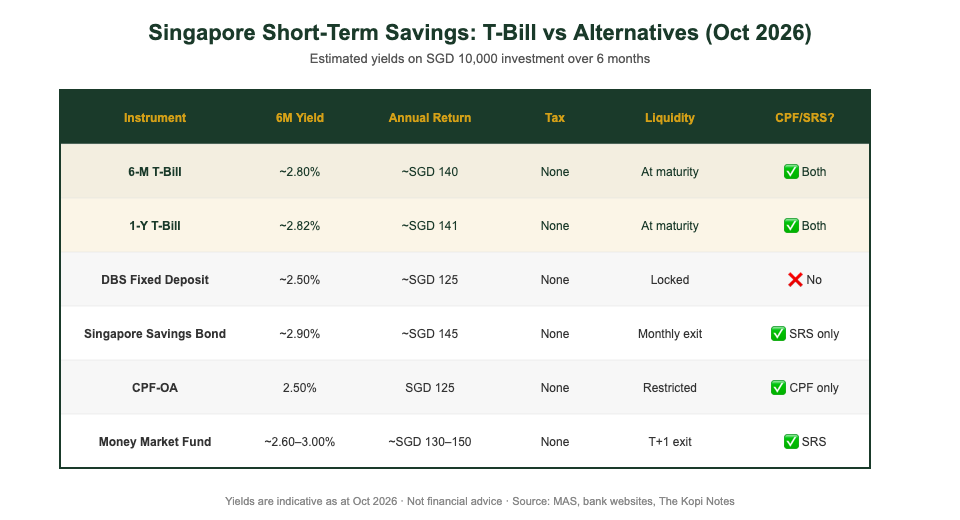
Comparison of SGD 10,000 over 6 months, indicative yields as at Oct 2026. Source: MAS, bank websites, The Kopi Notes.
| Feature | 6-M T-Bill | Bank Fixed Deposit | Singapore Savings Bond | CPF-OA |
|---|---|---|---|---|
| Yield (Oct 2026) | ~2.80% | ~2.30–2.50% | ~2.70–2.90% | 2.50% (floor) |
| Min. Investment | SGD 1,000 | SGD 1,000–10,000 | SGD 500 | SGD 1,000 |
| Liquidity | At maturity only | Locked (penalty for early exit) | Monthly exit (no penalty) | Restricted (CPF rules) |
| Withholding Tax | 0% | 0% | 0% | 0% |
| CPF / SRS Eligible | ✅ Both | Some (check bank) | ✅ SRS only | N/A |
| Secondary Market | ✅ (via SGX) | ❌ | ❌ (redeem only) | N/A |
| Returns on SGD 10,000 | ~SGD 140 | ~SGD 115–125 | ~SGD 135–145 | SGD 125 |
Returns estimated for 6-month period on SGD 10,000. Source: MAS, bank websites, October 2026. Not financial advice.
T-Bill vs Singapore Savings Bond (SSB)
The Singapore Savings Bond is the closest competitor to T-bills for risk-free, government-backed savings. The key differences are liquidity and yield structure:
- SSBs offer step-up yields: Interest increases each year you hold, rewarding long-term investors. T-bills lock in a fixed yield for 6 or 12 months only.
- SSBs have monthly liquidity: You can exit an SSB any month without penalty. T-bills must be held to maturity (or sold on the secondary market at market price).
- T-bills often win on 6-month yield: In the current environment, 6-month T-bill cut-off yields are typically comparable to or slightly above SSB average returns over the same 6-month window.
For more on SSBs, see our Singapore Savings Bonds guide.
Using CPF-OA and SRS to Buy Singapore T-Bills
One of the most compelling features of Singapore T-bills for retail investors is CPF-OA and SRS eligibility. This allows you to put otherwise idle government savings to work at better yields than the default CPF-OA interest rate.
T-Bills via CPF Ordinary Account
The CPF-OA pays a base interest rate of 2.50% p.a. When T-bill cut-off yields exceed 2.50%, you can enhance your CPF-OA returns by investing in T-bills through the CPF Investment Scheme (CPFIS-OA). When T-bill yields are below 2.50%, there is no benefit, and it may be better to leave CPF-OA funds earning the guaranteed floor rate.
Key considerations for CPF-OA T-bill investment:
- You must have a CPF Investment Account with a CPFIS-approved bank (DBS, OCBC, or UOB)
- Only investable CPF-OA balances are eligible (the first SGD 20,000 in OA cannot be invested)
- There is no annual account-keeping fee for T-bill holdings via CPFIS (unlike some unit trusts)
- T-bill proceeds are credited back to your CPF-OA account on maturity
T-Bills via Supplementary Retirement Scheme (SRS)
SRS investors can use their SRS account balance to apply for T-bills and SSBs. This is particularly attractive for top-income earners who max out their SGD 15,300 annual SRS contribution for tax relief — having idle SRS cash earn 2.80% p.a. risk-free is far better than the default SRS bank savings rate (~0.05% p.a.). For comprehensive SRS investment strategies, see our Singapore Savings Bonds guide and the CPF investment strategy guide.
Platforms like Endowus (referral code: 2V343) also allow you to invest SRS money into diversified, low-cost funds if you want higher long-term growth potential beyond T-bills. For cash-equivalent returns within your SRS, Syfe (referral code: SRPRFFFCD) offers cash-plus-type funds via SRS that complement a T-bill ladder strategy.
T-Bill Strategy for Singapore Investors in 2026
With yields settling around 2.80% and global rate uncertainty diminishing, here’s how to approach T-bills strategically in 2026:
1. Build a T-Bill Ladder
Rather than putting all your cash into a single T-bill auction, consider laddering: apply for 6-month T-bills at alternate auctions (e.g., every 3 months) so that you always have a T-bill maturing soon. This gives you regular liquidity windows while consistently earning above-bank yields. For SGD 50,000 of short-term savings, a simple 2-rung ladder (SGD 25,000 per rung, staggered 3 months apart) means you always have SGD 25,000 coming due within 3 months.
2. Use the 6-Month T-Bill Over the 1-Year in Most Environments
Unless the 1-year yield is materially higher (50+ basis points), the 6-month T-bill is preferable for most retail investors because it provides more frequent reinvestment opportunities. If rates rise, you can quickly reinvest at higher yields rather than being locked in at today’s 1-year rate.
3. Non-Competitive Bids Are Almost Always Better for Retail
The risk of a competitive bid being rejected (because your specified yield is above the cut-off) is real. In 2023, several investors who bid too aggressively missed out on popular auctions entirely. Unless you’re applying very large sums (SGD 500,000+) and have a specific yield view, non-competitive bids ensure allotment.
4. Consider T-Bills Alongside Singapore Savings Bonds for Emergency Funds
Your emergency fund should prioritise liquidity. SSBs can be redeemed monthly with no penalty, making them better for emergency savings. T-bills are better for money you’re confident you won’t need before maturity. A sensible split: 50% SSB (emergency), 50% T-bills (near-term savings that can wait 6 months). For long-term retirement planning, use our Singapore retirement calculator to see how T-bill returns compound into your overall plan.
Frequently Asked Questions: Singapore T-Bills
What is the current Singapore T-bill interest rate?
Is Singapore T-bill a good investment?
How do I apply for a Singapore T-bill?
What happens if I don't get allotted in a T-bill auction?
Can I sell a T-bill before maturity?
Is T-bill better than SSB (Singapore Savings Bond)?
How do Singapore T-bills work with CPF-OA?
Is the Singapore T-Bill Still Worth It in 2026?
Yes — for the right use case. Singapore T-bills remain one of the best risk-free, short-term savings instruments available to Singaporeans in 2026. At ~2.80% p.a. for the 6-month tenor, they consistently outperform savings accounts and most fixed deposits while carrying zero credit risk (government-backed) and zero withholding tax.
They are particularly compelling for:
- CPF-OA optimisation: Earning 2.80% vs the default 2.50% CPF-OA floor on your investable CPF-OA balance
- SRS enhancement: Getting meaningful returns on idle SRS savings before deploying into longer-term investments
- Short-term cash parking: Any savings you won’t need for 6–12 months can earn more in T-bills than in a bank
They are not ideal if you need flexibility (liquidity before maturity), or if you’re deploying long-term savings (in which case S-REITs, ETFs, or the Endowus SRS portfolio may offer better compounding). Use our Singapore retirement calculator to see how T-bill returns fit into your overall retirement picture.
📌 Quick Recap: Singapore T-Bill Key Facts (October 2026)
- 6-month yield: ~2.80% p.a. | 1-year yield: ~2.85% p.a.
- Min. investment: SGD 1,000 | No withholding tax
- Eligible via CPF-OA and SRS
- Apply via DBS/POSB, OCBC, or UOB internet banking or ATM
- Use non-competitive bids for guaranteed allotment
This article is for educational purposes only and does not constitute financial advice. Always check the latest MAS T-bill results and consult a licensed financial adviser before making investment decisions. The Kopi Notes may earn referral fees from partner links in this article.
This article was researched with the help of AI. While we strive to keep all information accurate and up to date, there may be errors. If you notice any discrepancies, please contact us.