Endowment Plan vs Annuity Singapore 2026: Which Gives You More Retirement Income?
A complete Singapore comparison — accumulation vs income, payout scenarios, flexibility, and our verdict on which suits your retirement stage.
An endowment plan in Singapore is a savings-insurance hybrid that grows your money over a fixed term — typically 10 to 25 years — and pays a lump sum at maturity. A private annuity converts a lump sum into guaranteed monthly income for life. Both serve retirement planning, but at different life stages and with very different mechanics. This 2026 guide compares them head-to-head so you can decide which fits your plan.
Not financial advice. All figures are for educational reference only. Data verified as at October 2026.
Table of Contents
Contents — Click to expand
- What Is an Endowment Plan?
- What Is an Annuity in Singapore?
- Key Differences at a Glance
- Payout Comparison: Which Pays More?
- Flexibility and Surrender Value
- Death Benefit and Dependant Protection
- Tax Treatment in Singapore
- When to Choose an Endowment Plan
- When to Choose an Annuity
- TKN Verdict
- Frequently Asked Questions
What Is an Endowment Plan?
An endowment plan is a participating (par) or non-participating (non-par) insurance product that combines a savings element with a small death benefit. You pay premiums — either a single lump sum or regular instalments — over a chosen term, and at maturity the insurer pays out a guaranteed sum plus, for par plans, a non-guaranteed bonus based on the insurer’s par fund performance.
Endowment plans in Singapore are offered by AIA, Prudential, NTUC Income (now Income Insurance), Great Eastern, Manulife, and Singlife. The Monetary Authority of Singapore (MAS) mandates that all par plan benefit illustrations use standardised projected rates of 3.25% p.a. (low scenario) and 4.75% p.a. (high scenario). These are non-guaranteed — the guaranteed component typically delivers 1.5% to 3.0% p.a.
Key characteristics of endowment plans:
- Term: typically 5, 10, 15, 20, or 25 years
- Premium types: single premium (lump sum upfront) or regular premium (monthly/annual payments)
- Death benefit: sum assured returned to beneficiaries if you pass away during the policy term
- Surrender value: builds up over time; early surrender (first 2–3 years) typically results in a loss
- CPF/SRS compatibility: some plans are eligible for SRS funding — check with your insurer
| Endowment Type | Returns | Bonus | Risk Level |
|---|---|---|---|
| Non-Participating (Non-Par) | 1.5–3.0% p.a. guaranteed | None | Very low |
| Participating (Par) | 3.25–4.75% p.a. (illustrated, non-guaranteed) | Annual + terminal bonus (non-guaranteed) | Low to moderate |
Source: MAS mandated illustration rates; LIA Singapore product summaries, October 2026
What Is an Annuity in Singapore?
An annuity is a financial product that converts a lump sum premium into a guaranteed stream of monthly income — typically for life, though some plans pay for a fixed period. In Singapore, there are two main forms: CPF LIFE (the mandatory public annuity scheme) and private annuities offered by insurers.
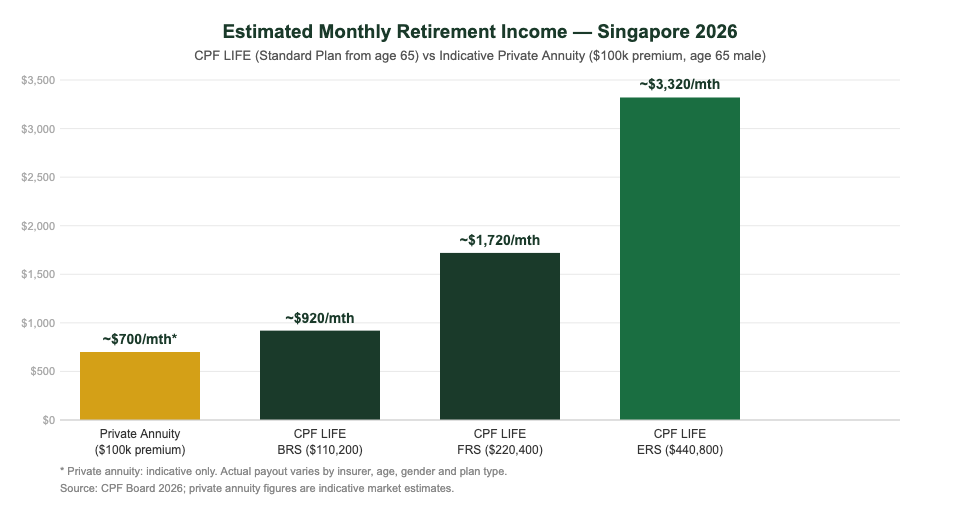
CPF LIFE applies automatically to most Singaporeans who have at least $60,000 in their CPF Retirement Account at age 65. It is not optional for most members. For 2026, the CPF Retirement Sums and their indicative monthly payouts (CPF LIFE Standard Plan, from age 65) are:
| Retirement Sum (2026) | Amount | Indicative Monthly Payout from Age 65 |
|---|---|---|
| Basic Retirement Sum (BRS) | $110,200 | ~$890–$950/month |
| Full Retirement Sum (FRS) | $220,400 | ~$1,600–$1,850/month |
| Enhanced Retirement Sum (ERS) | $440,800 | ~$3,200–$3,440/month |
Source: CPF Board, October 2026. Payouts are indicative and vary by life expectancy, interest rate changes, and plan type (Standard vs Basic). Actual amounts may differ.
Private annuities are offered by AIA, Great Eastern, Prudential, NTUC Income, and Manulife. They are purchased with a single lump sum premium, and income typically begins at a chosen future date (deferred annuity) or immediately. Private annuity payout rates are not standardised — they depend on your age at purchase, gender, premium size, and plan terms. A 65-year-old male purchasing a single-premium life annuity with $100,000 may receive approximately $600–$800 per month (indicative; obtain a quote from your insurer for accurate figures).
For Singapore investors planning retirement income, our guide on the Singapore retirement calculator can help you model how much monthly income you need at your target retirement age.
Key Differences at a Glance
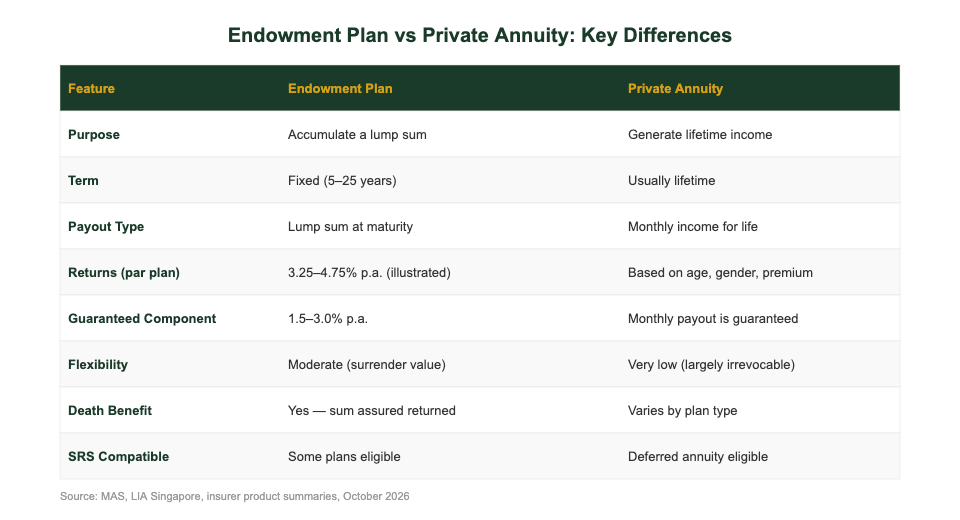
The most important distinction: an endowment plan is an accumulation vehicle; an annuity is an income vehicle. They solve different problems at different stages of retirement planning. Confusing the two is the most common mistake Singapore investors make when comparing them.
| Feature | Endowment Plan | Private Annuity |
|---|---|---|
| Primary Purpose | Accumulate a lump sum | Generate lifetime monthly income |
| Term | Fixed (5–25 years) | Lifetime (or fixed period) |
| Payout Type | Lump sum at maturity | Monthly income |
| Returns (par plan) | 3.25–4.75% p.a. (illustrated, non-guaranteed) | Depends on age, gender, premium |
| Guaranteed Element | 1.5–3.0% p.a. guaranteed component | Monthly payout is fully guaranteed |
| Flexibility | Moderate — surrender value available | Very low — largely irrevocable |
| Death Benefit | Yes — sum assured to beneficiaries | Varies by plan type |
| Longevity Protection | No — lump sum can run out | Yes — income paid for life |
| SRS / CPF Compatible | Some plans SRS-eligible | Deferred annuity SRS-eligible |
Source: LIA Singapore, insurer product summaries, CPF Board, October 2026
Payout Comparison: Which Pays More?
Comparing “which pays more” requires choosing a common starting point. Let’s use a S$100,000 single premium invested at age 45, with retirement at age 65 (a 20-year horizon).
Scenario A: Par Endowment Plan (20-year term, $100,000 single premium)
- At 4.75% p.a. illustrated rate: projected maturity value of approximately $250,000–$260,000 (non-guaranteed)
- At guaranteed 2.5% p.a.: guaranteed maturity value of approximately $164,000
- At maturity (age 65), you receive a lump sum — which you then need to invest or convert to income
- If you invest the lump sum at a 4% withdrawal rate, the projected $255,000 payout generates approximately $10,200/year, or about $850/month
Scenario B: Deferred Private Annuity (income from age 65, $100,000 premium at age 45)
- Indicative monthly payout from age 65: approximately $800–$1,000/month for life (male, age 45 at purchase, deferred to 65)
- If you live to age 80, total income received: approximately $144,000–$180,000
- If you live to age 90, total income: approximately $288,000–$360,000 — significantly exceeding the endowment’s projected lump sum value
Key insight: The annuity “wins” if you live a long life. For longevity protection — the risk of outliving your savings — the annuity is superior. For those who may need flexibility or who want to leave a larger estate, the endowment’s lump sum (later invested) offers more control. The right choice depends on your health, family history, and dependants.
To stress-test your own retirement income needs, use our Singapore retirement income calculator.
Flexibility and Surrender Value
One of the biggest practical differences between endowment plans and annuities is what happens if your financial circumstances change.
Endowment plans offer moderate flexibility. After the initial lock-in period (typically 2–3 years), most endowment plans have accumulated a surrender value you can access by terminating the policy. Surrendering early usually means receiving less than total premiums paid, but the option exists. Some plans also allow policy loans — you can borrow against the policy’s surrender value — which provides emergency liquidity without terminating the policy.
Private annuities are largely irrevocable. Once you pay the premium and the payout period begins, you cannot surrender the policy in most cases. Your capital has been converted to an income stream. If you face a medical emergency or major expense at age 70 and need $50,000, an annuity cannot help — you have no lump sum to draw from.
This illiquidity is the primary risk of annuities. Financial planners typically recommend against putting all your retirement savings into an annuity for this reason — maintain some accessible liquid assets (e.g., through Singapore Savings Bonds, T-bills, or a money market fund) alongside any annuity purchase.
Death Benefit and Dependant Protection
For Singapore families with dependants, the death benefit structure is an important comparison point.
Endowment plans include a death benefit — typically the higher of the sum assured or the policy’s accumulated value at the time of death. If you die during the endowment term, your beneficiaries receive this amount. This makes endowment plans attractive for parents who want savings growth alongside a basic life cover safety net for their family.
Private annuity death benefits vary significantly by the plan type you choose:
- Life annuity (no death benefit): Payouts stop at your death, with nothing returned to beneficiaries. This offers the highest monthly income for a given premium — best for those without dependants.
- Cash refund annuity: If you die before recovering your total premium, the remaining balance is paid to beneficiaries. Slightly lower monthly payout than a pure life annuity.
- Period-certain annuity: Income is guaranteed for a fixed period (e.g., 10 or 20 years), even if you die. Remaining payments go to your estate. This is a good middle ground for those with dependants.
For investors in the accumulation phase who want life coverage alongside savings, an endowment plan paired with a separate term life policy often provides better overall protection than an annuity. See our endowment plan vs CPF LIFE comparison for how to structure both in your retirement plan.
Tax Treatment in Singapore
Singapore has no capital gains tax and does not tax investment income from insurance products — making both endowment plans and annuities highly tax-efficient.
| Product | Maturity / Payout Tax | Death Benefit Tax | SRS Benefit |
|---|---|---|---|
| Endowment Plan | Not taxable | Not taxable | Some plans SRS-eligible; withdrawals at 62+ taxed at 50% |
| Private Annuity | Monthly income not taxable | Not taxable (refund of premium) | Deferred annuity SRS-eligible; withdrawals at 62+ taxed at 50% |
| CPF LIFE | Monthly payouts not taxable | N/A | N/A (CPF, not SRS) |
Source: IRAS Singapore, CPF Board, October 2026
The SRS + deferred annuity combination is particularly powerful for high-income earners. Contributing to your SRS account reduces your taxable income today (up to $15,300/year for Singapore citizens and PRs), and when you use those SRS funds to purchase a deferred annuity, withdrawals at age 62 or later are taxed at only 50% of the face value — a significant long-term tax advantage. Your CPF investment strategy should account for both CPF LIFE and private annuities as complementary income sources.
When to Choose an Endowment Plan
An endowment plan is the right product at the accumulation stage of your retirement journey — typically your 30s to 50s. Consider an endowment plan if:
- You want a disciplined savings vehicle with guaranteed returns and a defined maturity payout
- You have young dependants who benefit from the death benefit element of the policy
- You want some flexibility — the surrender value gives you a safety net if circumstances change
- You prefer a par plan that participates in insurer investment returns (potential upside above the guaranteed component)
- You are saving for a specific retirement goal: a target lump sum by age 60 or 65
- You want to complement your CPF savings and S-REIT portfolio with a lower-risk guaranteed component
Endowment plans also work well alongside robo-advisory platforms such as Endowus or Syfe, where your market-linked investments handle growth and the endowment plan handles the guaranteed portion of your nest egg.
When to Choose an Annuity
A private annuity is the right product at the decumulation stage of retirement — typically your late 50s to early 70s. Consider a private annuity if:
- You are near or at retirement age and have already accumulated sufficient savings
- You want guaranteed income regardless of market performance — removing sequence-of-returns risk
- You are concerned about longevity risk: the risk of outliving your savings (especially relevant given Singapore’s life expectancy of ~83 years)
- You have no major dependants who need a death benefit from this product
- You have maximised CPF LIFE (topped up to ERS at $440,800) but want additional guaranteed income on top
- You have SRS savings you plan to draw down in retirement (SRS-funded deferred annuity is a tax-efficient option)
TKN Verdict: Use Both at Different Stages
Endowment plans and private annuities are not rivals — they are complements in a well-structured Singapore retirement plan. Most people make the mistake of treating this as an either-or decision.
Here is a practical two-stage approach:
- Ages 30–55 (Accumulation): Use par endowment plans, CPF voluntary top-ups, and market investments (ETFs, S-REITs) to build your retirement nest egg. The endowment handles the guaranteed, lower-risk portion of your portfolio.
- Ages 55–65 (Pre-Retirement): Evaluate whether to convert part of your accumulated lump sum (endowment maturity payout + investment proceeds) into a private annuity. This creates a guaranteed income floor — on top of CPF LIFE — that you cannot outlive.
Our pick for most Singapore investors:
- For accumulation: par endowment plan (10–20 year term, single or regular premium) with a reputable insurer
- For income conversion: SRS-funded deferred annuity and/or CPF LIFE top-up to the Enhanced Retirement Sum (ERS) of $440,800
Neither product alone is optimal — endowment plans lack longevity protection; annuities lack flexibility. Together, they form the core of a guaranteed-income retirement strategy in Singapore.
Frequently Asked Questions
What is the main difference between an endowment plan and an annuity in Singapore?
An endowment plan is a savings-insurance hybrid that pays a lump sum at a fixed maturity date — it is an accumulation vehicle designed to grow your money over a set term. A private annuity converts a lump sum premium into a guaranteed monthly income, typically for life — it is an income vehicle. The key difference is timing: endowment plans are for building your retirement nest egg; annuities are for spending it. Most Singapore retirement plans benefit from using both at different life stages.
Which pays more — an endowment plan or an annuity?
It depends on how long you live and what you do with the proceeds. A par endowment plan with a $100,000 single premium over 20 years projects approximately $250,000–$260,000 at maturity (at the 4.75% illustrated rate, non-guaranteed). A deferred private annuity from the same $100,000 (income from age 65) may pay approximately $800–$1,000 per month for life. If you live to 85, total annuity income ($192,000–$240,000) is comparable to the endowment’s projected payout. If you live to 90+, the annuity significantly exceeds the endowment. Annuities protect against longevity risk; endowment plans offer more flexibility and a defined payout regardless of longevity.
Can I buy both an endowment plan and a private annuity?
Yes — and for most Singapore retirement plans, this combination is the recommended approach. Use an endowment plan during your working years (30s to 50s) to accumulate a lump sum in a disciplined, guaranteed way. At or near retirement, convert part of that lump sum into a private annuity to secure lifetime income. You can supplement further with CPF LIFE (a mandatory public annuity) for additional guaranteed monthly income. The three together — endowment maturity payout invested, private annuity income, and CPF LIFE payouts — form a robust, diversified retirement income base.
Are endowment plan payouts and annuity income taxable in Singapore?
No. Singapore does not tax endowment plan maturity payouts, death benefit payouts, or private annuity monthly income. CPF LIFE payouts are also not taxable. If you fund a deferred annuity with SRS contributions, withdrawals at age 62 or later are taxed at only 50% of the withdrawal amount — a significant tax advantage compared to your standard income tax rate during your working years. IRAS provides full guidance on SRS withdrawal tax treatment.
Can I use my SRS to buy an endowment plan or annuity?
Some endowment plans are eligible as SRS investments — confirm with the insurer before purchase, as not all plans qualify. Deferred annuities funded with SRS are a well-established retirement strategy: SRS contributions give you a tax deduction today (reducing your taxable income), and at retirement, only 50% of SRS withdrawals are included in your assessable income. This makes the SRS + deferred annuity combination one of the most tax-efficient retirement income strategies for high-income Singapore earners. The annual SRS contribution cap is $15,300 for Singapore citizens and Permanent Residents, and $35,700 for foreigners.
What happens to my annuity if I die early?
This depends entirely on the annuity type you purchase. A life annuity with no death benefit stops paying at your death — nothing is returned to beneficiaries. A cash refund annuity returns any unrecovered portion of your premium to beneficiaries if you die before receiving your total premium back. A period-certain annuity guarantees income for a fixed period (e.g., 10 or 20 years) even if you die — remaining payments go to your estate or beneficiaries. Plans with better death benefits typically offer slightly lower monthly payouts. For those with dependants who need financial protection, a cash refund or period-certain annuity is recommended over a pure life annuity.
Is an endowment plan better than CPF LIFE for retirement?
They serve different purposes and are not interchangeable. CPF LIFE is a mandatory public lifetime annuity — you cannot opt out if your CPF Retirement Account balance meets the threshold. An endowment plan is a private accumulation product. The best retirement strategy is to maximise CPF LIFE (consider topping up to the Enhanced Retirement Sum of $440,800 for ~$3,200–$3,440/month from age 65), then use a private endowment plan to build additional wealth alongside your CPF savings. You can read our detailed breakdown in the endowment plan vs CPF LIFE Singapore 2026 guide.
Start Building Your Retirement Plan Today
Whether you choose an endowment plan, an annuity, or both, the key is starting early. Explore our referral links for trusted Singapore financial platforms.
Get Free Insurance Advice
Speak with a licensed insurance advisor. No obligation, no cost.
By submitting this form, you agree to our Privacy Policy.
This article was researched with the help of AI. While we strive to keep all information accurate and up to date, there may be errors. If you notice any discrepancies, please contact us.