China Tech ETF Singapore: HST vs KWEB vs CQQQ (2026 Guide)
A Singapore investor’s comparison of SGX, Nasdaq and NYSE-listed ways to invest in Alibaba, Tencent, Meituan and Xiaomi — with the tax and cost differences that actually matter.
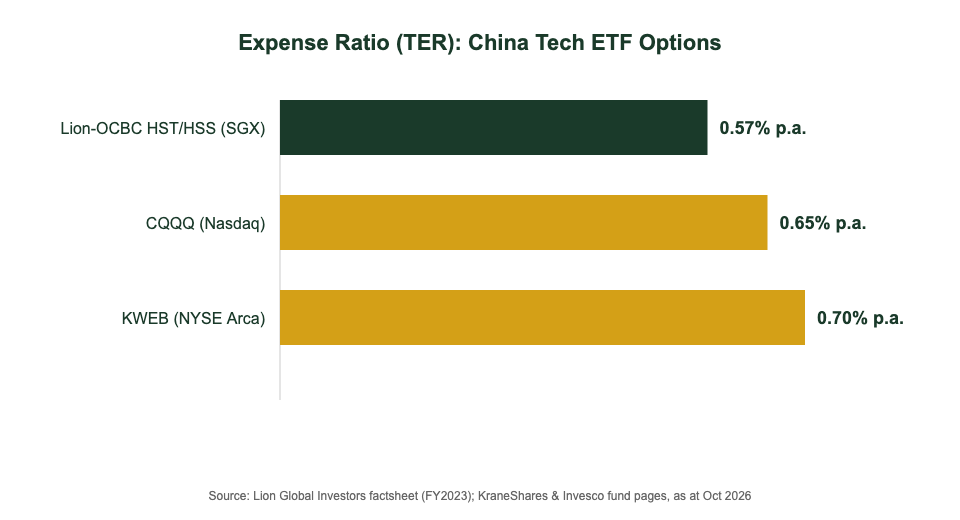
The main China tech ETF choices for Singapore investors are the Lion-OCBC Securities Hang Seng TECH ETF (SGX: HST/HSS), KraneShares CSI China Internet ETF (NYSE Arca: KWEB), and Invesco China Technology ETF (Nasdaq: CQQQ). HST/HSS is Singapore-domiciled with no US estate tax exposure and a lower 0.57% expense ratio, while KWEB and CQQQ offer broader China tech exposure but carry US estate tax risk above USD 60,000.
Not financial advice. All figures are for educational reference only. Data verified as at October 2026 unless otherwise noted.
What Is China Tech ETF Investing?
A China tech ETF gives you a single-ticket basket of the largest technology companies listed in Hong Kong, mainland China, or on US exchanges as American Depositary Receipts (ADRs) — names like Alibaba, Tencent, Meituan, Xiaomi, JD.com, and NetEase. Rather than picking individual China tech stocks (which carry single-stock risk and, for many Singapore investors, the hassle of a HKEX trading account), an ETF spreads your exposure across the sector in one trade.
For Singapore investors specifically, the practical question isn’t just “which companies” but “which wrapper” — an SGX-listed fund, a US-listed ETF, or an LSE-listed UCITS alternative — because the wrapper determines your withholding tax, estate tax exposure, and brokerage costs. This guide compares the three most accessible options and where each one fits.
Why China Tech Is Back in Focus in 2026
China tech ETFs went through a multi-year drawdown from 2021 following the regulatory crackdown on platform companies, but sentiment has shifted through 2026 on a combination of factors: Beijing’s continued policy support for the private tech sector, renewed consumer spending data out of China, and a wave of AI-related capital expenditure announcements from Alibaba, Tencent and Baidu as they compete on large language models and cloud infrastructure. The Hang Seng TECH Index — the benchmark most SGX-linked products track — has seen renewed institutional inflows through 2026 as valuations re-rated from historic lows.
This is a sector that rewards diversification rather than single-stock bets: Alibaba’s cloud and AI narrative, Tencent’s gaming and WeChat ecosystem, and Meituan’s local services business all move on different catalysts. An ETF captures the theme without requiring a view on any single name.
Best China Tech ETFs for Singapore Investors
Three funds cover most of what a Singapore investor needs: one SGX-listed option domiciled locally, and two US-listed options with deeper, broader exposure.
| ETF | Exchange | Index Tracked | TER | AUM (approx.) | Domicile |
|---|---|---|---|---|---|
| Lion-OCBC Securities Hang Seng TECH ETF SGX: HST (SGD) / HSS (USD) |
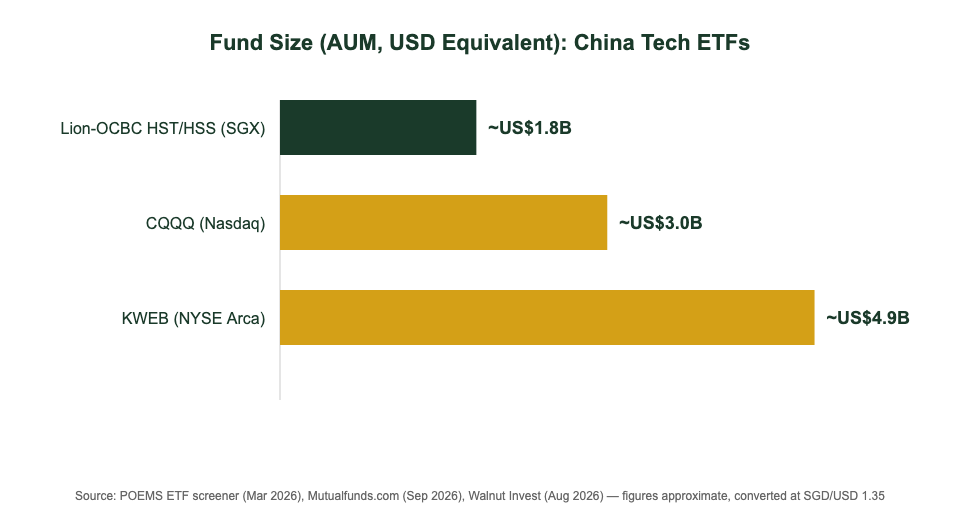
SGX | Hang Seng TECH Index | 0.57% | ~S$2.46B | Singapore |
| Invesco China Technology ETF Nasdaq: CQQQ |
Nasdaq | FTSE China Incl A 25% Technology Capped Index | 0.65% | ~US$3.0B | USA |
| KraneShares CSI China Internet ETF NYSE Arca: KWEB |
NYSE Arca | CSI Overseas China Internet Index | 0.70% | ~US$4.9B | USA |
Source: Lion Global Investors factsheet (FY2023 TER) and POEMS ETF screener (AUM, NAV date 20 Mar 2026); Invesco/Mutualfunds.com (CQQQ, Sep 2026); KraneShares/Walnut Invest (KWEB, Aug 2026).
HST/HSS gives you the 30 largest Hong Kong-listed tech names via the Hang Seng TECH Index — a cleaner, more concentrated basket skewed toward Alibaba, Tencent, Meituan and Xiaomi. CQQQ and KWEB cast a wider net across 100+ holdings including ADRs and A-shares, picking up smaller China tech names that HST/HSS doesn’t hold. If you specifically want exposure via a Hong Kong-listed fund structure rather than a tech-sector play, the broader HK market ETF is a different (and less concentrated) bet than any of these three.
Tax and Cost Comparison
This is where the real decision gets made. All three ETFs give you China tech exposure, but the wrapper determines how much of your return you actually keep — and whether your estate faces a US tax bill.
| Factor | HST / HSS (SGX) | CQQQ (Nasdaq) | KWEB (NYSE Arca) |
|---|---|---|---|
| Domicile | Singapore | USA | USA |
| US Estate Tax Risk (non-resident alien) | None | Yes, above USD 60,000 | Yes, above USD 60,000 |
| US Dividend Withholding Tax | Not applicable | 30% (no US-SG treaty relief for individuals) | 30% (no US-SG treaty relief for individuals) |
| Singapore Dividend/Capital Gains Tax | None | None | None |
| Trading Currency | SGD (HST) / USD (HSS) | USD | USD |
Source: IRS non-resident alien estate tax rules; IRAS — Singapore does not levy capital gains or dividend tax on individuals. Figures as at October 2026.
Here’s the worked example that matters: a Singapore investor holding USD 80,000 in KWEB or CQQQ at death is, in principle, exposed to US estate tax on the USD 20,000 above the USD 60,000 non-resident alien threshold — rates scale up to 40%. Singapore has no estate tax treaty with the US, so this exposure is real, not theoretical, and it’s the single biggest reason some investors choose to cap their US-domiciled ETF holdings or route China tech exposure through HST/HSS instead. Many investors manage this by holding the SGX-listed fund for the bulk of their position and using KWEB/CQQQ only for exposure HST/HSS doesn’t cover (smaller-cap names, ADRs).
On ongoing cost, the 0.57% vs 0.65–0.70% TER gap is smaller than it looks once you factor in FX spreads: HST/HSS trades in SGD, avoiding the FX conversion that CQQQ and KWEB require every time you buy or sell in USD through a SGD-funded account.
How to Buy China Tech ETFs in Singapore
For HST/HSS (SGX): Any SGX-enabled brokerage account works — fund your account in SGD, search for “HST” (SGD counter) or “HSS” (USD counter) on your broker’s platform, and place a normal board lot order. Brokers like moomoo Singapore and other SGX-licensed platforms support this without any extra account setup.
For CQQQ and KWEB (Nasdaq / NYSE Arca): You’ll need a brokerage account with US market access — Interactive Brokers (IBKR), Saxo Markets, Tiger Brokers, or moomoo’s US trading tier all support this. Fund your account, convert SGD to USD (watch the FX spread — this is a real cost that doesn’t show up in the TER), search for the ticker, and place your order during US market hours (typically 9:30pm–4am SGT).
SRS funds: HST/HSS, CQQQ and KWEB can generally be bought through SRS-linked brokerage accounts where your broker supports SRS trading for that exchange — check with your broker, as SRS equity trading access varies by platform. None of the three are currently listed on the CPFIS investment list, so CPF Ordinary Account funds cannot be used; always verify current CPFIS eligibility on the CPF Board’s website before assuming otherwise, since the list changes periodically. For a broader framework on using CPF alongside ETF investing, see our CPF investment strategy guide.
Risks to Consider
China tech ETFs are a concentrated sector bet, not a diversified core holding, and the risks are real on both the regulatory and market side.
Regulatory risk: Beijing’s policy stance toward platform companies has swung sharply before (the 2021 crackdown wiped out more than half the sector’s value in under a year) and can shift again with little warning — anti-monopoly action, data security rules, or gaming restrictions all move these stocks hard.
Concentration risk: HST/HSS holds just 30 names with heavy weighting toward Alibaba and Tencent; KWEB’s top 10 holdings make up roughly 60% of the fund. A bad quarter from one or two mega-caps moves the whole ETF.
Geopolitical and delisting risk: US-China tensions periodically raise the spectre of ADR delistings from US exchanges (the 2021–2022 PCAOB audit dispute was a real scare for KWEB and CQQQ holders). HST/HSS, tracking HK-listed shares directly rather than US ADRs, is less exposed to this specific risk.
Currency risk: Returns are driven by HKD/CNY-denominated underlying stocks but the ETFs themselves trade in SGD or USD — currency moves add a layer of volatility on top of the equity risk.
Given these risks, most advisers would frame a China tech ETF as a satellite position — perhaps 5–10% of an equity portfolio — rather than a core holding. For broader diversified exposure, pairing this with a global ETF like VWRA keeps the China tech allocation in proportion.
Frequently Asked Questions
What is the best China tech ETF for Singapore investors?
There’s no single “best” — it depends on your priorities. The Lion-OCBC Securities Hang Seng TECH ETF (SGX: HST/HSS) is the most tax-efficient and lowest-cost option for Singapore investors since it’s locally domiciled with no US estate tax exposure. KWEB and CQQQ offer broader exposure to smaller China tech names but carry US estate tax risk above USD 60,000 and a 30% US dividend withholding tax.
Is HST the same as KWEB or CQQQ?
No. HST/HSS tracks the Hang Seng TECH Index, a concentrated basket of 30 Hong Kong-listed tech companies. KWEB tracks the CSI Overseas China Internet Index (US-listed ADRs and HK shares), and CQQQ tracks the FTSE China Incl A 25% Technology Capped Index, which includes mainland A-shares. The holdings overlap significantly at the top (Alibaba, Tencent) but differ further down the list.
Can I buy China tech ETFs with my CPF or SRS funds?
None of HST, HSS, CQQQ or KWEB are currently on the CPF Investment Scheme (CPFIS) list, so CPF Ordinary Account funds cannot be used to buy them — always check the current CPFIS list on the CPF Board’s website, as it changes periodically. SRS funds can generally be used if your broker supports SRS trading on the relevant exchange; confirm this with your broker before assuming it’s available.
Which broker is best for buying China tech ETFs in Singapore?
For HST/HSS on SGX, any SGX-licensed broker works, including moomoo Singapore. For CQQQ and KWEB on US exchanges, you’ll need a broker with US market access — Interactive Brokers, Saxo Markets, Tiger Brokers, and moomoo’s US trading tier are common choices. Compare FX conversion fees carefully, since converting SGD to USD repeatedly for US-listed ETFs adds a real cost beyond the stated expense ratio.
Is China tech ETF investing risky?
Yes, more than a broad-market ETF. China tech is a concentrated sector bet exposed to Beijing regulatory risk (the 2021 platform-company crackdown halved the sector’s value), heavy weighting toward a handful of mega-caps, and geopolitical risk around US-listed ADRs. Most advisers treat it as a satellite position of perhaps 5–10% of an equity portfolio rather than a core holding.
What happens if I hold KWEB or CQQQ and pass away while living in Singapore?
Because KWEB and CQQQ are US-domiciled ETFs, they count as US-situs assets for US estate tax purposes even though you’re a Singapore resident. Non-resident aliens get only a USD 60,000 exemption before estate tax applies, with rates scaling up to 40% on the excess. Singapore-domiciled funds like HST/HSS don’t carry this risk, which is why some investors cap their US-listed ETF exposure or route China tech allocations through the SGX-listed option instead.
Ready to Start Investing in ETFs?
Open a brokerage account and build a diversified portfolio around your China tech allocation. Use our referral links for exclusive sign-up bonuses.
This article was researched with the help of AI. While we strive to keep all information accurate and up to date, there may be errors. If you notice any discrepancies, please contact us.