Dividend Investing Singapore 2026: Best Stocks, REITs & ETFs for Passive Income
A verified data guide to Singapore’s top dividend stocks, S-REITs and ETFs — with real yields, tax rules and portfolio-building steps.
Dividend investing in Singapore is one of the most tax-efficient strategies available to local investors. Singapore uses a one-tier tax system — dividends from SGX-listed companies arrive tax-free in your hands. Add no capital gains tax and access to high-yielding S-REITs (averaging ~5.9% as at 2026), and the combination makes dividend investing a compelling path to passive income. This guide covers verified yields, the best dividend stocks, S-REITs and ETFs, and how to build a portfolio starting from SGD 1,000.
Not financial advice. All figures are for educational reference only. Data verified as at 10 October 2026.
Table of Contents
Contents — Click to expand
Why Dividend Investing Suits Singapore Investors
Dividend investing — buying shares that regularly pay cash distributions — is well-suited to Singapore’s tax environment. Unlike countries where dividend income triggers a personal income tax bill, Singapore residents receive dividends from SGX-listed companies completely tax-free. This is thanks to Singapore’s one-tier corporate tax system: companies pay a 17% corporate tax on profits, and what’s distributed to shareholders is not taxed again.
Beyond the tax advantage, dividend investing delivers three practical benefits:
- Regular cash flow: Singapore blue-chips typically pay dividends twice a year; S-REITs often pay quarterly. A SGD 200,000 portfolio yielding 5% generates roughly SGD 10,000 per year in passive income.
- Portfolio resilience: Dividend-paying companies tend to be established, cash-generative businesses — banks, telecoms, infrastructure REITs — that hold up better during market downturns than pure growth stocks.
- Compounding via reinvestment: Reinvesting dividends into more shares accelerates long-term wealth building. A dividend yield of 5% reinvested annually doubles approximately every 14.4 years (rule of 72), on top of any price appreciation.
Singapore investors can supplement their passive income Singapore strategy by combining dividend stocks with S-REITs and ETFs — covering multiple sectors and yield levels within a single portfolio.
Singapore’s Tax-Friendly Dividend Landscape
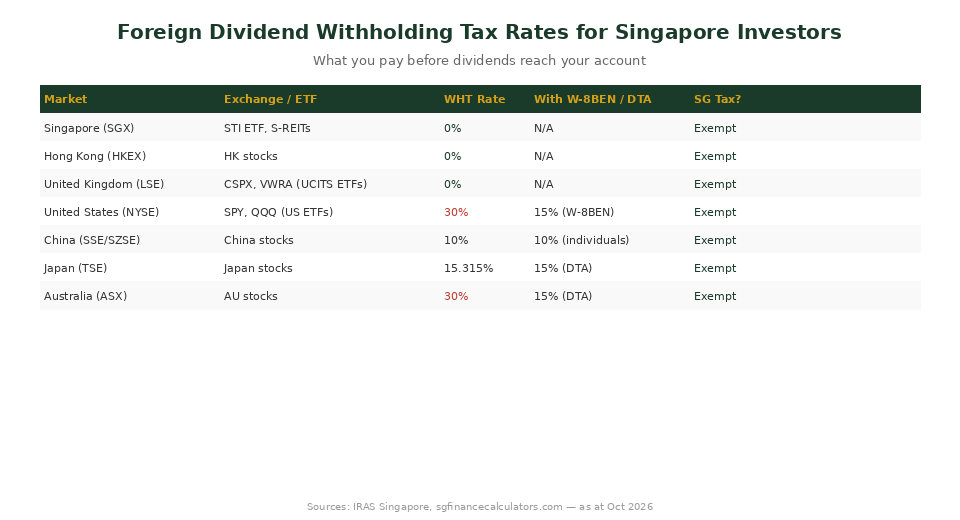
Understanding the tax treatment of dividends is essential before picking stocks. Here is how different markets compare:
| Market | Exchange | Withholding Tax (WHT) | SG Personal Tax? |
|---|---|---|---|
| Singapore (SGX) | Stocks, S-REITs | 0% | Exempt (one-tier) |
| Hong Kong (HKEX) | HK stocks | 0% | Exempt |
| United Kingdom (LSE) | UCITS ETFs (CSPX, VWRA) | 0% | Exempt |
| United States (NYSE/NASDAQ) | US ETFs (SPY, VYM) | 30% (15% with W-8BEN) | Exempt |
| China (SSE/SZSE) | China stocks | 10% | Exempt |
| Japan (TSE) | Japan stocks | 15.315% | Exempt |
| Australia (ASX) | AU stocks | 30% (15% with DTA) | Exempt |
Sources: IRAS Singapore (iras.gov.sg), CPF Board, OECD Tax Database — as at October 2026. WHT on US dividends can be reduced to 15% by submitting a W-8BEN form to your broker.
Key takeaway: Singapore-listed stocks and S-REITs deliver dividends at 0% withholding tax. For foreign stocks — especially US-listed ETFs — withholding tax permanently reduces your net yield. This is a significant reason experienced Singapore investors often prefer SGX-listed dividend stocks and Ireland-domiciled UCITS ETFs over US-listed funds for income portfolios. For more on the tax mechanics of different ETF structures, see our complete dividend investing Singapore guide.
Top Dividend Stocks in Singapore 2026
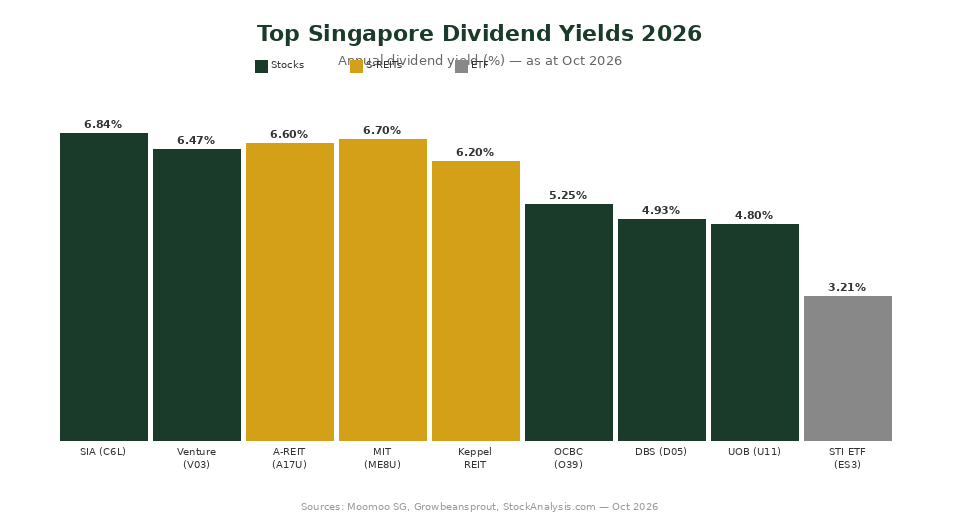
Singapore’s dividend investing landscape is anchored by three sectors: banking, industrials, and telecoms. The three local banks — DBS, OCBC, and UOB — are perennial dividend payers with strong balance sheets, rising dividends in recent years, and yields of 4.8%–5.3% as at early 2026. Airlines and industrials like SIA and Venture Corp round out the top yield list.
| Company | SGX Ticker | Sector | Dividend Yield (TTM) | FY2025 DPS (SGD) |
|---|---|---|---|---|
| SIA | C6L | Aviation | 6.84% | 0.38 |
| Venture Corp | V03 | Electronics | 6.47% | 0.75 |
| OCBC | O39 | Banking | 5.25% | 0.99 + 0.16 special |
| DBS | D05 | Banking | 4.93% | 3.24 ann. |
| UOB | U11 | Banking | 4.80% | 1.56 (FY2025) + 0.88 H1 interim |
| Singtel | Z74 | Telecoms | ~3.0% | 0.185 ordinary (FY2026) |
Sources: Syfe Magazine, Moomoo SG, company results announcements — as at September–October 2026. Yields shown are trailing twelve months (TTM); past yields are not a guarantee of future payouts.
Worked example — banking sector: A Singapore investor holding SGD 50,000 equally split across DBS, OCBC, and UOB would receive approximately SGD 2,498 in annual dividends — all tax-free. At current yields (~4.93%, ~5.25%, ~4.80%), the blended yield is roughly 5.0%. By comparison, a Singapore Savings Bond at the current rate of ~2.3% (10-year average) would yield SGD 1,150 on the same capital — less than half the return, with no price upside.
Risk note: banking dividends are not guaranteed. The Singapore banks cut or suspended dividends briefly during COVID-19 (2020) due to MAS guidance. Bank dividends recover strongly when restrictions lift, as seen in 2021–2026, but investors should hold a diversified portfolio rather than concentrating in one sector.
Best S-REITs for Dividend Income
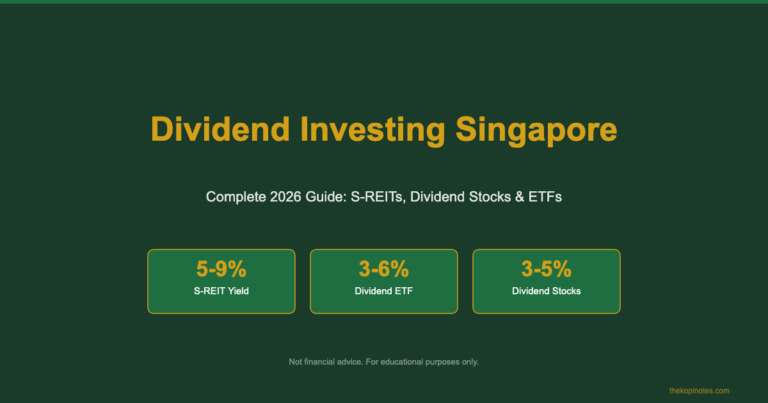
Singapore Real Estate Investment Trusts (S-REITs) are the cornerstone of many Singapore income portfolios. By law, S-REITs must distribute at least 90% of taxable income to maintain their REIT status — and for individual Singapore-resident investors, these distributions are tax-exempt. The FTSE ST Real Estate Investment Trusts Index average forward yield stood at approximately 5.9% as at mid-2026, well above bank fixed deposit rates.
For a deeper dive on specific REITs and performance, see our guide to the best S-REITs in Singapore 2026.
| S-REIT | Ticker | Sub-Sector | Distribution Yield | Latest DPU (period) |
|---|---|---|---|---|
| Mapletree Industrial Trust | ME8U | Data Centres / Industrial | ~6.7% | 3.11 cts (1Q FY26/27) |
| CapitaLand Ascendas REIT | A17U | Industrial / Logistics | ~6.6% | 7.482 cts (1H 2026) |
| Keppel REIT | K71U | Office | ~6.2% | 2.61 cts (1H 2026) |
| NTT DC REIT | TAJI | Data Centres | ~7.7% | Based on US$0.97 price (May 2026) |
Sources: Growbeansprout.com — as at September 2026. Distribution yields estimated by annualising the latest quarterly or half-yearly distribution. Past distributions are not guaranteed.
S-REIT distributions carry specific risks investors should understand. First, gearing limits: MAS caps S-REIT debt at 50% of total assets, providing a buffer against over-leverage. Second, foreign exchange risk: REITs with overseas assets (such as US data centres or European logistics warehouses) may see DPU fluctuate based on currency movements. Third, interest rate sensitivity: S-REITs typically borrow to finance properties, so rising rates increase financing costs and can compress DPU. The 2022–2024 rate hike cycle caused many S-REITs to cut distributions before recovering in 2025–2026.
For investors who prefer passive exposure to the entire S-REIT market, see our Singapore REIT ETF guide covering the CSOP IEdge S-REIT Leaders ETF (SRT) and similar funds.
Dividend ETFs for Passive Income
For investors who prefer broad diversification over picking individual stocks, dividend ETFs provide instant exposure to multiple dividend payers in a single trade. Singapore-listed dividend ETFs offer the same 0% WHT advantage as individual SGX stocks.
| ETF | Ticker (SGX) | What It Tracks | Dividend Yield | TER |
|---|---|---|---|---|
| SPDR STI ETF | ES3 | Straits Times Index (30 largest SGX stocks) | 3.21% | 0.30% p.a. |
| CSOP IEdge S-REIT Leaders ETF | SRT | Top 20 S-REITs by market cap | ~5.9% | ~0.60% p.a. |
| Nikko AM STI ETF | G3B | Straits Times Index | ~3.0–3.3% | 0.35% p.a. |
Sources: StockAnalysis.com, Growbeansprout.com, CSOP Asset Management — as at October 2026. ES3 yield based on trailing twelve months as at 8 Oct 2026 (price SGD 5.55, dividend SGD 0.178 TTM). SRT yield based on CSOP’s forward distribution estimate as at mid-2026.
The SPDR STI ETF (ES3) is a good starting point for dividend beginners: it pays a semi-annual distribution, requires a minimum of roughly SGD 555 for 100 units (the minimum board lot at ~SGD 5.55/unit), and provides automatic exposure to Singapore’s 30 largest companies including DBS, OCBC, UOB, Singtel and CapitaLand. For higher income, the CSOP IEdge S-REIT Leaders ETF (SRT) targets exclusively S-REITs and delivers roughly double the yield of ES3, though with greater interest-rate sensitivity. Both can be bought commission-free through platforms like Syfe Trade — see the Syfe referral code for a sign-up bonus when you open an account.
Building Your Dividend Portfolio: A Worked Example
A practical dividend portfolio for a Singapore investor balances income yield, sector diversification, and liquidity. Below is an illustrative structure for a SGD 30,000 starting portfolio targeting around 5% blended yield:
- 40% Stocks (SGD 12,000): Equal split across DBS, OCBC, UOB — the bank trio forms a stable income core. Blended yield ~5.0%. Annual income ~SGD 600.
- 35% S-REITs (SGD 10,500): CSOP IEdge S-REIT ETF (SRT) for diversified exposure to 20 S-REITs, or a mix of Ascendas REIT and Mapletree Industrial Trust. Blended yield ~6.0–6.7%. Annual income ~SGD 630–703.
- 25% STI ETF (SGD 7,500): ES3 for broad market diversification beyond pure income. Dividend yield ~3.21%. Annual income ~SGD 241.
Total estimated annual dividend income: SGD 1,471–1,544 on SGD 30,000 invested — a blended yield of roughly 4.9–5.1%. All tax-free.
Use the Singapore retirement calculator to model how this dividend stream compounds over 10, 20 and 30 years when dividends are reinvested. Historically, compounding a 5% yield on a growing principal has produced very competitive long-term returns compared to purely growth-focused strategies.
Platform recommendations for buying Singapore dividend stocks:
- IBKR (Interactive Brokers) — Most cost-effective for larger portfolios (SGD 30k+). SGX trades from USD 0.35/trade (tiered pricing). Referral code: jianxiong368.
- FSMOne — Good for RSP (Regular Savings Plans) on STI ETF from SGD 50/month at 0.08% min SGD 1 per transaction. Referral code: P0544985. See our FSMOne referral code page.
- Syfe Trade — Zero commission on SGX stocks and ETFs. Best for beginners and small portfolios. Use our Syfe referral code SRPRFFFCD for a cash bonus on your first deposit.
- Endowus — Best for CPF and SRS dividend investing via fund route (S-REIT funds). Flat 0.30–0.40% platform fee. Referral code 2V343. See the Endowus referral code page.
CPF note: SGX-listed stocks and most S-REITs are generally not eligible for direct CPFIS-OA investment. However, S-REIT unit trusts and certain CPF-approved funds via Endowus may qualify. For SRS (Supplementary Retirement Scheme), most SGX stocks and S-REITs are eligible via a standard brokerage account. For more on aligning your investment accounts, see our CPF investment strategy Singapore guide.
Data verified as at 10 October 2026 against official sources: SGX factsheets, company results announcements, Growbeansprout.com, StockAnalysis.com, Moomoo SG, CSOP Asset Management. Not financial advice.
Frequently Asked Questions
Are dividends from Singapore stocks tax-free for Singapore residents?
Yes. Singapore uses a one-tier corporate tax system: companies pay a 17% corporate tax on profits, and dividends distributed to shareholders are not taxed again in their hands. For individual Singapore tax residents, dividends from SGX-listed companies — including S-REIT distributions — are completely tax-exempt and do not need to be declared in your personal income tax return. This is one of Singapore’s most significant advantages for dividend investors.
What is the average S-REIT dividend yield in Singapore?
As at mid-2026, the forward distribution yield of the CSOP IEdge S-REIT Leaders ETF (which tracks the top 20 S-REITs by market cap) was approximately 5.9% — broadly in line with the sector’s historical average. Individual S-REITs ranged from about 6.2% to 7.7%+, depending on the sub-sector and gearing level. Blue-chip industrial REITs such as CapitaLand Ascendas REIT and Mapletree Industrial Trust yielded approximately 6.6%–6.7% as at September 2026.
Which dividend stocks pay the highest yield in Singapore?
As at early October 2026, SIA (C6L) and Venture Corporation (V03) were among the highest-yielding blue-chip stocks at approximately 6.84% and 6.47% respectively. Among S-REITs, NTT DC REIT yielded approximately 7.7%, Mapletree Industrial Trust ~6.7%, and CapitaLand Ascendas REIT ~6.6%. Note that a high yield can reflect a high payout ratio or a depressed share price — always check the payout ratio and dividend sustainability before investing purely for income.
Can I use CPF or SRS to invest in Singapore dividend stocks?
For CPF (CPFIS-OA and CPFIS-SA), the approved list of shares is limited and most individual blue-chip stocks are excluded. However, SRS (Supplementary Retirement Scheme) allows you to buy most SGX-listed stocks and S-REITs through a standard brokerage account, and contributions are tax-deductible (up to SGD 15,300 per year for Singapore citizens and PRs). Dividend income from SRS-purchased stocks is tax-exempt during the accumulation phase, making SRS a powerful wrapper for dividend investing ahead of retirement.
What are the main risks of dividend investing in Singapore?
The main risks are: (1) Dividend cuts — companies and REITs can reduce payouts during recessions, as Singapore banks did in 2020 under MAS guidance. (2) Interest rate sensitivity — S-REITs are particularly affected by rising rates as borrowing costs increase and distributable income falls. (3) Concentration risk — Singapore’s STI is heavily weighted toward banks (~40%) and REITs; a pure dividend portfolio can become sector-concentrated. (4) Currency risk — REITs with overseas properties may see DPU fluctuate with exchange rates. Diversify across sectors and supplement with global ETFs to mitigate concentration risk.
What is the minimum amount to start dividend investing in Singapore?
You can start dividend investing in Singapore with as little as SGD 50–100 per month through a Regular Savings Plan (RSP) offered by brokers like FSMOne (0.08% commission, min SGD 1 per trade). For single stock purchases on SGX, the minimum board lot is typically 100 shares. DBS shares at around SGD 38 require ~SGD 3,800 per lot; the STI ETF (ES3) at around SGD 5.55 requires only SGD 555 for 100 units. The CSOP IEdge S-REIT ETF (SRT) has a similarly low per-unit price, making it accessible from approximately SGD 200–400 for a board lot.
Start Building Your Dividend Portfolio Today
Open a brokerage account and start collecting tax-free dividends this quarter. Use our referral links for cash bonuses on sign-up.
This article was researched with the help of AI. While we strive to keep all information accurate and up to date, there may be errors. If you notice any discrepancies, please contact us.