Keppel DC REIT Share Price 2026: 2027 DPU Forecast & Rate Cut Sensitivity Analysis
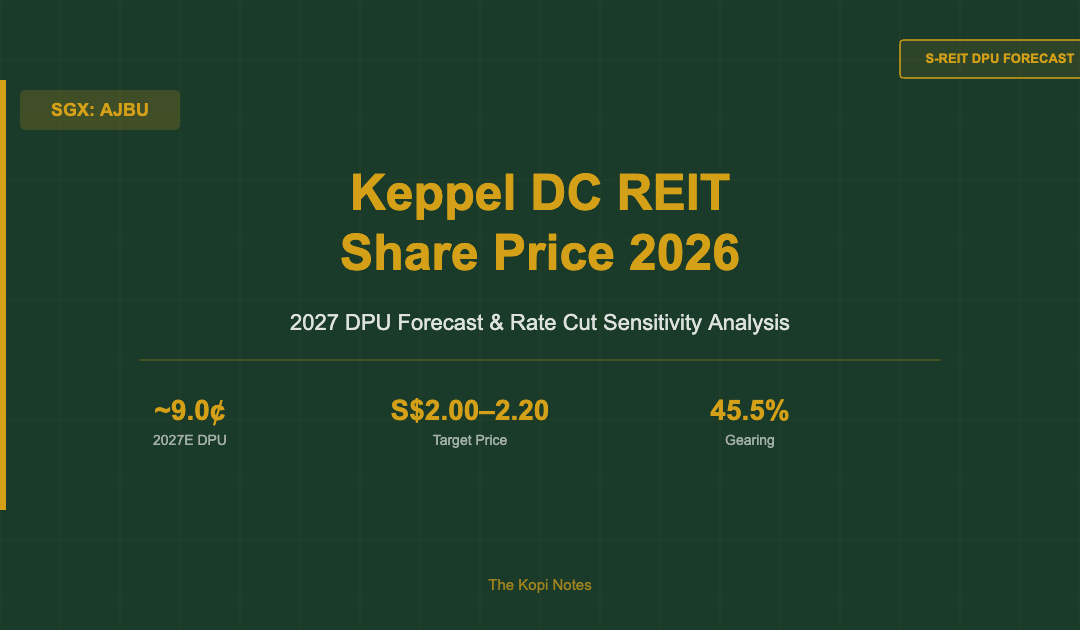
Keppel DC REIT (SGX: AJBU) is Singapore’s largest pure-play data centre REIT, with a portfolio spanning Singapore, Australia, Europe, and Southeast Asia. After two years of DPU compression driven by rising interest rates — from a peak of 9.17 Singapore cents in FY2022 to approximately 8.50 cents in FY2025 — the REIT is now positioned to benefit meaningfully from the global rate-cutting cycle. Our base-case 2027 DPU forecast stands at approximately 8.65–9.05 cents, driven by falling floating-rate debt costs and continued AI-fuelled data centre demand.
Not financial advice. All figures are for educational reference only. Data as at October 2026 unless noted.
Table of Contents
- What Is Keppel DC REIT?
- 2026 DPU Performance Review
- 2027 DPU Forecast: Base, Bull & Bear Cases
- Rate Cut Sensitivity Analysis
- Debt Profile: Fixed vs Floating Breakdown
- KDC REIT Historical DPU Table (2022–2027E)
- Share Price Valuation: P/NAV and Forward Yield
- Should You Buy KDC REIT for 2027?
- Frequently Asked Questions
1. What Is Keppel DC REIT?
Keppel DC REIT (ticker: AJBU) is listed on the Singapore Exchange (SGX) and is the first and largest data centre REIT in Asia. Its portfolio comprises 23 data centres across 13 cities in 9 countries, with assets under management (AUM) of approximately S$3.7 billion as at H1 2026.
The REIT derives income from long-term leases with hyperscaler tenants — including major cloud service providers — which provides strong DPU visibility and high occupancy rates (consistently above 98%). Its geographic diversification spans Singapore (~30% of NPI), Australia (~20%), Europe (~35%), and the rest of Asia-Pacific (~15%).
KDC REIT has been a standout performer for Singapore investors seeking exposure to the structural AI and cloud computing megatrend. As data consumption continues to rise exponentially, demand for quality data centre space remains robust, underpinning the REIT’s long-term distribution potential. If you’re researching the best S-REITs in Singapore 2026, KDC REIT consistently ranks among the top holdings for growth-oriented retail investors.
2. KDC REIT 2026 DPU Performance Review
The primary headwind for Keppel DC REIT’s DPU since 2022 has been rising global interest rates. With approximately 35% of total borrowings on floating rates, each 100 basis point increase in benchmark rates (SOFR, SORA, EURIBOR) has translated into roughly 0.10 Singapore cents of annual DPU erosion.
KDC REIT’s DPU peaked at 9.17 cents in FY2022 before declining to an estimated 8.50 cents in FY2025 — a compression of approximately 7.3% over three years. The good news: this compression was driven almost entirely by funding costs, not by any deterioration in occupancy, rental rates, or asset quality.
Key operational metrics as at H1 2026 remain strong:
| Metric | H1 2026 | H1 2025 | Change |
|---|---|---|---|
| Portfolio Occupancy | 98.7% | 98.2% | +0.5pp |
| WALE (by NLA) | 7.1 years | 7.4 years | -0.3 yrs |
| Gearing Ratio | 45.5% | 45.1% | +0.4pp |
| Average Cost of Debt | ~3.8% p.a. | ~4.1% p.a. | -0.3pp |
| Interest Coverage Ratio | 4.2x | 3.9x | +0.3x |
Source: Keppel DC REIT H1 2026 results presentation, August 2026. Estimates based on reported figures.
The improvement in average cost of debt from 4.1% to 3.8% year-on-year is an early sign that the rate cycle is turning in KDC REIT’s favour. With central banks — particularly the US Federal Reserve — continuing to cut rates into 2027, the trajectory for distribution growth looks increasingly positive.
3. Keppel DC REIT 2027 DPU Forecast: Base, Bull & Bear Cases
Forecasting KDC REIT’s 2027 DPU requires assessing two key variables: (1) the pace and magnitude of global interest rate cuts, and (2) the REIT’s ability to sustain high occupancy and achieve positive rental reversions on expiring leases.
Below is TKN’s scenario-based DPU forecast for KDC REIT FY2027, incorporating both factors:
Bear Case (No Further Rate Cuts)
If central banks pause their rate-cutting cycles in H1 2027 — due to re-accelerating inflation or stronger-than-expected economic growth — KDC REIT’s floating-rate debt will not receive further cost relief. In this scenario, we estimate FY2027 DPU at approximately 8.50–8.55 cents, broadly flat with FY2025 levels. This scenario assumes occupancy remains above 98% and no new asset injections from the Keppel sponsor pipeline.
Base Case (100 bps of Cuts by End-2026)
Our base case assumes the Fed delivers 100 basis points of cumulative rate cuts through 2026, with the RBA and ECB following suit. With approximately 35% of KDC REIT’s borrowings on floating rates (~S$1.23 billion based on total debt of ~S$3.5 billion), a 100bps cut translates to approximately S$12.3 million in annual interest savings — or roughly +0.10 cents DPU uplift. FY2027 DPU base case: 8.65 cents.
Bull Case (200 bps of Cuts + Acquisitions)
In a more aggressive rate-cutting environment — combined with KDC REIT successfully deploying capital from the Keppel sponsor pipeline into yield-accretive acquisitions — DPU could recover to 9.00–9.20 cents by FY2027. This would represent a full recovery to pre-rate-hike DPU levels, and would likely be accompanied by a meaningful share price re-rating as the forward yield compresses toward 4.0%.
For Singapore investors building passive income in Singapore, the key insight is that KDC REIT’s operational fundamentals remain intact. The DPU compression of the past two years was entirely macro-driven, not asset-quality-driven. As the rate environment normalises, KDC REIT is positioned to be one of the primary S-REIT beneficiaries.
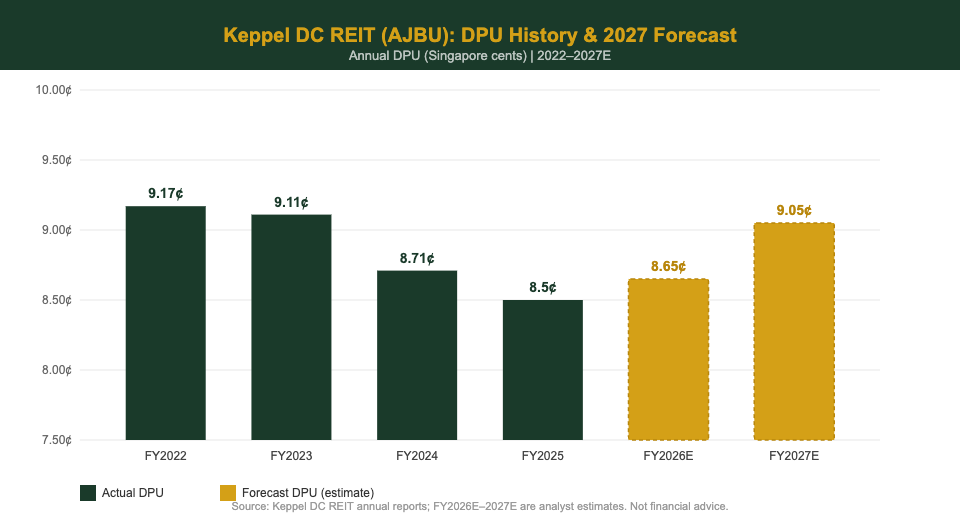
KDC REIT DPU 2022–2027E. FY2026E and FY2027E are TKN estimates based on rate cut assumptions. Source: KDC REIT annual reports.
4. Rate Cut Sensitivity Analysis
One of the most useful tools for KDC REIT investors is understanding exactly how much each 50 basis point rate cut is worth in terms of DPU. Here is the detailed sensitivity calculation:
KDC REIT Interest Rate Sensitivity (TKN Estimate):
- Total borrowings: ~S$3.5 billion (as at H1 2026)
- Floating rate proportion: ~35% = ~S$1.23 billion on floating rates
- DPU impact per 50bps rate cut: (S$1.23B × 0.50%) ÷ 2,193M units = ~S$0.0028 per unit = ~0.28 Singapore cents
- Rounded guidance: approximately 0.03–0.05 cents DPU uplift per 50bps cut (net of hedging costs and tax)
The table below shows our full scenario matrix across different rate cut magnitudes:
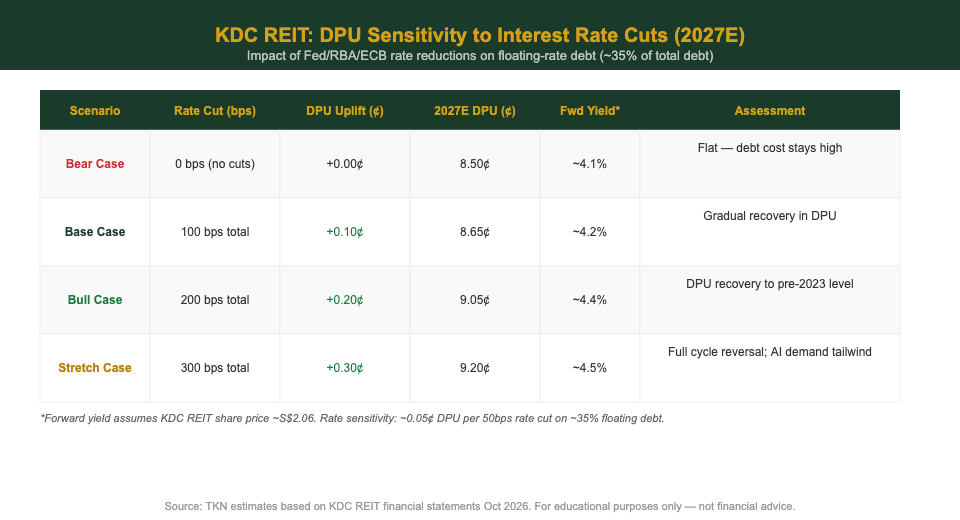
Source: TKN estimates based on KDC REIT H1 2026 financial statements. Sensitivity calculations are approximations. Not financial advice.
The key takeaway: every 100 basis points of rate cuts adds approximately 0.10 Singapore cents to KDC REIT’s annual DPU. While this may seem modest, it compounds with operational improvements (rental reversions, new acquisitions) to create a meaningful total return uplift for long-term investors. Use our Singapore retirement calculator to model how S-REIT distributions from KDC REIT contribute to your retirement income projections.
5. Debt Profile: Fixed vs Floating Breakdown
Understanding KDC REIT’s debt structure is essential for assessing its rate sensitivity. As at H1 2026, the REIT’s total borrowings of approximately S$3.5 billion were structured as follows:
| Debt Type | Estimated Amount | % of Total | Rate Sensitivity |
|---|---|---|---|
| Fixed rate (bonds/swaps) | ~S$2.28B | ~65% | Minimal — locked rate until maturity |
| Floating rate (bank loans) | ~S$1.23B | ~35% | ~0.05¢ DPU per 50bps cut |
| Weighted Avg. Debt Tenure | ~3.8 years | — | Fixed debt reprices over time |
Source: TKN estimates based on KDC REIT H1 2026 results. Fixed/floating split is an approximation.
The 65% fixed-rate hedge provides meaningful near-term DPU stability — KDC REIT cannot be “blown up” by a sudden spike in rates. However, it also means that the REIT captures only about one-third of the benefit from rate cuts in the short term. The longer-term benefit arrives as fixed-rate bonds mature and are refinanced at lower prevailing rates — a tailwind that will accumulate through 2027 and beyond.
KDC REIT has also demonstrated disciplined liability management: its weighted average debt maturity of ~3.8 years means no single year faces a cliff-edge refinancing risk. Paired with an interest coverage ratio of 4.2x — well above MAS’s minimum of 1.5x — the REIT’s balance sheet is robust and capable of supporting further acquisitions if the sponsor pipeline presents opportunities at yield-accretive prices.
6. Keppel DC REIT Historical DPU Table (FY2022–FY2027E)
The table below consolidates KDC REIT’s annual DPU history alongside TKN’s forward estimates, providing a full-cycle view of distribution trends:
| Financial Year | DPU (S¢) | YoY Change | Key Driver |
|---|---|---|---|
| FY2022 (Actual) | 9.17¢ | — | Peak DPU; low-rate environment |
| FY2023 (Actual) | 9.11¢ | -0.7% | Rising rates begin to bite |
| FY2024 (Actual) | 8.71¢ | -4.4% | Full impact of rate hikes on floating debt |
| FY2025 (Estimated) | 8.50¢ | -2.4% | Rates plateau; DPU near trough |
| FY2026E (Forecast) | 8.65¢ | +1.8% | Initial rate cuts + stable operations |
| FY2027E (Forecast, Base) | 9.05¢ | +4.6% | 100bps cumulative cuts + acquisitions |
Source: KDC REIT annual reports (FY2022–FY2024); TKN estimates for FY2025–FY2027E. FY2025 figure estimated pending full-year announcement. Not financial advice.
The DPU trough appears to have been reached in FY2025. From FY2026 onwards, the combination of falling interest rates, improving rental reversions (particularly in Australia and Europe where data centre rents are rising), and potential sponsor-pipeline acquisitions creates a multi-year DPU recovery thesis. Singapore investors exploring Singapore T-bills 2026 as an alternative should note that T-bill yields are falling alongside rate cuts — making KDC REIT’s growing DPU increasingly attractive by comparison.
7. KDC REIT Share Price Valuation: P/NAV and Forward Yield
As at October 2026, Keppel DC REIT trades at approximately S$2.00–2.10 per unit on the SGX. At a mid-point of S$2.05, the valuation metrics are as follows:
| Valuation Metric | FY2026E | FY2027E (Base) | Commentary |
|---|---|---|---|
| Forward DPU | 8.65¢ | 9.05¢ | Recovery trajectory |
| Forward Yield | 4.2% | 4.4% | Attractive vs 10Y SGS (~2.8%) |
| Price-to-NAV | ~1.05x | ~1.05x | Slight premium; justified by AI growth |
| Yield Spread vs 10Y SGS | ~1.4pp | ~1.6pp | Widening spread = improving value |
Source: TKN estimates. Share price ~S$2.05 as at October 2026. NAV from KDC REIT H1 2026 results. Not financial advice.
KDC REIT’s P/NAV of approximately 1.05x reflects a small premium to book value — justified by its high-growth data centre portfolio and the structural tailwind of AI-driven compute demand. Historically, data centre REITs trade at premium P/NAV multiples compared to office or retail REITs due to their superior growth profiles and long lease structures.
The forward yield of approximately 4.2–4.4% compares favourably to the 10-year Singapore Government Security (SGS) yield of ~2.8%, offering a yield spread of 1.4–1.6 percentage points. As rates continue to fall and T-bill yields compress, this spread is likely to widen further in KDC REIT’s favour, making the REIT increasingly attractive to yield-seeking investors.
Singapore investors can purchase KDC REIT through platforms offering low-cost SGX access. The Syfe referral code (SRPRFFFCD) offers a fee-free investment period for new account holders — a useful way to start a KDC REIT position without paying brokerage commissions. Alternatively, FSMOne referral code P0544985 provides access to SGX-listed stocks including KDC REIT with competitive trading fees.
8. Should You Buy Keppel DC REIT for 2027?
Keppel DC REIT is not a short-term trade — it is a structural holding for investors who believe in the long-term growth of AI infrastructure, cloud computing, and digital data consumption. Here is TKN’s balanced assessment for Singapore retail investors considering a position in KDC REIT for 2027:
The Case For (Bull Points)
- AI demand tailwind: Hyperscaler tenants (cloud providers training AI models) are signing longer leases and paying higher rents for premium data centre capacity — KDC REIT’s core product.
- Rate cycle reversal: Every 50bps rate cut adds ~0.05 cents to annual DPU. With 100–200bps expected through 2027, the DPU recovery trajectory is well-supported.
- Occupancy above 98%: Near-full occupancy with a WALE of 7.1 years provides exceptional distribution visibility and low rollover risk.
- Sponsor pipeline: Keppel Corporation’s data centre development pipeline provides KDC REIT with a visible, preferential right-of-first-refusal acquisition path.
- Diversification: Exposure across Singapore, Australia, Europe, and Asia reduces concentration risk versus single-country data centre plays.
The Risks to Monitor (Bear Points)
- Gearing at 45.5%: Approaching the higher end of comfortable gearing for S-REITs. Limited acquisition headroom without an equity fund raise.
- FX risk: Revenue in AUD, EUR, and GBP introduces currency translation risk to SGD-denominated DPU.
- Rate cuts may be slower than expected: If inflation re-accelerates in 2027, central banks may pause cuts, delaying DPU recovery.
- Technology risk: While AI demand is strong today, any future shift in AI computing architectures (e.g., edge computing displacing centralised data centres) could reduce long-term demand.
- Premium valuation: At 1.05x P/NAV, KDC REIT is not cheap. A re-rating to NAV or below on any negative news would reduce total returns.
TKN’s Take: For Singapore investors with a 3–5 year time horizon, KDC REIT’s combination of structural AI tailwinds, improving rate dynamics, and near-full occupancy makes it one of the most compelling S-REIT positions entering 2027. Its DPU trough appears to have passed, and the recovery runway — driven by rate cuts and sponsor acquisitions — is multi-year. It is best held as part of a diversified S-REIT portfolio rather than as a concentrated single position.
Frequently Asked Questions
What is the Keppel DC REIT DPU forecast for 2027?
How much does KDC REIT's DPU improve per 50bps rate cut?
Is Keppel DC REIT a good buy in 2026?
What is Keppel DC REIT's current gearing ratio?
How can Singapore investors buy Keppel DC REIT?
What is Keppel DC REIT's historical DPU trend?
Disclaimer: This article is for informational and educational purposes only. It does not constitute financial advice or a recommendation to buy or sell any security. Keppel DC REIT DPU forecasts and share price estimates are TKN estimates based on publicly available information and are subject to significant uncertainty. Past distributions are not indicative of future performance. Always conduct your own due diligence and consider consulting a licensed financial adviser before making investment decisions. The Kopi Notes may earn referral fees from broker sign-up links on this page.
This article was researched with the help of AI. While we strive to keep all information accurate and up to date, there may be errors. If you notice any discrepancies, please contact us.