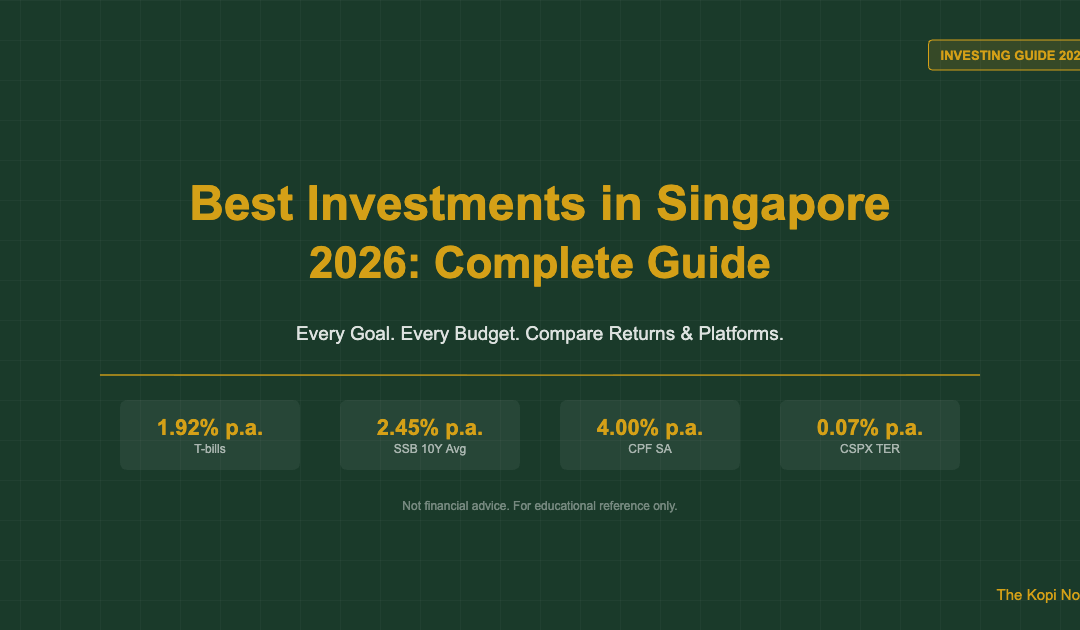
Best Investments in Singapore 2026: Complete Guide for Every Goal and Budget
From capital-safe T-bills and SSBs to long-term ETFs — Singapore’s 7 best investment options ranked by goal, risk, and budget.
The best investment in Singapore in 2026 depends entirely on your goal and timeline. For capital preservation: T-bills yield 1.92% p.a. and SSBs average 2.45% over ten years. For long-term wealth building: Ireland-domiciled UCITS ETFs like CSPX offer S&P 500 exposure at just 0.07% TER with no US estate tax risk. For guaranteed returns: CPF SA earns 4% p.a., making it one of the highest risk-free rates available to any Singapore resident.
Not financial advice. All figures are for educational reference only. Data verified as at 3 October 2026 unless noted. Past returns are not indicative of future results.
Table of Contents
Why the Best Investment Depends on Your Goal
There is no single best investment in Singapore. A 28-year-old building a retirement nest egg over 35 years has completely different needs from a 55-year-old protecting capital ahead of retirement. Equally, a fresh graduate investing SGD 200 per month cannot access the same instruments as a professional deploying a SGD 200,000 lump sum.
What makes Singapore unique is the depth of its risk-free options. Most countries offer government bonds at 1–2%. Singapore residents can stack CPF SA at a guaranteed 4% p.a. (floor extended to end-2027), SSBs at 2.45% ten-year average (November 2026 tranche), and T-bills at 1.92% p.a. (as at the September 2026 auction) — all sovereign-backed, zero credit risk. This changes the calculus for every portfolio.
On the growth side, Singapore investors have access to Ireland-domiciled UCITS ETFs on the London Stock Exchange — instruments that combine low costs, global diversification, and favourable tax treatment unavailable to US retail investors. The Ireland-US tax treaty caps withholding tax on US dividends at 15% (versus 30% for US-domiciled ETFs), and Ireland-domiciled ETFs carry no US estate tax risk for non-US persons regardless of holding size.
The right portfolio usually combines both: a capital-safe layer (T-bills, SSBs, CPF) providing predictable returns, and a growth layer (UCITS ETFs) providing long-term compounding. How you weight them depends on your timeline, income, and risk tolerance — factors we explore in the sections below.
The 7 Best Investment Options in Singapore Compared
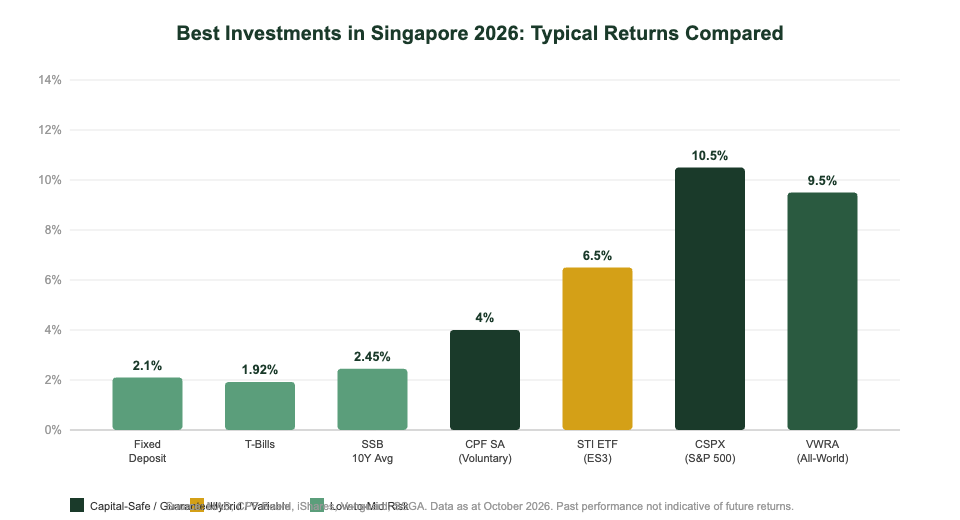
Here is a side-by-side comparison of the seven most commonly used investment options by Singapore retail investors in 2026. Data is sourced directly from MAS, CPF Board, iShares, Vanguard, SSGA, and official bank pricing pages.
| Option | Typical Return | Risk | Min. Invest | Liquidity | CPF / SRS? |
|---|---|---|---|---|---|
| Fixed Deposit | Up to 2.10% p.a. | Very Low | SGD 500 | Locked (3–12 mths) | No |
| Singapore T-Bills | 1.92% p.a. (Sep 2026) | Zero (Sovereign) | SGD 1,000 | 6-month lock-in | CPF OA, SRS |
| Singapore Savings Bonds | 2.45% avg 10Y (Nov 2026) | Zero (Sovereign) | SGD 500 | Fully redeemable | Cash only |
| CPF SA / RA Top-Up | 4.00% p.a. (guaranteed) | Zero (Government) | SGD 1 | Locked until 55/65 | CPF only |
| STI ETF (ES3) | ~5–8% long-term avg | Low–Medium | SGD 1 (via RSP) | High (exchange-traded) | CPFIS, SRS |
| CSPX (S&P 500 UCITS ETF) | ~8–13% long-term avg | Medium | ~USD 500–600 | High (exchange-traded) | SRS only |
| VWRA (All-World UCITS ETF) | ~7–12% long-term avg | Medium | ~USD 100–130 | High (exchange-traded) | SRS only |
Source: MAS T-bill auction results (Sep 2026), CPF Board (floor rate extended to end-2027), iShares CSPX factsheet (TER 0.07%), Vanguard VWRA (TER 0.22%), SSGA SPDR STI ETF factsheet (TER 0.30%), bank pricing pages (fixed deposits). Long-term ETF returns are historical averages and not a forecast. Data as at October 2026.
A few points deserve emphasis. First, CPF SA’s 4% p.a. guaranteed floor is extraordinary by any global standard — for money you will not need until retirement, it is genuinely difficult to beat. Second, the STI ETF’s CPFIS eligibility makes it the only Singapore-listed equity ETF you can buy inside CPF OA (after the SGD 20,000 set-aside). Third, for global equity exposure, CSPX and VWRA dominate because they avoid the 30% US withholding tax that applies to equivalent US-domiciled ETFs like VOO or VT.
Best Investment by Goal: Safety, Growth, Income, and Retirement
Goal 1: Capital Safety (Risk-Free Income)
If your priority is preserving capital and earning a predictable return — an emergency fund extension, a house deposit buffer, or pre-retirement capital — the Singapore government’s own instruments are hard to beat. The November 2026 SSB tranche offers a ten-year average of 2.45% p.a. with no lock-in (you can redeem in any month with interest paid to date). T-bills at 1.92% are slightly lower but settle in 6-month cycles, and CPF-OA funds can be deployed there for slightly higher return than the 2.5% OA rate.
For liquidity with zero risk, the SSB is currently the strongest option in Singapore. There is no capital gains tax on any of these instruments, and interest is not taxable for Singapore tax residents under the existing IRAS framework.
Goal 2: Long-Term Wealth Growth
For investors with a horizon of ten years or more, globally diversified UCITS ETFs listed on the London Stock Exchange have become the default choice for Singapore retail investors. Two ETFs dominate: CSPX (iShares Core S&P 500 UCITS ETF) tracks the 500 largest US companies at a TER of just 0.07% p.a., while VWRA (Vanguard FTSE All-World UCITS ETF) covers over 3,700 stocks across developed and emerging markets at 0.22% p.a.
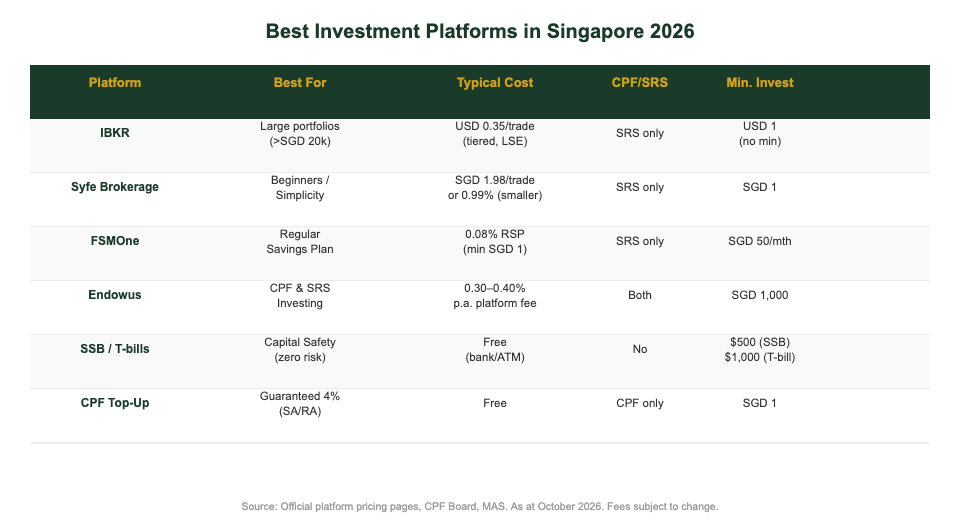
Both are accumulating ETFs — they reinvest dividends automatically, avoiding the need to pay the 15% withholding tax on each distribution. Both are Ireland-domiciled, meaning the Ireland-US tax treaty reduces withholding tax on US dividends to 15% (not 30%), and neither exposes non-US investors to US estate tax regardless of portfolio size. If you are building a long-term retirement portfolio and do not need CPF investment strategy complexity, a regular monthly purchase of CSPX or VWRA via IBKR or Syfe is one of the simplest and most cost-effective paths available.
Worked example: A Singapore investor purchasing SGD 1,000 of CSPX per month via IBKR (commission ~USD 0.35–1.70 per trade depending on size) pays roughly SGD 2–3 per order — under 0.3% transaction cost. At a long-term average return of 10% p.a. (not guaranteed), SGD 1,000/month over 20 years compounds to approximately SGD 765,000 (assuming 10% CAGR). The same SGD 1,000/month in fixed deposits at 2.10% produces about SGD 297,000 over the same period.
Goal 3: Passive Income
Singapore investors seeking regular distributions often turn to S-REITs, which are legally required to distribute at least 90% of taxable income to qualify for the tax-transparent treatment that makes their distributions tax-free in the hands of Singapore-resident investors. The REIT ETFs — CLR (Lion-Phillip S-REIT ETF) and SRT (NikkoAM-StraitsTrading Asia ex Japan REIT ETF) — bundle multiple REITs into a single holding, providing diversification with yields typically in the 4–6% range as at 2026. For a deeper look at the passive income angle, our passive income Singapore guide covers the exact REITs and target yields in detail.
Goal 4: Retirement and Tax Efficiency
Two instruments are specifically designed for Singapore retirement planning. CPF SA top-ups under the Retirement Sum Topping-Up (RSTU) scheme earn 4% p.a. and generate tax relief of up to SGD 8,000 per year (for self) plus SGD 8,000 for family members. SRS contributions — capped at SGD 15,300 per year for Singapore citizens and PRs — can be invested in T-bills, unit trusts, and LSE-listed ETFs via Endowus or FSMOne, and withdrawals after the statutory retirement age are 50% taxable, typically at a rate well below 7%. Using our Singapore retirement calculator will help you model exactly how much to target.
Best Investment by Budget
| Budget | Recommended First Step | Why |
|---|---|---|
| Under SGD 1,000 | SSBs or FSMOne RSP (SGD 50/mth min) | No lock-in, free to apply, sovereign-backed; RSP drip-feeds into ETFs |
| SGD 1,000 – SGD 10,000 | T-bills + VWRA via Syfe or FSMOne | T-bills cover near-term liquidity needs; VWRA builds long-term equity exposure |
| SGD 10,000 – SGD 50,000 | CPF SA top-up + CSPX via IBKR | Maximise the 4% guaranteed return first, then deploy remainder at low cost |
| Above SGD 50,000 | Full stack: CPF SA + SSB buffer + CSPX/VWRA via IBKR + SRS ETF | Layer by risk and timeline; IBKR’s flat commission makes large trades very cost-effective |
Source: TKN analysis. Not financial advice. All figures for educational reference only. October 2026.
How to Start Investing in Singapore — A 5-Step Plan
Regardless of where you are in the journey, the following sequence applies to virtually every Singapore investor starting out in 2026:
Step 1 — Build a 3–6 month emergency fund. Keep this in a high-yield savings account or SSB — fully liquid, zero risk. Do not invest emergency funds in equities.
Step 2 — Maximise CPF SA if eligible. If you are below 55 and have room below the Full Retirement Sum, a voluntary cash top-up to CPF SA earns 4% p.a. and generates tax relief. This is the highest guaranteed, risk-free return available to Singapore citizens and PRs. Read our CPF investment strategy guide for the exact mechanics.
Step 3 — Top up SRS annually. SGD 15,300 into SRS reduces your taxable income and can be invested in ETFs via Endowus or FSMOne. If you use the Endowus referral code, you’ll get a fee waiver bonus on initial deployment.
Step 4 — Open a brokerage for LSE ETFs. For most Singapore investors with a lump sum above SGD 10,000, IBKR offers the lowest per-trade cost for LSE-listed ETFs (CSPX, VWRA). For simplicity and smaller amounts, Syfe referral code gets you started with SGD 1.98 per trade and no minimum. Consider the Singapore REIT ETF guide if you want exposure to S-REITs via an ETF wrapper.
Step 5 — Dollar-cost average regularly. Set a fixed monthly amount — even SGD 200 — and buy CSPX or VWRA on a fixed schedule. Consistency over 20–30 years matters far more than market timing.
Disclaimer: The information above is for educational purposes only and does not constitute financial advice. Always consult a licensed financial adviser before making investment decisions. Past performance is not indicative of future returns. Data verified as at 3 October 2026.
Frequently Asked Questions
What is the best investment in Singapore for 2026?
The best investment depends on your goal. For capital safety: Singapore Savings Bonds (SSB) at 2.45% ten-year average (November 2026 tranche) or T-bills at 1.92% (September 2026 auction) are sovereign-backed and risk-free. For long-term growth: Ireland-domiciled UCITS ETFs like CSPX (TER 0.07%) or VWRA (TER 0.22%) provide global equity exposure with favourable tax treatment for Singapore investors. For guaranteed retirement income: CPF SA earns 4% p.a. — one of the highest guaranteed rates globally.
Is CPF or T-bills the better investment in Singapore?
CPF SA earns 4% p.a. (guaranteed, extended to end-2027) versus T-bills at approximately 1.92% (as at September 2026). CPF SA is clearly higher — but the trade-off is liquidity. CPF SA money is locked until age 55 (and then payable out gradually). T-bills mature in 6 months and are suitable for capital you may need sooner. The right answer depends on your timeline: for money you will not touch for 20+ years, CPF SA at 4% is essentially unbeatable on a risk-adjusted basis among Singapore instruments.
Can I invest in ETFs like CSPX using my SRS funds?
Yes. Singapore citizens and PRs can contribute up to SGD 15,300 per year into SRS, invest those funds in ETFs like CSPX or VWRA via Endowus or FSMOne, and enjoy deferred taxation on both the growth and eventual withdrawals. Withdrawals after the statutory retirement age (64 from 1 July 2026) are taxed at 50% of your applicable income tax rate — typically 0–7% for most retirees, making SRS one of Singapore’s most powerful tax-sheltered wrappers for ETF investing.
What is the best investment in Singapore for foreigners?
Foreigners (Employment Pass or S Pass holders) can invest in T-bills, fixed deposits, STI ETFs, LSE-listed UCITS ETFs (CSPX, VWRA), and unit trusts. They can also open SRS accounts (foreign cap: SGD 35,700 per year). CPF contributions for foreigners on EPs are generally not applicable. The most accessible and tax-efficient starting point for a foreigner is to open an IBKR account and invest in CSPX or VWRA — Ireland-domiciled ETFs avoid US estate tax and are available to any Singapore resident regardless of nationality.
How much money do I need to start investing in Singapore?
You can start from as little as SGD 50 per month through FSMOne’s Regular Savings Plan, or SGD 500 with Singapore Savings Bonds. For LSE-listed ETFs via IBKR, there is technically no minimum deposit, though the price of one unit of CSPX (around USD 500–600) is the practical floor. Syfe Brokerage allows fractional ETF purchases from SGD 1. CPF voluntary top-ups start from SGD 1. The key is to start early and invest consistently — even small amounts compound meaningfully over 20–30 years.
Are investment gains taxable in Singapore?
Singapore has no capital gains tax. Profits from selling ETFs, stocks, REITs, or any other investment are not taxable for individuals. Dividends from Singapore-listed REITs distributed to Singapore-resident unitholders are tax-exempt. Interest from T-bills, SSBs, and fixed deposits is also generally not taxable for Singapore tax residents. The only tax-related consideration for ETF investors is the withholding tax on foreign dividends — Ireland-domiciled UCITS ETFs reduce this to 15% on US-sourced dividends (versus 30% for US-domiciled ETFs), and accumulating ETFs defer this entirely by reinvesting rather than distributing.
Ready to Start Investing in Singapore?
Open a brokerage account and buy your first ETF or SSB today. Use our referral links for exclusive sign-up bonuses.
This article was researched with the help of AI. While we strive to keep all information accurate and up to date, there may be errors. If you notice any discrepancies, please contact us.