Best Credit Card for Travel in Singapore 2026: Miles vs Zero-FX-Fee Compared
The best credit card for travel in Singapore hinges on one overlooked figure: the 3.25% foreign transaction fee charged by virtually every miles card. At S$5,000 in annual overseas spend, that fee costs you S$162.50 — often more than the value of the miles you earn. This guide compares Singapore’s top travel credit cards across two camps: miles cards and zero-FX-fee cashback cards, so you can pick the one that genuinely saves you money. Data verified as at October 2026.
Not financial advice. All figures are for educational reference only. Data as at October 2026 unless noted.
Table of Contents
The Hidden Cost: What the 3.25% FX Fee Really Means
Almost every Singapore miles credit card charges a 3.25% foreign transaction fee on all overseas spending. This surcharge is applied on top of the Visa or Mastercard exchange rate — so you are paying for the privilege of spending in a foreign currency, even before a single mile is credited to your account.
Here is what the 3.25% FX fee looks like in practice for a Singapore traveller spending S$100 overseas on a typical miles card earning 2 miles per dollar (mpd):
- Miles earned: 200 miles, worth approximately S$2.60–S$3.00 if redeemed at 1.3–1.5 cents per mile
- FX fee charged: S$3.25
- Net outcome: you lose money on every overseas swipe unless you can redeem miles at 1.63 cents or above
The key insight is that miles cards are not automatically the best credit card for travel in Singapore — their value depends entirely on what you do with those miles. Frequent flyers who redeem business class seats at 2–4 cents per mile will always win. For everyone else, zero-FX-fee cashback cards often come out ahead on pure overseas spend.
| Annual Overseas Spend | FX Fee (3.25%) | Miles @ 2 mpd | Miles Value @ 1.5¢ | Miles Value @ 2¢ | Net @ 1.5¢ |
|---|---|---|---|---|---|
| S$1,000 | S$32.50 | 2,000 | S$30.00 | S$40.00 | –S$2.50 |
| S$5,000 | S$162.50 | 10,000 | S$150.00 | S$200.00 | –S$12.50 |
| S$10,000 | S$325.00 | 20,000 | S$300.00 | S$400.00 | –S$25.00 |
| S$20,000 | S$650.00 | 40,000 | S$600.00 | S$800.00 | –S$50.00 |
Source: TKN calculation based on published FX fee rates and typical miles valuation range (1.5¢–2.0¢ per mile). Data as at October 2026. Assumes 2.0 mpd earn rate.
Best Miles Credit Cards for Travel Singapore 2026
Miles cards reward you with air miles or transferable points for every dollar spent. For travel, the overseas earn rate and the annual fee are the two numbers that matter most. All cards below charge a 3.25% foreign transaction fee unless stated.
1. UOB PRVI Miles Card — Best for High Overseas Spenders
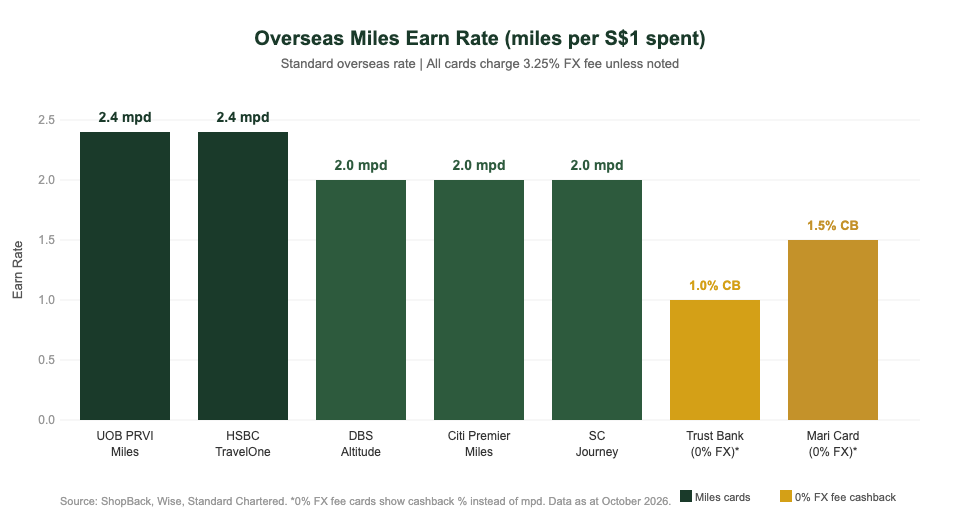
At 2.4 miles per S$1 overseas, the UOB PRVI Miles Card leads on raw earn rate among mainstream Singapore miles cards. It also offers 4 Priority Pass lounge visits per year and first-year annual fee waiver on its S$261.60 annual fee. The higher fee is offset if you spend S$60,000 or more annually — at that level, the 0.4 mpd difference over DBS Altitude translates to roughly 24,000 extra miles worth S$360–S$480 at typical valuations.
2. HSBC TravelOne — Best for Instant Redemption
HSBC TravelOne matches UOB PRVI at 2.4 mpd overseas with a lower annual fee of S$196.20. Its standout feature is instant mile redemption directly through the HSBC mobile app, bypassing the usual transfer lag to frequent flyer programmes. It includes 4 lounge visits annually and comprehensive travel insurance. If flexibility across multiple airline partners matters to you, TravelOne is a strong pick.
3. DBS Altitude Visa — Best for Flexibility
The DBS Altitude earns 2.0 mpd overseas and 3.0 mpd on online travel bookings through platforms like Expedia and Agoda — with no annual cap on that bonus rate. This makes it uniquely powerful for travellers who book all flights and hotels online. Annual fee is S$196.20 (waived first year), points never expire while the card is active, and you earn a 10,000-mile renewal bonus each year.
4. Citi PremierMiles Card — Best for Miles Preservation
Citi PremierMiles earns 2.0 mpd overseas at the same S$196.20 annual fee as DBS Altitude, but its strongest argument is stability: miles never expire and there are no caps on earning. For slower accumulators who bank miles over 2–3 years before redeeming a business class seat, Citi PremierMiles removes the anxiety of expiry cliffs. Welcome bonus of up to 30,000 miles for new cardholders.
5. Standard Chartered Journey — Best Miles Card with 0% FX*
SC Journey earns 2.0 mpd overseas and, uniquely, charges no FX fees when paired with a Standard Chartered Bonus$aver account. This makes it the only mainstream miles card in Singapore to offer the benefits of both worlds. Annual fee is approximately S$194.40 (S$180 + 9% GST). If you are willing to open a linked SC account, this card materially changes the miles-vs-cashback calculus in favour of miles.
| Card | Annual Fee | Local mpd | Overseas mpd | FX Fee | Lounge Visits |
|---|---|---|---|---|---|
| UOB PRVI Miles | S$261.60 | 1.4 | 2.4 | 3.25% | 4/yr |
| HSBC TravelOne | S$196.20 | 1.2 | 2.4 | 3.25% | 4/yr |
| DBS Altitude | S$196.20 | 1.2 | 2.0 (3.0 OTA) | 3.25% | 2/yr |
| Citi PremierMiles | S$196.20 | 1.2 | 2.0 | 3.25% | 2/yr |
| SC Journey* | ~S$194.40 | 1.2 | 2.0 | 0%* | 2/yr |
Source: ShopBack, Wise, Standard Chartered (accessed October 2026). *SC Journey 0% FX fee requires a linked Standard Chartered Bonus$aver Account. All other cards charge 3.25% FX fee on overseas transactions. mpd = miles per dollar spent.
Best Zero-FX-Fee Credit Cards for Travel Singapore 2026
Zero-FX-fee credit cards apply the Visa or Mastercard network exchange rate with no additional surcharge. For most Singapore travellers who spend S$5,000–S$15,000 overseas per year and do not actively redeem premium cabin flights, these cards will save more money than a miles card after the FX fee is accounted for.
Note: for pure FX rate efficiency at ATMs overseas, pairing any credit card with a YouTrip card (use a YouTrip referral code for sign-up bonuses) remains the most competitive combination — YouTrip charges 0% FX markup with no fees, making it better than any credit card for foreign currency ATM withdrawals.
1. Trust Bank Cashback Card — Best All-Rounder No-FX Card
The Trust Bank Cashback Card charges 0% foreign transaction fee and earns 1% unlimited cashback on all spend worldwide. Annual fee is S$0, income requirement is accessible, and the card is issued on the Visa network so acceptance is near-universal. For Singapore travellers who want a simple, low-friction travel card that earns something on every swipe, Trust Bank is the default recommendation. New applicants can use Trust Bank referral code HTWYQP95 for a sign-up bonus.
2. Mari Credit Card — Best for Slightly Higher Cashback
The Mari Credit Card earns 1.5% unlimited cashback at 0% FX fee, capped at S$1,500 per month in overseas spending. Annual fee is S$0. For a traveller spending S$10,000 overseas annually, that works out to S$150 cashback with zero FX cost — compared to a net loss of S$25 on a 2.0 mpd miles card (at 1.5¢/mile). The 1.5% rate is among the highest flat-rate overseas cashback in Singapore for a no-fee card.
3. UOB EVOL Card — Best for Digital Natives
UOB EVOL charges 0% FX fee and earns up to 1% cashback on overseas spend, with the annual fee waived when you make 3 eligible transactions per month. The card targets younger users and integrates well with digital payment wallets. It is a solid secondary card for overseas use if you already hold a UOB primary account.
| Card | Annual Fee | FX Fee | Overseas Earn Rate | Best For |
|---|---|---|---|---|
| Mari Credit Card | S$0 | 0% | 1.5% cashback* | Highest cashback, no fee |
| Trust Bank Cashback | S$0 | 0% | 1% cashback | Simplicity, no cap |
| UOB EVOL | S$0 (cond.) | 0% | 1% cashback | UOB customers |
Source: MoneySmart, bank websites (accessed October 2026). *Mari Credit Card 1.5% cashback capped at S$1,500/month overseas spending.
If you are deciding between a YouTrip or Revolut card versus a credit card for overseas spending, the key distinction is that YouTrip and Revolut are prepaid multi-currency debit cards — they offer better FX rates than credit cards but earn no cashback or miles. Many savvy Singapore travellers pair a 0% FX credit card for everyday overseas POS spending with YouTrip or Wise for ATM withdrawals.
The Break-Even: When Do Miles Cards Come Out Ahead?
The chart below shows the annual dollar cost of the 3.25% FX fee versus the value of miles earned at two redemption rates: 1.5 cents per mile (economy class / transfers) and 2.0 cents per mile (premium economy or business class). A miles card only makes financial sense on overseas spending when your redemption rate exceeds the break-even of 1.63 cents per mile — that is the point where 2.0 mpd at S$1 generates S$3.26 in miles value, just covering the S$3.25 FX fee.
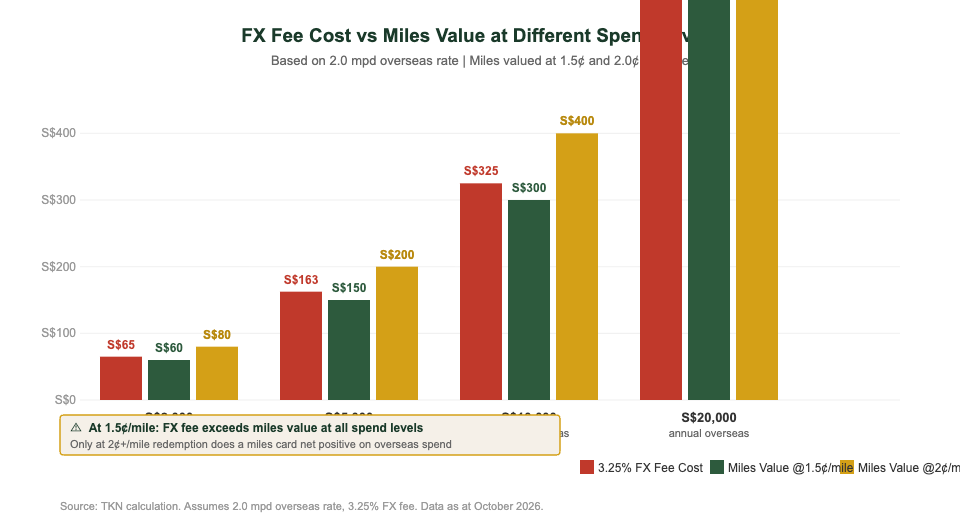
In practice, most Singapore flyers redeemed KrisFlyer miles for economy class at 0.9–1.4 cents per mile in 2025–2026 based on community data shared on The MileLion and Seedly forums. Business class redemptions through KrisFlyer, Asia Miles, or Avios can reach 2–4 cents per mile, making miles cards clearly worthwhile for this segment. For everyone else — the majority of travellers — the case for zero-FX-fee cashback cards is mathematically strong.
A useful rule of thumb: if you cannot confidently redeem your miles at above 1.7 cents per mile, the best credit card for overseas spending in Singapore from a pure cost standpoint is a 0% FX fee cashback card. If you can and do redeem business class tickets, a miles card at 2.4 mpd overseas (UOB PRVI or HSBC TravelOne) will save you considerably more over time.
Which Travel Card Should You Pick? (Decision Guide)
Here is a practical framework for Singapore travellers choosing between miles cards and zero-FX-fee cards:
Pick a miles card (UOB PRVI or HSBC TravelOne) if:
- You fly at least twice a year internationally and aspire to business or premium economy redemptions
- You can confidently redeem miles at 1.7 cents per mile or above
- You spend S$60,000+ annually (local and overseas combined) — the miles accumulation outpaces the FX cost
- You already have a miles card habit and are optimising which card to use overseas
Pick a zero-FX-fee card (Mari Credit Card or Trust Bank) if:
- You travel 1–4 times per year and spend S$3,000–S$15,000 overseas annually
- You do not actively redeem air miles and your miles tend to expire unused
- You prefer simplicity — cashback appears on your statement, miles require programme logins and transfer waits
- You want a fee-free card with no annual commitment
The hybrid approach (recommended for most travellers):
Use a miles card (DBS Altitude or HSBC TravelOne) for online travel bookings — where earn rates hit 2.4–3.0 mpd and the 3.25% FX fee is often built into OTA pricing anyway. Pair it with a zero-FX-fee card (Mari or Trust Bank) for all other overseas point-of-sale spending. Add a YouTrip multi-currency card for ATM withdrawals and smaller purchases where you need the tightest possible FX rate.
If you are looking to build passive income and want your savings working harder while you travel, consider reading our Singapore retirement planning calculator or our guide on generating passive income in Singapore. Travel card rewards are just one piece of a broader personal finance strategy.
For those who already bank with Wise, the Wise Singapore card is also worth comparing — it charges no FX markup up to S$1,500/month (thereafter 0.5%) and converts at the real mid-market rate, which beats both zero-FX credit cards and YouTrip in most currency pairs.
Frequently Asked Questions
Do all Singapore credit cards charge a foreign transaction fee?
No. Most miles cards from DBS, UOB, Citibank, and HSBC charge a 3.25% foreign transaction fee on overseas spending. However, some cashback cards — including Trust Bank, Mari Credit Card, and UOB EVOL — charge 0% FX fee. The Standard Chartered Journey also waives the FX fee when paired with a Bonus$aver account. Data verified as at October 2026.
Is it worth getting a miles card just for overseas travel in Singapore?
For most Singapore travellers, a miles card is worth it only if you actively redeem miles at above 1.63 cents per mile — the break-even against the 3.25% FX fee at 2.0 mpd. Business class redemptions via KrisFlyer, Avios, or Asia Miles typically achieve 2–4 cents per mile, making miles cards clearly worth it for this group. For economy class redemptions (typically 0.9–1.4 cents per mile), zero-FX-fee cashback cards save more money on overseas spend alone.
What is the best no-FX-fee credit card in Singapore in 2026?
As at October 2026, the Mari Credit Card offers the highest overseas cashback rate at 1.5% with 0% FX fee and no annual fee (capped at S$1,500/month overseas spend). Trust Bank Cashback Card is the best all-rounder at 1% unlimited cashback with 0% FX fee and no annual fee. UOB EVOL is a strong choice for UOB customers. For travellers who want a miles card with 0% FX, the SC Journey (paired with Bonus$aver account) is the only mainstream option.
Can I use the Trust Bank credit card overseas?
Yes. The Trust Bank Cashback Card is issued on the Visa network and is accepted at merchants worldwide that accept Visa. It charges 0% foreign transaction fee, so you pay only the Visa exchange rate with no surcharge. New applicants can use Trust Bank referral code HTWYQP95 for a sign-up bonus. Note that Trust Bank is a digital bank licensed by MAS in Singapore.
How do I calculate if a miles card is worth it for my travel spending?
Use this formula: multiply your annual overseas spend by the FX fee rate (3.25%) to get your annual FX cost. Then calculate the miles you would earn (spend × mpd) and estimate their value at your typical redemption rate. If miles value exceeds FX cost, the miles card wins. Example: S$10,000 overseas spend × 3.25% = S$325 FX fee. At 2.0 mpd, you earn 20,000 miles. At 1.5¢/mile, that is S$300 — a net S$25 loss. At 2¢/mile, that is S$400 — a net S$75 gain.
Should I use a multi-currency card like YouTrip instead of a credit card overseas?
YouTrip, Wise, and Revolut are multi-currency prepaid/debit cards — not credit cards. They typically offer the tightest FX rates (close to the interbank mid-market rate) with low or no fees, but they do not earn miles or cashback. Most Singapore financial advisors recommend a hybrid approach: use a miles or cashback credit card for everyday overseas purchases (where you earn rewards), and use YouTrip or Wise for ATM withdrawals and transactions where the FX rate matters most. See our comparison of Revolut vs YouTrip for more detail.
This article was researched with the help of AI. While we strive to keep all information accurate and up to date, there may be errors. If you notice any discrepancies, please contact us.