FIRE Singapore: The Number You Actually Need
How CPF LIFE changes your investable corpus target — and why Singapore’s path to financial independence looks nothing like the US playbook
- Singapore FIRE is not the US 4% rule applied to your full expenses. CPF LIFE is your income floor — you only need investments to cover the gap.
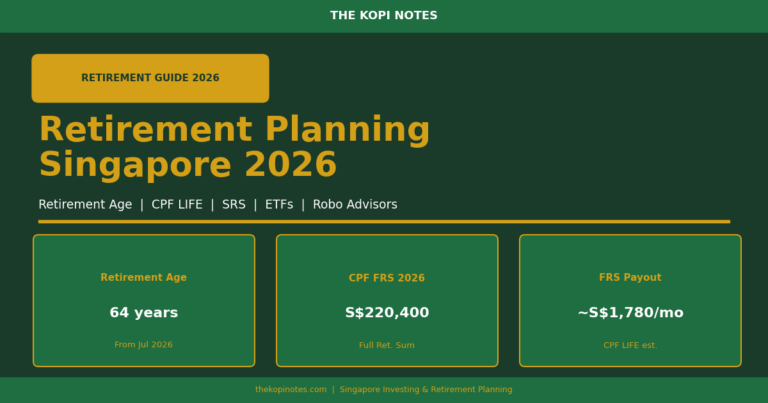
- At FRS ($220,400), CPF LIFE pays ~$1,600–$1,900/month at 65. At ERS ($440,800), it pays ~$3,300–$3,900/month.
- The formula: Investable corpus = (Monthly expenses − CPF LIFE payout) × 12 × 25
- For a $5,000/month lifestyle with FRS CPF LIFE (~$1,750/mo), you need ~$975,000 in investments — not $1.5 million.
- HDB home ownership, no car, and SG’s healthcare subsidies make a comfortable FIRE lifestyle cheaper than most Western cities.
- Your actual FIRE number depends on your CPF payout tier and your target monthly expenses. Use the calculator at the end of this article.
Why the US 4% Rule Gives Singapore Residents the Wrong Number
Open any Western FIRE blog and you will find the same formula: save 25 times your annual expenses, then withdraw 4% per year and never run out of money. The math is clean and the Trinity Study that backs it is well-researched. But it was built for Americans who retire with Social Security representing a fraction of their income and no forced retirement savings scheme to speak of.
Singapore is different. Every employed resident feeds a mandatory savings system — the CPF — that converts, at 65, into a lifetime income stream called CPF LIFE. That income stream is guaranteed by the Government of Singapore. It does not run out. It is not correlated with stock market returns. And it is not optional.
This means that a Singaporean pursuing financial independence already has a guaranteed income floor baked into their retirement — they just need to fund the gap between that floor and their target monthly spending. That gap is what the investable portfolio must cover. This fundamentally changes the size of the number you need.
If you target $5,000 a month in retirement and CPF LIFE pays you $1,750, you only need investments to cover $3,250 a month — not $5,000. Applied to the 4% rule, that gap becomes $975,000 in investments, not $1,500,000. The difference is more than half a million dollars and could mean retiring years earlier.
This is what we mean by “the Singapore FIRE number”: it is the investable corpus you personally need, after accounting for CPF LIFE. Not the US number. Your number.
For context on how Singapore compares to other Asia-Pacific markets, see our FIRE Number Asia-Pacific Index 2026.
CPF LIFE: Your Guaranteed Income Floor
CPF LIFE (Lifelong Income For the Elderly) is a national longevity insurance annuity. When you turn 55, your CPF savings are moved to a Retirement Account. At 65 (or any age from 65 to 70, if you defer for a higher payout), CPF LIFE starts paying you every month — for life. The payout depends on how much you have in your Retirement Account.
There are three retirement sum tiers, revised annually by CPF Board. As at September 2026:
| Retirement Sum Tier | Amount | CPF LIFE Standard Plan (monthly at 65) | Who typically hits this |
|---|---|---|---|
| Basic Retirement Sum (BRS) | $110,200 | ~$900–$1,000/month | Pledged or retained property; leaner lifestyle |
| Full Retirement Sum (FRS) | $220,400 | ~$1,600–$1,900/month | Default for most steady earners; recommended baseline |
| Enhanced Retirement Sum (ERS) | $440,800 | ~$3,300–$3,900/month | Higher earners who top up voluntarily for maximum payout |
Source: CPF Board, as at September 2026. Payouts are estimates for the Standard Plan at age 65. Escalating and Basic plans will differ. See cpf.gov.sg for the most current figures.
Three things to note: First, these payout ranges are estimates — actual payouts depend on your exact Retirement Account balance at 65. Second, deferring CPF LIFE to 68 or 70 increases the monthly payout by roughly 6–7% per year of deferral. Third, the ERS is now set at four times the BRS (raised from 3× in 2025), giving high earners more room to top up and receive a larger guaranteed income.
For most Singaporean FIRE aspirants, FRS is the planning anchor: a typical mid-career professional who hits FRS will receive roughly $1,600–$1,900 per month at 65, which we will use as ~$1,750 (the midpoint) throughout our worked examples below.
The Singapore FIRE Number Formula
The formula is simple once you understand that CPF LIFE reduces your investment requirement:
The “× 12 × 25” is equivalent to dividing the annual gap by 4% — it is the standard 4% safe withdrawal rate applied only to the portion of expenses not covered by CPF LIFE. If your CPF LIFE payout will exceed your target monthly expenses, the formula gives zero — you are already FIRE-funded through CPF alone, though most Singaporeans will still want a buffer portfolio for healthcare, travel, and inflation variability.
A few caveats worth being explicit about: The 4% withdrawal rate is derived from US historical data. Singapore’s investment universe may behave differently, and a 3.5% withdrawal rate is a more conservative planning assumption many SG-based fee-only advisers use. We use 4% here for comparability, but the tool linked below lets you vary the rate.
What Does It Actually Cost to Live in Singapore?
Your FIRE number is personal — it depends entirely on your target lifestyle in retirement. Singapore’s cost of living is high by global standards, but the picture is nuanced. HDB ownership removes rent as a recurring cost, the MRT makes car-free living practical, and government healthcare subsidies (Medishield Life, CHAS cards, Community Health Assist) dramatically reduce out-of-pocket medical bills for residents. Here is a realistic monthly cost-of-living spectrum as at 2026:
| Expense Category | Lean (HDB, no car) | Comfortable (HDB, no car) | Fat FIRE (Condo/car) |
|---|---|---|---|
| Housing (owned HDB / condo fees) | $200–$400 | $400–$700 | $1,500–$3,500 |
| Food (hawker / home cooking) | $400–$600 | $700–$1,200 | $1,500–$2,500 |
| Transport (MRT/bus or car) | $80–$150 | $150–$300 | $1,800–$3,000 |
| Utilities, telco | $150–$200 | $200–$350 | $350–$600 |
| Healthcare (after subsidies) | $100–$200 | $200–$400 | $400–$800 |
| Leisure, travel, misc. | $200–$400 | $800–$1,500 | $2,000–$4,000 |
| Total (per person) | ~$1,200–$2,000/mo | ~$2,500–$4,500/mo | ~$7,500–$14,000/mo |
Estimates based on MAS CPI data, HDB resale levies, and LTA transport survey data, as at 2026. Actual figures vary significantly by household size and lifestyle.
The biggest lever is transport. A car in Singapore costs $1,800–$3,000 per month when you factor in COE amortisation, road tax, petrol, insurance, and parking. Choosing a car-free lifestyle — entirely practical in Singapore given MRT coverage — can reduce your monthly burn by over $2,000, which cuts your FIRE number by $600,000 at the 4% rule. Very few cities in the world make a car-free retirement lifestyle this comfortable.
A Worked SGD Example: Chen Wei’s FIRE Plan
Let us put the formula to work. Chen Wei is 35 years old, a mid-career professional who owns an HDB flat (fully paid off by 65). He is targeting a retirement lifestyle of $5,000 per month: hawker food plus occasional restaurant meals, MRT travel, annual family holiday, and comfortable but not extravagant spending.
- Target monthly expenses at 65: $5,000
- Projected CPF LIFE (FRS, Standard Plan, at 65): ~$1,750/month
- Monthly gap to fund from investments: $5,000 − $1,750 = $3,250
- Annual gap: $3,250 × 12 = $39,000
- Investable corpus required (4% SWR): $39,000 ÷ 4% = $975,000
If Chen Wei had applied the raw US 4% rule to his full $5,000/month target, he would have calculated: ($5,000 × 12) ÷ 4% = $1,500,000. The Singapore FIRE number is $525,000 lower — more than 35% less — because CPF LIFE is doing part of the job.
At a 30% savings rate and a 7% nominal annual return on investments, Chen Wei needs roughly 18–20 years to reach $975,000 from scratch. He could reach FIRE as early as 53–55 — a decade before the CPF LIFE payout even starts. During that window (age 55–65), his portfolio funds the full $5,000/month; once CPF LIFE kicks in, his drawdown rate drops to $3,250/month, extending portfolio longevity significantly.
Singapore FIRE Variants: Which Flavour Fits You?
Not everyone is chasing the same endpoint. The Singapore FIRE movement encompasses several variants that look quite different from each other:
Lean FIRE Singapore: Targeting $2,000–$3,000 per month — hawker meals, HDB living, minimal leisure spending. At FRS CPF LIFE (~$1,750/mo), the investment gap is tiny: $250–$1,250/month, meaning an investable corpus of just $75,000–$375,000. Achievable for many in their 40s. The risk: healthcare inflation and unexpected expenses have less buffer. See our guide to financial independence in Singapore for a full breakdown of FI tiers.
Regular FIRE Singapore: The $4,000–$6,000/month bracket — the most common target for mid-career professionals. At FRS CPF LIFE, the investable gap is $2,250–$4,250/month, requiring $675,000–$1,275,000 in investments. Achievable but requires disciplined saving and a 15–25 year runway.
Fat FIRE Singapore: $8,000–$15,000/month — condo living, car or generous travel budget, private healthcare. At FRS CPF LIFE, you need $1,875,000–$4,125,000 in investments. Even at ERS CPF LIFE (~$3,600/mo), Fat FIRE still requires substantial investable assets. This is the territory where the SG income floor helps proportionally less.
Coast FIRE Singapore: You have invested enough early that compound growth will fund your retirement without further contributions — you can “coast” by covering just your current living expenses. In Singapore, the Coast FIRE corpus is smaller than in most markets because CPF LIFE reduces what the invested corpus needs to produce. Many Singaporeans find they have already Coast FIREd by 45 without knowing it.
Barista FIRE Singapore: Semi-retirement — you stop full-time employment but do part-time or passion work that covers day-to-day expenses, letting your portfolio grow untouched until you need it. Singapore’s gig economy, retail, F&B, and tuition sectors are natural Barista FIRE paths. The key advantage: CPF contributions continue, further building your CPF LIFE payout even during semi-retirement.
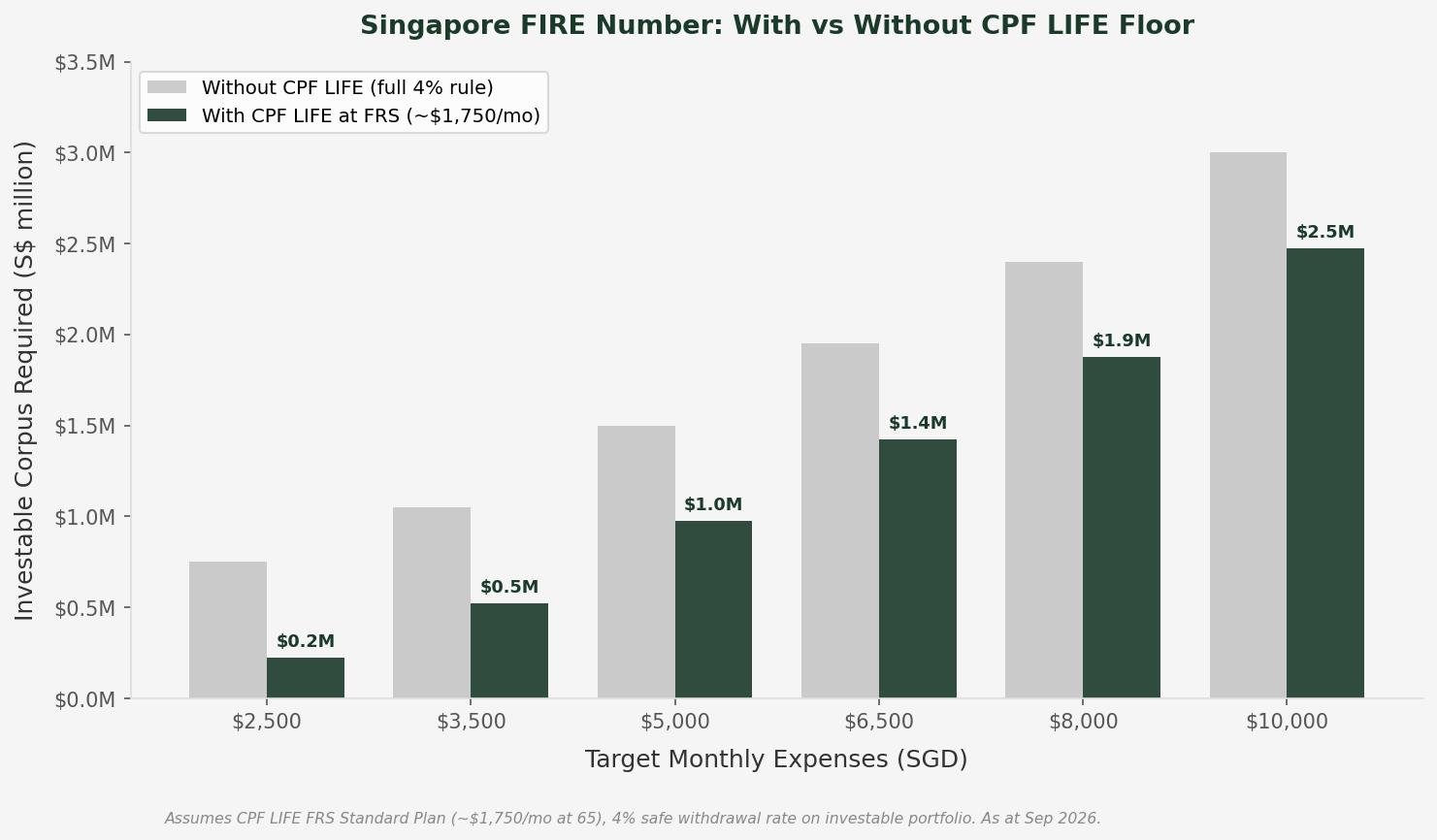
Chart: FIRE investable corpus required at different monthly expense targets — with and without the CPF LIFE FRS income floor (~$1,750/mo). As at Sep 2026.
How Your Savings Rate Gets You There Faster
The second major variable — after your FIRE number — is how fast you can accumulate the corpus. Savings rate is the most powerful lever. Higher savings rate means both faster accumulation and lower expenses to cover in retirement (because you have been living on less). The combination is multiplicative, not additive.
| Savings Rate | Years to FIRE (no CPF floor) | Years to FIRE (with FRS CPF LIFE, $5K/mo expenses) | CPF acceleration (years saved) |
|---|---|---|---|
| 20% | ~37 years | ~29 years | 8 years |
| 30% | ~28 years | ~21 years | 7 years |
| 40% | ~22 years | ~16 years | 6 years |
| 50% | ~17 years | ~12 years | 5 years |
| 60% | ~12 years | ~9 years | 3 years |
Assumes 5% real annual investment return; 4% safe withdrawal rate; $5,000/month expenses; CPF LIFE FRS payout $1,750/month from age 65. For illustration only.
For the investable portfolio itself, Singapore residents typically use a combination of: Singapore Savings Bonds (SSB) for the risk-free portion, low-cost global index funds via SGX or international brokers, REITs for income (SG REITs offer favourable tax treatment for individuals), and Supplementary Retirement Scheme (SRS) contributions for tax deferral. Passive income structures — dividends, rental income, bond coupons — are popular overlays for those who want cash flow before CPF LIFE starts.
What About OA and SA — Not Just RA?
Many FIRE calculators focus only on the Retirement Account (RA), but your CPF Ordinary Account (OA) and Special Account (SA) — or the merged account after 55 — also matter. At 55, balances above the FRS threshold in your CPF RA can be withdrawn in cash (you keep the FRS amount locked for CPF LIFE). This withdrawn cash is part of your investable asset base. For those who have saved diligently in SA, this creates a significant lump sum available at 55 that can go into investments and fund the gap years between early retirement and CPF LIFE commencement at 65.
Similarly, if you retire before 55, you have no CPF LIFE income yet. The bridge period — from early retirement to 65 — must be funded entirely from your investable portfolio. The FIRE number for the bridge period is larger than the post-65 number, which is why many SG FIRE planners model two phases: the drawdown-only phase (pre-65) and the reduced-drawdown phase (post-65 with CPF LIFE).
→ CPF FIRE Number Calculator — Enter your monthly expenses, CPF payout tier, and target retirement age. Get your personalised investable corpus target instantly.
→ Financial Independence Singapore — Full Guide
→ What Is Coast FIRE Singapore?
→ Barista FIRE Singapore Explained
Disclaimer: This article is for general information only and does not constitute financial advice. CPF payout figures are estimates from CPF Board as at September 2026 and will change with future policy reviews. Your actual retirement income will depend on your individual CPF balance, contribution history, and the plan you choose. Please consult a licensed financial adviser before making retirement planning decisions.
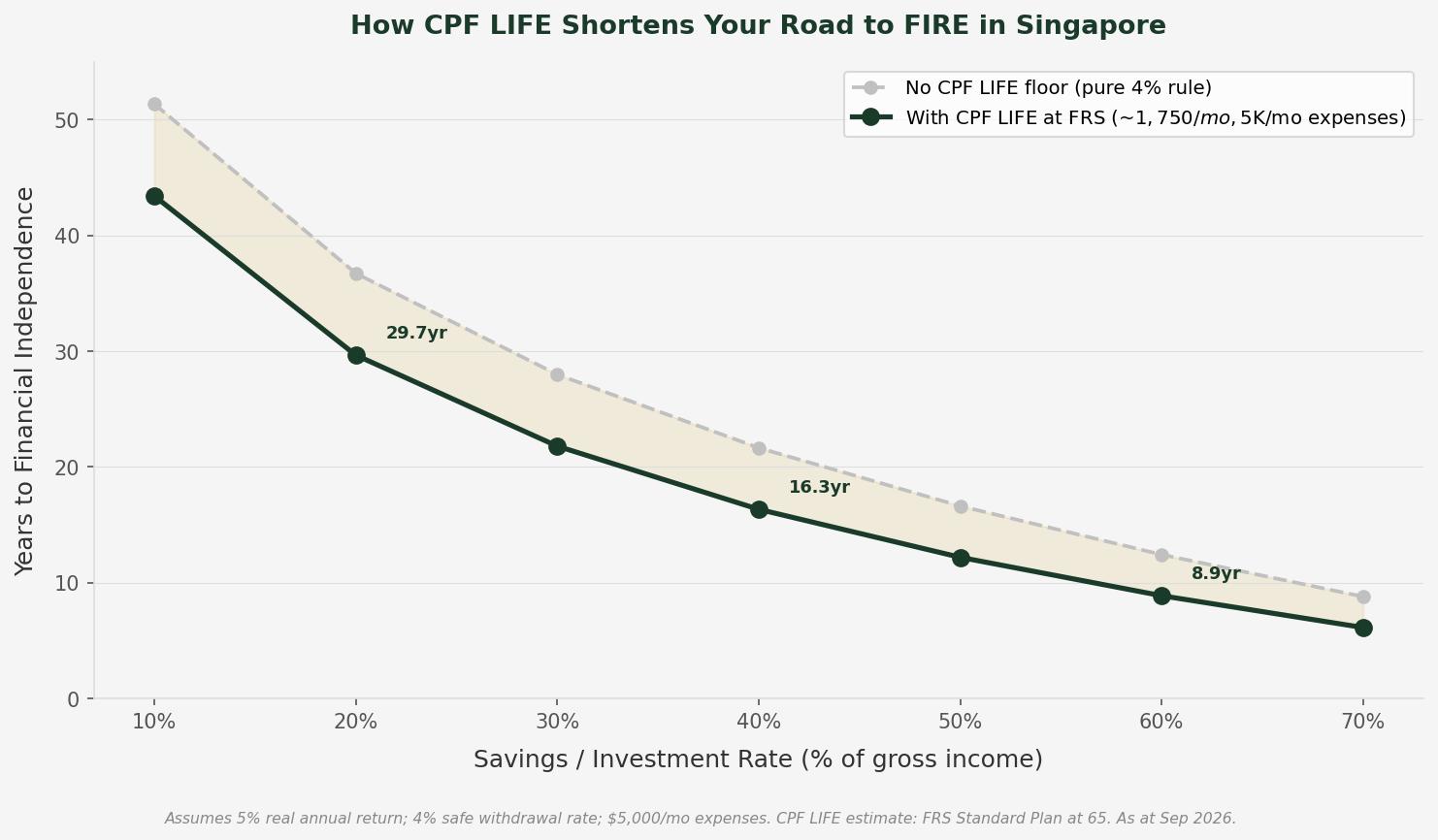
Chart: Years to financial independence at different savings rates — with vs without CPF LIFE FRS income floor. Assumes $5,000/month expenses, 5% real return, 4% SWR. As at Sep 2026.
Frequently Asked Questions
What is the FIRE number formula for Singapore?
How much CPF LIFE will I actually receive at 65?
Can I retire early in Singapore before CPF LIFE starts at 65?
Is the 4% safe withdrawal rate appropriate for Singapore?
Does owning an HDB flat affect my FIRE number?
What investments should I use to build my FIRE portfolio in Singapore?
What is Coast FIRE in Singapore and how is it different from regular FIRE?
How does inflation affect my Singapore FIRE number?
Ready to Calculate Your Singapore FIRE Number?
Enter your monthly expenses, choose your CPF payout tier, and get your personalised investable corpus target — in seconds.
This article was researched with the help of AI. While we strive to keep all information accurate and up to date, there may be errors. If you notice any discrepancies, please contact us.