IWDA ETF Singapore: Complete Guide to the iShares MSCI World ETF (2026)
A Singapore investor’s complete guide — tax advantages, step-by-step broker instructions, cost comparison, and 2026 data.
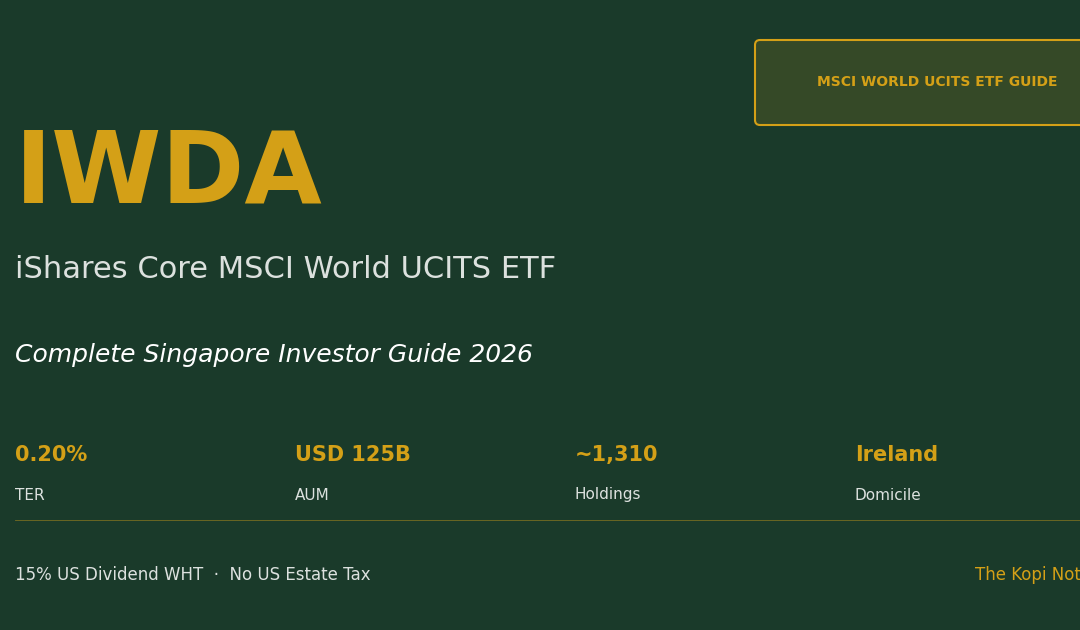
IWDA (LSE: IWDA) is the iShares Core MSCI World UCITS ETF — an Ireland-domiciled, accumulating fund tracking 1,310 large and mid-cap stocks across 23 developed markets. Singapore investors favour it over US-listed equivalents like VT or VOO because the Ireland domicile cuts US dividend withholding tax from 30% to 15% and eliminates US estate tax exposure entirely, making it one of the most tax-efficient global equity ETFs available to Singapore residents.
Not financial advice. All figures are for educational reference only. Data as at April 2026 unless noted.
What Is IWDA?
IWDA is the ticker for the iShares Core MSCI World UCITS ETF — one of the world’s largest exchange-traded funds, managed by BlackRock under the iShares brand. The fund is listed on the London Stock Exchange (LSE) under the ticker IWDA (USD share class) and SWDA (GBP share class). Both are the same underlying fund; Singapore investors typically trade the IWDA ticker using USD to avoid unnecessary currency conversion.
The fund tracks the MSCI World Index, which covers approximately 1,310 large and mid-capitalisation companies across 23 developed market countries — including the United States (which makes up roughly 70% of the index), Japan, the United Kingdom, France, Canada, and Switzerland. It does not include emerging markets like China, India, or Brazil — for those, you would need an all-world fund such as VWRA.
IWDA is an accumulating ETF, meaning it reinvests all dividends back into the fund rather than paying them out. For Singapore investors, this is highly efficient: there is no dividend income to declare, and compounding occurs automatically without requiring manual reinvestment.
The fund was launched in 2009 and has grown to one of the largest UCITS ETFs globally, with an AUM of approximately USD 125 billion as at Q1 2026 (source: BlackRock iShares factsheet, April 2026). This scale gives the fund exceptional liquidity and tight bid-ask spreads on the LSE — important for investors making regular purchases.
Key Facts at a Glance
| Metric | Detail |
|---|---|
| Full Name | iShares Core MSCI World UCITS ETF USD (Acc) |
| Ticker (LSE) | IWDA (USD) / SWDA (GBP) |
| ISIN | IE00B4L5Y983 |
| Index Tracked | MSCI World Index (23 developed markets) |
| Domicile | Ireland (UCITS) |
| Structure | Accumulating (dividends reinvested) |
| TER (Expense Ratio) | 0.20% p.a. |
| AUM | ~USD 125 billion (as at Q1 2026) |
| Number of Holdings | ~1,310 |
| Currency | USD (IWDA) / GBP (SWDA) |
| Exchange | London Stock Exchange (LSE) |
| Launch Year | 2009 |
Source: iShares / BlackRock factsheet, April 2026
Why Singapore Investors Buy IWDA on the London Stock Exchange
The reason Singapore investors specifically seek out the LSE-listed IWDA over comparable US-domiciled ETFs such as VTI or ACWI (listed on NYSE) comes down to two critical tax differences that can meaningfully impact long-term returns.
1. Lower Withholding Tax on US Dividends
Because IWDA is domiciled in Ireland, it benefits from the Ireland-US tax treaty, which reduces US dividend withholding tax (WHT) from 30% to 15%. For context, the MSCI World Index has roughly 70% US exposure. A Singapore investor holding a US-domiciled global ETF would have 30% of US dividends withheld at source — nearly double what IWDA pays. Over a 20-to-30-year investment horizon and on a large portfolio, this 15% saving compounds significantly.
To illustrate with a concrete example: a Singapore investor holding SGD 100,000 in IWDA and receiving an annual dividend yield of approximately 1.5% would earn ~SGD 1,500 in gross dividends. At 15% WHT, SGD 225 is withheld. Had they held a US-domiciled equivalent at 30% WHT, SGD 450 would be withheld — an extra SGD 225 lost annually, or over SGD 6,750 in lost returns over 30 years (before compounding effects). On a SGD 500,000 portfolio, this difference becomes substantial.
2. No US Estate Tax Exposure
Non-US investors (including Singaporeans) are subject to US estate tax on US-situs assets — including US-listed ETFs — above USD 60,000. For a Singapore investor with USD 500,000 in a US-domiciled ETF, the estate tax exposure at death could be substantial. Ireland-domiciled ETFs like IWDA are not US-situs assets and therefore carry no US estate tax risk, regardless of the portfolio size.
Singapore itself has no estate duty (abolished in 2008) and no capital gains tax, making the combination of Singapore residency + Ireland-domiciled UCITS ETF exceptionally tax-efficient for long-term global equity investors.
| ETF Type | Domicile | US Dividend WHT | US Estate Tax Risk |
|---|---|---|---|
| IWDA (LSE) | Ireland | 15% | None |
| VTI / ACWI (NYSE) | USA | 30% | Yes (above USD 60k) |
| VWRA (LSE) | Ireland | 15% | None |
Source: IRS (US estate tax), Ireland-US Double Taxation Agreement. As at April 2026.
For a deeper dive into how this tax structure works, our guide to US estate tax for Singapore investors covers the full mechanics — but the short version is: buy Irish-domiciled UCITS ETFs on the LSE, not US-listed equivalents on NYSE or NASDAQ.
Expense Ratio and Total Costs
IWDA’s Total Expense Ratio (TER) is 0.20% per annum. This is deducted from the fund’s NAV daily and is not charged separately — you simply see slightly less growth than the underlying index. On a SGD 50,000 portfolio, the annual management cost works out to approximately SGD 130 per year (SGD 50,000 × 0.20% × current USD/SGD rate ~1.30 ≈ SGD 130). This is extremely competitive for a fund providing exposure to over 1,300 companies across 23 countries.
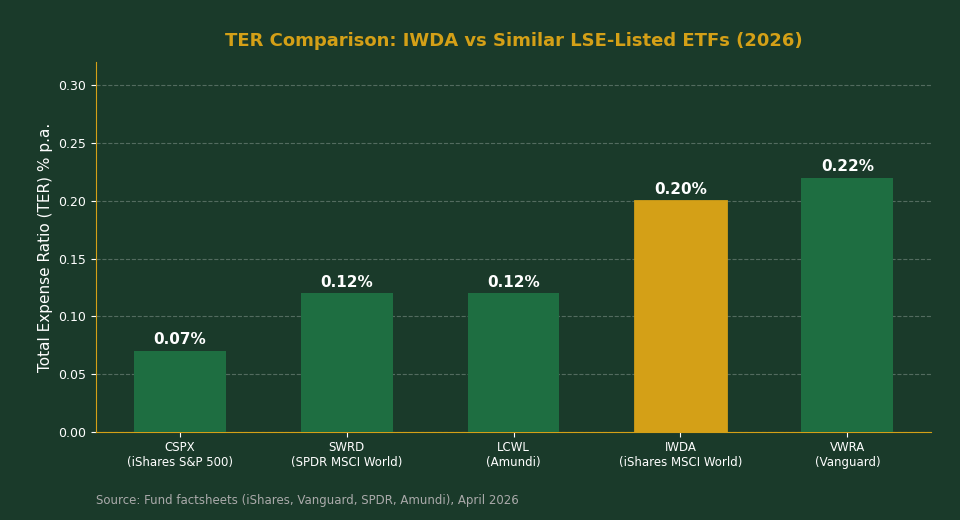
How does 0.20% compare? It’s higher than CSPX (which tracks only the S&P 500 at 0.07%) but meaningfully cheaper than many unit trusts and robo-advisory funds that charge 0.5%–1.0% for similar diversification. The trade-off is breadth: IWDA gives you Japan (6%), UK (4%), France (3%), and the rest of developed markets — not just US stocks.
For a Singapore investor’s true cost, the TER is only part of the picture. You also need to factor in broker trading commissions (typically USD 1–3 per trade on IBKR) and the bid-ask spread on LSE (typically 0.02%–0.05% for IWDA given its size and liquidity). On a lump-sum purchase of SGD 10,000, total transaction costs at IBKR would be well under SGD 10 — negligible relative to the annual holding cost.
How to Buy IWDA in Singapore (Step-by-Step)
IWDA is listed on the London Stock Exchange and is not available through CDP-linked local brokers like DBS Vickers or POEMS for LSE trading. You will need an international broker. Here are the best options for Singapore investors, from most cost-effective to most beginner-friendly.
Option 1: Interactive Brokers (IBKR) — Best for Cost
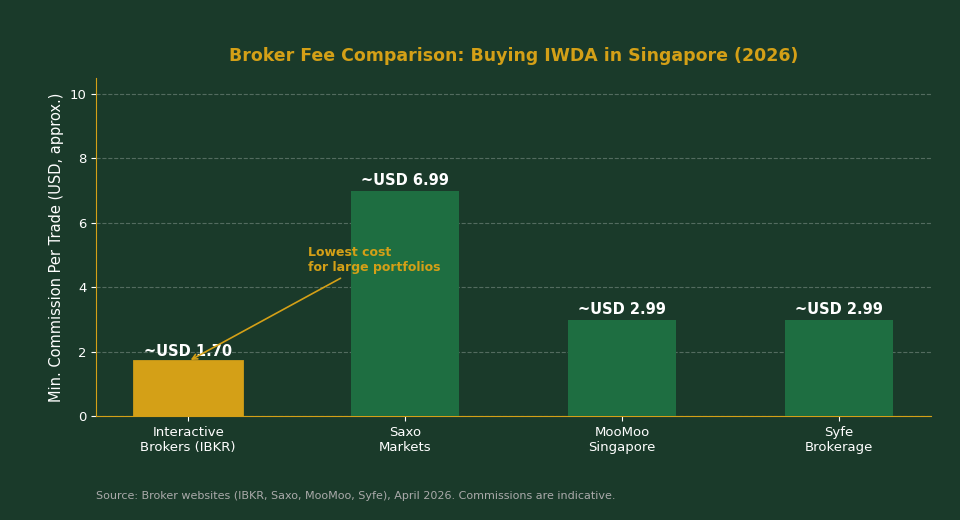
IBKR is the most cost-efficient option for larger portfolios (SGD 20,000+). Commission is approximately USD 1.70 per trade on LSE, with no account minimum and no custody fees on equities. To buy IWDA on IBKR: (1) Fund your account with USD or SGD; (2) Go to Trade → Stocks → search “IWDA” and select London Stock Exchange; (3) Choose USD share class (IWDA) or GBP share class (SWDA); (4) Place a market or limit order. IBKR supports fractional shares for IWDA, making it accessible even at small amounts.
Option 2: Saxo Markets Singapore — Best for Interface
Saxo offers a clean interface and competitive commissions at 0.08% of trade value (minimum USD 6.99 per trade). Saxo also provides a local Singapore entity (MAS-regulated), which some investors prefer. The process is similar: open an account, search for IWDA on the LSE, and place your order. Saxo is well-suited for investors who want a polished experience and don’t mind paying slightly more per trade than IBKR.
Option 3: MooMoo Singapore — Best for Beginners
MooMoo offers LSE trading with relatively competitive commissions starting from SGD 1.99 per order. The app is beginner-friendly with clean charts and market data. For investors new to ETF investing, MooMoo’s interface is easier to navigate than IBKR’s. You can read our moomoo Singapore review for a full breakdown of fees and features.
Option 4: Syfe Brokerage — Best for Simple Regular Investing
Syfe’s brokerage service allows you to buy IWDA directly as a standalone ETF. For investors who also use Syfe’s managed portfolios (such as Syfe Core Equity100, which invests in IWDA), having everything in one platform simplifies tracking. If you’re opening a new account, you can use the Syfe referral code for a fee waiver or cash bonus on your first deposit.
Whichever broker you choose, the process is essentially the same: (1) Open and fund an international brokerage account; (2) Search for IWDA on the London Stock Exchange; (3) Select how many units you want to buy; (4) Place your order during LSE trading hours (9am–5:30pm UK time, or 5pm–1:30am SGT). LSE trading hours overlap with Singapore’s late afternoon and evening, making it easy to execute trades without taking time off work.
IWDA vs Alternatives
IWDA is not the only global equity UCITS ETF available to Singapore investors. Here is how it compares to its closest rivals — all Ireland-domiciled, all LSE-listed, all offering similar tax advantages.
| ETF | Ticker | TER | Index | AUM | Structure |
|---|---|---|---|---|---|
| iShares Core MSCI World | IWDA | 0.20% | MSCI World (DM only) | ~USD 125B | Acc |
| Vanguard FTSE All-World | VWRA | 0.22% | FTSE All-World (DM + EM) | ~USD 25B | Acc |
| iShares Core S&P 500 | CSPX | 0.07% | S&P 500 (US only) | ~USD 80B | Acc |
| SPDR MSCI World UCITS | SWRD | 0.12% | MSCI World (DM only) | ~USD 3B | Acc |
| Amundi MSCI World III | LCWL | 0.12% | MSCI World (DM only) | ~USD 4B | Acc |
Source: Fund factsheets, iShares / Vanguard / SPDR. Data as at April 2026. AUM figures approximate.
IWDA vs VWRA: The key question is whether you want developed markets only (IWDA) or developed + emerging markets (VWRA). VWRA includes ~10% emerging market exposure (China, India, Taiwan, etc.), which adds diversification but also higher volatility and political risk. IWDA is a purer developed-market bet. Both have similar TERs (0.20% vs 0.22%). There is no right answer — it depends on your view of EM over the long term. For a deeper comparison, see our full VWRA ETF Singapore guide.
IWDA vs CSPX: CSPX (S&P 500) has a significantly lower TER at 0.07%, but is concentrated in US equities only. IWDA gives you ~70% US exposure plus meaningful allocations to Japan, UK, France, Switzerland, and other developed markets. If you want diversification beyond the US, IWDA is the better fit. If you believe in US market dominance and want the lowest cost, CSPX wins on fees.
IWDA vs SWRD/LCWL: SWRD (SPDR) and LCWL (Amundi) both track the same MSCI World index at a lower TER of 0.12%. The trade-off is AUM: IWDA’s USD 125B dwarfs both, meaning tighter spreads and better liquidity on the LSE. For large lump-sum purchases, IWDA’s liquidity advantage may offset its slightly higher TER.
Who Should Buy IWDA?
IWDA is ideal if you: want broad developed-market diversification (not just the US) in a single fund; prefer a low-cost, set-and-forget accumulating ETF that automatically reinvests dividends; have a long investment horizon of 10+ years and can ride out volatility; are concerned about US estate tax exposure and want a clean Irish-domiciled solution; or are building a core global equity position to complement Singapore-focused assets like S-REITs or CPF savings. You can use our Singapore retirement calculator to model how different annual returns from IWDA might affect your retirement target.
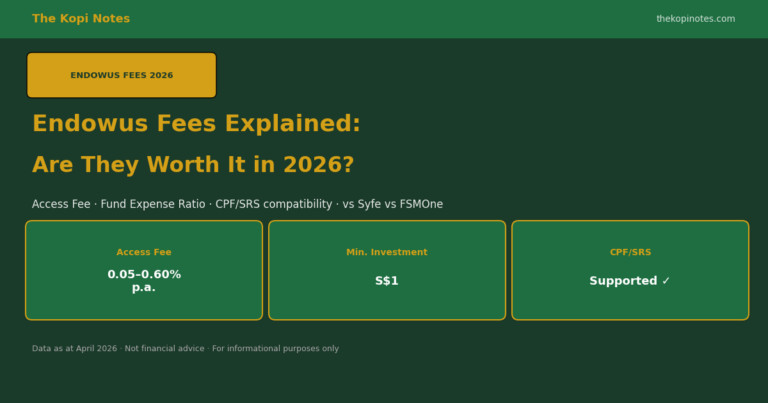
Consider alternatives if you: want emerging market exposure (choose VWRA instead); want the lowest possible TER on a developed-market tracker (look at SWRD at 0.12%); are investing primarily through CPF (LSE-listed ETFs are not CPF-investable — consider SGX-listed alternatives or Endowus for CPF investing, using our Endowus referral code for a fee rebate); or are just starting out with very small sums where IBKR/Saxo account fees may not be worth it yet.
IWDA is not suitable for investors seeking regular dividend income — as an accumulating ETF, it pays no distributions. For dividend-focused strategies, Singapore investors may prefer S-REITs or dividend ETFs. Browse our guide to passive income in Singapore for a full framework.
One important note: IWDA is not CPF-investable, as CPF requires SGX-listed approved investments. It may be compatible with SRS (Supplementary Retirement Scheme) accounts if bought through an SRS-approved broker — check with your broker before using SRS funds to invest. For CPF-related strategies, our CPF investment strategy guide covers the most effective options.
Frequently Asked Questions
What is IWDA ETF and why do Singapore investors buy it?
IWDA is the iShares Core MSCI World UCITS ETF, listed on the London Stock Exchange (LSE). It tracks 1,310 large and mid-cap stocks across 23 developed markets with a TER of 0.20% p.a. Singapore investors prefer it over US-domiciled equivalents because Ireland’s tax treaty with the US cuts US dividend withholding tax from 30% to 15%, and the fund carries no US estate tax risk — a significant advantage for non-US investors with large portfolios.
What is the difference between IWDA and SWDA?
IWDA and SWDA are share classes of the same underlying fund — the iShares Core MSCI World UCITS ETF (ISIN IE00B4L5Y983). IWDA is denominated in USD and SWDA in GBP, both listed on the London Stock Exchange. The underlying portfolio is identical. Most Singapore investors use IBKR or similar brokers to trade the IWDA (USD) share class, as their accounts are typically funded in USD and they want to avoid the extra FX conversion to GBP.
Can I buy IWDA using my CPF or SRS funds?
IWDA is not eligible for CPF investment, as CPF requires investments in SGX-approved listed products. However, it may be compatible with SRS (Supplementary Retirement Scheme) if purchased through an SRS-authorised broker — check with your broker before proceeding. For CPF investment options, Endowus allows you to invest CPF-OA funds into globally diversified portfolios that include MSCI World exposure.
Which broker is best for buying IWDA in Singapore?
For most Singapore investors, Interactive Brokers (IBKR) offers the lowest commission for buying IWDA on the LSE — approximately USD 1.70 per trade with no inactivity or custody fees. Saxo Markets and MooMoo are good alternatives with cleaner interfaces and local MAS-regulated entities. Syfe Brokerage is the most beginner-friendly option and allows you to hold IWDA alongside managed portfolios in one place. The best choice depends on your portfolio size and how often you plan to invest.
Is IWDA better than VWRA for Singapore investors?
IWDA and VWRA are both excellent choices, and the decision comes down to your view on emerging markets. IWDA (MSCI World) covers 23 developed markets only — about 70% US, 6% Japan, 4% UK, and so on. VWRA (FTSE All-World) adds ~10% emerging market exposure including China, India, Taiwan, and Brazil. Both are Ireland-domiciled with similar TERs (0.20% vs 0.22%). If you want purely developed-market exposure, choose IWDA. If you want global diversification including EM, choose VWRA. Both are valid core holdings for a long-term Singapore investor portfolio.
What is the minimum investment for IWDA?
On IBKR, you can buy fractional shares of IWDA with a minimum of approximately USD 1. On Saxo, the minimum is typically 1 full unit (currently around USD 130–140 per unit as at April 2026). On MooMoo and Syfe, minimums are similar — one full unit. Since IWDA is priced in USD at around USD 130–140 per unit, a starting investment of around SGD 200–250 is sufficient for your first unit through most brokers.
Is IWDA safe? What are the risks?
IWDA is a diversified, physically-replicated UCITS ETF managed by BlackRock — one of the world’s largest and most reputable asset managers — with over USD 125 billion in assets. The fund itself is low-risk in structural terms (it is not leveraged and does not use complex derivatives). However, as a global equity ETF, IWDA carries market risk: the fund’s NAV will fall during equity bear markets. It is appropriate for long-term investors (10+ year horizon) who can tolerate short-term volatility in exchange for long-term growth. It is not a capital-guaranteed product.
Ready to Start Investing in IWDA?
Open a brokerage account and buy your first IWDA unit today. Use our referral links for exclusive sign-up bonuses.
This article was researched with the help of AI. While we strive to keep all information accurate and up to date, there may be errors. If you notice any discrepancies, please contact us.