Mapletree Logistics Trust (M44U) 2026: Full Portfolio Review, Gearing & DPU Yield After Rate Hike
Updated September 2026 | SGX: M44U | Category: S-REITs | The Kopi Notes
Table of Contents
- What Is Mapletree Logistics Trust (M44U)?
- MLT Share Price Overview 2026
- Full Portfolio Breakdown: 9 Countries
- How the Sep 2026 Rate Hike Affects MLT
- DPU Analysis: Is the Yield Sustainable?
- Gearing and Debt Profile
- FX Hedging Across 9 Currencies
- Buy, Hold or Wait? Fair Value Assessment
- Frequently Asked Questions
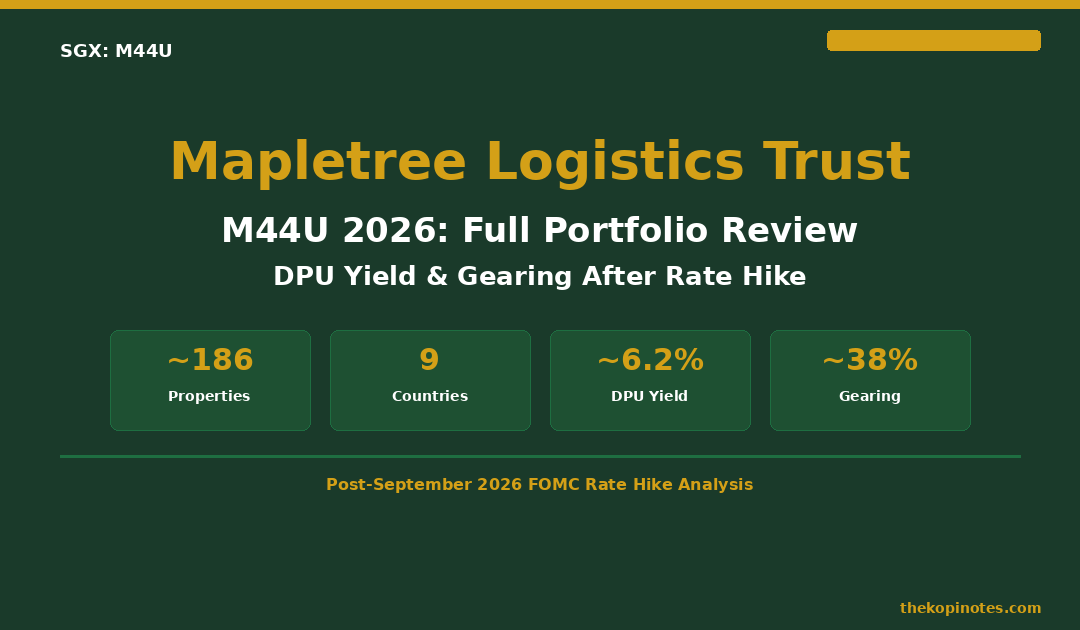
Mapletree Logistics Trust (SGX: M44U) is Singapore's largest pure-play logistics REIT, owning around 186 properties across 9 countries with an AUM of approximately S$13.7 billion. As of September 2026, M44U offers a distribution yield of about 6.2%, underpinned by long-term leases to blue-chip tenants across Asia-Pacific. After the Fed's surprise 25bps rate hike on 17 September 2026, the key question is whether MLT's diversified portfolio can sustain its payout.
Not financial advice. All figures are for educational reference only. Data as at September 2026 unless noted.
- MLT holds 186 logistics properties across 9 Asia-Pacific countries. Japan is the largest overseas market at ~28% of AUM.
- Gearing sits at ~38%, well below the 40% regulatory cap. About 75% of debt is on fixed rates, limiting near-term interest cost blowout after the rate hike.
- At a 6.2% yield on current share price, MLT looks attractive if you believe distributions are sustainable — this review unpacks the numbers.
What Is Mapletree Logistics Trust (M44U)?
Mapletree Logistics Trust was listed on the Singapore Exchange in 2005. It is managed by Mapletree Logistics Trust Management Ltd, a wholly-owned subsidiary of Mapletree Investments — one of Singapore's largest real estate conglomerates, backed by Temasek Holdings.
MLT's strategy is simple: own high-quality logistics and industrial properties across Asia-Pacific, lease them to creditworthy tenants on long-term agreements, and distribute at least 90% of taxable income to unit holders. The result is a high and relatively predictable yield.
What sets MLT apart from Singapore-focused REITs like passive income-focused REITs is its deliberate geographic diversification. By spreading across 9 markets, MLT reduces its exposure to any single country's economic cycle or property market.
MLT Share Price Overview 2026
Mapletree Logistics Trust's share price (SGX: M44U) has been under pressure in 2026. The broad S-REIT sector de-rated when the market priced in a Fed that was less willing to cut rates than expected — and then the surprise 25bps hike on 17 September 2026 added further headwinds.
| Metric | Value (Sep 2026 Est.) |
|---|---|
| Share Price | ~S$1.40 |
| 52-Week Range | S$1.28 – S$1.63 |
| Market Cap | ~S$8.0 billion |
| NAV per Unit | ~S$1.47 |
| P/NAV Ratio | ~0.95x (discount to book) |
| Distribution Yield | ~6.2% |
| DPU (annualised) | ~8.68 cents |
Source: SGX filings, MLT investor presentations (estimates; data as at Sep 2026). Not financial advice.
Trading at a ~5% discount to NAV, M44U is pricing in some uncertainty. The September rate hike widened the spread between MLT's yield and the risk-free rate — but also made the 6.2% distribution more attractive relative to fixed deposits that are already priced in.
Full Portfolio Breakdown: 9 Countries
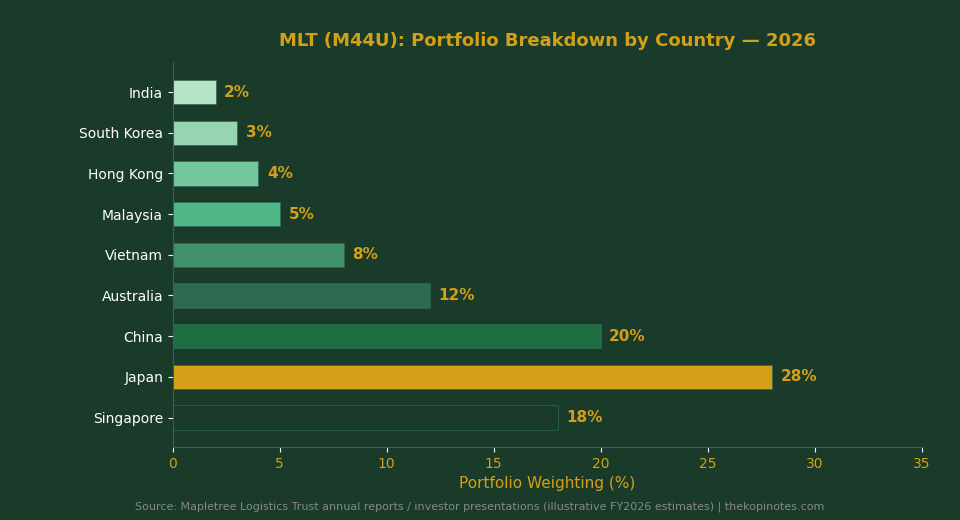
MLT's strength is its geographic spread. No single market represents more than 30% of AUM, which buffers the portfolio against country-specific downturns. Here is how each market contributes.
| Country | Est. AUM Share | Key Characteristics |
|---|---|---|
| Japan | ~28% | Largest overseas market; e-commerce and cold-chain logistics; JPY hedged |
| China | ~20% | Tier-1 and Tier-2 cities; e-commerce fulfilment hubs; CNY hedged |
| Singapore | ~18% | Anchor market; SGD-denominated; longest WALE leases |
| Australia | ~12% | Modern big-box logistics; AUD hedged; strong rental reversion |
| Vietnam | ~8% | Supply chain diversification play; USD-denominated leases |
| Malaysia | ~5% | MYR hedged; Johor industrial corridor; steady occupancy |
| Hong Kong | ~4% | HKD pegged to USD; high value-per-sqm; limited new supply |
| South Korea | ~3% | KRW hedged; e-commerce growth; modern facilities |
| India | ~2% | INR; newer entry; high growth potential; early-stage exposure |
Source: Mapletree Logistics Trust investor presentations (illustrative FY2026 estimates). Not financial advice.
The portfolio is deliberately tilted towards developed markets (Japan, Singapore, Australia) which offer stable rule-of-law environments and predictable rental income. Vietnam and India add a growth kicker without overweighting risk.
How the Sep 2026 Rate Hike Affects MLT
The Fed raised rates by 25bps on 17 September 2026. For a leveraged trust like MLT, higher rates mean higher debt costs. But the actual impact depends on how much of MLT's debt is floating-rate versus fixed.
MLT has historically maintained roughly 70–80% of its debt on fixed-rate terms. This means only 20–30% of total borrowings are directly exposed to short-term rate changes.
Based on MLT's borrowings of approximately S$5.2 billion and a 25% floating-rate share, every 25bps increase adds roughly S$3.3 million per year to interest expense. With ~5.7 billion units in issue, that translates to around 0.06 cents per unit in annual DPU dilution — less than 0.7% of the annualised DPU. Material, but not a dealbreaker.
What matters more is the trajectory: if rates stay elevated through 2027, MLT's refinancing cycle will gradually push the average debt cost higher as lower-rate fixed loans mature and are rolled at current market rates.
DPU Analysis: Is the 6.2% Yield Sustainable?
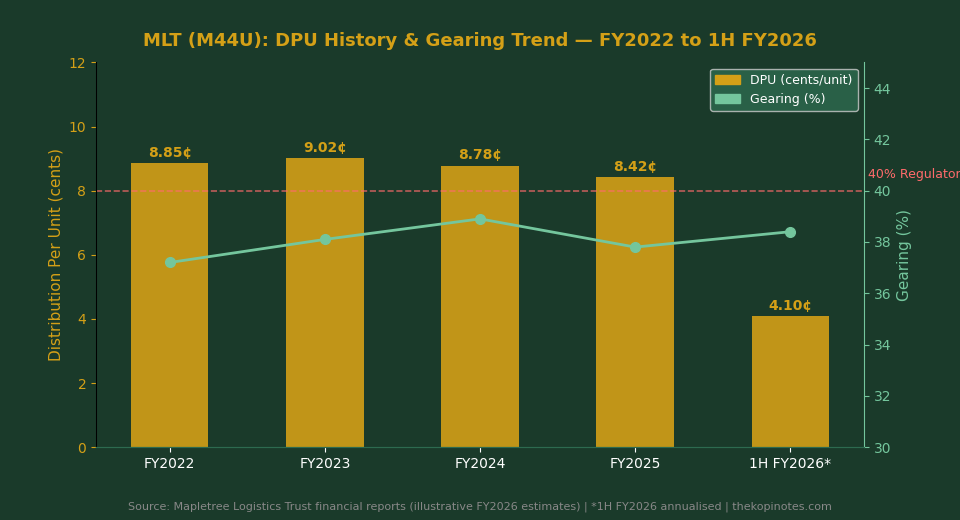
DPU — Distribution Per Unit — is the key figure for income investors. MLT pays distributions semi-annually. As the chart above shows, annual DPU has been fairly stable in the 8.4–9.0 cents range over recent financial years, with a mild downward drift as interest costs rose from 2022 onwards.
Three factors underpin DPU sustainability:
1. Long weighted average lease expiry (WALE): MLT's WALE is typically 3.5–4.5 years. This means most leases are locked in at current rents, providing revenue visibility regardless of short-term macro swings.
2. High occupancy: Portfolio occupancy sits above 96%, well above the S-REIT sector average. The logistics sector — driven by e-commerce fulfilment and just-in-case supply chain strategies — remains structurally undersupplied in most Asia-Pacific markets.
3. Built-in rental escalations: Most leases include annual rental escalation clauses (typically 1–3% for Singapore/Japan, inflation-linked for Australia). These provide natural DPU uplift over time.
For S$100,000 invested in M44U at today's price, you would receive approximately S$6,200 per year in distributions — paid in two tranches. For investors focused on the best S-REITs in Singapore 2026, MLT's combination of scale and diversification makes it a strong candidate.
| DPU Driver | Outlook | Comment |
|---|---|---|
| Rental Income | Stable + | Locked-in leases + built-in escalations |
| Interest Cost | Moderate headwind | ~25% floating exposure; gradual fixed rollover |
| FX Translation | Hedged (neutral) | JPY, AUD, CNY income hedged to SGD |
| Acquisition Growth | Selective | Higher rates raise accretion hurdle; prudent approach |
| Capital Recycling | Positive | Divestment of non-core assets at premium to book |
Source: The Kopi Notes analysis based on MLT public disclosures. Not financial advice.
Gearing and Debt Profile
MLT's gearing — debt as a percentage of total assets — sits at approximately 38%, comfortably below the 40% statutory cap for Singapore-listed REITs. (Singapore REITs can go up to 50% if they meet ICR requirements, but 40% is the effective market comfort zone.)
A gearing of 38% gives MLT meaningful headroom. At 40% gearing, MLT would have approximately S$540 million of additional debt capacity before hitting the conventional cap.
Interest coverage is the other key metric. MLT's ICR — net property income divided by interest expense — has historically been around 3.5–4.0x. MAS requires an ICR of at least 2.5x for REITs to borrow up to the 45–50% gearing threshold. MLT's buffer here is healthy.
If you want to track S-REIT financial health metrics against peers, the Singapore retirement planning calculator can help you model how REIT income fits into your overall portfolio plan.
| Debt Metric | Estimate (Sep 2026) |
|---|---|
| Total Borrowings | ~S$5.2 billion |
| Gearing | ~38% |
| Fixed-Rate Debt | ~75% |
| Weighted Average Debt Cost | ~3.2% |
| Interest Coverage (ICR) | ~3.6x |
| Weighted Average Debt Maturity | ~3.5 years |
Source: MLT financial disclosures (estimates). Not financial advice.
FX Hedging Across 9 Currencies
With income generated in JPY, CNY, HKD, AUD, VND, MYR, KRW, and INR — as well as SGD — MLT's biggest operational complexity is currency management. For Singapore unit holders who receive distributions in SGD, FX translation is critical.
MLT's approach is to hedge distributions (not asset values) back to SGD using forward contracts and cross-currency swaps. This means the distributions you actually receive are largely shielded from short-term currency moves, even if the underlying asset values (in SGD terms) still fluctuate with exchange rates.
The most important currency for MLT is the Japanese yen (JPY), given Japan's ~28% AUM share. The JPY has been weak against the SGD for most of 2024–2026. MLT's hedging programme locks in exchange rates for distribution purposes, but it cannot fully protect against a secular JPY decline — which would reduce the SGD-equivalent value of its Japan assets over time.
For investors thinking about their overall portfolio FX exposure, explore how S-REIT income fits within your CPF investment strategy as a SGD-denominated income complement.
Buy, Hold or Wait? Fair Value Assessment
At S$1.40 per unit, MLT trades at roughly 0.95x NAV — a modest discount. The 6.2% forward yield looks attractive compared to Singapore savings bonds (around 2.5–2.8%) and T-bills (around 3.0–3.5% post-hike), but REITs carry equity-like risk that fixed income doesn't.
For a back-of-envelope valuation: if you apply a 10-year discount rate of 7.5% (5% equity risk premium over a 2.5% risk-free rate) to an annualised DPU of 8.68 cents and assume 1% long-term DPU growth, the Gordon Growth model yields a fair value of approximately S$1.30–S$1.45 per unit. At S$1.40, that's around fair value.
If the rate cycle peaks here and starts to normalise in 2027, MLT's P/NAV could re-rate back towards 1.0x or above — generating capital appreciation on top of the 6.2% yield.
Investors interested in building a diversified portfolio can use the Singapore REIT ETF guide to compare MLT against REIT ETF alternatives — which spread exposure across many REITs for lower single-name risk.
Prefer investing via an online broker? You can sign up for Endowus (referral code: 2V343) or Syfe (referral code: SRPRFFFCD) — both offer S-REIT and REIT ETF exposure through managed portfolios.
Frequently Asked Questions
What is Mapletree Logistics Trust share price today?
What is MLT's distribution yield?
How many countries does Mapletree Logistics Trust operate in?
What is MLT's gearing ratio?
How does the Sep 2026 rate hike affect MLT's DPU?
Is MLT a good investment for Singapore retirees?
How do I buy MLT shares in Singapore?
Does MLT trade at a discount or premium to NAV?
Disclaimer: This article is for educational and informational purposes only. It does not constitute financial, investment, or tax advice. All figures cited are estimates based on publicly available data as at September 2026 and may not reflect the latest filings. Investments in REITs carry risks including but not limited to market risk, interest rate risk, foreign currency risk, and liquidity risk. Past performance and distributions are not indicative of future results. Always conduct your own due diligence or consult a licensed financial adviser before investing. The Kopi Notes may earn referral fees if you sign up via links in this article.
This article was researched with the help of AI. While we strive to keep all information accurate and up to date, there may be errors. If you notice any discrepancies, please contact us.