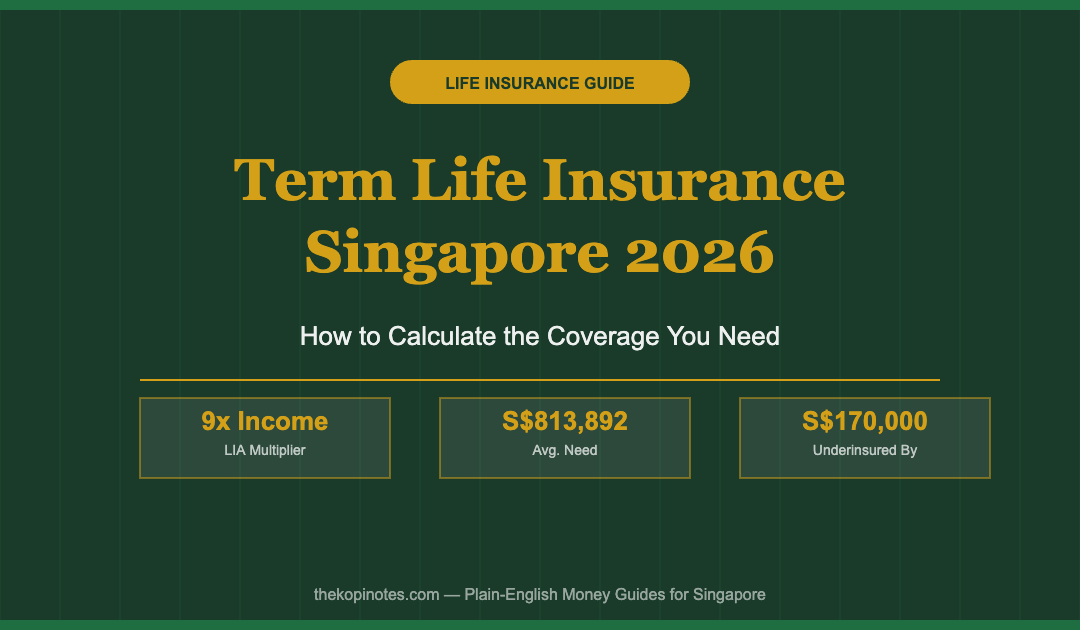
Term Life Insurance Singapore 2026: How to Calculate the Coverage You Need
Use the LIA income multiplier formula to find your exact sum assured — with worked SGD examples and 2026 premium data.
Most Singaporeans default to S$500,000 in term life cover. LIA Singapore’s 2022 Protection Gap Study puts the recommended figure at nine times your annual income. For someone earning S$80,000, that is already S$720,000 — before you add the mortgage balance. This guide shows you the four-step formula to calculate your exact target, what DPS covers, and what a 35-year-old pays today.
Not financial advice. All figures are for educational reference only. Data verified as at 8 September 2026.
Table of Contents
Why S$500,000 Is Rarely Enough
LIA Singapore’s 2022 Protection Gap Study found economically active Singaporeans face a S$373 billion mortality protection gap. The average working adult is underinsured by S$170,000. The study put the average protection need per working adult at S$813,892.
S$500,000 has become the default sum assured because it is a round number. For most households it falls well short of the actual need once you factor in income replacement, the mortgage, and education costs for dependants.
The average annual income used in the LIA study was S$90,855 — meaning even a median earner needs roughly S$817,695 in life cover before adding debts. Buying the round-number default without doing the calculation creates a gap the family must absorb out of savings or CPF.
The LIA Formula: 9 Times Your Annual Income
LIA Singapore recommends income multipliers to estimate the right coverage level.
- Death and total permanent disability (TPD): 9 times your annual income
- Critical illness (CI): 4 times your annual income
The 9x multiplier for death/TPD assumes the payout provides income replacement for roughly nine years while your dependants adjust financially. It does not include outstanding debts — add those separately.
The table below applies the LIA multipliers across four income levels. Add your outstanding mortgage balance and subtract existing cover to find your personal gap.
| Annual Income | Death/TPD (9x) | CI Cover (4x) | Total Baseline Need |
|---|---|---|---|
| S$40,000 | S$360,000 | S$160,000 | S$520,000 |
| S$60,000 | S$540,000 | S$240,000 | S$780,000 |
| S$80,000 | S$720,000 | S$320,000 | S$1,040,000 |
| S$100,000 | S$900,000 | S$400,000 | S$1,300,000 |
Source: LIA Singapore Protection Gap Study 2022 multiplier guidelines. CI coverage is usually bought as a rider or standalone policy alongside term life.
Four Steps to Calculate Your Target Coverage
Step 1: Income replacement. Multiply your annual income by 9. This is your baseline death/TPD need per LIA guidelines.
Step 2: Add outstanding debts. Add your current mortgage balance, car loan, and personal loans. These obligations do not disappear when you die. Your dependants would need to service or clear them.
Step 3: Subtract existing cover. Add up what you already have — DPS sum assured, employer group insurance, and other in-force life policies. Subtract the total from Steps 1 and 2 combined.
Step 4: The remainder is your personal policy target. Round to the nearest S$100,000 for pricing clarity. This is the sum assured to request when comparing quotes.
Compare quotes on CompareFIRST, the MAS-endorsed portal, before committing. See our best term life insurance Singapore 2026 guide for a breakdown of the top-rated plans.
What DPS and Group Insurance Actually Cover
The Dependants’ Protection Scheme (DPS) is a term life scheme linked to CPF. It covers CPF members automatically from age 21. The maximum sum assured is S$70,000 for members below age 60, reducing to S$55,000 between ages 60 and 65.
Most employer group insurance provides 1 to 2 times annual salary in life cover. A S$60,000 earner might receive S$60,000 to S$120,000 from their employer policy. Both DPS and group cover have key limitations: DPS ends at 65 and group cover ends when you leave the job.
Neither closes your income replacement gap in full. Use their current values in Step 3 of the formula, but do not rely on them as permanent coverage.
| Coverage Source | Typical Amount | Key Limitation |
|---|---|---|
| DPS (CPF) | S$70,000 (under 60) | Ends at age 65; no CI cover |
| Employer Group Insurance | 1 – 2x annual salary | Ends when you leave the company |
| Personal Term Policy | You choose the amount | Stays as long as premiums are paid |
How Long a Term Do You Need?
Coverage should run to the longest of three events: your youngest child turns 25 and is financially independent; your mortgage is fully paid off; or you reach age 65. For most Singaporeans in their 30s, that translates to a 25 to 30 year term.
A 35-year-old with a 30-year mortgage and young children should buy a 30-year term. That locks in a rate at 35 and covers the full liability period. Buying a shorter term to save on premiums and renewing at 50 is expensive — premiums at 50 for a new policy are often three to four times what you paid at 35.
A 30-year term at 35 is cheaper in total cost than two consecutive 15-year terms over the same period, because the second term is priced at an older age. Singaporeans running buy term invest the rest (BTIR) strategies benefit most from locking in a long-term rate early.
What Term Life Insurance Costs in Singapore (2026)
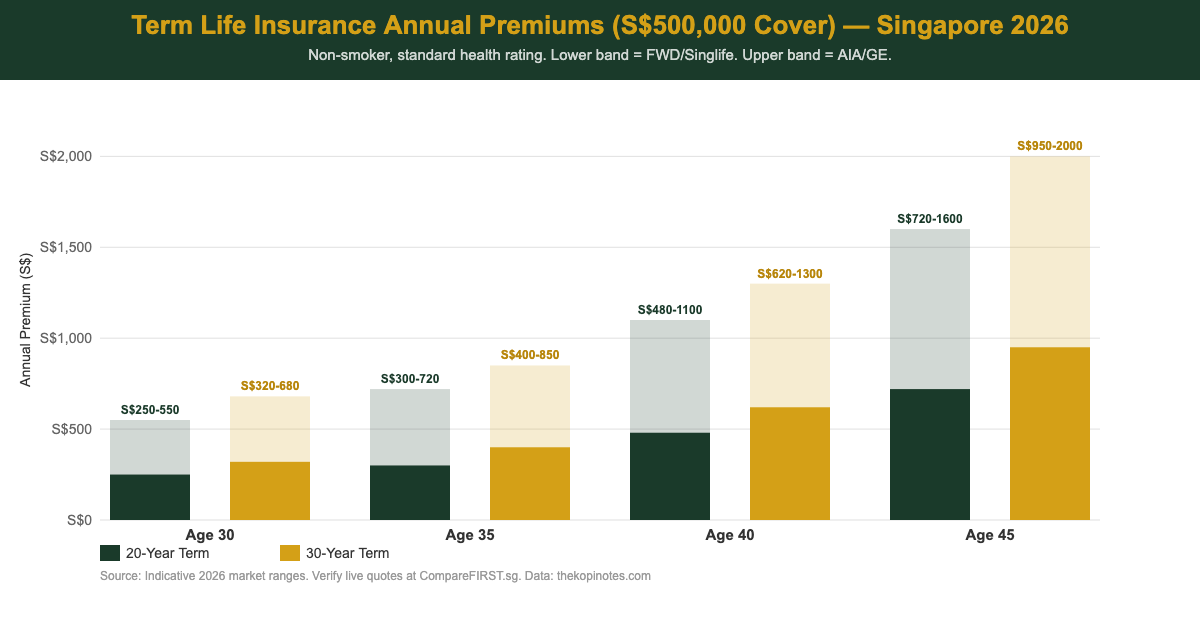
Premium data below is for S$500,000 sum assured, level term, non-smoker, standard health rating. Actual quotes vary by insurer, underwriting outcome, and riders added.
| Age at Entry | 20-Year Term (per year) | 30-Year Term (per year) |
|---|---|---|
| 30 | S$250 – S$550 | S$320 – S$680 |
| 35 | S$300 – S$720 | S$400 – S$850 |
| 40 | S$480 – S$1,100 | S$620 – S$1,300 |
| 45 | S$720 – S$1,600 | S$950 – S$2,000 |
Source: Indicative 2026 market ranges. FWD Term Life Plus and Singlife MyTerm sit at the lower end for standard profiles. AIA Secure Flexi Term and Great Eastern SupremeTermLife tend to price higher. Get live quotes at CompareFIRST.sg (MAS-endorsed). Ranges are indicative only.
Each year you delay costs more. A 30-year-old buying S$500,000 at S$300/year saves roughly S$2,500 over 20 years compared to a 35-year-old paying S$550/year for the same cover.
Worked Example: Calculating Coverage for a S$80,000 Earner
Profile: 35-year-old, married, two young children, S$450,000 outstanding mortgage, annual income S$80,000.
Step 1: S$80,000 x 9 = S$720,000 income replacement need.
Step 2: S$720,000 + S$450,000 mortgage = S$1,170,000 gross need.
Step 3: DPS provides S$70,000. Employer group insurance at 1.5x salary provides S$120,000. Total existing cover: S$190,000.
Step 4: S$1,170,000 minus S$190,000 = S$980,000. Rounded to S$1,000,000 personal policy target.
A S$1,000,000 30-year term policy for a 35-year-old non-smoker costs approximately S$700 to S$1,500 per year depending on the insurer and health rating. That is S$58 to S$125 per month to protect a S$1 million need. See our life insurance comparison Singapore guide for side-by-side plan data.
If you also need critical illness cover, the critical illness insurance Singapore 2026 guide explains the LIA 2024 CI framework and the 37 conditions covered under the standard definition.
Once coverage is in place, our Singapore retirement calculator can show how insurance premiums fit into your overall savings plan. Investors building long-term wealth alongside insurance often use platforms like Syfe and Endowus for the investment component.
Not financial advice. Consult a licensed financial adviser for personalised recommendations. Data verified as at 8 September 2026.
Frequently Asked Questions
How much term life insurance do I need in Singapore?
Is S$500,000 enough term life insurance in Singapore?
What is the LIA income multiplier formula for life insurance?
Does DPS count towards my life insurance coverage?
When should I buy term life insurance in Singapore?
Get Free Insurance Advice
Speak with a licensed insurance advisor. No obligation, no cost.
By submitting this form, you agree to our Privacy Policy.
This article was researched with the help of AI. While we strive to keep all information accurate and up to date, there may be errors. If you notice any discrepancies, please contact us.