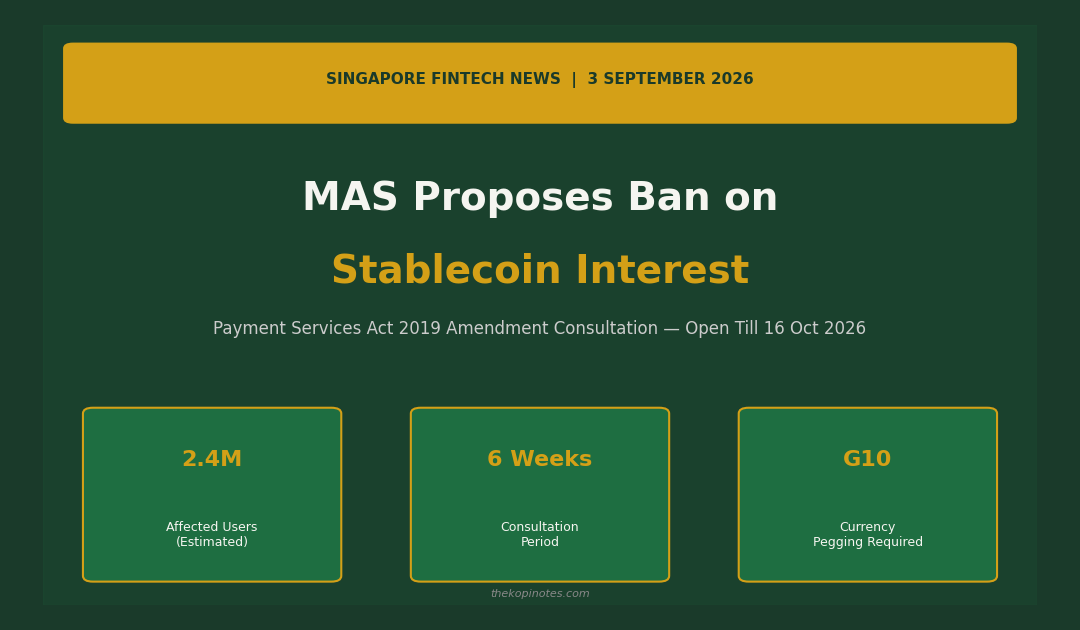
Singapore’s central bank has taken a major step toward regulating stablecoins as payment tools, not yield-bearing deposits. On 1 September 2026, MAS published a consultation proposing to ban interest payments on MAS-regulated stablecoins, require 100% high-quality liquid reserve backing, and restrict the “MAS-regulated” label to licensed issuers only. The consultation closes on 16 October 2026. Here’s what every Singapore investor needs to understand.
This is an editorial analysis. Not financial advice. Data verified as at 3 September 2026.
What Is MAS Proposing?
On 1 September 2026, the Monetary Authority of Singapore (MAS) published a consultation paper proposing amendments to the Payment Services Act 2019 (PSA). The package gives legal force to the Single-Currency Stablecoin (SCS) framework that MAS first outlined in 2023, and adds several tighter safeguards — most notably a ban on interest payments to stablecoin holders.
Under the proposal, only issuers that obtain a new MAS licence would be allowed to market themselves as “MAS-regulated stablecoin” issuers or to describe their tokens using that protected label. Any stablecoin that fails to meet the new standard would remain classified as an ordinary digital payment token (DPT) under existing rules — not prohibited, but unable to use the regulated designation.
This matters because the “MAS-regulated” label is likely to carry real weight with institutional and retail users seeking the safest, most transparent form of digital cash for payments and settlement.
The Interest Ban — Why It Matters
The most closely watched element of the proposal is the prohibition on interest. MAS would bar licensed issuers from paying holders any interest, return, or other benefit that is directly or indirectly linked to the mere holding of the stablecoin.
MAS’s stated rationale: stablecoins should function as payment instruments, not as savings or investment products. Paying yield on stablecoins blurs that line — and creates bank-like risks without bank-like supervision.
For Singapore retail investors currently holding yield-bearing stablecoins on platforms like Bybit, OKX, or via DeFi protocols, this is a structural signal. While such tokens won’t be banned outright, they will not qualify for the protected label. This could affect how exchanges market these products locally and whether institutional investors can hold them for treasury or settlement purposes.
The ban applies to the issuer itself. Commercial revenue-sharing arrangements between issuers and exchanges or distributors are explicitly not intended to be caught — but those nuances will likely be tested in the public consultation process.
How MAS Stablecoins Would Work
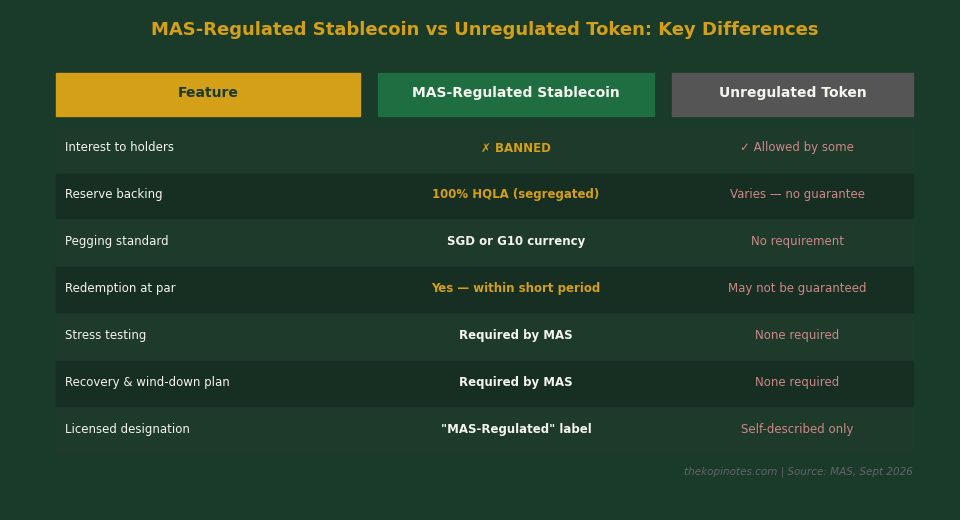
For a stablecoin to earn the MAS-regulated designation under the proposed rules, issuers would need to meet the following requirements:
| Requirement | MAS Standard |
|---|---|
| Currency peg | Singapore dollar or a G10 currency (USD, EUR, GBP, JPY, CHF, CAD, AUD, NZD, SEK, NOK) |
| Reserve backing | 100% high-quality liquid assets (HQLA), held in segregated accounts at all times |
| Redemption | At par value, within a short prescribed period set by MAS |
| Interest prohibition | No interest, return, or benefit linked to holding the stablecoin |
| Stress testing | Periodic MAS-mandated stress tests required |
| Recovery plans | Formal recovery and orderly wind-down plans required |
Source: MAS Consultation Paper, 1 September 2026.
What This Means for Singapore Retail Investors
For most Singapore retail investors, stablecoins have been a niche tool — primarily used by crypto traders to park value between trades, or to access DeFi yields. But the MAS framework signals something broader: regulated stablecoins are being positioned as legitimate settlement and payment rails for tokenised asset markets.
Here’s the practical investor angle:
If you hold USDT or USDC on a local exchange: These tokens will not automatically qualify for the MAS-regulated designation unless their issuers apply and receive a licence. They’ll remain available as ordinary DPTs — you can still hold and trade them, but they won’t carry the new consumer-protection label.
If you’re using stablecoins to earn yield (e.g., in DeFi or via staking products): Those products won’t disappear — but they won’t be able to market themselves as MAS-regulated. This matters for institutional investors, but less so for retail users in the short term.
If you’re a conservative investor looking for digital cash alternatives: A properly licensed, MAS-regulated stablecoin pegged to SGD or USD would offer stronger guarantees than an unregulated token — full reserve backing, redemption at par, and no exposure to issuer yield-chasing risk. Think of it like a high-security digital bearer instrument.
For investors who prefer traditional alternatives — such as Singapore T-bills, SSBs, or high-yield savings accounts — MAS-regulated stablecoins won’t replace these instruments. But they may eventually sit alongside them as a payment-layer tool in tokenised portfolios.
Digital-banking-savvy readers tracking bonus interest rate rotation strategies should note that regulated stablecoins won’t yield anything by design — that’s the whole point. They’re meant to be stable, not profitable from holding alone.
How Singapore Compares Globally
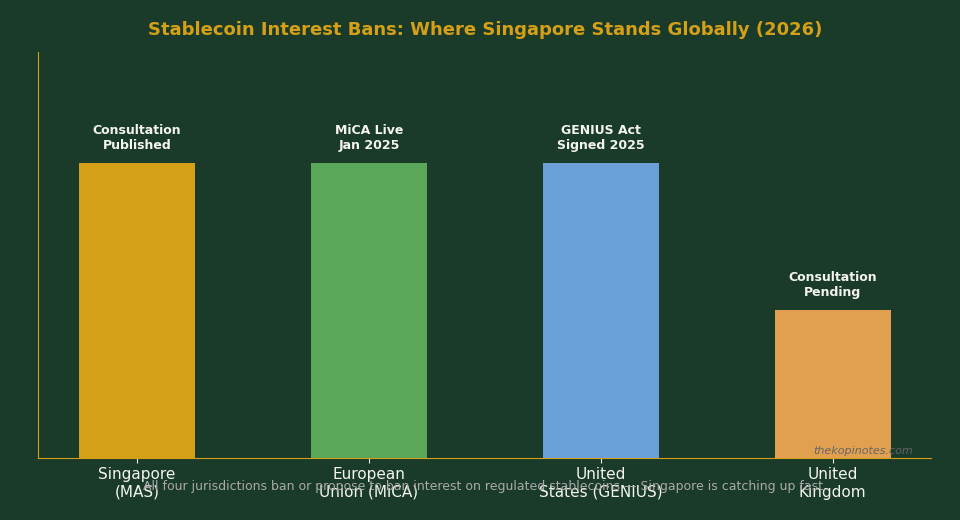
Singapore is not moving in isolation. The interest ban mirrors rules already in place or proposed in:
European Union (MiCA): The Markets in Crypto-Assets Regulation, live since January 2025, already prohibits interest on e-money tokens (the EU equivalent of stablecoins). MiCA also requires minimum 30% daily liquid asset reserves.
United States (GENIUS Act): Signed into law in 2025, the GENIUS Act requires full 1:1 backing for USD-pegged stablecoins and prohibits yield payments on stablecoins to retail holders. It also restricts the “payment stablecoin” label to licensed issuers.
United Kingdom: The UK is still at consultation stage. Draft legislation has circled similar restrictions but no final law has been passed as of September 2026.
Singapore’s framework is notably in line with G10 norms — which is intentional. MAS wants SGD-pegged stablecoins to be usable in cross-border wholesale settlement without friction from regulatory arbitrage concerns.
Cross-Border Provisions
MAS is considering two limited openings for cross-border stablecoin activity:
First, jointly issued tokens involving a Singapore-licensed issuer and a foreign partner could qualify if risks are adequately managed. This opens the door for SGD-denominated stablecoins co-developed with overseas banks or payment providers.
Second, a small number of foreign-issued stablecoins supervised under comparable overseas regimes — primarily those covered by MiCA or the GENIUS Act — might receive recognition in Singapore, mainly for wholesale settlement use. This would allow institutions to settle tokenised bond transactions using, say, an EU-regulated EUR stablecoin without it being reclassified as an unregulated DPT in Singapore.
For retail investors, these cross-border provisions are less directly relevant — but they matter for the long-term viability of tokenised asset markets that S-REIT and ETF investors may participate in over the coming years.
Timeline and Next Steps
The consultation is open until 16 October 2026. MAS has included draft legislative text in the consultation document, which signals a relatively advanced stage of policy development — this is not a concept paper. Industry participants, exchanges, and retail investors who wish to submit views can do so via mas.gov.sg.
MAS has not announced an implementation date. However, given the inclusion of draft text and Singapore’s track record of moving quickly once consultation closes, an amended Payment Services Act could realistically take effect in 2027 or early 2028.
Keep an eye on:
- Which stablecoin issuers apply for the new MAS licence
- Whether Temasek-linked entities or Singapore banks move to issue an SGD stablecoin
- Reactions from USDC issuer Circle and USDT issuer Tether — whether they pursue Singapore recognition for wholesale use
- MAS’s final rules on “short prescribed period” for redemption — this will be key for institutional adoption
Separately, if you’re thinking about Singapore’s broader cash-management landscape, the Budget 2026 COL Special Payment of $400–$600 is being credited to eligible Singaporeans from 9 September 2026 — a good reminder to have your PayNow-NRIC link active.
Bottom Line for SG Investors
The MAS stablecoin consultation is a significant regulatory milestone, not just a fintech story. It signals that Singapore is building a payment infrastructure layer that is tightly regulated, globally harmonised, and deliberately separated from yield-bearing financial products.
For most retail investors, the practical impact is modest in the near term — you can still hold USDT or USDC, and no existing token is being banned. But the framework matters for where the puck is heading: tokenised securities, cross-border settlement, and eventual integration of stablecoin rails into mainstream SGX and banking infrastructure.
If you’re an investor in S-REITs, ETFs like VWRA or CSPX, or simply building a passive income portfolio, understanding how payment infrastructure evolves is part of the long game. And if you want to stay ahead of Singapore’s digital finance landscape, considering how you engage with digital-first financial tools matters now more than ever.
The consultation is open. The industry will be watching. And Singapore — as usual — is moving faster than most give it credit for.
Frequently Asked Questions
What is the MAS stablecoin consultation about?
Will my USDT or USDC be banned in Singapore?
Why is MAS banning interest on stablecoins?
What currencies can MAS-regulated stablecoins be pegged to?
When will the new stablecoin rules take effect?
Does this affect Singapore investors in ETFs or S-REITs?
How does Singapore's stablecoin framework compare to MiCA and the GENIUS Act?
This article was researched with the help of AI. While we strive to keep all information accurate and up to date, there may be errors. If you notice any discrepancies, please contact us.