Term Life Insurance Singapore 2026: CI Rider or Separate CI Plan — Which Saves More?
A data-backed breakdown for Singapore policyholders
When you buy term life insurance in Singapore, your insurer will often offer to add a critical illness (CI) rider. It sounds convenient — one policy, one premium, one claim process. But bundling your CI coverage with your term life plan can leave you with less protection than you think. This guide breaks down the key difference: adding a CI rider versus buying a separate standalone CI plan, so you can make the right call for your situation.
Not financial advice. All figures are indicative and for educational reference only. Premium data is based on independent research from publicly available insurer information, as at Sep 2026. Always verify premiums directly with your insurer or a licensed financial adviser.
- A CI rider on term life is cheaper upfront — but your CI payout reduces your remaining life cover. You don’t get both payouts in full.
- A standalone CI plan keeps your life cover completely intact after a CI claim. You also get access to multipay plans that can pay out more than once.
- Separate plans cost a bit more each year but give your family significantly stronger protection overall.
What Is a CI Rider on Term Life Insurance?
A CI rider is an add-on to your term life insurance policy. For an extra premium, the rider pays out a lump sum if you are diagnosed with one of the covered critical illnesses — typically cancer, heart attack, or stroke.
Here’s the catch: most CI riders are accelerated riders. That means the CI payout comes from your life cover sum assured. If you have S$500,000 of life cover and you claim S$300,000 for a CI event, only S$200,000 remains for your beneficiaries when you pass away.
Some riders are standalone (they don’t reduce your life cover), but these are less common and typically more expensive. Always check which type your insurer offers before signing up.
What conditions does a CI rider cover? Most CI riders in Singapore cover the 37 severe-stage conditions defined by the Life Insurance Association (LIA). These are the same conditions your insurer must cover if they offer a CI product. Some riders go further and include early-stage CI coverage as an additional benefit.
Key point: the LIA updated the standard CI definitions in 2024 to expand coverage to 52 conditions (including more early-stage conditions). Not all riders automatically adopt the new definitions — check your policy schedule carefully.
What Is a Standalone Critical Illness Plan?
A standalone CI insurance plan is a separate policy that pays out only upon a CI diagnosis. It has nothing to do with your life cover — so if you claim for critical illness, your term life insurance sum assured is completely unaffected.
Standalone CI plans also come in two flavours:
1. Single-payout plans — pay out once per claim. Most basic standalone CI plans work this way. After the payout, the policy ends.
2. Multipay plans — can pay out multiple times across different CI events or different stages of the same illness. For example, Singlife Multipay Critical Illness II can pay out up to 900% of your sum assured across multiple claims. These plans cost more but offer significantly stronger coverage if you’re concerned about recurring CI events (which are more common than people think).
Standalone CI plans also tend to offer broader condition lists. The best critical illness insurance Singapore 2026 options can cover 52+ conditions including early-stage CI — conditions like early-stage cancer that don’t qualify under the standard LIA 37-condition definition.
Key Differences: Coverage Structure
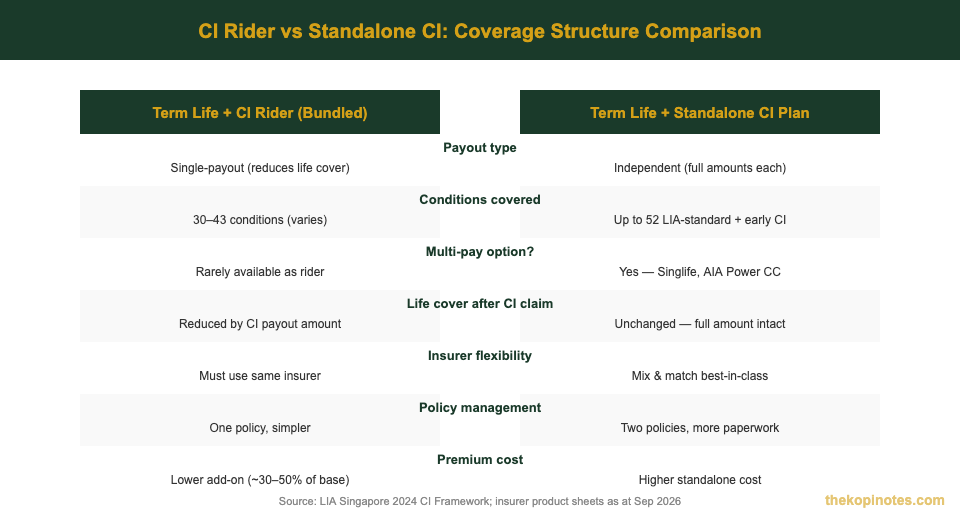
The most important difference isn’t cost — it’s what happens to your coverage after a CI claim. Here’s a clear breakdown:
| Feature | CI Rider (Bundled) | Standalone CI Plan |
|---|---|---|
| Payout type | Usually accelerated (reduces life cover) | Independent — life cover unchanged |
| Multipay option | Rarely available | Yes — Singlife Multipay, AIA Power CC |
| Conditions covered | 30–43 (varies by insurer) | Up to 52+ (LIA 2024 framework) |
| Life cover after CI claim | Reduced by CI payout amount | Fully intact — 100% preserved |
| Insurer flexibility | Must use same insurer as term life | Any insurer — pick best in class |
| Underwriting | Single application (convenient) | Separate application required |
| Annual premium | Lower add-on cost | Higher but dedicated coverage |
Source: LIA Singapore CI Framework (2024 update); insurer product sheets as at Sep 2026. Data is illustrative.
Premium Comparison: Bundled vs Separate Plans
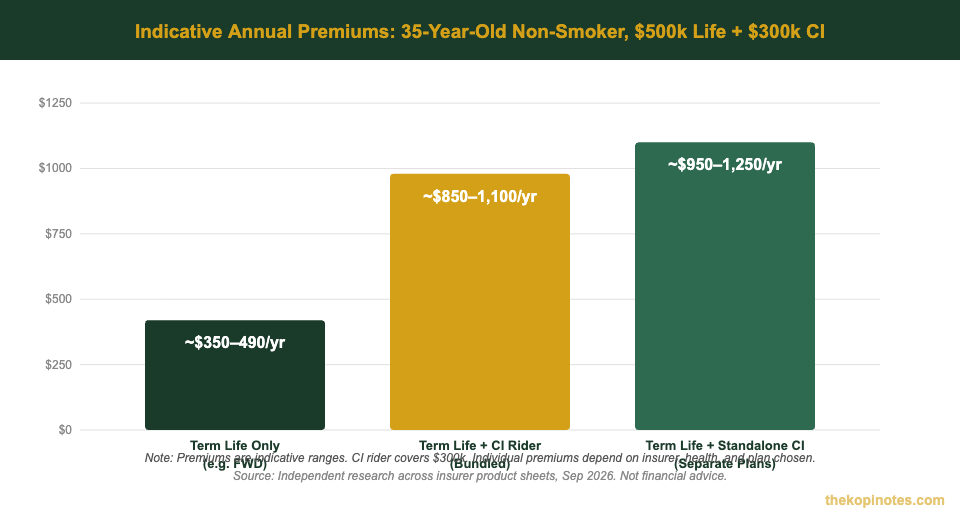
Price is often the deciding factor. Here’s an indicative comparison for a 35-year-old male non-smoker wanting S$500,000 life cover and S$300,000 CI coverage over a 20-year term:
| Scenario | Indicative Annual Premium | 20-Year Total Cost | Life Cover After CI Claim |
|---|---|---|---|
| Term Life Only (e.g. FWD, Singlife) | ~$350–490/yr | ~$7,000–9,800 | Full $500k (no CI cover) |
| Term Life + CI Rider (bundled, same insurer) | ~$850–1,100/yr | ~$17,000–22,000 | Reduced to $200k after $300k CI claim |
| Term Life + Standalone CI Plan (separate insurers) | ~$950–1,250/yr | ~$19,000–25,000 | Full $500k preserved |
Source: Independent research based on publicly available insurer premium data, Sep 2026. Premiums are indicative ranges and vary by insurer, health status, plan structure, and riders chosen. Not a quote.
For a fully independent S$300k CI plan that doesn’t touch your life cover
Which Is Better for You?
There’s no single right answer — it depends on your age, budget, and how much your family relies on your life cover. Here’s the honest breakdown:
Choose a CI rider if:
- You’re on a tight budget and need some CI coverage now rather than waiting
- You’re young (under 30) and just starting your protection portfolio — you can upgrade later
- You don’t have dependants yet, so the life cover reduction matters less
- You want simplicity — one policy, one insurer, one renewal date
Choose a separate standalone CI plan if:
- You have a spouse or children depending on your life insurance payout
- You want access to multipay CI coverage (pays out more than once)
- You want to mix and match — e.g. cheapest term life from FWD + best CI from Singlife or AIA
- You’re buying at 35–45 when the premium difference is still manageable
- You already have a term life policy in force and want to add CI protection
Most licensed financial advisers in Singapore recommend keeping your life cover and CI coverage separate. The reasoning: your family needs the full life cover if you pass away AND had a CI claim earlier. With a CI rider, a portion of that protection disappears after the CI claim.
You can read more about how term life fits into a broader protection strategy in our guide on best term life insurance Singapore 2026 and why it’s the foundation of any coverage plan.
3 Questions to Ask Before Deciding
Before you speak to an insurer or adviser, work through these three questions:
Question 1: Do you have dependants who rely on your life cover?
If yes, your life cover is a critical safety net. A CI event shouldn’t erode it. Go separate. If no (e.g. you’re single, no dependants), a CI rider is more acceptable as a starting point.
Question 2: Can you afford the extra S$100–200/year for a separate plan?
That’s roughly S$8–17 more per month. For most working Singaporeans, this is manageable — especially compared to the protection gap it closes. If budget is genuinely a constraint, start with a CI rider and upgrade to standalone later when your income grows.
Question 3: Do you want multipay CI coverage?
CI is increasingly survivable — which means you may survive one CI event and face another later (e.g. cancer, then heart disease). Multipay CI plans are designed for this. They are only available as standalone policies, not as riders. If multipay matters to you, the choice is clear: go separate. Our Singlife Multipay CI II review covers this in detail.
For context on how CI insurance fits alongside disability income insurance for income protection, see our guide on disability income insurance Singapore 2026.
Where to Get Quotes and Compare in Singapore
For term life insurance, the most competitive premiums typically come from digital-first insurers like FWD, Singlife, and China Life — all accessible directly online without going through an adviser. You can also compare via the MAS CompareFirst portal, which lists standardised term life and CI products side by side.
For standalone CI insurance, the best-in-class options in 2026 include AIA Power Critical Care, Great Eastern LIVE Great Critical Cover, and Singlife Multipay CI II. These are more complex products — speaking to a licensed financial adviser who can model both scenarios (rider vs standalone) for your specific age and health profile will give you a more accurate comparison.
If you use Endowus or Syfe for your investments, their advisers can sometimes refer you to appropriate insurance coverage as part of a holistic financial plan. You can sign up with our Endowus referral code (code: 2V343) or Syfe referral code (code: SRPRFFFCD) and use the savings from lower fund fees to fund your insurance premiums.
Also see our full comparison of best critical illness insurance Singapore 2026 for standalone CI plan rankings and premium data.
Frequently Asked Questions
Is a CI rider on term life insurance worth it?
What is the difference between an accelerated and a standalone CI rider?
Can I add a CI rider to an existing term life policy?
Does a CI rider cover the same conditions as a standalone CI plan?
How much CI coverage do I need in Singapore?
What happens to my CI rider if I cancel my term life policy?
Compare Your Options Before You Decide
Before committing to either a CI rider or a standalone CI plan, get quotes for both and compare the protection gap side by side. The S$100–200/year difference in premiums is small. The difference in coverage after a CI claim can be hundreds of thousands of dollars.
Looking for more Singapore insurance and investment guides?
Get Free Insurance Advice
Speak with a licensed insurance advisor. No obligation, no cost.
By submitting this form, you agree to our Privacy Policy.
This article was researched with the help of AI. While we strive to keep all information accurate and up to date, there may be errors. If you notice any discrepancies, please contact us.