Agriculture & Timber ETFs in Singapore: How to Invest in Farmland and Forestry (2026 Guide)
SPAG vs WOOD vs MOO — TER, tax, and how to buy from Singapore
Agriculture ETFs like the iShares Agribusiness UCITS ETF (SPAG) and timber ETFs like the iShares Global Timber & Forestry UCITS ETF (WOOD) give Singapore investors exposure to farming, fertiliser and forestry companies worldwide. Both trade on the London Stock Exchange as Ireland-domiciled UCITS funds, letting you buy through brokers like Syfe or FSMOne while avoiding the 30% US dividend withholding tax and US estate tax that apply to US-listed alternatives like MOO.
Not financial advice. All figures are for educational reference only. Data verified as at 26 August 2026 unless noted.
- SPAG (agribusiness) and WOOD (timber) are London-listed, Ireland-domiciled UCITS ETFs — no US estate tax exposure, and lower US withholding tax than US-listed funds
- SPAG charges 0.55% TER and holds 103 stocks across fertiliser, food and farm-equipment companies. WOOD charges 0.65% and holds just 25 forestry and timberland names
- US-listed alternatives (MOO, WOOD on Nasdaq) look cheaper on paper but expose you to 30% dividend withholding tax and up to 40% US estate tax on the entire holding above a USD 60,000 exemption
Table of Contents
Contents — Click to expand
- What Are Agriculture and Timber ETFs?
- Why Farmland and Forestry Are Getting Attention in 2026
- iShares Agribusiness UCITS ETF (SPAG)
- iShares Global Timber & Forestry UCITS ETF (WOOD)
- SPAG vs WOOD vs MOO: Side-by-Side Comparison
- The Tax Drag: UCITS vs US-Listed ETFs
- Risks You Should Know
- How to Buy SPAG or WOOD From Singapore
- Frequently Asked Questions
What Are Agriculture and Timber ETFs?
Agriculture and timber ETFs don’t hold physical crops, cattle or logs. They hold shares of listed companies across the value chain instead.
An agribusiness ETF like SPAG owns fertiliser makers, seed and crop-science companies, farm equipment manufacturers, and food processors. Think Nutrien, Deere, Bayer and Archer-Daniels-Midland — the businesses that make modern farming possible, not the farms themselves.
A timber ETF like WOOD owns forestry management companies, timberland owners (often structured as REITs), and wood-product manufacturers. You’re buying the businesses that grow, harvest and process trees — not lumber futures.
This matters for risk. You’re taking equity market risk in these sectors, not pure commodity-price risk. Share prices react to earnings, interest rates and sentiment, not just crop yields or timber prices.
Why Farmland and Forestry Are Getting Attention in 2026
Three structural trends are pushing these sectors back onto investors’ radars this year.
Population growth is colliding with food demand. The United Nations’ 2024 World Population Prospects revision projects global population will reach 9.7 billion by 2050, up from around 8.2 billion today. The UN expects growth to peak near 10.3 billion in the mid-2080s before easing. The UN’s Food and Agriculture Organization (FAO) has separately estimated that global food production needs to rise by roughly 70% to feed a larger, more urban, wealthier population — a structural tailwind for the fertiliser, seed and farm-equipment companies that agribusiness ETFs hold.
Construction is going green — and that means more timber. Mass timber (engineered wood used in place of steel and concrete) is one of the fastest-growing construction materials. Industry estimates put the global mass timber construction market at roughly USD 2.8 billion in 2026, growing to around USD 9.55 billion by 2035 — a compound annual growth rate near 14.6%. The push comes from decarbonisation goals: mass timber buildings cut embodied carbon compared to steel and concrete, and can be built faster.
Real assets are back in the portfolio conversation. After a few years dominated by AI and technology names, some investors are rebalancing toward sectors with lower correlation to the S&P 500 — agriculture and timber included. That doesn’t make them a hedge against everything, but it does explain the renewed interest.
iShares Agribusiness UCITS ETF (SPAG): The Anchor Agriculture Pick
SPAG is the largest and most liquid agribusiness ETF available to Singapore investors on the London Stock Exchange. It tracks the S&P Commodity Producers Agribusiness Index (Net Total Return), holding 103 companies as at 24 August 2026.
By sector, the fund leans Consumer Staples (45.96%), Materials (36.83%, mostly fertiliser and agri-chemical names) and Industrials (16.34%, farm machinery). That’s a meaningfully different mix from a generic global equity ETF like VWRA, which is why SPAG is used as a satellite holding, not a core position.
| Detail | SPAG |
|---|---|
| ISIN | IE00B6R52143 |
| Exchange / Ticker | London Stock Exchange, SPAG |
| TER | 0.55% p.a. |
| Net Assets | USD 486.4 million (25 Aug 2026) |
| Domicile | Ireland |
| Use of Income | Accumulating (dividends reinvested) |
| Holdings | 103 |
| Inception | 16 September 2011 |
Source: iShares official product page (ishares.com), data as at 24-25 Aug 2026.
Because SPAG is accumulating, you won’t see a dividend hit your brokerage account. The fund reinvests income automatically, which suits a buy-and-hold strategy but means SPAG behaves more like a growth holding than an income one — a different role than an S-REIT in your portfolio.
iShares Global Timber & Forestry UCITS ETF (WOOD): The Forestry Complement
WOOD is the LSE-listed, Ireland-domiciled version of iShares’ timber fund. It tracks the S&P Global Timber & Forestry Index (Net) and holds just 25 companies as at 20 August 2026 — a much more concentrated bet than SPAG.
Sector exposure is Materials (84.14%, mostly forestry and paper companies), Real Estate (11.23%, timber REITs that own and manage forestland) and a small Consumer Discretionary sleeve (3.81%). Unlike SPAG, WOOD is a distributing fund, paying dividends semi-annually.
At USD 84.9 million in net assets, WOOD is a fraction of SPAG’s size. That’s not necessarily a dealbreaker for a long-term buy-and-hold position, but it does mean wider bid-ask spreads and lower daily trading volume — worth checking before you place a large order.
| Detail | WOOD (LSE) |
|---|---|
| ISIN | IE00B27YCF74 |
| Exchange / Ticker | London Stock Exchange, WOOD |
| TER | 0.65% p.a. |
| Net Assets | USD 84.9 million (21 Aug 2026) |
| Domicile | Ireland |
| Use of Income | Distributing (semi-annual) |
| Holdings | 25 |
| Inception | 12 October 2007 |
Source: iShares official product page (ishares.com), data as at 20-21 Aug 2026.
SPAG vs WOOD vs MOO: Side-by-Side Comparison
Here’s how the two London-listed UCITS options stack up against their US-listed counterparts — VanEck’s Agribusiness ETF (MOO) and the US-listed version of WOOD on Nasdaq, which tracks the identical S&P Global Timber & Forestry Index.
| Fund | Exchange | TER | AUM | Holdings | Domicile |
|---|---|---|---|---|---|
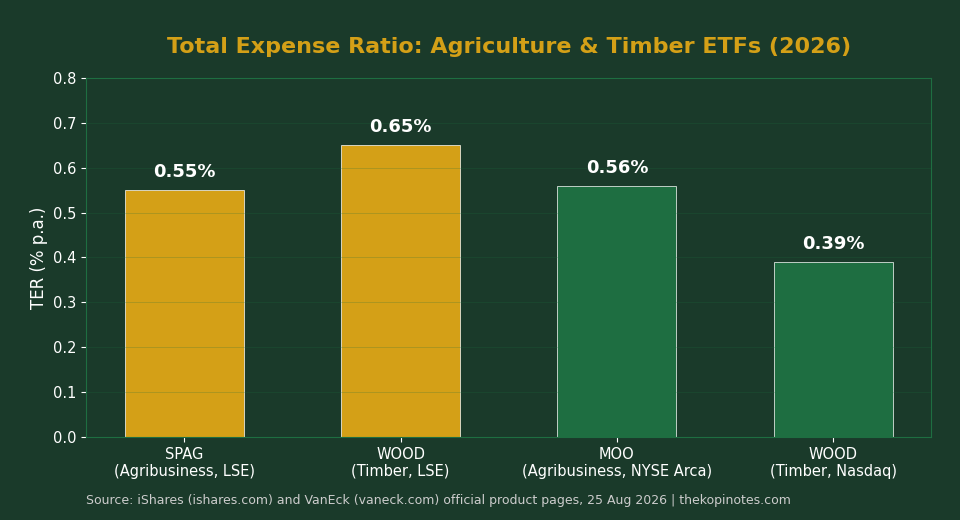
| SPAG (Agribusiness) | LSE | 0.55% | USD 486.4M | 103 | Ireland |
| WOOD (Timber) | LSE | 0.65% | USD 84.9M | 25 | Ireland |
| MOO (Agribusiness) | NYSE Arca | 0.56% | USD 1.00B | 55 | United States |
| WOOD (Timber, US) | Nasdaq | 0.39% | USD 274.5M | n/a | United States |
Source: iShares (ishares.com) and VanEck official product pages, data as at 24-25 Aug 2026.
Note that SPAG and MOO track different indices (S&P Commodity Producers Agribusiness vs MVIS Global Agribusiness), so their holdings and country weights aren’t identical — they’re close cousins, not twins. WOOD on the LSE and WOOD on Nasdaq, by contrast, track the exact same index and are managed by the same issuer, which makes them the cleanest apples-to-apples comparison for the tax discussion below.
The Tax Drag: Why LSE-Listed UCITS ETFs Beat US-Listed Alternatives
MOO and the Nasdaq-listed version of WOOD look cheaper at first glance — especially WOOD’s US TER of 0.39% versus 0.65% for the LSE version. But for a Singapore-based investor, the headline expense ratio isn’t the full cost picture. Two tax rules matter more.
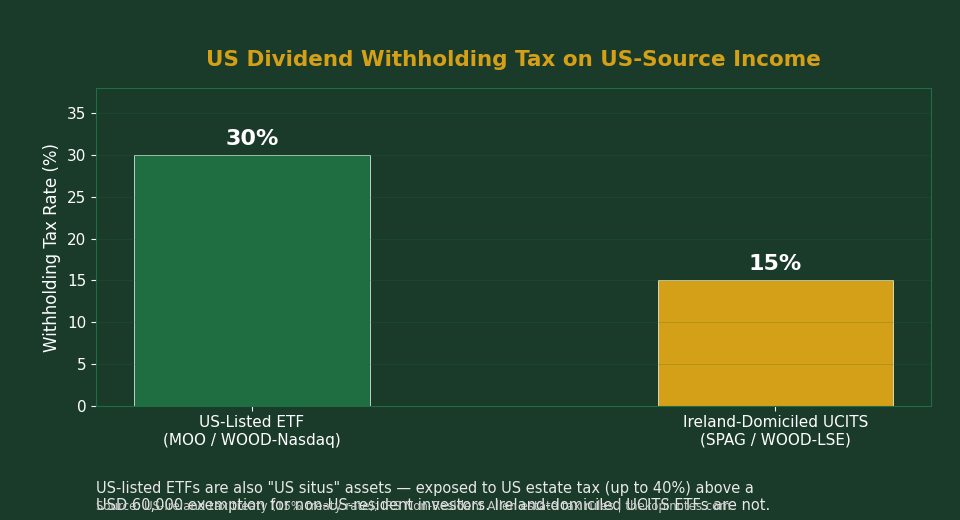
Dividend withholding tax (WHT). Singapore does not have a tax treaty with the United States. That means a US-listed ETF paying dividends to a Singapore investor is subject to the default 30% US withholding tax on US-source dividend income. An Ireland-domiciled UCITS fund like SPAG or WOOD (LSE), by contrast, benefits from the US-Ireland tax treaty at the fund level — US-source dividends the fund receives are taxed at 15%, not 30%. This is baked into the fund’s performance before you ever see a distribution.
US estate tax. This is the bigger risk, and one investors underestimate. US-listed ETFs are classified as “US situs” assets. If you hold a US-listed ETF and pass away, your estate can be liable for US federal estate tax on the value above a USD 60,000 exemption for non-resident aliens — at rates up to 40%. Singapore has no estate tax treaty with the US, so this exposure is real, not theoretical. Ireland-domiciled UCITS ETFs fall outside US estate tax scope entirely, regardless of how much US exposure sits inside the fund.
Worked example: say you hold a SGD 100,000 position in MOO. At MOO’s current 12-month distribution yield of roughly 2.12%, that’s about SGD 2,120 in annual dividends — of which 30%, or roughly SGD 636, is withheld at source before it reaches you. The same position in SPAG (which is accumulating, so income is reinvested inside the fund rather than distributed) sidesteps that visible deduction, and the fund-level 15% treaty rate applies instead of 30% on its US-sourced holdings. More importantly, that SGD 100,000 in MOO sits exposed to US estate tax; the SPAG position does not.
Read more in our guide to why Singapore investors buy ETFs on the London Stock Exchange for the full breakdown of UCITS structure and how it differs from US-listed funds.
Risks You Should Know
Agriculture and timber ETFs aren’t a substitute for a diversified core portfolio. Here’s what can go wrong.
Commodity price swings. Fertiliser and crop prices move with weather cycles like El Niño and La Niña, geopolitical disruptions to grain exports, and input costs like natural gas (a key fertiliser feedstock). These swings hit agribusiness company earnings directly.
Concentration risk. WOOD holds just 25 companies. A problem at any single large holding — a regulatory ruling, a wildfire season, a management scandal — can move the whole fund noticeably more than it would in a 500-stock index fund.
Currency risk. Both SPAG and WOOD are priced in USD. As a Singapore investor buying with SGD, you’re taking on USD/SGD currency risk on top of the underlying equity risk.
Cyclicality, not steady income. Unlike an S-REIT, which typically distributes a fairly predictable quarterly DPU (Distribution Per Unit — the cash paid out per REIT unit), agribusiness and timber companies are cyclical. Earnings and dividends can swing hard between good and bad years for crop prices or timber demand.
Regulatory and ESG scrutiny. Land use, pesticide regulation and deforestation concerns are active policy areas globally. Both SPAG and WOOD carry SFDR Article 8 sustainability classifications, which apply exclusionary screens — but regulatory shifts can still affect specific holdings.
How to Buy SPAG or WOOD From Singapore
Both ETFs trade on the London Stock Exchange in USD, so you’ll need a broker with LSE access.
- Open a brokerage account that offers LSE market access — most major Singapore-accessible brokers support this, including platforms covered in our moomoo Singapore review.
- Fund your account and convert SGD to USD (check the FX spread — this is often the hidden cost brokers don’t advertise).
- Search the ticker — SPAG for agribusiness or WOOD for timber — and confirm you’ve selected the London Stock Exchange, USD-denominated listing (not a similarly-named US fund).
- Place your order. Given WOOD’s smaller trading volume, consider a limit order rather than a market order to avoid an unfavourable fill.
If you’re building out a broader ETF portfolio alongside SPAG or WOOD, our passive income Singapore guide covers how income-generating S-REITs and dividend ETFs can complement a growth-oriented, accumulating fund like SPAG. Note that neither SPAG nor WOOD is on the CPFIS-OA approved investment list, so these are cash or SRS-funded positions only.
Frequently Asked Questions
What is an agriculture ETF and how does it work?
An agriculture ETF holds shares of listed companies in the farming value chain — fertiliser producers, seed and crop-science firms, farm equipment makers and food processors. It does not hold physical crops or commodity futures contracts. SPAG (iShares Agribusiness UCITS ETF) is the main London-listed option for Singapore investors.
Is SPAG (iShares Agribusiness UCITS ETF) available to Singapore investors?
Yes. SPAG trades on the London Stock Exchange in USD. You can buy it through any broker offering LSE market access, such as Interactive Brokers, Saxo, Tiger Brokers, FSMOne or moomoo. It is not, however, on the CPFIS-OA approved list, so you’d need to fund the purchase with cash or SRS.
Timber ETF vs agriculture ETF — what's the difference?
A timber ETF like WOOD holds forestry management companies, timberland REITs and wood-product makers. An agriculture ETF like SPAG holds fertiliser, seed, farm-equipment and food-processing companies. They’re both “real asset” adjacent equity sectors, but driven by different demand cycles — construction and paper demand for timber, versus food demand and input costs for agriculture.
Do I pay withholding tax on SPAG or WOOD dividends as a Singapore investor?
SPAG is accumulating, so it doesn’t pay out visible dividends to you — income is reinvested inside the fund. WOOD (LSE) is distributing and pays semi-annually. Because both are Ireland-domiciled UCITS funds, US-source dividend income the fund receives is taxed at the 15% US-Ireland treaty rate at fund level, rather than the 30% default rate that applies to US-listed ETFs held by Singapore investors. Singapore itself does not tax foreign dividend income received by individuals in most cases.
Is agriculture or timber a good long-term investment theme?
Both sectors have long-term structural demand drivers — population growth and food security for agriculture, decarbonised construction for timber. But they’re cyclical and commodity-price-sensitive in the short-to-medium term, and shouldn’t replace a diversified core portfolio like a global equity ETF (VWRA) or S-REIT holdings. Most investors use SPAG or WOOD as a smaller satellite position, not a core holding.
Can I buy these ETFs through CPF or SRS?
Neither SPAG nor WOOD appears on the CPFIS-OA (CPF Investment Scheme – Ordinary Account) approved investment list, so you cannot use CPF-OA funds to buy them directly. SRS (Supplementary Retirement Scheme) funds can typically be used through brokers that support SRS-funded overseas ETF purchases, such as FSMOne — check with your broker for current SRS eligibility on LSE-listed funds.
Planning Your Broader Portfolio?
See how a satellite position like SPAG or WOOD fits alongside your core holdings and retirement plan.
This article was researched with the help of AI. While we strive to keep all information accurate and up to date, there may be errors. If you notice any discrepancies, please contact us.