Dividend Investing Singapore: A Complete Beginner's Guide (2026)
How to build passive income from Singapore blue chips and S-REITs — without paying dividend taxDividend investing in Singapore means buying shares in companies or Real Estate Investment Trusts (REITs) that pay out regular cash distributions — and the best part is that Singapore investors pay zero dividend tax. Whether you start with $1,000 or $100,000, a dividend portfolio of blue chip banks, S-REITs, and ETFs can generate 5–7% annual income, compounding into a meaningful passive income stream over time.
Not financial advice. All figures are for educational reference only. Data as at August 2026 unless noted.
- Singapore has no dividend withholding tax — every dollar of dividends goes straight into your pocket.
- DBS, OCBC, UOB and S-REITs currently yield 5–7%, making SG one of the best markets for income investing globally.
- Reinvest your dividends and you can potentially grow S$10,000 into S$29,000+ over 20 years through compounding alone.
Table of Contents
Contents
- What Is Dividend Investing?
- Why Singapore Is Perfect for Dividend Investing
- Best Dividend Stocks and REITs in Singapore 2026
- How to Start Dividend Investing in Singapore (Step by Step)
- The Power of Reinvesting Your Dividends
- Key Dividend Investing Strategies
- Best Brokers for Dividend Investing
- Common Mistakes to Avoid
- Frequently Asked Questions
What Is Dividend Investing?
Dividend investing is a strategy where you buy shares of companies that regularly pay out a portion of their profits to shareholders. These payouts are called dividends — for REITs, they are called Distribution Per Unit (DPU), which basically means the same thing: cash deposited into your brokerage account.
The goal is simple. You build a portfolio that generates a steady stream of cash — quarterly, semi-annually, or annually — without having to sell any shares. Over time, if you reinvest those dividends back into more shares, the compounding effect is powerful.
In Singapore, dividend investing is especially popular because of two structural advantages: zero dividend tax and the availability of high-quality dividend payers like the three local banks and a deep market of S-REITs yielding 5–7%.
Why Singapore Is Perfect for Dividend Investing
Most investors in the US or Europe pay 15–30% withholding tax on dividends. In Singapore, you pay zero. The one-tier corporate tax system means that once a company pays corporate tax, all dividends distributed to shareholders are tax-exempt — in your hands, regardless of citizenship.
That is a massive advantage. A 6% yield in Singapore is truly 6% in your pocket. In the US, you would net closer to 5.1% after the 15% withholding tax on a similar yield.
Beyond the tax advantage, Singapore capital markets are mature and liquid. The SGX has over 40 S-REITs listed, required by MAS regulations to distribute at least 90% of their taxable income each year. That is a structural guarantee of high payout ratios — something you simply do not get with regular stocks.
Singapore three local banks — DBS, OCBC, and UOB — are globally well-capitalised and have grown dividends consistently over the past decade. They are the backbone of most Singapore dividend portfolios.
Best Dividend Stocks and REITs in Singapore (2026)
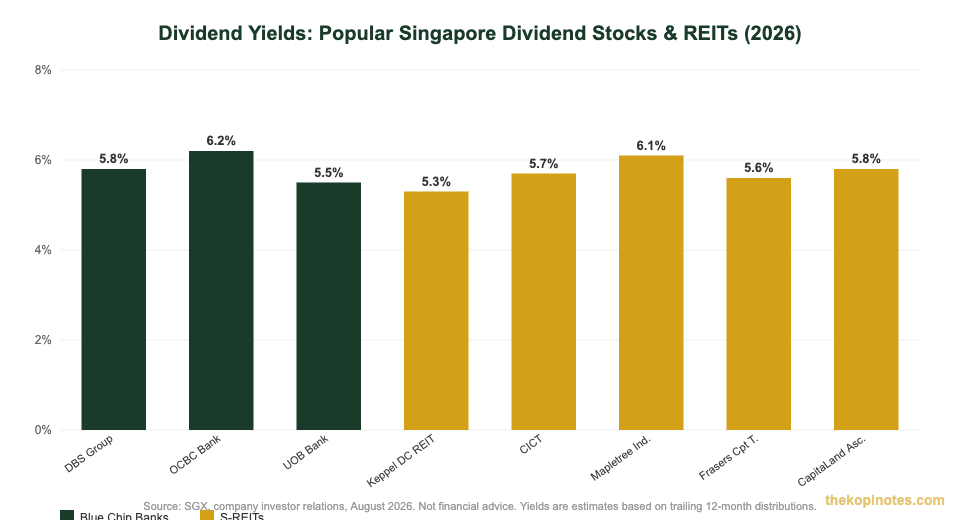
Here is a snapshot of dividend yields for popular Singapore dividend investments, based on trailing 12-month distributions as at August 2026. These are not recommendations — always do your own due diligence.
| Stock / REIT | Sector | Est. Yield (2026) | Payout Frequency |
|---|---|---|---|
| DBS Group | Banking | ~5.8% | Quarterly |
| OCBC Bank | Banking | ~6.2% | Semi-annual |
| UOB Bank | Banking | ~5.5% | Semi-annual |
| CapitaLand Integrated Commercial Trust (CICT) | Retail/Office REIT | ~5.7% | Semi-annual |
| Mapletree Industrial Trust (MIT) | Industrial REIT | ~6.1% | Quarterly |
| Frasers Centrepoint Trust (FCT) | Retail REIT | ~5.6% | Semi-annual |
| CapitaLand Ascendas REIT (CLAR) | Industrial REIT | ~5.8% | Semi-annual |
Source: SGX, company investor relations pages, August 2026. Yields are estimates based on trailing 12-month distributions / current unit price. Past performance does not guarantee future distributions.
For a deeper dive into S-REITs, see our guide on the best S-REITs in Singapore 2026. If you prefer a one-stop approach, the Singapore REIT ETF guide covers diversified REIT ETFs you can buy with a single trade.
How to Start Dividend Investing in Singapore (Step by Step)
Getting started is simpler than most people think. Here is the practical path for a Singapore investor starting from zero.
Step 1: Open a brokerage account. You need a CDP-linked brokerage for SGX-listed stocks or an international broker for foreign-listed ETFs. FSMOne, Syfe Trade, and IBKR are popular choices.
Step 2: Set your income target. Work out how much passive income you want per month. To generate S$1,000/month at a blended 6% yield, you need a portfolio of roughly S$200,000. Use our retirement planning calculator to model your own number.
Step 3: Pick your allocation. A simple, beginner-friendly split: 50% in the three local banks (DBS/OCBC/UOB), 40% in 3–4 diversified S-REITs across retail, industrial, and healthcare, and 10% in a broad ETF like the STI ETF for ballast.
Step 4: Start with Dollar Cost Averaging (DCA). Do not try to time the market. Invest a fixed amount every month — say S$500 — regardless of price. Over time, this reduces your average entry cost. Syfe DCA plan makes this fully automated for a Syfe referral code sign-up bonus.
Step 5: Reinvest your dividends. Do not spend the dividends — use them to buy more shares. This is the most powerful wealth-building move available to a dividend investor.
The Power of Reinvesting Your Dividends
When you reinvest your dividends, you buy more units. Those extra units generate their own dividends next time. And so on. This is compounding — and over 20 years, the difference is staggering.
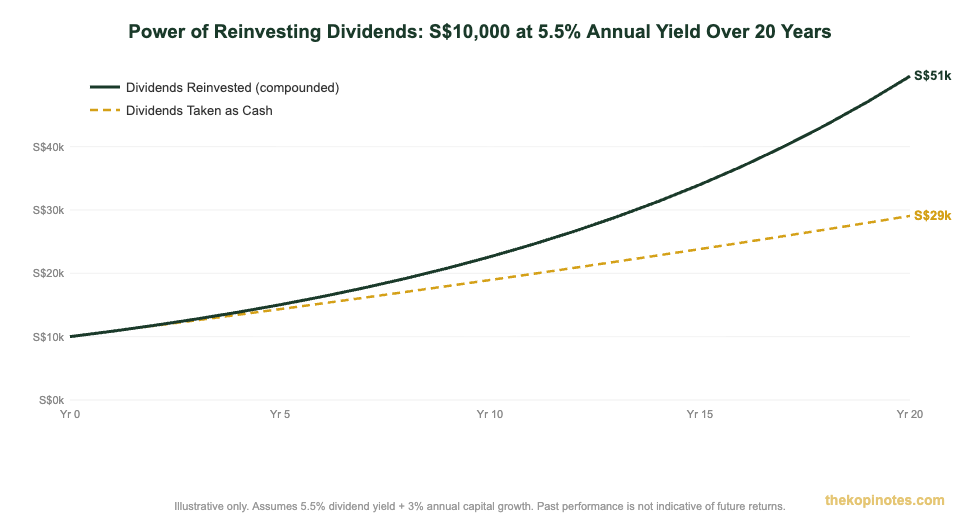
The chart above shows what happens to a S$10,000 investment at a 5.5% yield with 3% annual capital growth — with and without reinvesting dividends. Reinvested dividends compound into roughly 40% more wealth than taking the same dividends as cash.
This is why building a passive income Singapore strategy through dividend reinvestment works so powerfully over long periods. The key is patience and consistency.
Key Dividend Investing Strategies for Singapore Investors
Strategy 1 — The Barbell Portfolio: Put 50–60% into stable high-yielders (SG banks) and 40–50% into growth-oriented S-REITs such as data centres and industrials. Banks provide resilience; REITs provide higher income with growth optionality.
Strategy 2 — Dividend Growth Investing: Instead of chasing the highest yield today, focus on companies that grow their dividends year-over-year. DBS has increased its quarterly dividend consistently since 2020. A growing dividend is a much more powerful compounding engine than a stagnant high yield.
Strategy 3 — The CPF Booster: If your OA funds are idle at 2.5%, consider using CPFIS-OA to invest in dividend-paying ETFs or REITs that yield 5–7%. Read more in our CPF investment strategy guide. The yield difference compounded over 20 years is significant.
Strategy 4 — Managed Income Portfolio: If you prefer a fully managed approach, Endowus income-focused fund portfolios blend global dividend funds with SG bonds to target 4–6% annual distributions. Use Endowus referral code 2V343 for a fee rebate on your first investment.
Best Brokers for Dividend Investing in Singapore
Your broker choice matters because commissions eat directly into your dividend income. Here is how the main options compare:
| Broker | Min. Commission (SGX) | CDP-Linked? | Best For |
|---|---|---|---|
| FSMOne | S$8.80 flat | Yes | Funds + SGX stocks |
| Syfe Trade | S$1.49 or 0% | No (custodian) | Beginners, DCA plans |
| IBKR | S$1.50 min | No (custodian) | LSE ETFs, multi-currency |
| DBS Vickers | S$25 min (online) | Yes | CDP holders, bank integration |
| MooMoo SG | S$1.99 min | No (custodian) | Active traders, US stocks |
Source: Broker websites, August 2026. Fees subject to change. Always verify current rates on the broker official site.
Common Dividend Investing Mistakes to Avoid
1. Chasing yield blindly. A 12% yield sounds amazing — until the REIT cuts its DPU by 50% because it over-leveraged in a rising rate environment. Always check the gearing ratio (keep below 40% for S-REITs) and distribution coverage ratio before buying.
2. Ignoring capital erosion. If a REIT yields 7% but its unit price falls 8% per year, you are actually losing money. Total return — yield plus capital change — is what matters, not just the headline yield.
3. Under-diversifying. Putting 80% of your portfolio into one sector exposes you to concentration risk. Spread across banking, industrial REITs, healthcare REITs, and global ETFs.
4. Forgetting the ex-dividend date. You must own shares before the ex-dividend date to receive the next payment. Buying on or after ex-dividend means waiting until the next distribution — often six months away for S-REITs.
5. Spending dividends instead of reinvesting. In your wealth-building phase, reinvesting is almost always the optimal choice. Only switch to drawing income when you actually need the cash flow — typically at or near retirement. Use our retirement calculator to figure out when that switch makes sense for you.
Frequently Asked Questions
Is dividend investing suitable for beginners in Singapore?
Do Singapore residents pay tax on dividend income?
How much money do I need to start dividend investing?
What is a good dividend yield in Singapore?
Can I use CPF money to invest in dividend stocks?
What is the difference between dividends and DPU?
Start Your Dividend Portfolio Today
Open an account with one of our trusted broker partners and get a sign-up bonus when you use a TKN referral code.
This article was researched with the help of AI. While we strive to keep all information accurate and up to date, there may be errors. If you notice any discrepancies, please contact us.