United Hampshire US REIT Dividend 2026 (SGX: ODBU): DPU History, ~8.8% Yield & Investor Guide
Why this necessity-retail and self-storage S-REIT has grown its payout for three straight years — while office-focused US peers cut theirs.
United Hampshire US REIT (SGX: ODBU) paid a FY2025 dividend per unit of 4.39 US cents, up 8.1% year-on-year, for a forward yield of roughly 8.8%. Unlike its office-focused US S-REIT peers, which have cut or suspended payouts, UHREIT’s grocery-anchored retail and self-storage portfolio has kept distributions growing for three straight years.
Not financial advice. All figures are for educational reference only. Data as at June 2026 unless noted.
- UHREIT (SGX: ODBU) paid FY2025 DPU of 4.39 US cents (+8.1% YoY) — its 3rd straight year of dividend growth, while office-focused peers cut theirs.
- Forward yield sits around 8.2%–8.8% depending on your entry price; FY2026 DPU consensus estimate is 4.51 US cents.
- You can usually avoid US withholding tax on distributions if you file the right W-8 forms — but you must choose SGD or USD payout, not both.
Table of Contents
Contents — Click to expand
What Is United Hampshire US REIT?
United Hampshire US REIT is a Singapore-listed REIT that owns US real estate — but not the office towers that have hurt other “US S-REITs.” Its portfolio is split between two necessity-driven property types: grocery-anchored and necessity-based retail centres (think supermarket-anchored strip malls), and modern, climate-controlled self-storage facilities.
You’ll sometimes see it called UHREIT. It trades on the SGX mainboard under the ticker ODBU. Because its tenants sell everyday essentials — groceries, pharmacy items, storage space — demand for its properties tends to hold up even when the broader economy wobbles.
That distinction matters. Singapore has four SGX-listed REITs that own US property: UHREIT, Manulife US REIT, Prime US REIT and Keppel Pacific Oak US REIT. The other three are office-focused. We’ll come back to why that split has produced very different dividend outcomes.
United Hampshire US REIT Dividend History & DPU Growth
UHREIT’s distribution per unit (DPU) — basically how much cash each unit pays you per year — has climbed for three consecutive years. FY2025 DPU came in at 4.39 US cents, up 8.1% from FY2024. That’s a meaningful acceleration from the smaller gains of the two years before.
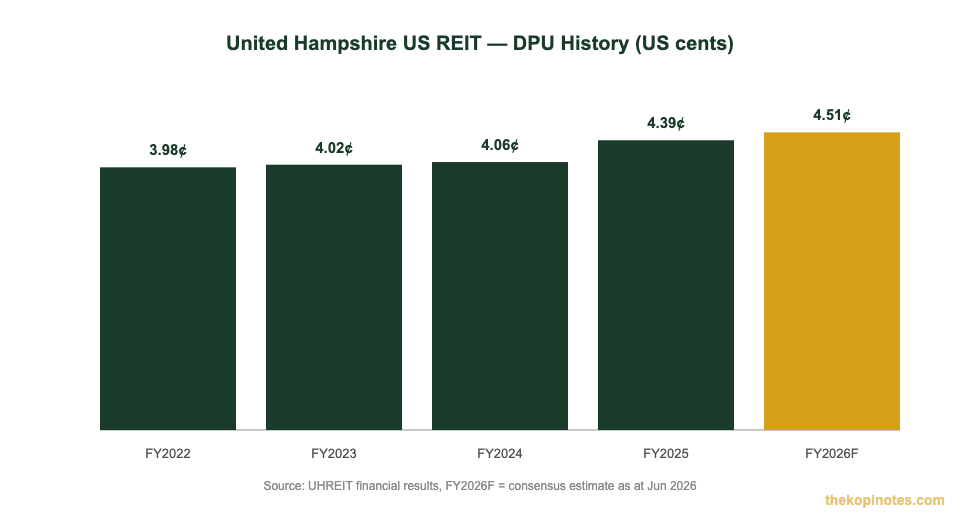
| Financial Year | DPU (US cents) | YoY Change |
|---|---|---|
| FY2022 | ~3.98 | — |
| FY2023 | ~4.02 | +1.0% |
| FY2024 | ~4.06 | +1.0% |
| FY2025 | 4.39 | +8.1% |
| FY2026F (consensus) | ~4.51 | ~+2.7% |
Source: UHREIT financial results and market commentary aggregated as at June 2026. FY2026F is a consensus estimate, not a company guidance figure — actual results may differ.
Distribution yield naturally moves with the unit price. Various snapshots through 2026 put UHREIT’s yield anywhere from about 8.2% to 8.8%, depending on the day and whether it’s calculated on trailing FY2025 DPU or forward FY2026F DPU. If you’re comparing REITs, always check whether a quoted “yield” is trailing or forward — the two numbers can look quite different.
United Hampshire US REIT 1Q 2026 Results Breakdown
UHREIT’s first-quarter 2026 numbers show the growth wasn’t a one-off. Distributable income rose 10.0% year-on-year to US$6.9 million. Gross revenue climbed 8.7% to US$19.7 million, and net property income (NPI) — revenue minus the direct cost of running the properties — grew a faster 12.7% to US$13.2 million.
That NPI growth outpacing revenue growth is a good sign. It usually means operating costs are being managed well, or that higher-margin new leases are kicking in. In UHREIT’s case, both are true: new leases, rental escalations (built-in annual rent increases), and contributions from two recently acquired grocery-anchored properties all played a part.
Occupancy also held up. As at 31 March 2026, grocery & necessity retail occupancy was 97.7%. Self-storage occupancy improved 55 basis points to 89.2% — a smaller number, but self-storage REITs typically run lower occupancy than retail by design, since unit turnover is higher.
Why UHREIT Still Pays When Other US S-REITs Don’t
Here’s the bit that matters most if you’re considering UHREIT. Singapore has three other SGX-listed REITs that own US property — Manulife US REIT, Prime US REIT and Keppel Pacific Oak US REIT. All three are concentrated in US office buildings, and all three have suspended or cut their distributions at some point as office valuations and occupancy came under pressure from the shift to hybrid work.
UHREIT has avoided that fate for one structural reason: its tenants aren’t paying rent for office space nobody wants to use anymore. They’re paying rent for supermarkets, pharmacies and storage units — things people need regardless of where they work. That’s why UHREIT has maintained occupancy above 95% for its grocery-anchored retail portfolio since its IPO, even through the pandemic and the office downturn that hit its peers.
That said, “different sector” doesn’t mean “risk-free.” Rising interest rates, US retail spending trends and currency movements all still affect UHREIT — more on that in the risks section below.
Portfolio: Grocery-Anchored Retail & Self-Storage
UHREIT’s portfolio is built around two necessity-based property types spread across the United States. The grocery & necessity retail segment leases space to supermarkets, pharmacies and everyday-essentials tenants, with a long weighted average lease expiry (WALE) of 8.0 years — meaning most leases won’t come up for renewal (and rent renegotiation risk) for years.
The REIT has also kept growing through acquisitions. It added Dover Marketplace in August 2025 and Wallingford Fair Shopping Centre in January 2026, both grocery-anchored centres that contributed directly to the revenue and NPI growth seen in 1Q 2026.
The self-storage segment is smaller but diversifies the income base — storage demand tends to be driven by different factors (moving, downsizing, business storage) than grocery retail, which smooths out UHREIT’s overall income against any single demand driver weakening.
Balance Sheet & Gearing
Gearing — how much of the REIT’s assets are funded by debt — is one of the clearest early-warning signs for dividend risk. High gearing plus rising interest rates is exactly what forced UHREIT’s office-focused peers to cut distributions.
UHREIT’s aggregate leverage stood at 40.3% as at 1Q 2026, comfortably under the regulatory cap of 50% for S-REITs. Its average cost of borrowing was 4.91%, and management has flagged no refinancing requirements until February 2028 — which removes near-term refinancing risk from the picture (a real concern for REITs that have to roll over debt into a higher-rate environment).
| Metric | 1Q 2026 |
|---|---|
| Aggregate leverage (gearing) | 40.3% |
| Average cost of borrowing | 4.91% |
| Next refinancing due | Feb 2028 |
| WALE (grocery & necessity retail) | 8.0 years |
| Grocery & necessity retail occupancy | 97.7% |
| Self-storage occupancy | 89.2% (+55bps QoQ) |
Source: UHREIT 1Q 2026 business updates and financial results, as at 31 March 2026.
Tax Treatment for Singapore Investors
Two tax questions come up a lot with UHREIT because it’s a Singapore-listed REIT that owns US property — which currency do you get paid in, and do you lose a chunk to US withholding tax?
Currency: You choose. Unitholders elect to receive their entire distribution in either Singapore dollars or US dollars — you can’t split a single distribution between the two. If you elect USD, you’re taking on direct SGD/USD exchange rate exposure on every payout.
Withholding tax: UHREIT states that for periods when the REIT is not engaged in a trade or business within the United States, unitholder distributions aren’t subject to US withholding tax under IRC Section 1446 — provided you’ve submitted the correct paperwork. Non-US individual unitholders need a completed IRS Form W-8 plus a US Tax Compliance Certificate; non-US corporate unitholders need Form W-8BEN-E plus the same certificate. Miss the paperwork, and you could be withheld under FATCA rules instead.
This is different from holding individual US stocks directly, where dividends are typically subject to a flat 30% US withholding tax (Singapore has no tax treaty with the US covering dividend withholding). UHREIT’s REIT structure is specifically designed to sidestep that outcome for compliant unitholders — but the exact mechanics depend on your broker and how distributions flow through CDP or your custodian. Check UHREIT’s official tax information page or speak to a tax advisor about your specific holding structure before assuming any tax outcome.
UHREIT vs Peer US S-REITs
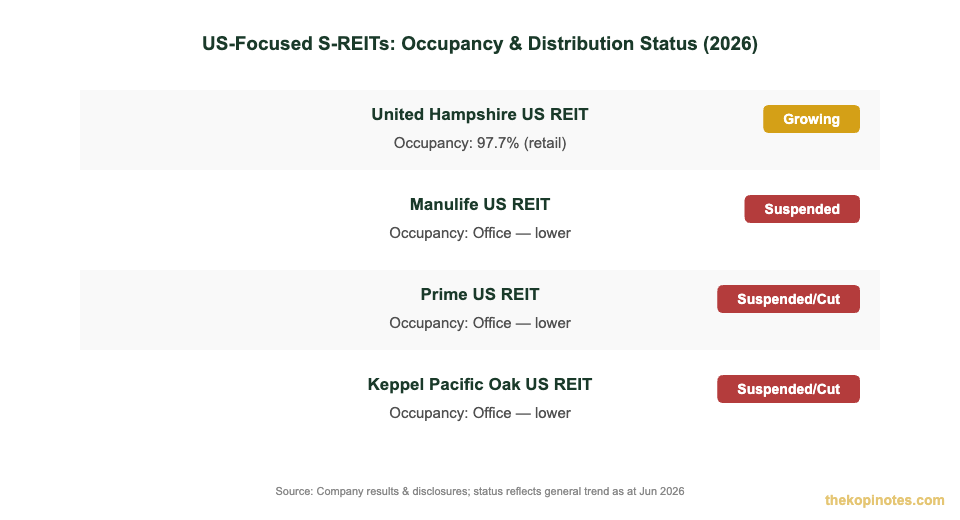
Here’s how UHREIT stacks up against the three other SGX-listed US property REITs at a glance:
| REIT | Property Focus | Occupancy Trend | Distribution Status (2026) |
|---|---|---|---|
| United Hampshire US REIT | Grocery retail + self-storage | 97.7% retail, stable/rising | Growing (+8.1% FY2025) |
| Manulife US REIT | Office | Under pressure | Suspended |
| Prime US REIT | Office | Under pressure | Suspended / cut |
| Keppel Pacific Oak US REIT | Office | Under pressure | Suspended / cut |
Source: company disclosures and market commentary, general trend as at June 2026. Distribution status can change quickly — always verify against each REIT’s latest results before investing.
The takeaway isn’t “office REITs are always bad” — it’s that property type drove very different dividend outcomes for REITs that all share the same “US-focused S-REIT” label. Don’t assume two REITs are similar just because they’re grouped the same way on a stock screener.
Risks to Watch
UHREIT’s track record is stronger than its office-focused peers, but it isn’t risk-free. Here’s what could change the picture:
- Currency risk. Its income is US-dollar denominated. A weaker USD/SGD rate reduces what you receive if you elect SGD distributions, even if the underlying US-dollar DPU keeps growing.
- Interest rate risk. Gearing of 40.3% means UHREIT still carries meaningful debt. While no refinancing is due until Feb 2028, a higher-for-longer US rate environment would raise borrowing costs when that debt does roll over.
- US consumer spending. Grocery-anchored retail is more resilient than discretionary retail, but it isn’t immune to a genuine US consumer slowdown.
- Small market cap and liquidity. UHREIT is smaller than many SGX blue-chip REITs, which can mean wider bid-ask spreads and more volatile price swings on lower trading volumes.
- Self-storage occupancy. At 89.2%, this segment runs lower than the retail portfolio — worth monitoring if the trend reverses instead of continuing to improve.
How to Buy United Hampshire US REIT in Singapore
UHREIT trades on the SGX mainboard under ticker ODBU, so you can buy it the same way you’d buy any other Singapore-listed REIT:
- Open a brokerage account that gives you SGX access — most local and online brokers qualify.
- Fund your account with cash, or check whether your broker supports CPFIS-OA or SRS funds for this counter.
- Search “ODBU” on your broker’s trading platform.
- Decide your distribution currency election — SGD or USD — through your broker or CDP before the next distribution record date.
- Place your order and monitor UHREIT’s quarterly business updates for DPU and occupancy trends.
If you’re comparing UHREIT against Singapore’s core S-REITs before deciding how much to allocate, our best S-REITs in Singapore 2026 guide is a good starting point, and our highest yield REITs in Singapore roundup shows how UHREIT’s yield compares to the broader S-REIT universe.
For low-cost SGX trading, FSMOne’s referral code gets you started with competitive brokerage fees, while Syfe’s referral code is worth checking if you’d rather build broad REIT exposure through a managed portfolio instead of picking single counters. If you’re building a passive income plan around dividend-paying assets like UHREIT, see our passive income Singapore guide, and run your numbers through our retirement calculator to see how a growing DPU stream fits your bigger retirement plan.
Open a low-cost brokerage account to start building your S-REIT dividend portfolio.
Frequently Asked Questions
What is United Hampshire US REIT's dividend yield in 2026?
United Hampshire US REIT (SGX: ODBU) offered a forward distribution yield of roughly 8.2%–8.8% through mid-2026, depending on the unit price on the day you buy. Its FY2025 DPU of 4.39 US cents was 8.1% higher than FY2024, its third straight year of growth.
Is United Hampshire US REIT dividend safe?
No dividend is guaranteed, but UHREIT’s payout has grown for three consecutive years while its office-focused US S-REIT peers cut or suspended distributions. That’s because grocery-anchored retail and self-storage tenants sign long, necessity-driven leases (WALE of 8.0 years) with high occupancy — 97.7% for grocery & necessity retail as at 1Q 2026.
Does UHREIT pay dividends in SGD or USD?
Both, but you have to choose. Unitholders elect to receive their entire distribution in either Singapore dollars or US dollars — you can’t split it between the two currencies.
Do I pay US withholding tax on United Hampshire US REIT dividends?
UHREIT states that for periods when the REIT is not engaged in a US trade or business, distributions aren’t subject to US withholding tax under IRC Section 1446 — but only if you submit the correct documentation (Form W-8 or W-8BEN-E, plus a US Tax Compliance Certificate). If you don’t file these forms, you may be withheld under FATCA rules instead. Check the REIT’s tax information page or speak to a tax advisor for your specific situation.
What does United Hampshire US REIT own?
UHREIT owns a portfolio of stabilised, income-producing grocery-anchored and necessity-based retail properties, plus modern climate-controlled self-storage facilities, all located in the United States. Recent acquisitions include Dover Marketplace (Aug 2025) and Wallingford Fair Shopping Centre (Jan 2026).
How is United Hampshire US REIT different from Manulife US REIT or Prime US REIT?
The key difference is property type. Manulife US REIT, Prime US REIT and Keppel Pacific Oak US REIT are office-focused, a sector that’s faced falling occupancy and valuations since the shift to hybrid work. UHREIT’s grocery-anchored and self-storage assets are necessity-driven, which is why it has kept growing its dividend while office-focused peers cut theirs.
What is UHREIT's gearing ratio?
As at 1Q 2026, UHREIT’s aggregate leverage was 40.3%, with an average borrowing cost of 4.91% and no refinancing due until February 2028 — a manageable position versus the regulatory cap of 50% for S-REITs.
Can I buy United Hampshire US REIT with CPF or SRS?
UHREIT trades on the SGX mainboard like any other S-REIT, so it’s generally accessible through CPF Investment Scheme (CPFIS-OA, subject to your broker and bank agent’s supported counter list) and SRS funds, in addition to cash. Confirm current CPFIS eligibility with your broker before investing, as the approved counter list changes periodically.
This article was researched with the help of AI. While we strive to keep all information accurate and up to date, there may be errors. If you notice any discrepancies, please contact us.