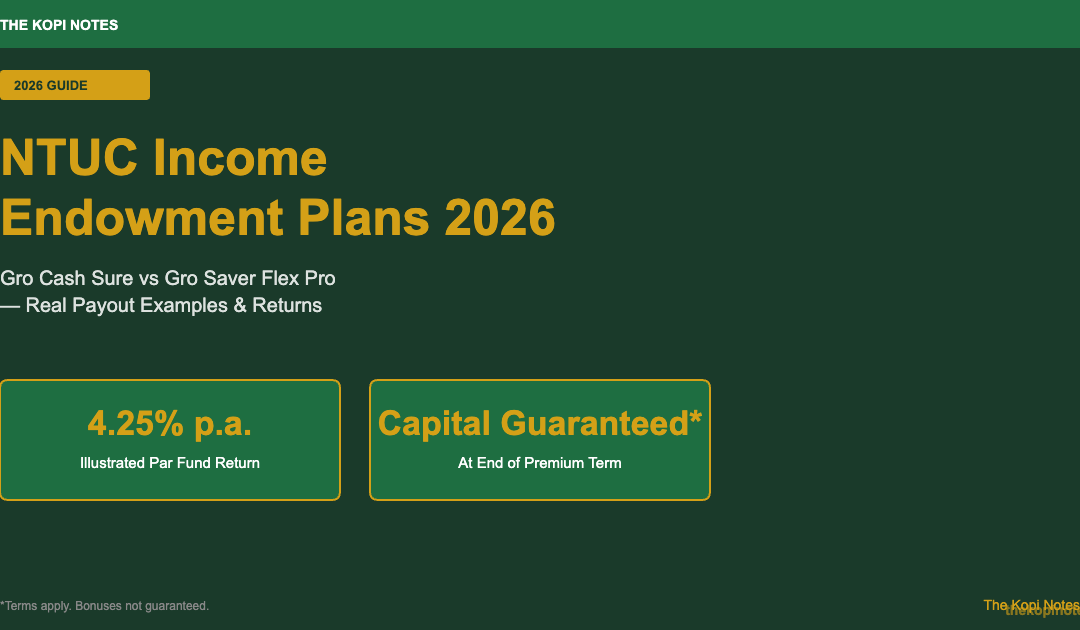
NTUC Income Endowment Plan Singapore 2026: Complete Guide & Comparison
Gro Cash Sure vs Gro Saver Flex Pro vs Gro Capital Ease — real payout examples, guaranteed vs non-guaranteed returns, and who each plan actually suits.
NTUC Income (now legally branded Income Insurance) runs two main endowment-style plans: Gro Cash Sure, which pays lifetime cash income after a 5- or 10-year premium term, and Gro Saver Flex Pro, a flexible lump-sum endowment. Both guarantee your capital if held to term, but bonuses ride on the Life Participating Fund, illustrated at 4.25% p.a. and not guaranteed.
Not financial advice. All figures are illustrations taken from Income Insurance’s official product pages and are not guaranteed except where explicitly stated. Data verified as at 13 July 2026.
- Gro Cash Sure pays you lifetime cash income starting after a 5- or 10-year premium term — your capital is guaranteed if you hold to term, but the payout amount depends on non-guaranteed bonuses.
- Gro Saver Flex Pro is a flexible lump-sum endowment. In Income’s own example, the illustrated maturity value swings between S$153,894 and S$387,505 on the same S$30,000 premium — a 2.15%–3.38% p.a. spread — depending purely on the Par Fund’s assumed return.
- Gro Capital Ease, the short 2–3 year single-premium plan, is currently between tranches as of July 2026 — there’s no live rate to buy today, so don’t confuse old marketing rates with what’s on offer now.
Table of Contents
Contents — Click to expand
- NTUC Income’s 2026 Savings Plan Lineup
- Gro Cash Sure: Lifetime Cash Payouts
- Gro Saver Flex Pro: The Flexible Lump-Sum Plan
- Gro Capital Ease: The Short-Term Tranche Plan
- How the Life Participating Fund Pays Your Bonus
- NTUC Income Endowment vs CPF, SSB and ETFs
- Who Should (and Shouldn’t) Buy One
- How to Buy: CPF, SRS, Cash & Steps
- FAQ
NTUC Income’s 2026 Savings Plan Lineup
NTUC Income rebranded its corporate name to Income Insurance in 2022, though most Singaporeans still search “NTUC endowment plan.” As at July 2026, its savings-plan shelf has nine insurance savings plans and six investment-linked plans (ILPs). This guide focuses on the two core endowment-style plans — Gro Cash Sure and Gro Saver Flex Pro — plus the short-term Gro Capital Ease tranche product.
| Plan | Type | What It’s For |
|---|---|---|
| Gro Cash Sure | Whole-life cash payout | Lifetime income after a 5- or 10-year premium term |
| Gro Saver Flex Pro | Participating endowment | Flexible lump sum at maturity — single or 5–30 year premium terms |
| Gro Capital Ease | Short-term single premium, tranche-based | 2–3 year guaranteed-return parking spot for lump sums (currently between tranches) |
| Gro Cash Plus / Gro Cash Flex Pro | Cash-payout savings plans | Similar cash-payout structure to Gro Cash Sure, different terms and riders |
| Gro Retire Flex Pro II / Gro Annuity Pro | Retirement income plans | Structured payouts timed to retirement, closer to an annuity than a classic endowment |
| Luxe Plus Solitaire II / Wealth Plus Solitaire | Premier single-premium plans | Higher-ticket legacy and monthly-payout plans under Income’s Solitaire series |
Source: Income Insurance, Savings & Investments product listing (income.com.sg), fetched 13 July 2026.
Gro Cash Sure: Lifetime Cash Payouts After 5 or 10 Years
Gro Cash Sure is a whole-life plan that runs until age 120. You pick a 5- or 10-year premium term. Once that’s done, Income Insurance starts paying you a yearly (or monthly) cash benefit — up to 9.9% of your sum assured — for the rest of your life, whether you spend it or let it accumulate.
Your capital is guaranteed once the premium term ends, as long as you’ve paid every premium and haven’t made any policy changes or claims. From 20 years after your premium term ends, a loyalty bonus tops up your yearly payout. There’s also guaranteed acceptance regardless of health (financial underwriting still applies), and an optional Savings Protector Pro rider that waives future premiums if you suffer total permanent disability before age 70.
Here’s what that looks like in Income’s own worked examples:
| Example | Premiums Paid | Sum Assured | Illustrated Yearly Payout |
|---|---|---|---|
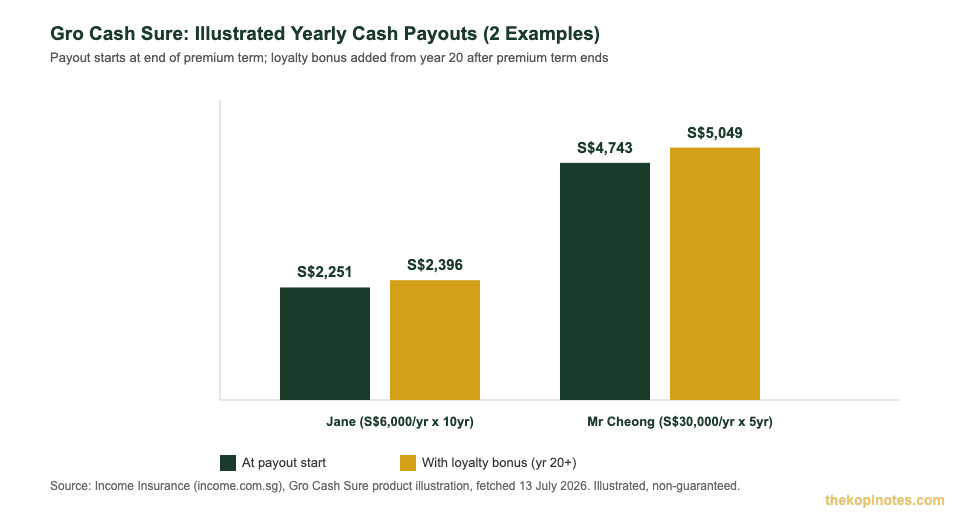
| Jane — S$6,000/yr x 10 years | S$60,000 | S$24,200 | S$2,251/yr, rising to S$2,396/yr with loyalty bonus from year 20 |
| Mr Cheong — S$30,000/yr x 5 years | S$150,000 | S$51,000 | S$4,743/yr, rising to S$5,049/yr with loyalty bonus from year 20 |
Source: Income Insurance, Gro Cash Sure product illustration (income.com.sg), fetched 13 July 2026. Figures assume the Life Participating Fund earns 4.25% p.a. long-term — not guaranteed.
That “3.10x” figure sounds great until you remember it’s spread across decades and rides on non-guaranteed bonus rates. Treat every Gro Cash Sure quote as an illustration, not a promise — the guaranteed portion is only the capital return at the end of your premium term.
Gro Saver Flex Pro: The Flexible Lump-Sum Endowment
Gro Saver Flex Pro is Income’s participating endowment plan. Instead of the lifetime cash stream you get with Gro Cash Sure, it pays a single lump sum (plus any death benefit) at the end of your chosen policy term. You can structure it as a single premium, or spread premiums over 5, 10, 15, 20, 25 or 30 years, with a policy term of 10 to 30 years, or all the way to age 120.
Income’s own example shows just how wide the gap can be between a conservative and an optimistic bonus assumption. Sophia pays a single S$30,000 premium at birth, with the policy maturing at age 77:
| Assumed Par Fund Return | Illustrated Maturity Value | Multiple of Premium | Effective CAGR* |
|---|---|---|---|
| 3.00% p.a. | S$153,894 | 5.13x | ~2.15% p.a. |
| 4.25% p.a. | S$387,505 | 12.92x | ~3.38% p.a. |
Source: Income Insurance, Gro Saver Flex Pro product illustration (income.com.sg), fetched 13 July 2026. *CAGR calculated by The Kopi Notes from the illustrated 77-year holding period — not an official Income Insurance figure.
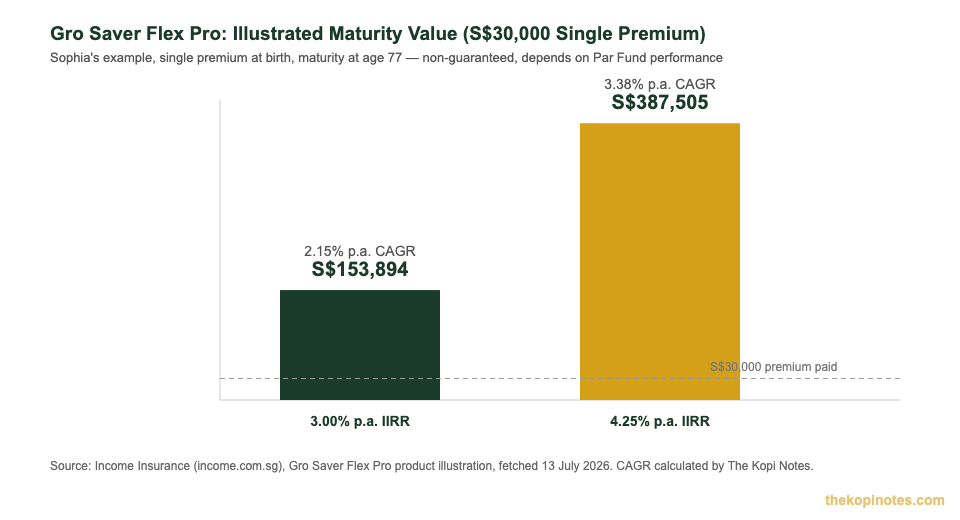
Why bother with the CAGR conversion? “12.92 times your premium” sounds spectacular, but it’s earned over 77 years. Converting it to an annualised rate — using the standard compound growth formula (ending value ÷ starting value)^(1/years) − 1 — tells you it’s actually about 3.38% p.a. at best, and 2.15% p.a. if the Par Fund underperforms its long-term assumption. That’s a useful number because you can hold it up against CPF Ordinary Account (2.5% p.a., guaranteed) or a globally diversified ETF (historically averaging roughly 6–8% p.a. before fees, not guaranteed) and judge for yourself.
Gro Saver Flex Pro also carries a Guaranteed Insurability Option (buy another policy later without health underwriting) and an optional Cancer Premium Waiver rider. Like Gro Cash Sure, Income allocates 90% of Par Fund surpluses to policyholders and keeps a maximum of 10% for shareholders — a detail worth knowing since your bonus size depends entirely on how that fund performs.
Gro Capital Ease: The Short-Term Tranche Plan (Currently Paused)
Gro Capital Ease is Income’s short-term, single-premium insurance savings plan — historically released in 2- to 3-year tranches with a fixed guaranteed yield at maturity, guaranteed acceptance, and death/TPD cover before age 70. Because it’s tranche-based, the rate changes (or disappears) every time a new batch is released.
As at 13 July 2026, Income’s own product page shows Gro Capital Ease is between tranches: “Register your interest for the next launch… the guaranteed return for the new tranche may differ from previous tranches.” Past tranches have reportedly offered guaranteed yields ranging from roughly 1.2% to 3.6% p.a. depending on when they launched and prevailing interest rates at the time. If you see a specific rate quoted for Gro Capital Ease online, check the date — it’s almost certainly from a past tranche, not one you can buy today.
Source: Income Insurance, Gro Capital Ease product page (income.com.sg), fetched 13 July 2026; historical tranche rates via Seedly and Dollar Bureau product reviews.
How the Life Participating Fund Actually Pays Your Bonus
Every non-guaranteed dollar in Gro Cash Sure and Gro Saver Flex Pro comes from Income’s Life Participating Fund (Par Fund) — a pool of policyholders’ premiums invested across bonds, equities and other assets. The fund’s investment returns, expenses and claims experience determine how much bonus gets declared each year.
Two things matter here. First, all illustrations you’ll see are based on an assumed long-term return of 4.25% p.a. — that’s an industry-standard assumption, not a forecast, and Income also shows a 3.00% p.a. downside scenario for comparison (as in the Gro Saver Flex Pro table above). Second, Income says it allocates at least 90% of Par Fund surpluses to policyholders, capping the shareholders’ share at 10% — so for every S$9 the fund distributes, policyholders get S$9 of it and shareholders get at most S$1.
None of this is a guarantee of future performance. Bonus rates are recommended by Income’s Appointed Actuary and approved by its Board each year, and they can rise or fall with the fund’s results.
NTUC Income Endowment vs CPF, SSB and ETFs
An endowment plan is not the only place to park savings you don’t need for a while. Here’s roughly how Gro Cash Sure and Gro Saver Flex Pro stack up against the alternatives most Singaporeans compare them to.
| Option | Guaranteed Return | Liquidity | Best For |
|---|---|---|---|
| CPF Ordinary Account | 2.5% p.a. (guaranteed) | Locked until eligible withdrawal age/use | Risk-free baseline for CPF-eligible savings |
| Singapore Savings Bonds / T-bills | Set at each issue (check MAS/MAS SSB website for current rates) | SSB: redeemable monthly; T-bills: fixed term | Short-to-medium term cash you may need back |
| Gro Cash Sure / Gro Saver Flex Pro | Capital only, at end of term | Poor — surrendering early can return less than premiums paid | Forced savings discipline + a life insurance element bundled in |
| Globally diversified ETF (e.g. VWRA) | None — market risk | High — sell anytime | Long-term growth for investors comfortable with volatility |
Illustrative comparison compiled by The Kopi Notes, July 2026. CPF OA rate per CPF Board; SSB/T-bill rates change at each monthly auction — check the official MAS Singapore Savings Bonds site for the latest.
The honest takeaway: an endowment plan from NTUC Income isn’t trying to beat the stock market. It’s trading upside for a guaranteed floor, a forced-savings structure, and a small life insurance benefit. If you’d invest the difference in an ETF anyway and don’t need the insurance, a low-cost robo-advisor platform like Endowus will usually out-earn it over 20-plus years — just without the guarantee.
Who Should (and Shouldn’t) Buy One
Gro Cash Sure or Gro Saver Flex Pro could suit you if: you want a savings target you won’t touch, you value a capital guarantee more than upside, you’re planning around a fixed future event (a child’s education, your own retirement income), or you want a small bundled life insurance benefit without buying two separate products.
They’re probably not for you if: you might need the cash before the term ends (surrender values in the early years can be well below what you’ve paid in), you already have adequate term life coverage and would rather invest the difference yourself, or you’re chasing the highest possible return — a low-cost ETF portfolio has historically outperformed par fund bonus rates over long horizons, though with real market risk attached.
How to Buy: CPF, SRS, Cash & Steps
Gro Cash Sure and Gro Saver Flex Pro can typically be paid for with cash or via SRS depending on the specific plan variant — CPF Investment Scheme (CPFIS) eligibility varies by product, so confirm with an Income representative or on the product’s Product Highlights Sheet before assuming you can use CPF-OA. Here’s the general buying flow:
- Decide your goal first — lump sum at a fixed age (Gro Saver Flex Pro) or lifetime income stream (Gro Cash Sure) — then pick the plan that matches, not the other way round.
- Request the latest Benefit Illustration and Product Highlights Sheet from Income Insurance or a tied representative.
- Check both the guaranteed and non-guaranteed (4.25% and 3.00% scenario) columns — never assume the higher figure.
- Confirm your premium term and payment mode (cash, SRS, or CPF where eligible) match your cash flow.
- Remember the 14-day free-look period: you can cancel within 14 days of receiving your policy document for a refund of premiums paid, less any medical exam or admin costs.
- Review your policy statement annually and compare the actual bonus declared against the illustrated 4.25% scenario.
If you’re weighing this against other options first, our Endowment Plan Singapore 2026 guide and What Is an Endowment Plan? explainer cover the category more broadly, while our Manulife Endowment Plan and OCBC 2-Year Endowment Plan reviews give you two more insurers to compare against.
FAQ
Is NTUC Income's endowment plan capital guaranteed?
Yes, for the capital portion — but only if you pay every premium and hold the policy to the end of its premium term (Gro Cash Sure) or full policy term (Gro Saver Flex Pro) without alterations or claims. Any bonus on top of that capital is non-guaranteed and depends on the Life Participating Fund’s performance.
What's the difference between Gro Cash Sure and Gro Saver Flex Pro?
Gro Cash Sure pays you a stream of yearly (or monthly) cash payouts for life, starting after your 5- or 10-year premium term. Gro Saver Flex Pro instead pays one lump sum at maturity, with much more flexibility on premium and policy term length.
What return can I expect from an NTUC Income endowment plan?
Income illustrates returns assuming the Par Fund earns 4.25% p.a. long-term, alongside a more conservative 3.00% p.a. scenario. In Income’s own Gro Saver Flex Pro example, that translates to an effective annualised return of roughly 2.15%–3.38% p.a. over a multi-decade holding period — not the “times your premium” headline figure alone.
Is Gro Capital Ease still available in 2026?
As at July 2026, Gro Capital Ease is between tranches — Income’s own website invites you to register interest for the next launch rather than buy today. Rates you may see quoted online are from past tranches and won’t necessarily match the next one.
Can I use CPF or SRS to pay for these plans?
SRS is commonly accepted across Income’s savings plans; CPF Investment Scheme (CPFIS) eligibility varies by specific product and is not universal. Confirm with Income Insurance or check the plan’s Product Highlights Sheet before assuming CPF-OA can be used.
What happens if I surrender my policy early?
Surrendering before the end of your premium or policy term means you forgo the capital guarantee. Depending on how early you surrender, the cash value you receive can be less than the total premiums you’ve paid — always check the surrender value table in your Benefit Illustration before signing up.
How is the bonus on my policy decided?
Bonuses come from the Life Participating Fund’s actual investment performance, expenses and claims experience. Income says it allocates at least 90% of Par Fund surpluses to policyholders. Bonus rates are recommended annually by Income’s Appointed Actuary and approved by its Board — they are not fixed in advance.
Is an NTUC Income endowment plan better than investing in ETFs?
They serve different goals. An endowment plan offers a capital guarantee, forced savings discipline and a small life insurance benefit, at an illustrated 2%–4% p.a. range. A globally diversified ETF portfolio has historically returned more over long periods but carries real market risk and no guarantee. Many Singaporeans use both — insurance for protection, ETFs for growth.
Comparing Options Before You Commit?
If you’d rather invest the premium difference yourself, compare low-cost platforms and calculate your real retirement number first.
Disclaimer: This article is for educational purposes only and is not financial advice. The Kopi Notes is not affiliated with Income Insurance / NTUC Income. Product names, figures and illustrations are sourced from Income Insurance’s official product pages as at 13 July 2026 and may change without notice. Non-guaranteed figures depend on the future performance of the Life Participating Fund and are not promises of future returns. Always review the latest Benefit Illustration and Product Highlights Sheet, and consult a licensed financial adviser, before purchasing any insurance or investment product. The Kopi Notes may earn a referral fee from some links on this page.
Get Free Insurance Advice
Speak with a licensed insurance advisor. No obligation, no cost.
By submitting this form, you agree to our Privacy Policy.
This article was researched with the help of AI. While we strive to keep all information accurate and up to date, there may be errors. If you notice any discrepancies, please contact us.