ParkwayLife REIT 1Q 2026 Results: DPU Jumps 15.1% to 4.42¢
Singapore’s premier healthcare REIT resets its master lease — here’s what investors need to know
Key Numbers: DPU 4.42¢ (+15.1% YoY) | New SG Master Lease min rent ↑24.3% | Share price ~S$4.08 | Analyst target S$4.90 | SGX: C2PU
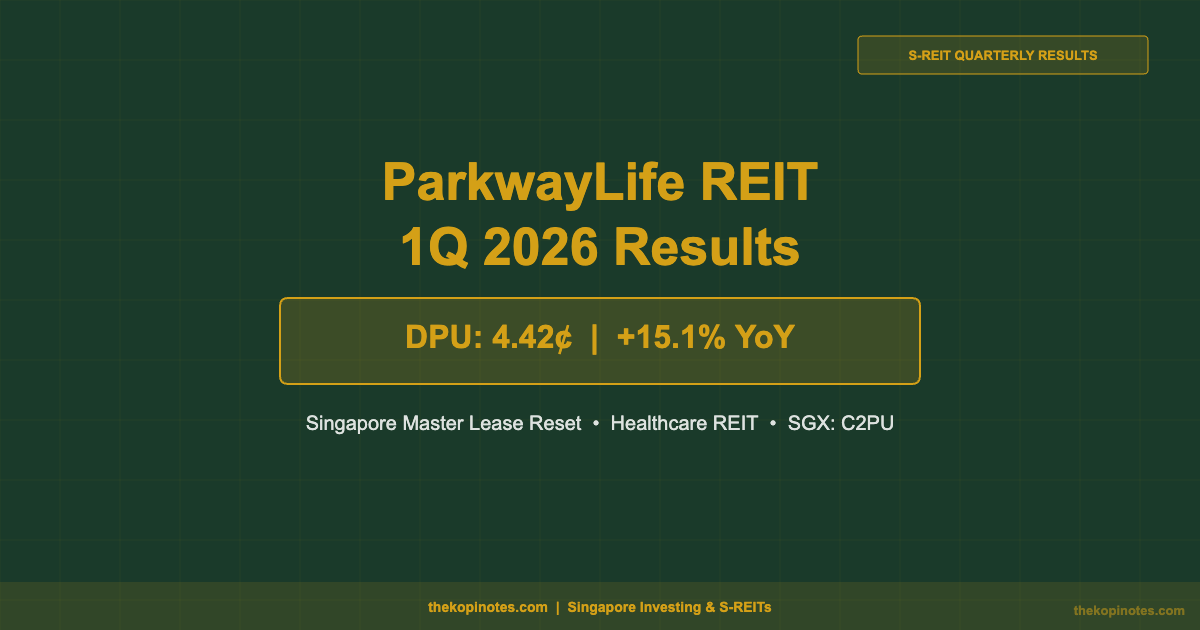
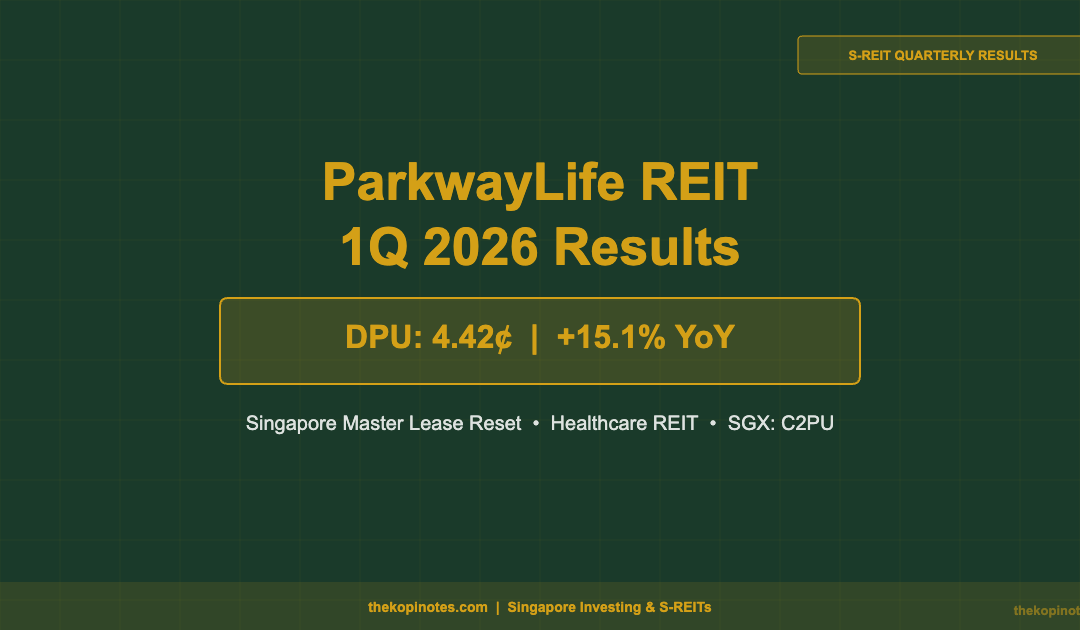
ParkwayLife REIT (SGX: C2PU) — Singapore’s largest listed healthcare REIT — delivered a standout first quarter for FY2026, with distribution per unit (DPU) surging 15.1% year-on-year to 4.42 cents. The leap was powered by the reset of its Singapore master lease, which locked in a minimum rent increase of 24.3% to S$99.1 million per year through 2042.
For investors tracking S-REITs for passive income and long-term capital appreciation, ParkwayLife REIT’s 1Q 2026 results reinforce its reputation as a defensive, inflation-linked income asset. This guide breaks down the numbers, the lease dynamics, and what they mean for your portfolio.
Table of Contents
- What Is ParkwayLife REIT?
- 1Q 2026 Financial Results at a Glance
- DPU Breakdown and Yield Analysis
- The Singapore Master Lease Reset: What It Means
- Key Charts: Financials & DPU Trend
- Portfolio Overview: SG + Japan + France
- Investment View: Is ParkwayLife REIT Worth Buying?
- How to Invest in ParkwayLife REIT in Singapore
- Frequently Asked Questions
What Is ParkwayLife REIT?
ParkwayLife REIT (C2PU) is Asia’s largest listed healthcare REIT by assets under management. Listed on the Singapore Exchange (SGX) in August 2007, it invests in income-producing real estate used for healthcare and healthcare-related purposes.
Key facts (as at 1Q 2026):
- Portfolio: 60 properties across Singapore, Japan, and France
- Singapore assets: 3 private hospitals (Mount Elizabeth, Gleneagles, Parkway East) leased to Parkway Hospitals Singapore (IHH Healthcare group)
- Japan: 57 nursing homes and care facilities
- France: 1 nursing home (Les Trois Forêts)
- Total Assets Under Management: ~S$2.2 billion
- Manager: Parkway Trust Management Limited (subsidiary of IHH Healthcare)
Its Singapore portfolio generates the majority of distributable income, and the Singapore Master Lease — a long-term contract with IHH — is the cornerstone of its stability. The 2026 lease reset is therefore a pivotal event for unitholders.
1Q 2026 Financial Results at a Glance
ParkwayLife REIT released its 1Q FY2026 Business Update in May 2026. Here are the headline numbers:
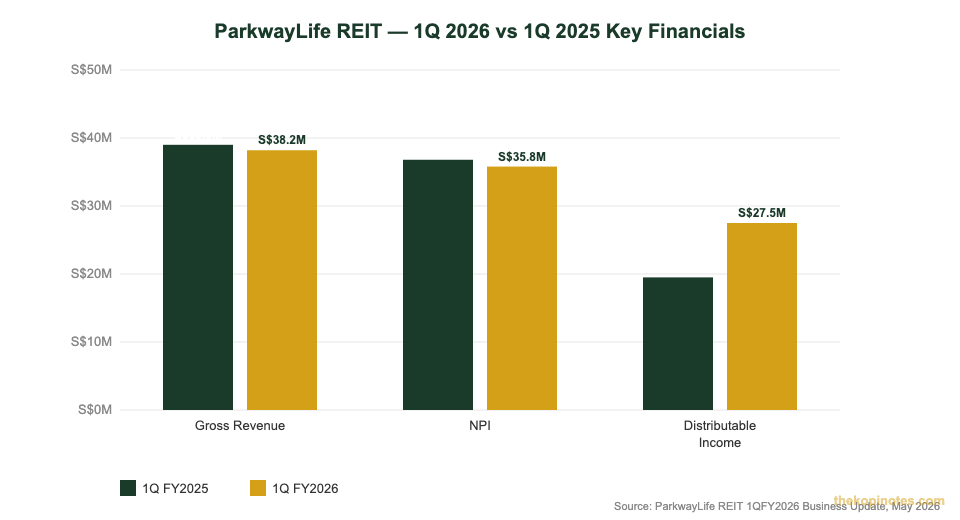
| Metric | 1Q FY2025 | 1Q FY2026 | Change |
|---|---|---|---|
| Gross Revenue | S$39.0M | S$38.2M | −2.1% |
| Net Property Income (NPI) | S$36.8M | S$35.8M | −2.7% |
| Distributable Income | S$19.5M | S$27.5M | +41.0% |
| DPU | 3.841¢ | 4.42¢ | +15.1% |
Source: ParkwayLife REIT 1QFY2026 Business Update. All figures in SGD.
While gross revenue and NPI dipped modestly (partly due to JPY weakness affecting Japan portfolio income), distributable income surged 41% on the strength of the higher Singapore Master Lease rent — a structural improvement, not a one-off.
DPU Breakdown and Yield Analysis
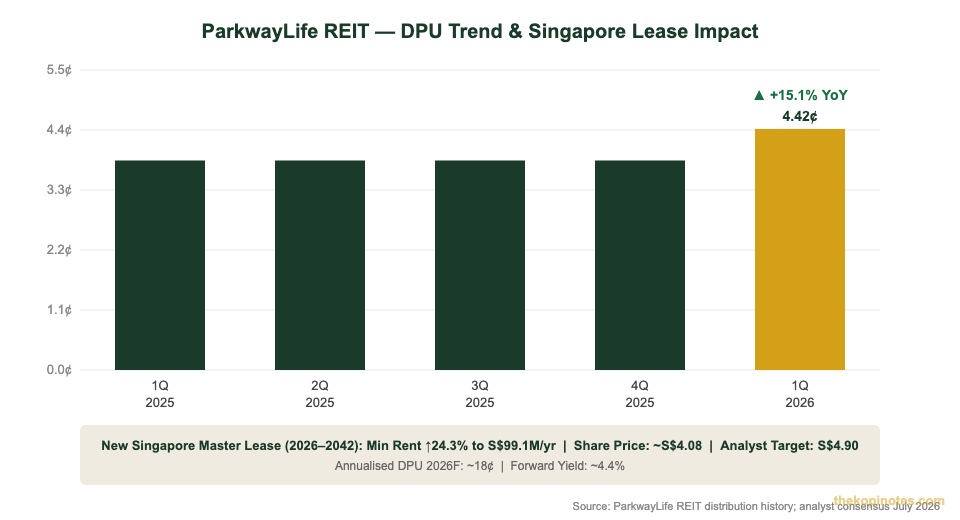
The DPU of 4.42 cents for 1Q FY2026 represents the highest quarterly distribution ParkwayLife REIT has paid since its listing. At the current share price of approximately S$4.08, the annualised metrics look like this:
| Metric | Value |
|---|---|
| 1Q 2026 DPU | 4.42¢ |
| Annualised DPU (2026F) | ~17.7¢ |
| Share Price (approx.) | S$4.08 |
| Forward Dividend Yield | ~4.3–4.4% |
| Analyst Target Price | S$4.90 |
| Implied Upside | ~20% |
Compared to the broader S-REIT universe — which averages 5–7% yield — ParkwayLife trades at a premium due to its defensive healthcare exposure, long WALE (weighted average lease expiry), and inflation-linked income structure. Investors pay for quality and predictability.
The Singapore Master Lease Reset: What It Means
The biggest catalyst for ParkwayLife REIT’s improved distributions in 2026 is the renewal and reset of its Singapore Master Lease, which governs the three Singapore hospital properties.
Key terms of the new Singapore Master Lease (effective 2026):
- Lease term: 2026 to 2042 (16 years)
- New minimum base rent: S$99.1 million per year
- Increase vs. prior lease: +24.3%
- Escalation: Linked to Singapore CPI with downside protection (minimum guaranteed rent)
- Lessee: Parkway Hospitals Singapore Pte Ltd (100% owned by IHH Healthcare — one of Asia’s largest private hospital operators)
This lease structure provides exceptional income visibility. Unlike retail or commercial REITs exposed to occupancy risk, ParkwayLife’s Singapore income is contractually guaranteed for 16 years. The CPI-linkage means distributions grow with inflation — a key differentiator in rising-rate environments.
The reset to S$99.1M minimum rent essentially locked in the 15%+ DPU improvement permanently for the duration of the lease, barring any extraordinary events with IHH.
Key Charts: Financials & DPU Trend
Portfolio Overview: Singapore, Japan & France
ParkwayLife REIT’s geographic diversification provides resilience, though Singapore remains the dominant income contributor:
| Geography | Properties | Asset Type | % Revenue |
|---|---|---|---|
| Singapore | 3 | Private hospitals | ~70% |
| Japan | 56 | Nursing homes / aged care | ~29% |
| France | 1 | Nursing home | ~1% |
Japan portfolio note: The Japan assets are leased on master lease structures (similar to Singapore) with CPI-linked escalation. A weakening JPY has been a headwind in 2025–2026, softening JPY-denominated income when converted to SGD. However, JPY-hedging and long WALE leases mitigate this. The Japan portfolio adds aging-population demographic tailwinds as a long-term growth driver.
Investment View: Is ParkwayLife REIT Worth Buying?
ParkwayLife REIT is not a high-yield REIT — its ~4.3% forward yield lags the sector average. But it compensates with something most S-REITs cannot offer: near-certainty of income growth.
Bull case:
- New Singapore lease locked in for 16 years at +24.3% minimum rent — structural DPU step-up, not a temporary blip
- CPI escalation clause means distributions grow with inflation
- IHH Healthcare (AAA-credit quality tenant) eliminates default risk on 70% of income
- Aging population in Japan and Singapore drives long-term demand for healthcare facilities
- Analysts have target price of S$4.90 vs. ~S$4.08 current price — ~20% upside potential
Bear case / risks:
- JPY weakness compresses Japan income in SGD terms
- Premium valuation (lower yield vs. peers) limits margin of safety
- Any IHH credit event would directly impact ~70% of revenue (concentration risk)
- Rising interest rates increase cost of debt (though ~90% fixed-rate debt provides near-term buffer)
TKN view: For investors seeking defensive income with inflation protection and long income visibility, ParkwayLife REIT is one of Singapore’s highest-quality REITs. It suits a conservative or core allocation — not a yield-maximiser play, but a compounder with downside protection.
Compare it with other best REITs in Singapore 2026 to see where it fits in a diversified REIT portfolio.
How to Invest in ParkwayLife REIT in Singapore
ParkwayLife REIT (C2PU) is listed on SGX and can be purchased through any Singapore brokerage. Here are our top platforms for S-REIT investors:
| Platform | Best For | SGX Fees |
|---|---|---|
| moomoo | Low-cost SGX trading | From 0.03% |
| Endowus | CPF/SRS investing + managed portfolios | 0.3–0.4% p.a. platform fee |
| Syfe | REIT+ managed portfolio | 0.35–0.65% p.a. platform fee |
| FSMOne | Low commission SGX stocks | 0.08%, min S$10 |
Want to save on fees? Use our exclusive referral codes:
- Endowus: Code 2V343 — get S$20 off fees on your first S$10,000 invested → Endowus referral code page
- Syfe: Code SRPRFFFCD — 3 months fee-free → Syfe referral code page
- FSMOne: Code P0544985 → FSMOne referral code page
- moomoo: → moomoo referral code Singapore 2026
Frequently Asked Questions
What is ParkwayLife REIT's DPU for 1Q 2026?
Why did ParkwayLife REIT's DPU jump so much in 2026?
What is ParkwayLife REIT's dividend yield in 2026?
Is ParkwayLife REIT a good long-term investment?
How can I buy ParkwayLife REIT (C2PU) in Singapore?
What are the risks of investing in ParkwayLife REIT?
This article was researched with the help of AI. While we strive to keep all information accurate and up to date, there may be errors. If you notice any discrepancies, please contact us.