Term vs Whole Life Insurance Singapore: Which Should You Pick? (2026)
A practical side-by-side comparison to help you choose the right life insurance in Singapore.
For most Singaporeans, term life insurance is the better choice — it costs 5–10x less than whole life for the same death benefit, letting you invest the premium savings for potentially higher returns. A 30-year-old male non-smoker pays roughly $480 per year for $500,000 of term cover, compared to about $5,400 per year for equivalent whole life cover. The only reason to consider whole life is if you need forced savings discipline or want guaranteed lifetime coverage regardless of cost.
Not financial advice. All figures are for educational reference only. Data as at July 2026 unless noted. Consult a licensed financial adviser for personalised insurance recommendations.
- Term life = pure protection at low cost. Whole life = protection + savings at much higher cost
- For most people: buy term, invest the difference — you’ll likely end up with more money AND better coverage
- Whole life makes sense only if you struggle to save/invest on your own and need forced discipline
Table of Contents
Quick Answer: Term or Whole Life?
If you’re short on time, here’s the bottom line: buy term life insurance unless you have a specific reason not to. Term life gives you maximum protection at minimum cost. You can then invest the premium savings in low-cost ETFs, robo-advisors, or CPF top-ups for potentially much better long-term returns than the cash value of a whole life policy.
This “buy term, invest the difference” (BTID) strategy is recommended by most independent financial advisers in Singapore. However, whole life does have valid use cases — we’ll cover both sides fairly below.
What Is Term Life Insurance?
Term life insurance provides a death benefit for a fixed period — typically 20, 25, or 30 years. If you die during the policy term, your beneficiaries receive the payout. If you survive the term, the policy expires with no payout and no refund. It’s pure protection with no savings or investment component.
Think of it like car insurance. You pay premiums for protection. If nothing happens, the premiums are “gone” — but that doesn’t mean they were wasted. You bought peace of mind and financial protection for your dependents during the years they needed it most (while your children were growing up, while your mortgage was outstanding, etc.).
In Singapore, direct-purchase term plans from insurers like Singlife, FWD, and Etiqa are among the cheapest available. You can also buy through a financial adviser, though premiums may be slightly higher due to commission structures. For a detailed comparison of the best options, see our best term life insurance Singapore guide.
What Is Whole Life Insurance?
Whole life insurance covers you for your entire lifetime — there’s no expiry date. As long as you keep paying premiums (typically for 20–25 years), the policy stays active until you die, whenever that happens. When you pass away, your beneficiaries receive the death benefit regardless of your age.
The key difference is that whole life has a cash value component. A portion of your premiums goes into a participating fund managed by the insurer. Over time, this fund grows and builds a surrender value — money you can get back if you cancel the policy. This is why whole life premiums are so much higher: you’re paying for protection AND savings in one product.
However, the returns on the cash value component are typically modest — around 3–4% per annum for participating funds in Singapore, based on historical data from major insurers. That’s lower than what you’d likely earn investing on your own in a diversified portfolio over 20+ years.
The cash value also takes years to build up. If you surrender a whole life policy in the first 10 years, you’ll usually get back significantly less than what you paid in premiums. This “lock-in” effect is both the biggest criticism and, for some people, the biggest feature — it forces you to save.
Cost Comparison: How Much More Does Whole Life Cost?
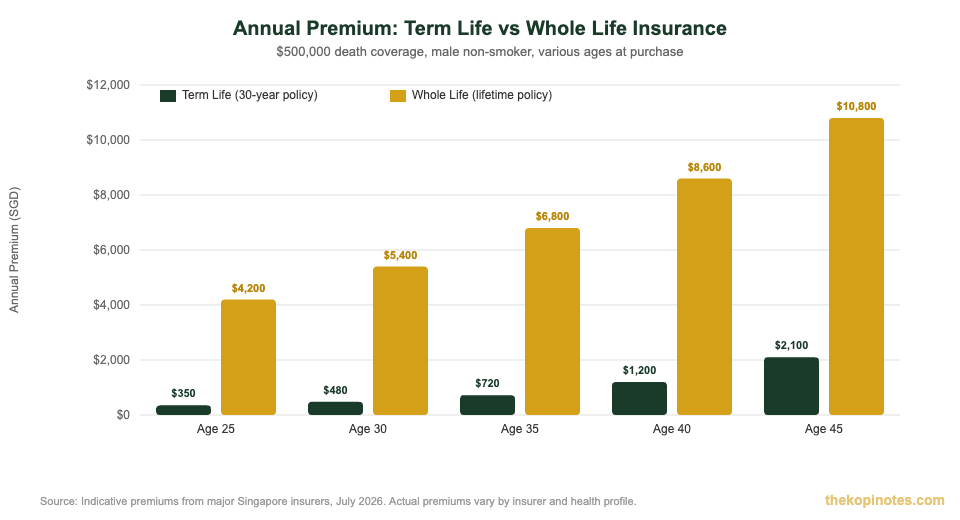
The premium difference between term and whole life is dramatic. Here’s a real comparison for $500,000 death coverage for a male non-smoker:
| Age at Purchase | Term Life (30-year) | Whole Life (25-year pay) | Difference |
|---|---|---|---|
| Age 25 | ~$350/yr | ~$4,200/yr | 12x more |
| Age 30 | ~$480/yr | ~$5,400/yr | 11x more |
| Age 35 | ~$720/yr | ~$6,800/yr | 9x more |
| Age 40 | ~$1,200/yr | ~$8,600/yr | 7x more |
| Age 45 | ~$2,100/yr | ~$10,800/yr | 5x more |
Source: Indicative premiums from major Singapore insurers (AIA, Prudential, NTUC Income, Singlife), July 2026. Actual premiums vary.
At age 30, you’re paying an extra $4,920 per year for whole life. Over 25 years of premium payments, that’s $123,000 more — money that could have been invested in a diversified portfolio earning 6–7% per year. We’ll run the numbers in the BTID section below.
Key Differences at a Glance
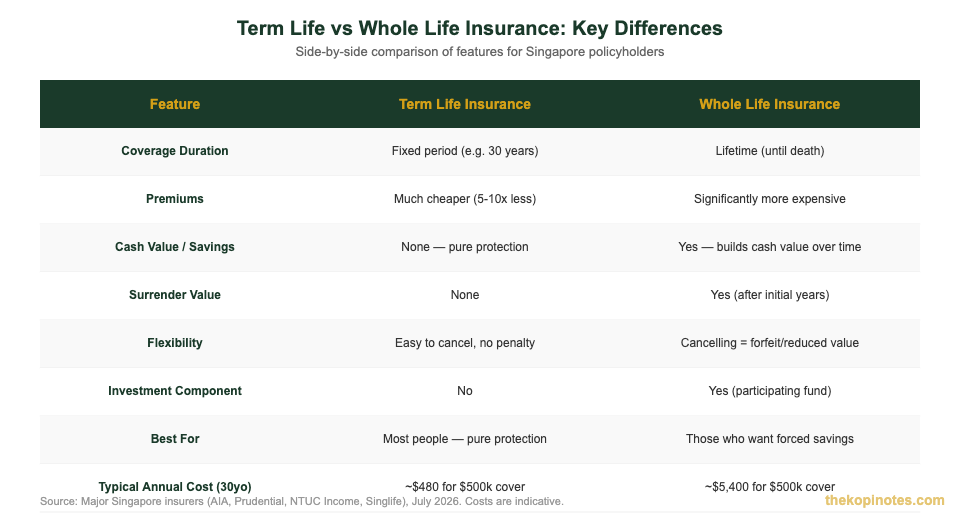
| Feature | Term Life | Whole Life |
|---|---|---|
| Coverage Period | Fixed (e.g. 20, 25, 30 years) | Lifetime — until death |
| Premiums | Much lower (5–10x less) | Much higher |
| Cash / Surrender Value | None | Yes — builds over time |
| Investment Component | No | Yes (participating fund ~3–4% p.a.) |
| Flexibility | Cancel anytime, no penalty | Cancelling = forfeit surrender value |
| Renewability | Can renew (at higher premium) | No renewal needed — lifetime |
| Best For | Most people — pure protection | Those needing forced savings |
Source: General comparison across major Singapore insurers, July 2026
Buy Term, Invest the Difference — Does It Work?
The “buy term, invest the difference” (BTID) strategy is simple: buy cheap term insurance and invest the money you save on premiums. Let’s see how the numbers play out.
Take a 30-year-old male who needs $500,000 in coverage. He has two options:
Option A (Whole Life): Pay $5,400/year for 25 years. Total premiums paid: $135,000. At age 65, the policy has a cash value of approximately $180,000–$220,000 (depending on the insurer’s participating fund performance). The $500,000 death benefit stays active for life.
Option B (BTID): Pay $480/year for term insurance (30-year policy). Invest the remaining $4,920/year in a diversified portfolio earning 6% per year. After 25 years, the investment portfolio grows to approximately $285,000. After 30 years (when the term policy expires), it’s roughly $412,000. The term policy expires at age 60, but by then the investment portfolio provides a financial cushion.
The BTID strategy wins on paper — by a significant margin. However, there are two important caveats. First, you actually need to invest the difference consistently. If you spend it instead, you get neither savings nor protection. Second, investment returns are not guaranteed. A prolonged market downturn could reduce your returns below the whole life cash value. That said, over 25–30 year horizons, a diversified global portfolio has historically delivered 6–8% annualised returns.
For practical implementation, consider investing through a low-cost robo-advisor like Syfe or Endowus for automatic, diversified investing. You can also use our retirement calculator to model different scenarios.
Who Should Buy Which?
Buy term life insurance if: you want maximum coverage at minimum cost, you’re disciplined enough to invest the premium savings on your own, you have dependents who need protection for a specific period (until children are independent, until mortgage is paid off), or you prefer keeping insurance and investing separate for transparency and flexibility.
Consider whole life insurance if: you genuinely struggle to save or invest on your own and need forced discipline, you want guaranteed lifetime coverage regardless of future health changes, you value the psychological comfort of a policy that never expires, or you’ve already maxed out your CPF contributions and want another long-term savings vehicle.
Most independent financial advisers in Singapore recommend term life for the majority of people. The key is to actually invest the premium savings — otherwise, BTID doesn’t work. If you know you’ll spend the difference, whole life’s forced savings mechanism may serve you better despite the lower returns.
Regardless of which type you choose, ensure you have adequate coverage. A common rule of thumb is 9–10x your annual income. For a detailed assessment, consider speaking with a fee-based financial adviser who doesn’t earn commission from product sales. You can also explore passive income strategies to supplement your insurance coverage with investment income.
Not financial advice. Insurance needs vary by individual. Always consult a licensed financial adviser before making insurance decisions.
Frequently Asked Questions
Is term life insurance better than whole life in Singapore?
For most Singaporeans, yes. Term life costs 5–10x less than whole life for the same death benefit. If you invest the premium savings, you’ll likely accumulate more wealth than the cash value of a whole life policy. However, whole life is better for people who need forced savings discipline or want guaranteed lifetime coverage.
How much does term life insurance cost in Singapore?
A 30-year-old male non-smoker can get $500,000 of term life coverage for approximately $480 per year (30-year policy) as at July 2026. Women pay less — around $350–$400 for the same coverage. Direct-purchase plans from Singlife, FWD, and Etiqa tend to be cheapest. Premiums increase significantly with age — the same coverage costs about $2,100 per year if purchased at age 45.
What happens when my term life insurance expires?
When your term life policy expires, coverage simply ends. There’s no payout and no refund of premiums — the protection period is over. Most term policies offer a renewal option at a higher premium, but it’s generally better to plan ahead. By the time your term expires (e.g. at age 55–60), ideally your children are independent, your mortgage is paid off, and you’ve built sufficient savings to self-insure.
Can I have both term and whole life insurance?
Yes, many Singaporeans have both. A common strategy is to buy a small whole life policy (e.g. $100,000 coverage) for lifetime base protection, then top up with a larger term policy (e.g. $400,000) for the years when your financial dependents need maximum coverage. This gives you the best of both worlds — lifetime coverage plus affordable high coverage during critical years.
Should I surrender my whole life insurance policy?
This depends on how long you’ve held the policy. If you’ve paid premiums for less than 10 years, surrendering usually means getting back much less than you paid. If you’ve held it 15+ years, the surrender value may be reasonable. Before surrendering, check your current surrender value with your insurer, ensure you can still qualify for term insurance if you need coverage, and consider whether you’ll actually invest the freed-up cash. Never surrender without a plan.
What does 'buy term invest the difference' mean?
BTID means buying cheaper term life insurance instead of whole life, then investing the money you save on premiums. For example, if term costs $480/year and whole life costs $5,400/year, you invest the $4,920 difference in ETFs or a robo-advisor. Over 25–30 years, the invested savings typically grow to more than the cash value of a whole life policy — but only if you actually invest the difference consistently.
How much life insurance coverage do I need in Singapore?
A common rule of thumb is 9–10x your annual income. So if you earn $60,000 per year, aim for $540,000–$600,000 in death coverage. You should also factor in outstanding debts (mortgage, car loan), children’s education costs, and your spouse’s ability to earn income. Subtract any existing coverage (employer group insurance, CPF dependants’ protection scheme) to find the gap you need to fill with personal insurance.
Protect Your Family, Grow Your Wealth
Get the right insurance coverage and start investing the difference today.
Get Free Insurance Advice
Speak with a licensed insurance advisor. No obligation, no cost.
By submitting this form, you agree to our Privacy Policy.
This article was researched with the help of AI. While we strive to keep all information accurate and up to date, there may be errors. If you notice any discrepancies, please contact us.