
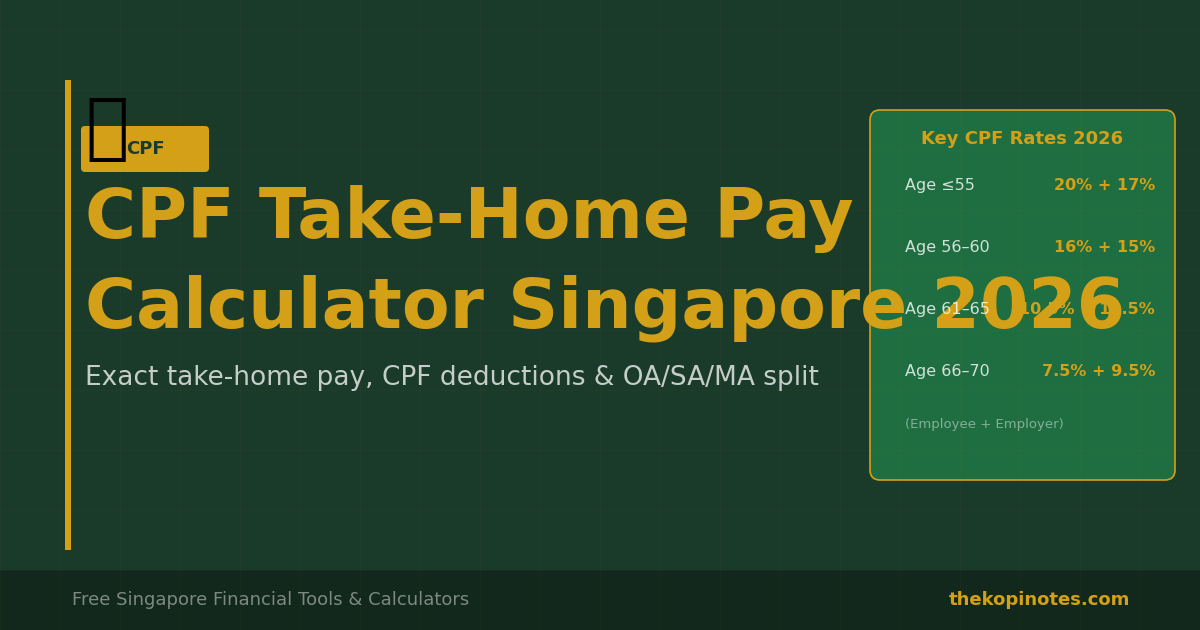
CPF Take-Home Pay Calculator Singapore 2026
Instantly calculate your monthly take-home pay after CPF deductions — free calculator with real-time results in SGD for Singapore Citizens, PRs, and all age groups.
💰 CPF Take-Home Pay Calculator Singapore 2026
Based on CPF Board contribution rates effective Jan 2024. Ordinary Wage ceiling $6,800/mo (from Jan 2025). Not financial advice.
Understanding CPF Contributions and Take-Home Pay in Singapore
The Central Provident Fund (CPF) is the cornerstone of Singapore’s retirement, healthcare, and housing savings system. Every month, both employees and employers make mandatory CPF contributions based on gross ordinary wages — and those contributions directly determine how much you actually take home. With the Ordinary Wage (OW) ceiling raised to $6,800 per month from January 2025 and ongoing contribution rate adjustments for older workers, understanding your exact take-home pay requires more than rough estimates. This calculator uses the CPF Board’s official 2026 contribution rates to give you precise figures for every age band and residency status — from Singapore Citizens to Permanent Residents in their first year. All figures are based on CPF Board data as at Q1 2026.
Not financial advice. All figures are for educational reference only and should be verified against CPF Board’s official contribution rate table. Data as at Q1 2026.
How CPF Contribution Rates Work
CPF contributions are split between the employee (deducted from your salary) and the employer (an additional cost on top of your salary). For a Singapore Citizen under 55 earning $5,000/month, the employee contributes $1,000 (20%) and the employer contributes $850 (17%), for a total of $1,850 going into CPF. These funds are split across three accounts: the Ordinary Account (OA) for housing and investments, the Special Account (SA) for retirement savings, and the MediSave Account (MA) for healthcare. The contribution ceiling means that once your ordinary wages exceed $6,800/month, CPF is only calculated on $6,800 — so a $10,000/month salary still only attracts CPF on $6,800.
Why Residency Status and Age Band Matter
Singapore Citizens (SC) and Permanent Residents (PRs) have different contribution rates. PRs in their first year contribute at a reduced rate — approximately 55% of the full rate — giving them a slightly higher take-home pay while they settle in. From Year 3 onward, PRs contribute at the same rate as SCs. Age is equally important: contribution rates step down significantly after 55, 60, 65, and 70 to account for retirement drawdown and reduced earning years. A worker aged 62 earning $5,000/month takes home $472.50 more than a 45-year-old at the same salary, purely because the employee CPF rate drops from 20% to 10.5%.
How to Use This CPF Take-Home Pay Calculator
- Enter your monthly gross salary: Type in your full monthly basic salary (ordinary wages) before any deductions. Include bonuses only if they are part of your fixed monthly pay — variable bonuses are calculated separately as additional wages.
- Enter your age: Your age determines which CPF contribution rate band applies. The calculator automatically picks the correct band: under 55, 56–60, 61–65, 66–70, or above 70.
- Select your residency status: Choose Singapore Citizen, PR Year 1, PR Year 2, PR Year 3+ (same as SC), or Employment Pass/Work Permit holder. EPs and WP holders do not contribute to CPF.
- Read your results: The calculator instantly shows your take-home pay, your employee CPF deduction, your employer’s CPF contribution, and the breakdown across OA, SA, and MediSave accounts.
Results update in real-time as you change any input. The CPF contribution cap of $6,800/month ordinary wages is applied automatically — if your salary exceeds this, only $6,800 is used to calculate CPF.
Pro tip: Combine this calculator with our CPF LIFE Payout Calculator to project how today’s contributions translate into monthly retirement income under CPF LIFE.
Contents — Click to Expand
What Is CPF and Why Does It Affect Take-Home Pay?
The Central Provident Fund (CPF) is a mandatory social savings scheme administered by the CPF Board under the Ministry of Manpower. It was established in 1955 and today covers retirement savings, healthcare (via MediSave), and housing (via the Ordinary Account). Unlike voluntary savings, CPF contributions are legally required for all Singapore Citizens and Permanent Residents who are employees earning more than $50 per month.
The reason CPF directly reduces your take-home pay is that the employee contribution comes out of your gross salary. If you earn $6,000/month and are a SC under 55, you contribute $1,200 (20%) to CPF, leaving you with $4,800 in cash. Your employer separately contributes $1,020 (17%) — which is their cost above your salary, not taken from your pay. This means the "true cost" of employing you is actually $7,020, while you take home $4,800. Understanding this distinction is crucial for salary negotiations, especially when comparing offers with different employment structures or when negotiating annual raises.
For freelancers and self-employed persons (SEPs), CPF treatment differs: SEPs only contribute to MediSave and are exempt from OA/SA contributions unless they choose to top up voluntarily. This is one reason some Singaporeans prefer contract or freelance arrangements despite lower CPF accumulation.
CPF Contribution Rates 2026: Full Table by Age
CPF contribution rates have been progressively increased for workers aged 55 and above since 2022, as part of the government’s effort to boost retirement adequacy. The table below shows the rates effective from January 2024 (unchanged as at Q1 2026):
| Age Band | Employee Rate | Employer Rate | Total |
|---|---|---|---|
| 55 & below | 20% | 17% | 37% |
| 56 – 60 | 16% | 15% | 31% |
| 61 – 65 | 10.5% | 11.5% | 22% |
| 66 – 70 | 7.5% | 9.5% | 17% |
| Above 70 | 5% | 7.5% | 12.5% |
A key practical example: a 58-year-old earning $8,000/month contributes $1,088 to CPF (16% × $6,800 cap), taking home $6,912. At 62, the same salary yields a take-home of $7,286 as the rate falls to 10.5%. By age 67, take-home rises further to $7,490, making re-employment post-65 more financially attractive in net pay terms.
The Ordinary Wage Ceiling Explained
The CPF Ordinary Wage (OW) ceiling is the maximum monthly salary on which CPF contributions are calculated. Effective January 2025, this ceiling was raised from $6,300 to $6,800 per month — the second step of a phased increase announced in Budget 2023, which will eventually bring it to $8,000 by 2026. This means that if your salary is $10,000/month, CPF is only calculated on $6,800. Your take-home pay still reflects the full $10,000 minus only the CPF on the capped amount.
Separately, the Annual Wage Supplement (AWS, or "13th month bonus") and other variable bonuses are categorised as Additional Wages (AW). These attract CPF contributions up to an Annual Wage ceiling of $102,000 minus the ordinary wages already contributed in the year. For someone earning $6,800/month, the OW CPF base is $81,600/year, leaving $20,400 of AW ceiling — meaning the first $20,400 of bonuses in that year will still attract CPF at the applicable rate.
For high earners above the ceiling, this creates a useful planning angle: since CPF on the uncapped portion of salary is not compulsory, the actual effective CPF rate on total gross pay is lower than the headline rates. Our CPF FIRE Number Calculator can help you project how these contributions compound toward financial independence over time.
PR vs SC CPF Contributions: What’s the Difference?
New PRs enjoy a graduated CPF contribution schedule for their first two years to ease the transition from no CPF (as a foreigner) to full CPF contributions. In Year 1, both employee and employer contribute at a reduced rate — the employee at approximately 55% of the full rate and the employer at a similar reduction. In Year 2, rates step up to around 85% of full rates. From Year 3 onward, PRs contribute at identical rates to Singapore Citizens.
Practically, a 35-year-old PR in Year 1 earning $5,000/month contributes approximately $550 in CPF (vs $1,000 for a SC), taking home $4,450 vs $4,000. The employer also contributes less — around $467 vs $850. This means PR Year 1 employees are somewhat cheaper to employ, though the savings diminish rapidly over the 3-year period. Employees considering whether to apply for PR should factor in the long-term CPF accumulation benefits: the OA earns 2.5% p.a. (with an extra 1% on the first $20,000), while the SA earns 4% p.a. — both government-guaranteed rates that outperform most bank savings accounts. For SRS and CPF top-up strategies, see our SRS Tax Savings Calculator.
OA, SA, and MediSave: Where Does Your CPF Go?
Total CPF contributions are automatically split across three accounts in ratios that shift with age. For a Singapore Citizen under 35, approximately 62.2% goes to the Ordinary Account (OA), 16.2% to the Special Account (SA), and 21.6% to MediSave (MA). As you age, the allocation shifts progressively toward MediSave to fund rising healthcare needs: by age 66–70, 62.2% of your CPF goes to MediSave, with only 8.1% each to OA and SA.
The OA can be used for HDB and private property purchases, CPF Investment Scheme (CPFIS) investments in approved instruments, and education loans. This is why many Singapore homeowners see their CPF balance as "tied up" in property — when you use OA for housing, CPF accrued interest (currently 2.5%) must be refunded upon sale. Our CPF Accrued Interest Calculator helps you estimate this amount before selling.
The SA earns 4% p.a. and cannot be withdrawn before 55 (except in specific circumstances). It is the most powerful retirement savings vehicle in Singapore — tax-free, government-guaranteed at 4%, and impossible to lose to market downturns. Maximising SA through the CPF Cash Top-Up scheme (up to $8,000 personal top-up + $8,000 for family members per year, all tax-deductible) is one of the best financial moves a Singapore salaried worker can make. See our CPF Cash Top-Up Tax Relief Calculator for the exact tax savings.
How to Maximise Your CPF for Retirement
For most Singapore salaried employees, CPF is the single largest retirement savings vehicle — yet many treat it as a black box rather than optimising it. Here are the most impactful strategies, all supported by our suite of CPF calculators. First, ensure your SA is growing: if your SA is below the Full Retirement Sum (FRS, $213,000 for those turning 55 in 2026), making voluntary top-ups earns you 4% guaranteed and reduces taxable income. Second, use the CPF OA/SA Allocation Calculator to model how your current contributions will accumulate by age 55. Third, if you are considering using OA for investments under CPFIS, our CPFIS Calculator helps you assess whether investing beats leaving money at 2.5%.
For retirement income planning, the CPF LIFE Payout Calculator shows exactly how much monthly income your projected retirement sum will generate. Pair this with our Retirement Planning Calculator to check whether CPF LIFE alone covers your retirement needs, or whether you need supplementary income from dividends, S-REITs, or an SRS portfolio. Finally, consider platforms like Endowus (which lets you invest CPF OA and SRS funds in low-cost index funds) or Syfe for cash-based dividend investing to build income beyond CPF.
Frequently Asked Questions
How much CPF do I pay on a $5,000 monthly salary in Singapore?
For a Singapore Citizen or PR (Year 3+) aged 55 or below earning $5,000/month, the employee CPF contribution is $1,000 (20%) and the employer contribution is $850 (17%), totalling $1,850 into CPF. Your monthly take-home pay is $4,000. The contribution ceiling of $6,800/month does not apply here since $5,000 is below the cap.
What is the CPF contribution ceiling in 2026?
The CPF Ordinary Wage (OW) ceiling is $6,800 per month effective January 2025 — raised from $6,300. This means CPF is only calculated on the first $6,800 of monthly ordinary wages regardless of your actual salary. If you earn $10,000/month, CPF applies to $6,800. The ceiling is being phased up to $8,000 by January 2026 per the Budget 2023 announcement, so expect another increase. Always verify the current ceiling at cpf.gov.sg.
Do Employment Pass (EP) holders need to contribute CPF in Singapore?
No. Employment Pass, S Pass, and most Work Permit holders (foreigners) are not required to make CPF contributions. CPF is only mandatory for Singapore Citizens and Permanent Residents. However, some employers offer ex-gratia payments in lieu of CPF for EP holders as part of their benefits package. If you become a PR, you will start contributing from your first month of PR status.
How does CPF contribution rate change after age 55 in Singapore?
CPF rates step down in stages after 55 to reflect retirement drawdown. At 56–60, the employee rate drops from 20% to 16% (and employer from 17% to 15%). At 61–65, employee rate falls to 10.5% and employer to 11.5%. At 66–70, employee contributes only 7.5% and employer 9.5%. Above 70, rates are 5% (employee) and 7.5% (employer). These reductions mean meaningfully higher take-home pay in the later working years, which the government designed to encourage continued employment past 55.
What is the difference between CPF employee and employer contribution?
The employee contribution is deducted from your gross salary — it reduces your take-home pay. The employer contribution is an additional cost paid by your employer on top of your salary and does not reduce your take-home. Both amounts go into your CPF accounts. When comparing job offers, always check whether the quoted salary is gross (before employee CPF deduction) or net (after). In Singapore, gross salary is the standard quoted figure.
How is CPF split between OA, SA, and MediSave?
The split varies by age. For workers 35 and below, roughly 62.2% of total CPF goes to OA, 16.2% to SA, and 21.6% to MediSave. As you age, MediSave allocation increases significantly: at 66–70, about 62.2% of total CPF flows to MediSave and only 8.1% each to OA and SA. The calculator above shows the exact monthly allocation in SGD for your inputs. CPF Board publishes the full allocation table at cpf.gov.sg.
Can I use my CPF to invest in stocks or ETFs in Singapore?
Yes — your CPF Ordinary Account (OA) balance above $20,000 can be invested in approved instruments under the CPF Investment Scheme (CPFIS). Approved options include Singapore ETFs (like the Nikko AM STI ETF), unit trusts, and certain insurance products. However, since OA earns a risk-free 2.5% p.a. (plus 1% extra on the first $20,000), your investments need to consistently outperform this baseline to justify the risk. Platforms like Endowus allow CPF OA investing in low-cost index funds. See our CPFIS Calculator to model breakeven performance.
What is a good savings rate for a Singapore salaried employee?
Most Singapore financial planners suggest a total savings rate (CPF + voluntary savings) of at least 30–35% of gross income. Since mandatory CPF for a SC under 55 already accounts for 20% of gross salary (the employee portion), your voluntary savings of just 10–15% of gross can put you on track. Higher earners above the $6,800 CPF ceiling effectively have a lower CPF rate on total income, meaning they should save more voluntarily through instruments like SRS, ETFs via Endowus or Syfe, or S-REITs. Use our Savings Rate Calculator for a personalised target.
Put Your CPF to Work for Retirement
Now that you know your take-home pay, plan your retirement income with our free Singapore financial tools and referral bonuses from top platforms.