CPFIS ETF Singapore 2026: Which ETFs Can You Buy With CPF Money?
A complete guide to CPFIS-approved ETFs — the full list of eligible funds, fees compared, how to invest your CPF OA savings in ETFs, and whether CPFIS investing actually makes sense in 2026.
Not financial advice. Data current as at May 2026. CPFIS eligibility can change — always verify with CPF Board or your broker before investing.
Can you invest your CPF money in ETFs? Yes — but only in a specific, CPF Board-approved list. The CPF Investment Scheme (CPFIS) allows Singapore Citizens and PRs to invest their CPF Ordinary Account (OA) savings above the first S$20,000 in a range of eligible products, including a curated set of ETFs listed on the Singapore Exchange (SGX).
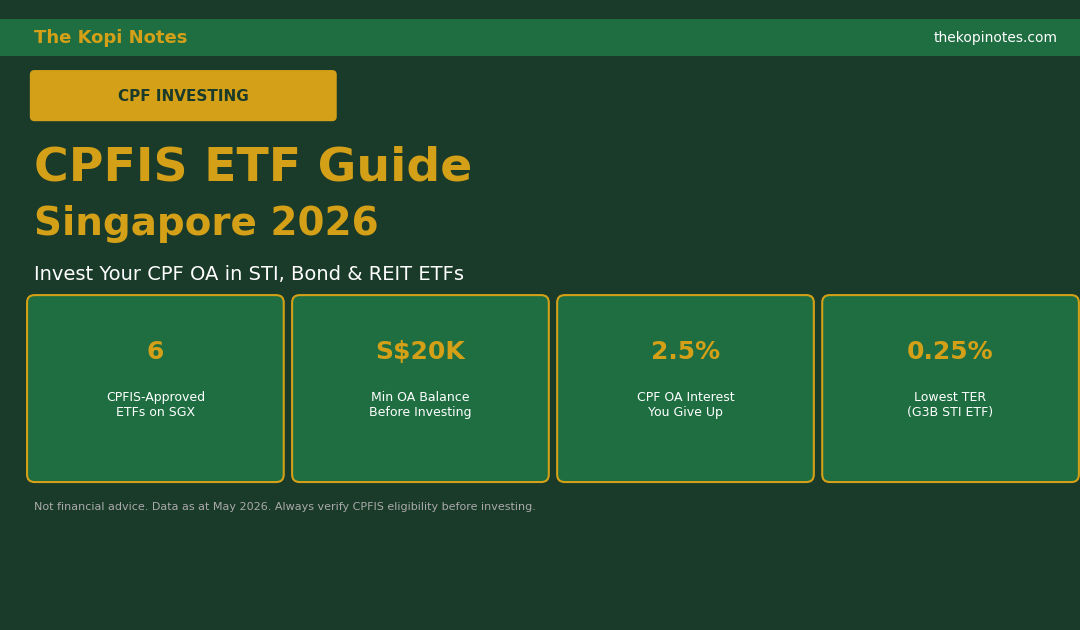
As at May 2026, there are six ETFs approved under CPFIS-OA covering four asset classes: Singapore equities (STI), Singapore government and investment-grade corporate bonds, Asian REITs, and gold. This guide breaks down the full CPFIS ETF list, compares costs, and helps you decide whether investing your CPF OA in ETFs makes sense — or whether you’re better off leaving your money to earn the guaranteed 2.5% OA interest.
Already using CPFIS? Try our CPF Investment Scheme (CPFIS) Calculator to model your portfolio vs. the guaranteed OA interest rate.
Table of Contents
Contents — Click to expand
What Is CPFIS and How Does It Work?
The CPF Investment Scheme (CPFIS) allows CPF members to invest their Ordinary Account (OA) or Special Account (SA) savings in a range of approved investment products, with the aim of potentially earning returns above the CPF’s guaranteed interest rates. The OA earns 2.5% p.a. (with a bonus 1% on the first S$20,000), while the SA earns 4% p.a.
Key CPFIS rules:
- You can invest OA savings above the first S$20,000 (you must keep S$20,000 in cash in your OA)
- For SA, you can invest savings above the first S$40,000
- Not all products available to CPFIS-OA are available to CPFIS-SA — ETFs are approved for OA only
- You invest through a CPFIS-approved agent bank (DBS, OCBC, UOB) or broker
- Brokerage fees and fund expenses apply — these reduce your effective returns
The fundamental trade-off is clear: you give up the guaranteed 2.5% OA interest in exchange for the possibility (but not certainty) of higher returns from market-linked investments. For ETF investing under CPFIS, the relevant benchmark to beat is 2.5% p.a. — and that is not as easy as it sounds over a full market cycle.
For a deeper view of your CPF investment strategy, see our CPF OA investment strategy guide.
Full CPFIS ETF List 2026 (All 6 Approved ETFs)
As at May 2026, there are six ETFs eligible under CPFIS-OA listed on the Singapore Exchange. These cover four broad asset classes: Singapore equities (STI), Singapore government bonds, investment-grade corporate bonds, Asian REITs, and gold.
| ETF Name | Ticker | Asset Class | TER | Dist. / Acc. |
|---|---|---|---|---|
| SPDR Straits Times Index ETF | ES3 | SG Equities (STI) | 0.30% | Distributing |
| Amova Singapore STI ETF (Dist) | G3B | SG Equities (STI) | 0.25% | Distributing |
| ABF Singapore Bond Index Fund | A35 | SG Govt Bonds | 0.25% | Distributing |
| Nikko AM SGD Investment Grade Corporate Bond ETF | MBH | IG Corporate Bonds | 0.30% | Distributing |
| Amova-StraitsTrading Asia ex Japan REIT ETF | CFA | Asia ex-Japan REITs | 0.50% | Distributing |
| SPDR Gold Shares | O87 | Gold | 0.40% | Accumulating |
Source: CPF Board CPFIS approved product lists; SGX. TER figures as at May 2026. Always verify current eligibility at cpf.gov.sg before investing.
Notable exclusions: Popular ETFs like CSPX (iShares Core S&P 500), VWRA (Vanguard FTSE All-World), IWDA, and Nikko AM STI ETF (G3B/G3C accumulating versions) are not on the CPFIS approved list. These can only be bought with cash or SRS funds, not CPF.
STI ETFs Under CPFIS: ES3 vs G3B
The two STI ETFs under CPFIS both track the Straits Times Index — Singapore’s benchmark of 30 blue-chip stocks — but differ slightly in fees and structure.
SPDR STI ETF (ES3) is the original Singapore blue-chip ETF, launched by State Street Global Advisors. It carries a TER of 0.30% p.a. and pays dividends semi-annually. ES3 is the most liquid STI ETF and has the longer track record — it has been CPFIS-approved for many years.
Amova Singapore STI ETF (G3B) launched by Amova (formerly Lion-OCBC) carries the lowest TER among distributing STI ETFs at 0.25% p.a. — a small but compounding advantage over time. G3B also pays semi-annual dividends and is CPFIS-OA eligible. Given its lower cost, G3B is often the preferred choice for cost-conscious CPFIS investors.
The performance of both ETFs is nearly identical (both track the STI), so the main differentiator is cost. At 0.25% vs 0.30%, the 5bps saving on G3B amounts to roughly S$50/year per S$100,000 invested — meaningful over decades.
For a deeper dive on the STI ETF landscape, see our SPDR STI ETF (ES3) investor guide and our Singapore REIT ETF guide.
Bond ETFs Under CPFIS
ABF Singapore Bond Index Fund (A35) is Singapore’s first bond ETF, tracking the iBoxx ABF Singapore Bond Index — a basket of high-quality bonds issued primarily by the Singapore government and quasi-government entities (like HDB, LTA). It pays quarterly dividends and offers conservative, stable returns. A35 is an appropriate CPFIS choice for members who want capital preservation over growth.
Nikko AM SGD Investment Grade Corporate Bond ETF (MBH) was included in CPFIS since April 2020. It invests in investment-grade Singapore dollar-denominated corporate bonds, offering slightly higher yields than government bonds — but with modestly more credit risk. MBH provides a yield pickup over A35 while remaining in the IG credit space.
Important consideration: Bond ETFs under CPFIS need to yield more than 2.5% p.a. (after TER) to beat the guaranteed OA rate. In a rising-rate environment, bond ETF prices also fall — so the total return picture needs careful monitoring. In 2025–2026, with SGS bonds yielding in the 3–3.5% range, bond ETFs have been generating competitive returns relative to the OA rate.
Asia Ex-Japan REIT ETF Under CPFIS
The Amova-StraitsTrading Asia ex Japan REIT ETF (CFA) provides exposure to real estate investment trusts across Asia, excluding Japan. The fund covers S-REITs, Hong Kong REITs, Australian REITs, and other regional property funds. It offers dividend income and broad REIT diversification, but carries a higher TER of 0.50% p.a. compared to other CPFIS-eligible ETFs.
Given the S-REIT sector’s volatility in recent years, CFA is best suited for members who have a longer time horizon and are comfortable with property-sector cyclicality. For those interested purely in S-REITs, individual S-REIT shares (not just ETFs) are also eligible under CPFIS-OA — see our Best S-REITs 2026 guide for top picks.
Gold ETF Under CPFIS
SPDR Gold Shares (O87) is the only gold ETF eligible under CPFIS-OA in Singapore. Unlike the distributing equity and bond ETFs, O87 is an accumulating fund — it does not pay dividends; returns come solely from gold price appreciation. SPDR Gold Shares physically backs each unit with real gold stored in vaults.
Gold’s role in a CPFIS portfolio is primarily as a hedge against inflation and currency debasement — not as an income generator. Given the 2.5% OA opportunity cost, allocating CPF OA savings to gold is a speculative bet that requires gold to appreciate by more than 2.5% p.a. consistently to justify the swap. This makes O87 most appropriate as a small tactical allocation rather than a core holding.
Is CPFIS ETF Investing Worth It?
This is the central question, and the honest answer is: it depends — and the bar is higher than most people realise.
When you invest your CPF OA in ETFs, you give up the guaranteed 2.5% p.a. OA interest. That 2.5% is risk-free, government-backed, and compounds reliably. To justify CPFIS investing, your ETF portfolio needs to return more than 2.5% p.a. after fees, consistently, over your investment horizon.
The STI has historically returned roughly 5–7% p.a. including dividends, before taxes and fees. So in theory, a CPFIS-OA investment in ES3 or G3B should beat the 2.5% OA rate over a long enough period. But there are important caveats:
- Brokerage fees add up: Each ETF trade costs brokerage commissions. Regular lump-sum or DCA into CPFIS ETFs incurs transaction costs that erode returns.
- Timing risk: Investing a lump sum near a market peak could mean years of underperformance vs. the guaranteed OA rate.
- Opportunity cost is real: S$100,000 in CPF OA at 2.5% grows to S$128,000 after 10 years — guaranteed. An STI ETF might beat that, but it might also underperform in a bad decade.
- Liquidity and flexibility: Money invested in CPFIS is not available for housing or CPFIS-prohibited uses until you sell.
Who CPFIS ETF investing makes most sense for: Members with a 10+ year horizon, who already have more than S$20,000 in CPF OA, who are comfortable with equity volatility, and who invest in broad-market low-cost ETFs (not individual stocks) via a lump sum or regular DCA approach.
Use our CPFIS Calculator to model your specific scenario — and our Retirement Planning Calculator to see how CPFIS fits into your overall retirement picture.
How to Invest in ETFs Using Your CPF OA
Investing your CPF OA in ETFs through CPFIS involves a few straightforward steps:
Step 1: Open a CPFIS Investment Account
You need a CPFIS-OA investment account with one of the three approved agent banks: DBS, OCBC, or UOB. If you already have a brokerage account with one of their affiliated brokers (DBS Vickers, OCBC Securities, UOB Kay Hian), you can link your CPFIS account to it.
Step 2: Check Your Investable Balance
You can only invest CPF OA savings above the first S$20,000. Log in to my.cpf.gov.sg to check your OA balance and the amount available to invest.
Step 3: Place Your ETF Order
Once your CPFIS account is set up and linked to your brokerage, place your ETF order through the brokerage platform as you would for any SGX-listed stock. Select the CPFIS-eligible ETF (ES3, G3B, A35, MBH, CFA, or O87) and specify that the funds should come from CPF OA.
Step 4: Monitor and Rebalance
Track your CPFIS portfolio’s performance relative to the CPF OA rate. If you’re underperforming consistently over 3+ years, consider liquidating and returning funds to the OA to earn the guaranteed interest.
Dividends from CPFIS ETFs: Dividends paid by CPFIS-eligible distributing ETFs are credited back to your CPF OA — not paid in cash. This means dividend reinvestment happens automatically within the CPF system.
Frequently Asked Questions
How many ETFs are approved under CPFIS in 2026?
Can I buy CSPX or VWRA with CPF money?
What is the minimum CPF OA balance required before I can invest under CPFIS?
Are dividends from CPFIS ETFs paid out in cash?
Is the STI ETF (G3B or ES3) a good CPFIS investment?
Which banks offer CPFIS investment accounts in Singapore?
Can I invest CPF SA savings in ETFs?
Model Your CPFIS Returns
Use our free CPFIS Calculator to compare investing your CPF OA in ETFs vs. earning the guaranteed 2.5% interest — and see which strategy wins over your time horizon.
This article was researched with the help of AI. While we strive to keep all information accurate and up to date, there may be errors. If you notice any discrepancies, please contact us.