Lion-Nomura Japan Active ETF Singapore Guide (2026)
Singapore’s first actively managed Japan equity ETF — how it works, what it costs, and whether it belongs in your portfolio.
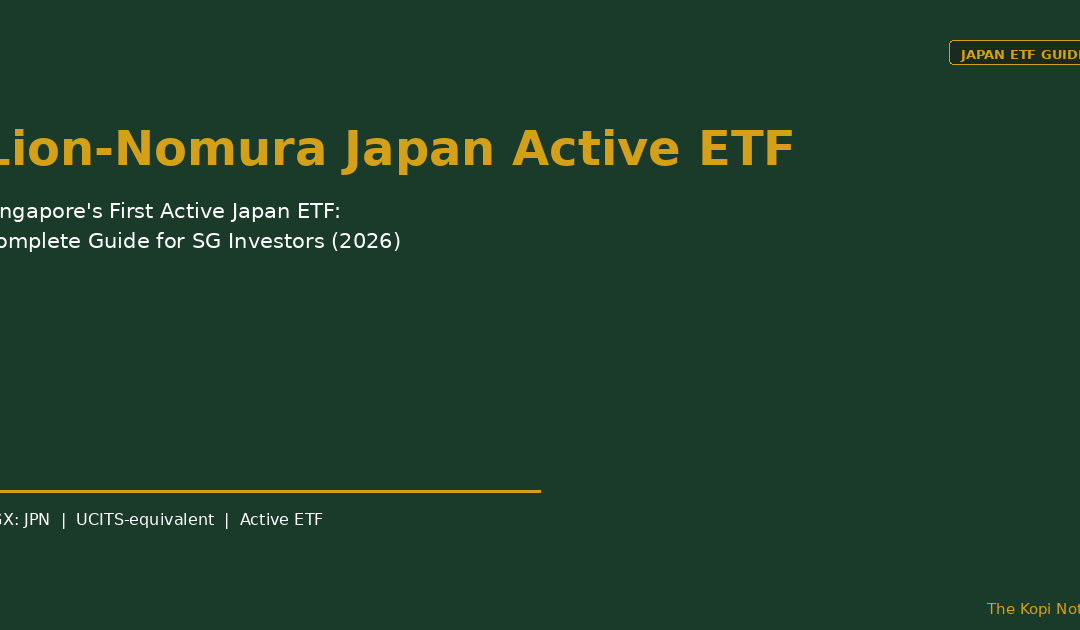
The Lion-Nomura Japan Active ETF (SGX: JPN) is Singapore’s first actively managed Japan equity ETF, listed on the Singapore Exchange (SGX) in 2024. Managed by Lion Global Investors and Nomura Asset Management, it targets Japanese growth stocks using active stock selection — unlike passive ETFs that simply track an index. The TER is 0.75% p.a. and the fund is denominated in SGD-hedged and unhedged share classes, making it accessible to Singapore retail investors without the need for a separate foreign brokerage account.
Not financial advice. All figures are for educational reference only. Data as at May 2026 unless noted.
Table of Contents
Contents — Click to expand
- What Is the Lion-Nomura Japan Active ETF?
- Key Facts at a Glance
- Why Singapore Investors Are Looking at Japan in 2026
- Active vs Passive: What’s the Difference?
- Expense Ratio and Total Costs
- How to Buy the Lion-Nomura Japan ETF in Singapore
- Alternatives: Other Japan ETF Options for SG Investors
- Who Should Buy This ETF?
- Frequently Asked Questions
What Is the Lion-Nomura Japan Active ETF?
The Lion-Nomura Japan Active ETF is jointly managed by Lion Global Investors — one of Southeast Asia’s largest asset managers — and Nomura Asset Management, Japan’s largest fund manager by AUM. The ETF was listed on the Singapore Exchange (SGX) under the ticker JPN and gives Singapore retail investors access to a concentrated portfolio of Japanese equities selected through active fundamental research.
Unlike a passive ETF that mechanically tracks an index such as the MSCI Japan or Nikkei 225, this ETF’s portfolio managers select individual Japanese companies based on factors including corporate governance improvements, earnings growth potential, shareholder return programmes (share buybacks and dividend increases), and valuation relative to peers. The investment thesis is that Japan’s ongoing corporate reform wave — driven by the Tokyo Stock Exchange’s push for companies to improve their Price-to-Book ratios — creates alpha opportunities that a passive index cannot fully capture.
The fund is available in two share classes on SGX: an SGD-hedged class and an SGD-unhedged class. The hedged class uses currency forwards to reduce the impact of JPY/SGD fluctuations on returns, while the unhedged class gives full exposure to yen movements alongside equity performance.
Key Facts at a Glance
| Metric | Detail |
|---|---|
| Full Name | Lion-Nomura Japan Active ETF |
| Ticker (SGX) | JPN (SGD-hedged) / JPNU (SGD-unhedged) |
| Investment Type | Actively managed Japan equity ETF |
| Exchange | Singapore Exchange (SGX) |
| Managers | Lion Global Investors & Nomura Asset Management |
| TER (Expense Ratio) | 0.75% p.a. (est.) |
| Currency | SGD (hedged & unhedged classes) |
| Domicile | Singapore |
| Structure | Open-ended fund listed as ETF |
| CPF / SRS Eligible | SRS-compatible (check with broker); not CPFIS |
Source: SGX ETF listings, Lion Global Investors fund documents, May 2026
Why Singapore Investors Are Looking at Japan in 2026
Japan’s equity market has attracted significant global investor attention since 2023, driven by a structural shift that is still playing out in 2026. Three factors are most relevant for Singapore investors:
1. Corporate governance reform: The Tokyo Stock Exchange launched its landmark request to listed companies trading below book value (Price-to-Book ratio < 1x) to disclose plans for improving capital efficiency. This led to a wave of share buybacks, dividend increases, and cross-shareholding unwinds not seen in decades. As at early 2026, hundreds of Japanese companies are still underway with reform programmes, and many analysts believe the re-rating of Japanese equities is still in its early-to-middle stages.
2. End of negative interest rates: The Bank of Japan raised its policy rate out of negative territory in 2024 for the first time since 2007, signalling a normalisation of monetary policy. This has strengthened the structural case for Japanese financial stocks — banks and insurers that were structurally unprofitable under negative rates now benefit from rising net interest margins. This is a theme an active manager can overweight; a passive MSCI Japan index is more broadly spread.
3. Warren Buffett’s Japan trade: Berkshire Hathaway’s ongoing investment in Japan’s five major trading houses (the “Sogo Shosha”) brought global attention to Japanese value stocks. While the easy money in direct Berkshire-basket trades may have been made, the renewed global investor interest in Japan’s undervalued corporate sector continues to attract fund flows in 2026.
For a Singapore investor, Japan represents geographic diversification beyond the typical S-REIT and US equity-heavy portfolio. The JPY/SGD dynamic is also relevant — a weaker yen makes Japanese exports competitive but reduces SGD returns for unhedged investors, which is why the hedged share class of JPN exists.
Active vs Passive: What’s the Difference for Japan?
Most ETFs available to Singapore investors — CSPX tracking the S&P 500, VWRA tracking the FTSE All-World — are passive index ETFs. They hold every stock in the index at its market-cap weight, providing broad diversification at very low cost (TERs of 0.07%–0.22%).
An active ETF like Lion-Nomura JPN takes a different approach: the portfolio managers select a concentrated basket of Japanese stocks they believe will outperform, based on fundamental research, management meetings, and on-the-ground knowledge of the Japanese corporate landscape. Nomura Asset Management’s Japanese equity team has native-language access to Japanese company managements — an edge that is genuinely hard to replicate from Singapore.
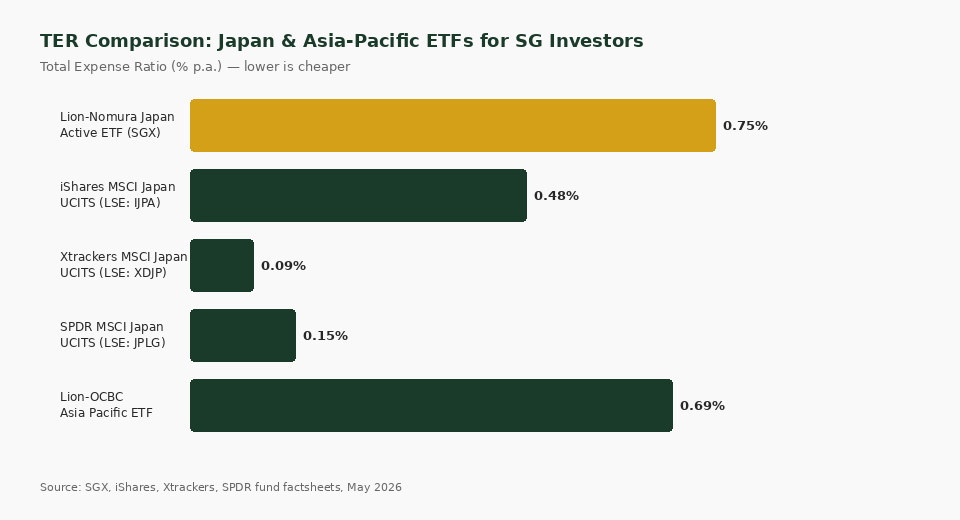
The trade-off is cost. At 0.75% p.a., JPN costs roughly 5–8 times more than a passive Japan ETF like Xtrackers MSCI Japan UCITS (XDJP on LSE, 0.09% TER) or SPDR MSCI Japan UCITS (JPLG on LSE, 0.15% TER). Over a 20-year investment horizon on a SGD 50,000 portfolio, that cost difference compounds significantly.
Whether active management in Japan can consistently justify the fee premium is an open question. Japan is one of the more analyst-covered developed markets, but it also has structural inefficiencies — particularly in small and mid-cap names and in the ongoing governance reform trade — where active managers argue they can add alpha. Investors should review JPN’s reported performance versus the MSCI Japan index once sufficient track record data is available from SGX.
Expense Ratio and Total Costs
The estimated TER for Lion-Nomura JPN is 0.75% per annum. For context, this is higher than passive Japan ETFs available to Singapore investors, but significantly lower than most actively managed unit trusts (OEICs) that charge 1.5%–2.0% p.a. plus front-end load fees.
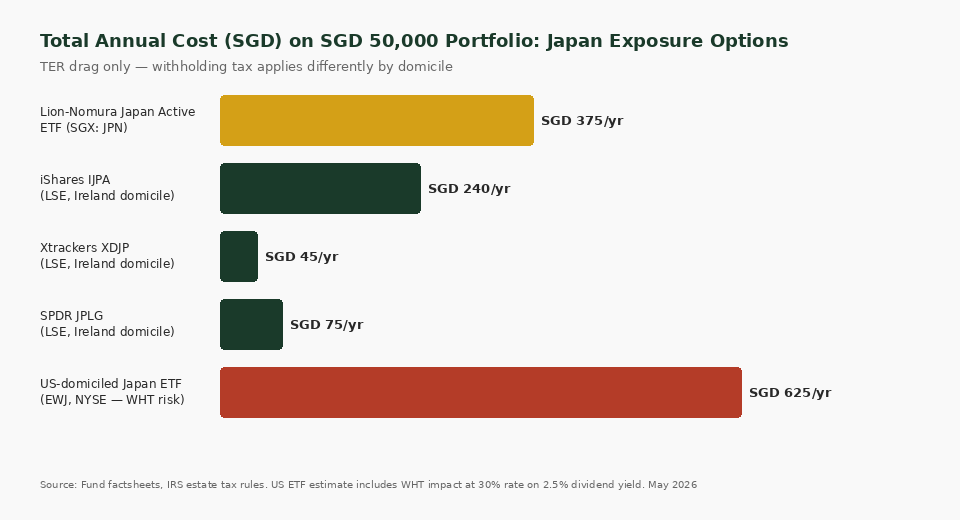
Here is what the TER drag looks like in SGD terms at different portfolio sizes:
| Portfolio Size (SGD) | Annual TER Cost (JPN, 0.75%) | Annual TER Cost (Passive XDJP, 0.09%) | Annual Cost Difference |
|---|---|---|---|
| SGD 10,000 | SGD 75 | SGD 9 | SGD 66 |
| SGD 30,000 | SGD 225 | SGD 27 | SGD 198 |
| SGD 50,000 | SGD 375 | SGD 45 | SGD 330 |
Source: Author calculation based on published TER data, May 2026. TER is deducted from NAV daily and not paid separately by the investor.
Note that the TER is embedded in the fund’s NAV — it is not a separate fee you see on your brokerage statement. The fund’s quoted price already reflects this daily deduction.
Transaction costs on top of TER: when buying JPN on SGX, you pay brokerage commissions and the SGX clearing fee (0.0325% of trade value). For most Singapore brokers, commissions range from SGD 0.99 to SGD 25 per trade depending on the platform and trade size.
How to Buy the Lion-Nomura Japan ETF in Singapore (Step-by-Step)
Because JPN is listed on SGX, it can be bought through virtually any Singapore-based brokerage that provides SGX access — no international broker account or foreign currency conversion needed. Here is how to buy it on the most common platforms:
Interactive Brokers (IBKR): Search for ticker “JPN” and select the SGX exchange. IBKR’s SGX commissions are among the lowest available, starting at SGD 1.50 per trade or 0.05% of trade value (whichever is higher). IBKR is the most cost-effective option for larger purchases above SGD 10,000. You can also use IBKR to buy passive Japan ETFs on the LSE (such as XDJP or JPLG in GBP) if you prefer the lower-TER passive route.
Syfe Brokerage: Syfe’s brokerage platform provides access to SGX-listed ETFs. For Singapore investors who prefer a clean mobile-first interface and are already using Syfe for their Syfe referral code and sign-up bonus, JPN can be added to a self-directed portfolio alongside other SGX holdings. Check the moomoo Singapore review for a comparison of brokerage fees before choosing your platform.
Standard Chartered Online Trading / DBS Vickers / Maybank Securities: All major Singapore bank-linked brokerages provide SGX access. These tend to have higher commissions (SGD 10–25 per trade minimum) but may be convenient if you already have accounts with these banks. They are generally not the most cost-efficient for regular ETF purchasing.
FSMOne: FSMOne provides SGX ETF access and a clean ETF screener. Use the FSMOne referral code for a sign-up bonus when opening a new account. FSMOne charges a flat brokerage commission for SGX trades.
Step-by-step for most platforms:
1. Log in to your brokerage account
2. Navigate to “Buy” or “Trade”
3. Search for ticker: JPN (SGD-hedged) or JPNU (SGD-unhedged)
4. Select “SGX” as the exchange
5. Enter your lot size (JPN trades in board lots of 100 units)
6. Place a limit order at or near the current market price
7. Confirm — no currency conversion required as JPN is priced in SGD
One key advantage for Singapore investors: because JPN is SGX-listed, you avoid the foreign currency conversion costs that come with buying LSE-listed ETFs in GBP or USD. For smaller portfolios, this can offset a portion of the TER premium versus passive alternatives.
Alternatives: Other Japan ETF Options for SG Investors
Singapore investors who want Japan equity exposure have several options beyond JPN. The right choice depends on whether you prioritise active management potential, cost minimisation, currency hedging, or simplicity.
| ETF | Exchange | TER | Index/Strategy | Currency | Best For |
|---|---|---|---|---|---|
| JPN / JPNU | SGX | 0.75% | Active Japan equity | SGD | Active alpha seekers, SGX simplicity |
| XDJP | LSE | 0.09% | MSCI Japan (passive) | GBP | Cost minimisers with IBKR/Saxo |
| JPLG | LSE | 0.15% | MSCI Japan (passive) | GBP | Broad passive Japan exposure |
| IJPA | LSE | 0.48% | MSCI Japan (passive, large/mid) | USD | iShares fans, USD-denominated |
| VWRA / CSPX | LSE | 0.22% / 0.07% | Global / S&P 500 (includes Japan) | USD | Japan exposure via global allocation |
Source: SGX, iShares, Xtrackers, SPDR fund factsheets, May 2026. TER figures from latest available fund documents.
Note that VWRA (the Vanguard FTSE All-World UCITS ETF) already allocates approximately 5–6% to Japanese equities at market weight. If you hold VWRA as your core global ETF, you already have Japan exposure — the question is whether you want to overweight Japan specifically, which is the use case for a dedicated Japan ETF like JPN.
For investors who prefer the simplicity of a Singapore retirement calculator-driven approach — maximising long-term wealth through low-cost index investing — the passive LSE-listed options (XDJP at 0.09%) offer the same geographic exposure at a fraction of the cost.
Who Should Buy the Lion-Nomura Japan Active ETF?
JPN may be suitable if you:
- Have a specific conviction on the Japan corporate governance reform trade and want active management to identify the best beneficiaries
- Prefer SGX-listed products and want Japan exposure without opening a foreign brokerage account
- Want JPY/SGD currency risk managed through the hedged share class
- Are comfortable paying a higher TER for the potential of active outperformance
- Have a medium-to-long investment horizon (5 years or more) to allow the active strategy time to demonstrate its value
Consider alternatives if you:
- Are primarily a passive, low-cost investor — the 0.66% TER premium over XDJP is significant over a 20-year horizon
- Already hold VWRA or a global ETF with built-in Japan allocation at market weight
- Have an Interactive Brokers account and are comfortable buying LSE-listed ETFs in GBP — the passive options are significantly cheaper
- Are sensitive to the limited track record of JPN (the ETF was relatively newly listed as at 2026)
This ETF is not CPF-investable (CPFIS-approved ETFs are limited to SGX-listed Nikko AM and SPDR STI ETFs as at 2026). However, it may be compatible with SRS funds depending on your SRS broker — confirm eligibility directly with your SRS operator before investing. See our guide to CPF investment strategy Singapore for a full breakdown of CPF-investable options.
For Singapore investors building a diversified passive income Singapore portfolio, Japan allocation fits naturally alongside S-REITs (for income) and global ETFs (for growth) — particularly given Japan’s low correlation with SGX-listed assets and growing dividend culture among Japanese corporates.
Disclaimer: This article is for educational purposes only and does not constitute financial advice. Always consult a licensed financial adviser before making investment decisions. Past performance of any ETF or fund is not indicative of future results.
Frequently Asked Questions
What is the Lion-Nomura Japan Active ETF and how is it different from a regular ETF?
The Lion-Nomura Japan Active ETF (SGX: JPN) is an actively managed ETF that invests in Japanese equities selected by portfolio managers at Lion Global Investors and Nomura Asset Management, rather than passively tracking an index. Unlike a passive ETF that holds every stock in the Nikkei 225 or MSCI Japan at index weight, JPN’s managers actively select stocks they believe will outperform — focusing on corporate governance reform beneficiaries, earnings growth, and shareholder return improvement. This active approach comes at a higher cost (0.75% TER vs 0.09%–0.15% for passive alternatives) but offers the potential to beat the index if the managers’ stock picks prove correct.
What is the ticker for the Lion-Nomura Japan ETF on SGX?
The Lion-Nomura Japan Active ETF trades on SGX under two tickers: JPN for the SGD-hedged share class (which uses currency forwards to reduce JPY/SGD exchange rate impact) and JPNU for the SGD-unhedged share class (which gives full exposure to yen movements). Most Singapore investors who want to reduce currency volatility would use the JPN (hedged) class, while those who are comfortable with or want exposure to JPY/SGD movements would use JPNU.
Can I buy the Lion-Nomura Japan ETF with my CPF or SRS funds?
As at May 2026, JPN is not on the CPF Investment Scheme (CPFIS) approved list — CPFIS-approved ETFs are limited to selected SGX-listed ETFs such as Nikko AM STI ETF (ES3) and SPDR STI ETF (G3B). For SRS (Supplementary Retirement Scheme) funds, JPN may be eligible depending on your SRS bank operator (DBS, OCBC, or UOB) — confirm directly with your SRS operator before investing. For CPF-compatible investment options, see our guide on CPF investment strategy Singapore.
Is the Lion-Nomura Japan Active ETF better than a passive Japan ETF like XDJP or JPLG?
It depends on your investment philosophy and cost sensitivity. Passive Japan ETFs listed on the LSE — such as Xtrackers MSCI Japan UCITS (XDJP at 0.09% TER) or SPDR MSCI Japan UCITS (JPLG at 0.15% TER) — are significantly cheaper than JPN (0.75% TER) and track the broad MSCI Japan index. If you are a cost-focused passive investor, the passive options give you the same geographic exposure at a fraction of the price. JPN makes more sense if you specifically believe active management can add alpha in Japan’s governance reform environment and you prefer SGX-listed access in SGD without needing a foreign brokerage account.
What are the risks of investing in the Lion-Nomura Japan Active ETF?
Key risks include: (1) Active management risk — the portfolio managers may underperform the MSCI Japan index, in which case investors would have paid a higher TER for worse returns than a passive fund; (2) Currency risk — for the unhedged class (JPNU), a weakening JPY against SGD reduces returns in SGD terms; (3) Japan equity market risk — Japanese stocks are subject to economic slowdown, BoJ policy changes, and geopolitical risk in Northeast Asia; (4) Concentration risk — as an actively managed fund, JPN may hold a concentrated portfolio that underperforms in periods when the broader market does not reward its chosen stock selection criteria; (5) Track record risk — the ETF was relatively newly listed, meaning investors have limited historical performance data to evaluate.
How does the Lion-Nomura Japan ETF fit into a Singapore investor’s portfolio?
For a typical Singapore investor, JPN can serve as a tactical allocation to Japan within a broader portfolio. A common structure might be: core holdings in a global ETF (e.g. VWRA) for broad market exposure, S-REITs for SGD income, and a smaller satellite allocation (5%–15% of equity portfolio) in a specific country or theme — of which Japan could be one. Because VWRA already holds ~5–6% Japan at market weight, an explicit Japan ETF position is an overweight relative to global market cap. Investors who believe Japan’s corporate reform story justifies this overweight may consider JPN; those who prefer strict market-cap weighting are better served staying with their global ETF. Plan your Japan allocation alongside your overall retirement goals using our Singapore retirement calculator.
Ready to Start Investing in ETFs?
Open a brokerage account and buy your first ETF today. Use our referral links for exclusive sign-up bonuses.
This article was researched with the help of AI. While we strive to keep all information accurate and up to date, there may be errors. If you notice any discrepancies, please contact us.