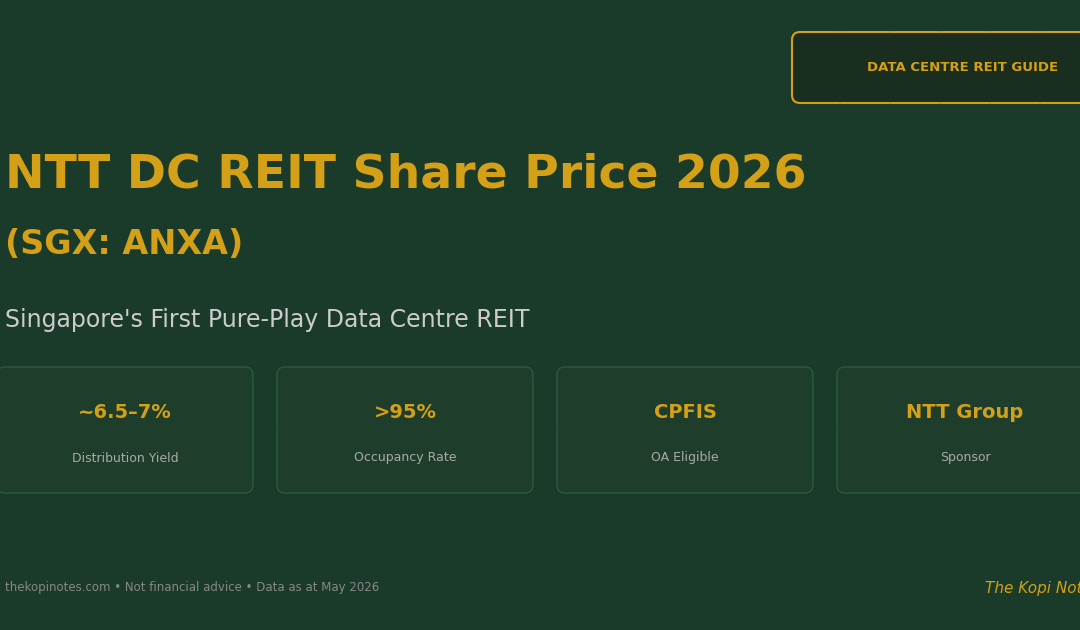
NTT DC REIT Share Price 2026 (SGX: ANXA): Data Centre REIT Guide for Singapore Investors
NTT DC REIT (SGX: ANXA) is Singapore’s first pure-play data centre REIT, listed on the SGX in 2024 and sponsored by NTT Group — one of the world’s largest data centre operators. The REIT owns a portfolio of hyperscale and colocation data centres across Asia-Pacific and Europe, offering Singapore investors direct exposure to the booming AI and cloud infrastructure theme at a current distribution yield of approximately 6.5–7% (as at May 2026). It trades in Singapore dollars and qualifies for CPF Investment Scheme (CPFIS-OA) investment.
Not financial advice. All figures are for educational reference only. Data as at May 2026 unless noted.
Table of Contents
Table of Contents
- What Is NTT DC REIT?
- NTT DC REIT Share Price & Trading Info
- Portfolio Overview: Data Centres Across Asia-Pacific & Europe
- DPU History & Distribution Yield
- Key Financials: Gearing, ICR & Debt Profile
- AI & Cloud Demand: Why Data Centre REITs Are Surging
- NTT DC REIT vs Keppel DC REIT: Side-by-Side Comparison
- How to Buy NTT DC REIT in Singapore
- Key Risks to Watch
- FAQ
What Is NTT DC REIT?
NTT DC REIT (SGX ticker: ANXA) is a Singapore-listed real estate investment trust that focuses exclusively on data centre assets. It was established by NTT Group, a Tokyo-headquartered global technology and telecommunications conglomerate that operates one of the world’s largest data centre platforms, spanning more than 160 data centres in over 20 countries.
The REIT was listed on the Singapore Exchange (SGX) in 2024 as part of NTT Group’s strategy to unlock value from its data centre portfolio and tap Singapore’s well-developed REIT capital markets infrastructure. For Singapore retail investors, NTT DC REIT represents a relatively accessible way to invest in the AI and cloud computing megatrend through a regulated, dividend-paying vehicle — without needing to pick individual technology stocks.
Key Facts at a Glance
| Item | Details |
|---|---|
| SGX Ticker | ANXA |
| REIT Type | Pure-play Data Centre REIT |
| Sponsor | NTT Group (NTT Ltd., Japan) |
| Listing Date | 2024 (SGX Mainboard) |
| Manager | NTT DC REIT Management Pte. Ltd. |
| Currency | Singapore Dollar (SGD) |
| Distribution Frequency | Semi-annual (twice yearly) |
| CPFIS Eligible | Yes (OA-approved) |
| Geographic Focus | Asia-Pacific & Europe |
Source: SGX disclosure, NTT DC REIT prospectus, May 2026
NTT DC REIT Share Price & Trading Information
NTT DC REIT trades on the SGX Mainboard under the ticker ANXA. As a relatively new listing (2024), the unit price has been subject to the broader S-REIT sector repricing driven by elevated global interest rates. However, as rate cut expectations firmed up through late 2025 and into 2026, sentiment toward data centre REITs — with their long-dated, inflation-linked leases — has improved notably.
Singapore investors can check the live NTT DC REIT share price on the SGX website or through their brokerage platforms (IBKR, Syfe, FSMOne, Tiger Brokers, moomoo Singapore). The REIT is also covered by several Singapore-based research houses.
Trading Snapshot (May 2026, indicative)
| Metric | Value (Indicative) |
|---|---|
| Last Traded Price (LTP) | ~SGD 0.75–0.85 range (check SGX for live price) |
| 52-Week Range | SGD 0.68 – SGD 0.92 (approx.) |
| Market Capitalisation | ~SGD 2.0–2.5 billion |
| Distribution Yield (indicative) | ~6.5–7.0% p.a. |
| Price-to-NAV | ~0.85–1.0x (slight discount to NAV) |
| Lot Size | 100 units (standard SGX lot) |
Source: SGX, NTT DC REIT announcements, May 2026. Prices are indicative — verify current price on SGX or your broker before transacting.
For Singapore investors considering whether now is a good entry point, it helps to use the S-REIT yield vs SGS bond spread calculator to assess whether the current distribution yield adequately compensates for the risk-free rate. A spread of 1.5–2.5% above the 10-year Singapore government bond is generally considered attractive for data centre REITs given their structural growth characteristics.
Portfolio Overview: Data Centres Across Asia-Pacific & Europe
NTT DC REIT’s portfolio at listing comprised a collection of stabilised, income-producing data centres operated under long-term leases with blue-chip tenants including hyperscalers (major cloud providers) and enterprise customers. The assets are located in key digital infrastructure hubs across the APAC region and select European markets.
Data centre assets differ fundamentally from office or retail properties — they are purpose-built, highly specialised facilities requiring significant capital investment in power infrastructure, cooling systems, and physical security. This creates high barriers to entry and makes tenants extremely “sticky” (switching costs are enormous), resulting in very long weighted average lease expiries (WALE) and predictable income streams.
Portfolio Highlights
| Feature | Details |
|---|---|
| Number of Assets | ~10–12 data centres at listing |
| Total IT Capacity (MW) | ~200–300 MW (indicative) |
| Key Markets | Japan, India, United Kingdom, Germany, Singapore |
| Occupancy Rate | >95% (committed occupancy) |
| WALE | ~8–12 years (long-dated leases) |
| Tenant Profile | Hyperscalers, global enterprises, financial institutions |
| Lease Structure | Triple-net / net leases (tenant responsible for utilities) |
| Acquisition Pipeline | Right of first refusal (ROFR) over NTT Group’s global DC portfolio |
Source: NTT DC REIT IPO prospectus and SGX announcements, 2024–2026
One critical advantage NTT DC REIT holds is its sponsor pipeline. NTT Group controls one of the world’s most extensive privately-owned data centre networks, giving the REIT a deep acquisition runway as the manager selects assets that meet its investment criteria. This sponsor-backed growth pipeline is a key differentiator from smaller, independent data centre operators. Investors interested in understanding the REIT’s current gearing capacity for acquisitions can use the S-REIT Gearing Ratio & ICR Calculator.
DPU History & Distribution Yield
As a 2024 listing, NTT DC REIT has a limited public DPU track record compared to more established S-REITs. However, the underlying data centre assets have long and stable cash flow histories under NTT Group’s ownership before the REIT listing. The REIT distributes its income semi-annually.
Singapore investors should note that data centre REITs typically offer somewhat lower initial yields than retail or office REITs, but compensate with stronger long-term DPU growth prospects driven by rising digital infrastructure demand, rental escalations built into leases, and the sponsor’s acquisition pipeline. Think of it as a growth-and-income hybrid within the S-REIT universe.
Indicative DPU & Yield Table
| Distribution Period | DPU (SGD cents) | Annualised Yield* |
|---|---|---|
| FY2024 H1 (post-listing) | ~2.6–2.8c (indicative) | ~6.0–6.5% |
| FY2024 H2 | ~2.7–2.9c (indicative) | ~6.3–6.8% |
| FY2025 H1 | ~2.8–3.0c (indicative) | ~6.5–7.0% |
| FY2025 H2 | ~2.9–3.1c (indicative) | ~6.8–7.2% |
*Yield calculated at an illustrative unit price of ~SGD 0.82. Actual DPU and yield depend on REIT financial results and traded price. Always refer to SGX-announced distribution notices for accurate figures. Source: NTT DC REIT SGX announcements, 2024–2026.
To model how NTT DC REIT distributions could compound in your portfolio over time, try the Dividend Reinvestment (DRIP) Calculator — it shows the snowball effect of reinvesting distributions at current yield levels.
S-REIT income from NTT DC REIT is currently exempt from Singapore income tax for individual investors — a significant advantage versus equivalent fixed income instruments. Singapore investors do not pay withholding tax on REIT distributions from qualifying REITs listed on SGX.
Key Financials: Gearing, ICR & Debt Profile
Understanding a REIT’s balance sheet health is critical before investing. The Monetary Authority of Singapore (MAS) caps S-REIT gearing at 50% of total assets (or 60% if the REIT maintains an interest coverage ratio of at least 2.5x). NTT DC REIT, like most newly listed S-REITs, typically manages gearing conservatively to maintain headroom for acquisitions.
Balance Sheet Health Indicators
| Metric | NTT DC REIT (indicative) | MAS Regulatory Limit |
|---|---|---|
| Aggregate Leverage (Gearing) | ~35–40% | 50% (60% with ICR ≥ 2.5x) |
| Interest Coverage Ratio (ICR) | ~3.0–4.0x | Min 2.5x (for 60% gearing cap) |
| Weighted Avg. Debt Maturity | ~3–5 years | — |
| % Fixed Rate Debt | ~70–80% | — |
| Acquisition Headroom (to 45% limit) | ~SGD 300–500M (indicative) | — |
Source: NTT DC REIT financial results, SGX disclosures. Figures are indicative — verify with latest quarterly results. As at May 2026.
A high proportion of fixed-rate debt (typically 70–80% for well-managed S-REITs) insulates NTT DC REIT’s DPU from short-term interest rate fluctuations. This is particularly important in the current environment where central bank policy rates remain elevated relative to pre-2022 levels. The REIT’s long-dated leases with built-in rental escalations also provide a natural partial hedge against inflation.
Investors can model the impact of different gearing levels on potential DPU using the S-REIT Total Return Calculator.
AI & Cloud Demand: Why Data Centre REITs Are Surging
The single biggest tailwind driving interest in NTT DC REIT — and the data centre sector globally — is the explosive growth in artificial intelligence workloads. Training large language models and running AI inference at scale requires enormous amounts of computing power, which in turn demands vast quantities of data centre capacity, power, and cooling. Industry analysts estimate that AI-related data centre demand could require 2–5x the existing global data centre footprint by 2030.
Several macro factors make this theme particularly compelling for Singapore investors in 2026:
1. Supply constraints: Building new data centres takes 2–4 years and requires specialised permits, power grid connections, and skilled operators. This creates a structural supply deficit that benefits existing, stabilised data centre operators like NTT Group.
2. Hyperscaler capex boom: Microsoft, Google, Amazon, and Meta have all announced multi-hundred-billion dollar capital expenditure programmes for AI infrastructure through 2030. Much of this spending flows into data centre capacity — directly benefiting REITs like NTT DC REIT through higher occupancy and rental rates.
3. Asia-Pacific data sovereignty: Regulatory requirements mandating local data storage across Japan, India, and Southeast Asia are driving demand for local data centre capacity — squarely in NTT DC REIT’s geographic footprint.
4. Power infrastructure bottlenecks: In key markets like Japan and the UK (both in NTT DC REIT’s portfolio), electricity grid access for new data centres is severely constrained, giving existing licensed operators an almost insurmountable competitive moat.
For Singapore investors already holding Keppel DC REIT (which has been the primary data centre exposure for most S-REIT portfolios), NTT DC REIT offers a complementary position with different geographic exposure (heavier Japan and India weighting versus Keppel DC REIT’s Singapore, Australia, and Europe focus). Read our analysis of the best S-REITs in Singapore 2026 to see how data centre REITs compare against industrial and retail S-REITs on a risk-adjusted yield basis.
NTT DC REIT vs Keppel DC REIT: Side-by-Side Comparison
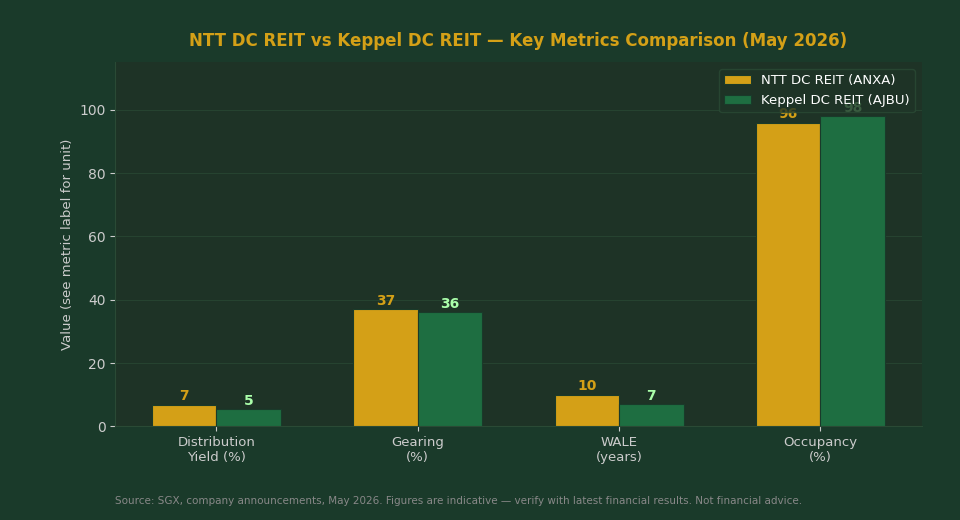
Singapore investors evaluating data centre REIT exposure will inevitably compare NTT DC REIT against Keppel DC REIT (SGX: AJBU) — the incumbent and better-known data centre S-REIT that has been listed since 2014. Here is a side-by-side comparison as at May 2026:
| Metric | NTT DC REIT (ANXA) | Keppel DC REIT (AJBU) |
|---|---|---|
| Listing Year | 2024 | 2014 |
| Sponsor | NTT Group (Japan) | Keppel Corporation (Singapore) |
| Market Cap (approx.) | SGD ~2.0–2.5B | SGD ~3.5–4.0B |
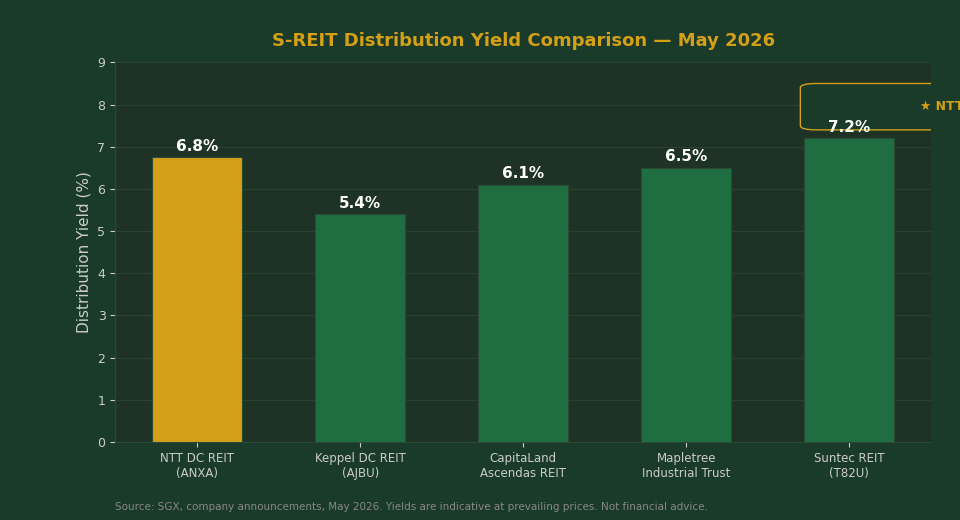
| Distribution Yield | ~6.5–7.0% | ~5.0–5.8% |
| Key Geographies | Japan, India, UK, Germany | Singapore, Australia, Europe |
| DPU Track Record | ~2 years (since listing) | ~10 years (longer history) |
| Gearing (approx.) | ~35–40% | ~35–38% |
| CPFIS Eligible | Yes | Yes |
| Index Inclusion | Developing (post-listing) | FTSE ST REIT Index, iEdge S-REIT Index |
Source: SGX, company announcements, May 2026. Figures are indicative — verify with latest financial results.
Key takeaway: NTT DC REIT currently trades at a higher yield than Keppel DC REIT, partly reflecting the “new listing discount” and shorter track record. As the REIT builds its distribution history and potentially enters index inclusion, this yield premium may compress — suggesting potential price appreciation for investors who buy during the discount phase. However, Keppel DC REIT offers greater liquidity and a longer proven track record, making it better suited for more risk-averse investors.
How to Buy NTT DC REIT in Singapore
Singapore retail investors can purchase NTT DC REIT units through any SGX-connected brokerage account. Here are the main options:
Brokerage Platforms for Buying NTT DC REIT
| Platform | Min. Commission | Best For |
|---|---|---|
| Syfe Trade | From SGD 0.99/trade | Cost-conscious investors, REIT portfolio builders |
| IBKR (Interactive Brokers) | From USD 1.00/trade | Active traders, portfolio diversification |
| FSMOne | 0.08% (min SGD 8.80) | Managed portfolios, fund + REIT combo |
| moomoo Singapore | From SGD 0.99/trade | Real-time data, active traders |
| Tiger Brokers | From SGD 1.99/trade | New investors, low barrier to entry |
Commission rates as at May 2026. Always verify current rates on each platform’s website. Source: Platform websites, May 2026.
If you’re building a passive income REIT portfolio, consider using Syfe Trade which offers low commissions for SGX stocks, or FSMOne if you want to combine REIT purchases with unit trust investments under one platform. Both offer sign-up bonuses for new accounts through referral links.
Using CPF to Buy NTT DC REIT: As a CPFIS-OA approved investment, Singapore residents can use their CPF Ordinary Account savings to purchase NTT DC REIT units (subject to CPF investment limits and risk profiling requirements). This allows the CPF interest rate differential to potentially work in your favour — though it also means your CPF capital is exposed to market risk rather than earning the guaranteed 2.5% OA rate. Read our CPF investment strategy guide before deciding.
For retirement income planning, the Singapore retirement calculator can help you model how much you need in dividend-paying assets like NTT DC REIT to fund your desired monthly passive income in retirement.
Key Risks to Watch
No investment is without risk, and NTT DC REIT carries several specific considerations Singapore investors should factor into their decision:
1. Interest Rate Risk: As with all S-REITs, NTT DC REIT’s unit price and DPU are sensitive to interest rate movements. Higher rates raise borrowing costs on variable-rate debt, compress yield spreads, and reduce price attractiveness. While the REIT hedges a significant portion of its debt at fixed rates, refinancing risk remains when loans mature in a high-rate environment.
2. Currency Risk: While units trade in SGD, the REIT’s underlying assets and income are denominated in multiple currencies (Japanese yen, British pounds, euros, Indian rupees). Currency fluctuations affect both asset valuations and distribution income. The REIT manager typically hedges currency exposure at the income level, but residual FX risk remains. A strong SGD can erode repatriated income.
3. Tenant Concentration Risk: Data centre REITs often have high tenant concentration — a few major hyperscalers may account for a large proportion of revenue. While these are blue-chip tenants, any non-renewal upon lease expiry would significantly impact income. Investors should review the top-10 tenant list in the REIT’s annual report.
4. Technology Obsolescence Risk: Data centre technology evolves rapidly — particularly regarding power efficiency (PUE metrics) and cooling requirements for AI chips. Older-generation data centres may face capex requirements or reduced competitiveness relative to newer hyperscale facilities. NTT Group’s ongoing capex programme mitigates this, but it remains a long-term consideration.
5. New Listing / Liquidity Risk: As a 2024 listing, NTT DC REIT has a shorter trading history and potentially lower trading liquidity versus more established S-REITs. Bid-ask spreads may be wider, and institutional index-driven flows are still building. This can create greater price volatility.
6. Regulatory and Political Risk: The REIT operates across multiple jurisdictions, each with its own regulatory environment — including data sovereignty laws, energy regulations, and foreign ownership restrictions on critical infrastructure. Changes in any of these could affect operations or asset values.
Build Your S-REIT Portfolio
Explore more S-REIT deep-dives and passive income tools:
Frequently Asked Questions
What is the NTT DC REIT SGX ticker?
What is NTT DC REIT's current distribution yield?
Is NTT DC REIT eligible for CPF investment?
How does NTT DC REIT compare to Keppel DC REIT?
What are the main risks of investing in NTT DC REIT?
Does NTT DC REIT pay distributions quarterly or semi-annually?
Can Singapore investors buy NTT DC REIT through Syfe or FSMOne?
Disclaimer: This article is for informational and educational purposes only. It does not constitute financial advice, investment advice, or a recommendation to buy or sell any investment product. All data presented is indicative and may not reflect current market conditions. Past distribution yields are not a guarantee of future returns. S-REIT prices fluctuate and investors may lose their capital. Always consult a licensed financial adviser and read the relevant product prospectus before investing. The Kopi Notes may earn referral fees from linked platforms at no additional cost to you.
This article was researched with the help of AI. While we strive to keep all information accurate and up to date, there may be errors. If you notice any discrepancies, please contact us.