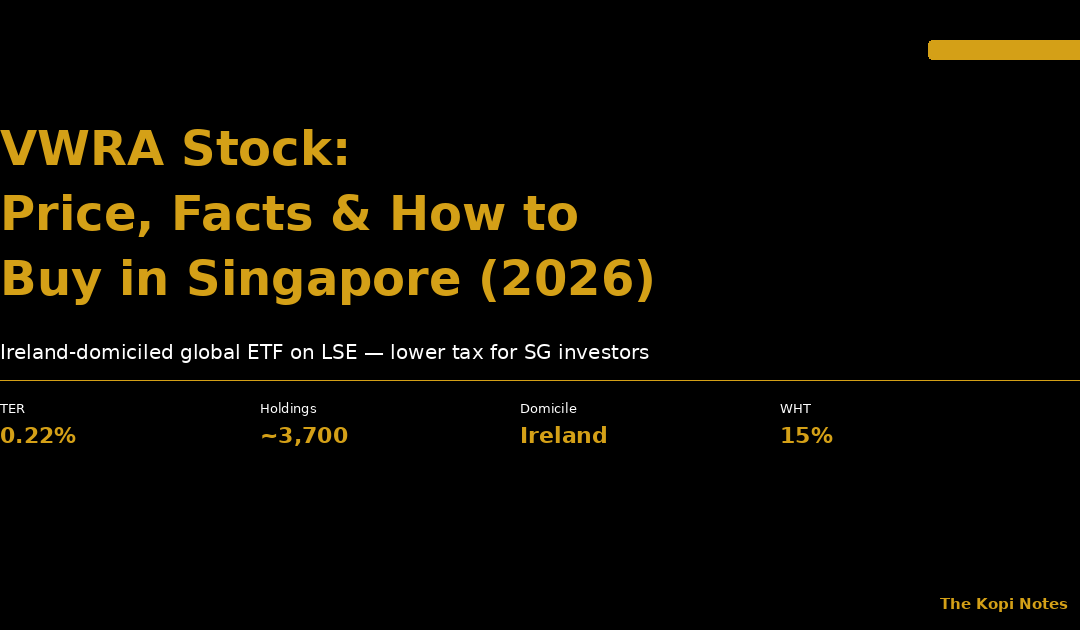
VWRA Stock: What It Is, Price & How to Buy in Singapore (2026)
A complete Singapore investor guide — what VWRA stock is, live price tracking, tax advantages, and step-by-step broker instructions for 2026.
VWRA stock refers to the Vanguard FTSE All-World UCITS ETF (Accumulating), listed on the London Stock Exchange (LSE) under the ticker VWRA. It tracks approximately 3,700 stocks across 49 countries, giving Singapore investors instant global diversification. Unlike US-listed alternatives such as VT, VWRA is Ireland-domiciled — meaning no US estate tax exposure and a lower 15% withholding tax rate on US dividends.
Not financial advice. All figures are for educational reference only. Data as at May 2026 unless noted.
Table of Contents
What Is VWRA Stock?
VWRA is the ticker symbol for the Vanguard FTSE All-World UCITS ETF (Accumulating), managed by Vanguard Asset Management and listed on the London Stock Exchange (LSE). When investors in Singapore search for “VWRA stock,” they are typically looking for price information, fund details, or how to purchase shares of this ETF through a brokerage account.
Despite being called a “stock” in common parlance, VWRA is an Exchange-Traded Fund (ETF) — a basket of approximately 3,700 individual company stocks from 49 countries worldwide. Buying one unit of VWRA gives you fractional exposure to giants like Apple, Microsoft, Nvidia, Samsung, TSMC, Nestle, and thousands more in a single transaction.
VWRA is accumulating in structure, meaning dividends paid by the underlying companies are automatically reinvested into the fund rather than distributed to shareholders. For Singapore investors, this is tax-efficient: there is no income tax on Singapore-sourced investment gains, so you benefit from compound growth without a tax drag on reinvested dividends.
The fund is domiciled in Ireland, which is the critical tax advantage for Singapore-based investors compared to buying the US-listed equivalent (Vanguard Total World Stock ETF, ticker VT). Ireland’s tax treaty with the US reduces the withholding tax (WHT) on US dividends from 30% to 15%, saving you money on every dividend the fund receives from US companies, which make up roughly 63% of the portfolio.
Key Facts at a Glance
| Metric | Detail |
|---|---|
| Full Name | Vanguard FTSE All-World UCITS ETF (Accumulating) |
| Ticker (LSE) | VWRA |
| Index Tracked | FTSE All-World Index (~3,700 stocks, 49 countries) |
| Domicile | Ireland (UCITS) |
| Structure | Accumulating (dividends reinvested automatically) |
| TER (Expense Ratio) | 0.22% per annum |
| AUM | USD ~8 billion (as at Q1 2026) |
| Number of Holdings | ~3,700 |
| Currency (LSE listing) | USD (also available in GBP as VWRL — distributing) |
| Exchange | London Stock Exchange (LSE) |
| Launch Date | 2019 (VWRA accumulating version) |
Source: Vanguard fund factsheet, May 2026
VWRA Stock Price: How to Track It
The VWRA stock price fluctuates daily in line with the 3,700 underlying stocks it holds. Because VWRA trades on the London Stock Exchange, it is priced in US dollars (USD) and trades during LSE market hours: 8:00am–4:30pm UK time, which is 3:00pm–11:30pm Singapore time (SGT).
As of May 2026, VWRA stock trades at approximately USD 120–130 per share, though this changes daily. To track the live VWRA stock price, Singapore investors can use any of these free tools:
- Google Finance: Search “VWRA LON” for the London Stock Exchange listing
- Yahoo Finance: Search for ticker “VWRA.L”
- Your broker app: IBKR, Saxo, MooMoo, and Syfe all display live LSE quotes once your account is funded
- LSE website: londonstockexchange.com — official source for real-time data
Note that VWRA’s price changes continuously throughout the trading day. However, as an accumulating ETF, the price growth you see includes the value of reinvested dividends — there is no separate dividend payout to track. This makes VWRA’s chart a clean representation of total return.
For Singapore investors planning to retire on their portfolio, tracking VWRA’s price is less important than monitoring its long-term trajectory. Use our Singapore retirement calculator to model how a VWRA portfolio could grow to your target retirement sum.
Why Singapore Investors Buy VWRA on the London Stock Exchange
The single most important reason Singapore investors choose VWRA over its US-listed equivalent (VT) is the tax efficiency of Ireland-domiciled UCITS ETFs. Here is a direct comparison:
| ETF Type | Domicile | US Dividend WHT | US Estate Tax Risk |
|---|---|---|---|
| VWRA (LSE) | Ireland | 15% | None |
| VT (NYSE) | USA | 30% | Yes (above USD 60k) |
Source: IRS.gov, Ireland-US tax treaty, MAS
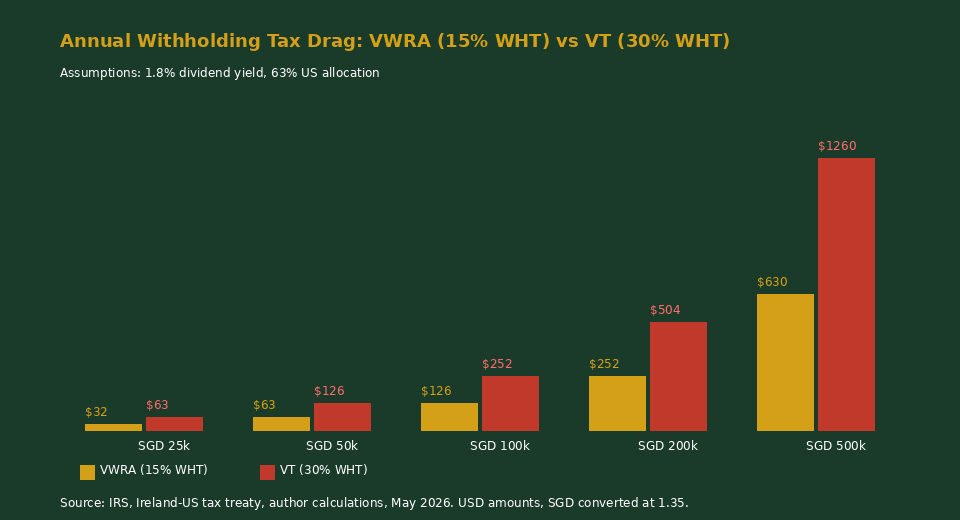
On a SGD 100,000 VWRA portfolio (roughly USD 74,000), the difference in annual withholding tax drag is meaningful. Assuming the fund’s dividend yield is approximately 1.8% per year on the gross underlying stocks, and about 63% is from US companies:
- VWRA at 15% WHT: USD 74,000 × 1.8% × 63% × 15% = ~USD 126 per year in tax drag
- VT at 30% WHT: USD 74,000 × 1.8% × 63% × 30% = ~USD 252 per year in tax drag
The saving of ~USD 126 per year compounds significantly over a 20–30 year retirement horizon. Additionally, if your US-listed ETF holdings exceed USD 60,000, you face US estate tax exposure of up to 40% on the excess — a risk that VWRA completely eliminates for Singapore investors.
For more on this topic, read our guide on passive income in Singapore and how ETF selection affects long-term portfolio efficiency.
VWRA Expense Ratio and Total Costs
VWRA’s Total Expense Ratio (TER) is 0.22% per annum, charged automatically by the fund — it is deducted from the fund’s assets and never appears as a separate line item in your brokerage statement. For a SGD 50,000 portfolio, this amounts to approximately SGD 110 per year in management fees.
When comparing costs, many investors focus only on the TER. But for Singapore investors, the full cost picture includes broker commissions and foreign exchange spread:
| Broker | Commission (per trade) | FX Spread | Min. Funding | Best For |
|---|---|---|---|---|
| IBKR | USD 1.70 min | ~0.08% | None | Frequent traders, large portfolios |
| Saxo Markets | USD 5 min | ~0.25% | SGD 3,000 | Intermediate investors |
| MooMoo SG | USD 1.99 min | ~0.20% | None | Beginners, mobile-first |
| Syfe Brokerage | SGD 1.49/trade (promo) | ~0.30% | None | Beginners, low account size |
Source: Broker fee schedules, May 2026. Fees subject to change.
For a Singapore investor buying SGD 2,000 of VWRA per month through IBKR, the annual transaction cost is roughly SGD 28 — less than 0.15% of the total invested. Combined with VWRA’s 0.22% TER, the all-in annual cost is approximately 0.37%, which remains highly competitive for global ETF exposure. Use our retirement planning calculator to model the long-term impact of these costs on your portfolio.
How to Buy VWRA Stock in Singapore (Step-by-Step)
Buying VWRA in Singapore requires a brokerage account that has access to the London Stock Exchange. Here is the step-by-step process for the four most popular brokers among Singapore investors.
Option 1: Interactive Brokers (IBKR) — Best for Cost
- Open and fund your IBKR account at interactivebrokers.com
- In the trading platform (Trader Workstation or IBKR mobile app), search for ticker VWRA
- When prompted to select an exchange, choose LSE (London Stock Exchange)
- Select currency: USD (VWRA trades in USD on LSE)
- Place a limit order or market order. IBKR charges a minimum of USD 1.70 per LSE trade
Option 2: Syfe Brokerage — Best for Beginners
- Sign up for a Syfe account using our referral code to get a sign-up bonus
- Fund your SGD cash wallet and convert to USD
- Search for VWRA in the Syfe Brokerage interface
- Select LSE as the exchange and place your order
Option 3: MooMoo Singapore — Best Mobile Experience
- Download the MooMoo app and complete account opening
- In the Markets section, switch to US/UK markets and search for VWRA
- Select the LSE listing, choose your order type, and confirm
- Check out the moomoo Singapore review for more details on its features and fees
Option 4: Saxo Markets
- Open a Saxo account and fund with at least SGD 3,000
- In the platform, search VWRA and select the LSE listing in USD
- Note that Saxo has a minimum USD 5 commission per LSE trade — best suited for larger lump-sum purchases
SRS compatibility: VWRA purchased through IBKR, Saxo, or MooMoo is generally compatible with Supplementary Retirement Scheme (SRS) accounts if you use an SRS-linked brokerage. However, VWRA is not eligible for CPF Investment Scheme (CPFIS) — CPF funds can only be invested in SGX-listed instruments. For CPF-compatible ETF options, see our CPF investment strategy guide.
VWRA vs Alternatives
VWRA is not the only way to get global equity exposure as a Singapore investor. Here is how it compares to the closest alternatives:
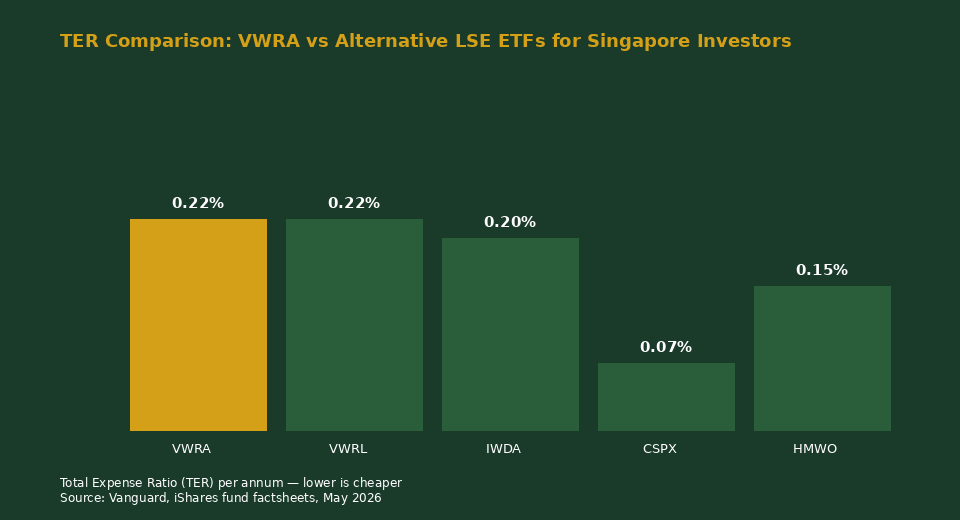
| ETF | Ticker | TER | Index | Structure | Exchange |
|---|---|---|---|---|---|
| VWRA | VWRA | 0.22% | FTSE All-World | Accumulating | LSE (USD) |
| VWRL | VWRL | 0.22% | FTSE All-World | Distributing | LSE (GBP) |
| IWDA | IWDA | 0.20% | MSCI World (developed only) | Accumulating | LSE (USD) |
| CSPX | CSPX | 0.07% | S&P 500 (US only) | Accumulating | LSE (USD) |
| VT | VT | 0.07% | FTSE All-World (US-listed) | Distributing | NYSE (USD) |
Source: Vanguard, iShares fund factsheets, May 2026
VWRA vs VWRL: These two ETFs track the same index. The key difference is that VWRA is accumulating (dividends reinvested) while VWRL is distributing (dividends paid out quarterly). For long-term investors who do not need income, VWRA is generally preferred — it avoids the need to manually reinvest dividends and reduces FX transaction costs.
VWRA vs IWDA: IWDA only holds developed-market stocks (no emerging markets). VWRA includes about 12% in emerging markets like China, India, Brazil, and Taiwan. If you want pure developed-market exposure, IWDA at 0.20% TER is slightly cheaper. See our full Singapore REIT ETF guide for how these ETFs fit into a broader portfolio strategy.
VWRA vs CSPX: CSPX tracks only US large-cap stocks (S&P 500), so it is more concentrated but has delivered stronger recent returns. VWRA provides global diversification at the cost of diluting US outperformance. For Singapore investors who want the best of both, some hold 70% CSPX and 30% IWDA/VWRA as a core-satellite strategy.
Who Should Buy VWRA?
VWRA is ideal if you:
- Want a single-fund solution for global equity exposure across developed and emerging markets
- Prefer an accumulating structure — no need to manually reinvest dividends
- Are investing for the long term (10+ years) and want to minimise transaction costs
- Have significant assets and want to avoid US estate tax exposure entirely
- Are building a passive income Singapore portfolio alongside S-REITs and bonds — VWRA provides the growth equity allocation
Consider alternatives if you:
- Need regular income from your portfolio — consider VWRL (distributing) instead, or complement VWRA with S-REITs that pay quarterly dividends
- Want to use CPF funds for investing — VWRA is not CPFIS-eligible; you would need an SGX-listed ETF like the Nikko AM STI ETF or Lion-Phillip S-REIT ETF
- Prefer purely US market exposure — CSPX at 0.07% TER is a lower-cost option for S&P 500 exposure
- Are a very active trader — VWRA’s relatively high share price (USD 120+) may limit fractional investing on some platforms
For long-term retirement planning, consider pairing VWRA with Singapore Savings Bonds or Singapore T-bills for the defensive portion of your portfolio. VWRA handles your global equity growth; SSBs/T-bills provide capital stability as you approach retirement.
To see how VWRA fits into a retirement plan tailored to Singapore’s CPF and SRS rules, use the free Singapore retirement planning calculator on this site.
Disclaimer: Nothing in this article constitutes financial advice. Investing carries risk. You should consider whether any investment is appropriate for your personal situation and consult a licensed financial adviser if needed. Past performance is not indicative of future results.
Frequently Asked Questions
”What
VWRA (Vanguard FTSE All-World UCITS ETF Accumulating) is an exchange-traded fund listed on the London Stock Exchange that tracks approximately 3,700 stocks across 49 countries. Singapore investors buy it because it is Ireland-domiciled, which means only 15% withholding tax on US dividends (versus 30% for US-domiciled funds), and no exposure to US estate tax — a significant risk for non-US residents holding more than USD 60,000 in US-listed assets.
”Is
VWRA and VT both track the FTSE All-World Index (similar global coverage), but they are different funds. VT is US-domiciled (Delaware), charges 0.07% TER, and exposes Singapore investors to 30% US dividend withholding tax and US estate tax on holdings above USD 60,000. VWRA is Ireland-domiciled, charges 0.22% TER, and qualifies for the 15% Ireland-US tax treaty rate with no estate tax risk. For Singapore residents, VWRA is almost always the better choice despite the higher TER.
”Can
VWRA is not eligible for the CPF Investment Scheme (CPFIS), as CPFIS only covers instruments listed on SGX or approved unit trusts. However, VWRA can be purchased using SRS (Supplementary Retirement Scheme) funds through SRS-linked brokerage accounts at brokers such as DBS Vickers, OCBC Securities, or UOB Kay Hian, provided those brokers offer LSE access. Check with your SRS operator before investing.
”What
As of May 2026, VWRA trades at approximately USD 120–130 per share on the London Stock Exchange. The price changes daily in line with global equity markets. To get the live price, search for “VWRA.L” on Yahoo Finance, “VWRA LON” on Google Finance, or check directly on your broker’s trading platform. Note that LSE trades during UK market hours (3pm–11:30pm SGT), so you may see delayed prices outside those hours.
”Which
Interactive Brokers (IBKR) is generally the most cost-effective for larger portfolios, charging a minimum of USD 1.70 per LSE trade with tight FX spreads. For beginners, Syfe Brokerage and MooMoo Singapore offer simpler onboarding and lower minimum investment amounts. If you are investing a lump sum of SGD 10,000 or more per trade, IBKR’s cost advantage becomes significant. For regular monthly investing of SGD 1,000–3,000, MooMoo or Syfe may offer a better overall experience.
”What
VWRA’s Total Expense Ratio (TER) is 0.22% per annum. CSPX (iShares Core S&P 500 UCITS ETF) has a TER of 0.07% — significantly cheaper. However, CSPX only tracks US large-cap stocks. If you want global diversification including emerging markets, VWRA’s higher TER is justified. On a SGD 100,000 portfolio, the TER difference amounts to SGD 150 per year — a modest cost for exposure to 3,700 global stocks versus 500 US stocks.
”Is
VWRA carries market risk — its price falls when global equity markets fall. In the 2020 COVID crash, global equities dropped 30–35% before recovering. As an accumulating ETF, VWRA does not provide regular income during downturns, which can be psychologically challenging. Vanguard (the fund manager) is one of the world’s largest and most reputable asset managers, so fund-level counterparty risk is very low. Currency risk also applies: VWRA is priced in USD, so a stronger SGD relative to USD would reduce returns when converted back to SGD. For a balanced retirement portfolio, many Singapore investors pair VWRA with dividend-paying S-REITs and fixed income instruments.
Ready to Buy VWRA?
Open a brokerage account today and start investing in global markets. Use our referral links for exclusive sign-up bonuses.
This article was researched with the help of AI. While we strive to keep all information accurate and up to date, there may be errors. If you notice any discrepancies, please contact us.