Best S&P 500 ETFs for Singapore Investors (2026): CSPX, SPYL & VUAA Guide
Ireland-domiciled, LSE-listed ETFs — lower withholding tax, no US estate tax risk.
Singapore investors who want S&P 500 exposure should look at three Ireland-domiciled, LSE-listed UCITS ETFs: CSPX (iShares, TER 0.07%), SPYL (SPDR, TER 0.03%), and VUAA (Vanguard, TER 0.07%). All three are accumulating, carry no US estate tax risk, and face only a 15% withholding tax on US dividends — half the 30% applied to US-domiciled equivalents like VOO or SPY.
Not financial advice. All figures are for educational reference only. Data as at May 2026 unless noted.
Table of Contents
Contents — Click to expand
- What Is an S&P 500 ETF?
- Why Singapore Investors Buy on the LSE (Not NYSE)
- The 3 Best S&P 500 ETFs for Singapore Investors
- Side-by-Side Comparison: CSPX vs SPYL vs VUAA
- Withholding Tax Cost at Different Portfolio Sizes
- How to Buy an S&P 500 ETF in Singapore
- CPF and SRS Compatibility
- Who Should Buy an S&P 500 ETF?
- Frequently Asked Questions
What Is an S&P 500 ETF?
The S&P 500 is an index of the 500 largest companies listed in the United States, weighted by market capitalisation. It includes giants like Apple, Microsoft, Nvidia, Amazon, and Alphabet, and represents roughly 80% of the total US stock market’s value. An S&P 500 ETF is a fund that passively tracks this index — buying the same 500 companies in the same proportions — giving investors broad exposure to the US economy in a single, low-cost trade.
For Singapore investors, S&P 500 ETFs have become one of the most popular long-term investment tools precisely because they are simple, diversified, and historically one of the best-performing asset classes over rolling 10-year periods. Rather than picking individual US stocks — and taking on the currency risk, brokerage complexity, and withholding tax headaches that come with it — a single LSE-listed S&P 500 ETF handles everything inside a UCITS-compliant, Ireland-domiciled structure that dramatically reduces the tax drag for non-US investors.
The three dominant options for Singapore investors are CSPX (iShares Core S&P 500 UCITS ETF), SPYL (SPDR S&P 500 UCITS ETF), and VUAA (Vanguard S&P 500 UCITS ETF) — all accumulating, all Ireland-domiciled, and all listed on the London Stock Exchange.
Why Singapore Investors Buy S&P 500 ETFs on the LSE (Not NYSE)
Most investors instinctively think of buying VOO or SPY — the two most famous S&P 500 ETFs — because they have enormous brand recognition and ultra-low expense ratios. The problem for Singapore investors is that both are US-domiciled, which creates two serious financial penalties that erode long-term returns.
1. Withholding Tax (WHT): When a US-domiciled ETF receives dividends from its US stock holdings, the IRS withholds 30% before the dividends reach the fund. An Ireland-domiciled ETF like CSPX benefits from the Ireland-US tax treaty, which reduces that withholding to just 15%. Over a long investment horizon, this 15-percentage-point difference in dividend treatment compounds significantly — particularly important as the S&P 500 dividend yield typically runs around 1.3% per year.
2. US Estate Tax: Non-US persons who hold US-situs assets — including US-listed ETFs like VOO and SPY — above USD 60,000 at the time of death face a US estate tax of up to 40% on those assets. Ireland-domiciled ETFs like CSPX, SPYL, and VUAA are not US-situs assets, so they fall entirely outside this regime. For Singapore investors building long-term wealth, this is not a small technical footnote — it is a critical structural risk to avoid.
| Feature | LSE UCITS ETF (CSPX / SPYL / VUAA) |
US-listed ETF (VOO / SPY / IVV) |
|---|---|---|
| Domicile | Ireland | United States |
| US Dividend WHT | 15% | 30% |
| US Estate Tax Risk | None | Yes (above USD 60k) |
| Capital Gains Tax (SG) | None | None |
| Available on CPF? | No (SRS-compatible) | No |
Source: IRS estate tax rules, Ireland-US tax treaty, MAS CPF Investment Scheme approved list, May 2026.
The 3 Best S&P 500 ETFs for Singapore Investors
1. CSPX — iShares Core S&P 500 UCITS ETF (Acc)
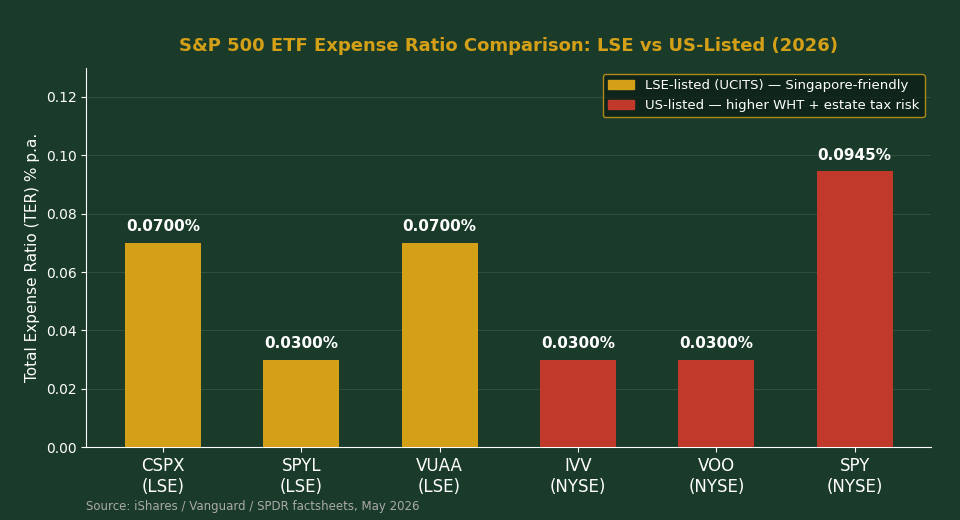
CSPX is the most established of the three, launched in 2010 and managed by BlackRock’s iShares. It has the largest AUM among LSE-listed S&P 500 ETFs at around USD 80 billion (as at Q1 2026), which means extremely tight bid-ask spreads and deep liquidity. It is an accumulating ETF, meaning dividends are reinvested automatically rather than paid out — this removes the administrative hassle of reinvesting distributions and is more tax-efficient for Singapore investors who have no withholding tax on their end. The TER is 0.07% per year. CSPX is priced in USD on the LSE and can be bought through Interactive Brokers (IBKR), Saxo Markets, and MooMoo Singapore, among others. See our dedicated CSPX ETF Singapore guide for a full step-by-step walkthrough.
2. SPYL — SPDR S&P 500 UCITS ETF (Acc)
SPYL is the newest entrant of the three, launched by State Street Global Advisors in late 2023 as a direct competitive response to the established CSPX and VUAA. Its headline feature is the lowest TER of any LSE-listed S&P 500 UCITS ETF at just 0.03% per year — matching the expense ratio of IVV and VOO in the US while retaining all the tax advantages of Ireland domicile. AUM has grown rapidly to over USD 8 billion (Q1 2026). SPYL is the cost-leader pick for expense-ratio-conscious investors who prioritise minimising the annual management fee above all else. For most Singapore investors building long-term wealth, the 0.04% TER difference between SPYL and CSPX translates to just SGD 20 per year on a SGD 50,000 portfolio — meaningful over decades, but not a decisive factor for smaller portfolios.
3. VUAA — Vanguard S&P 500 UCITS ETF (Acc)
VUAA is Vanguard’s Ireland-domiciled offering, launched in 2019. The TER is 0.07% — matching CSPX. AUM stands at approximately USD 52 billion (Q1 2026). Vanguard’s investor-owned structure means the fund has a long-term incentive to keep costs low, and many investors feel a brand affinity with Vanguard’s philosophy. In practical terms for Singapore investors, VUAA and CSPX are nearly identical in cost and structure — the choice often comes down to broker availability and which one has a narrower spread on any given trading day. VUAA also trades in USD on the LSE.
Side-by-Side Comparison: CSPX vs SPYL vs VUAA
| Feature | CSPX | SPYL | VUAA |
|---|---|---|---|
| Issuer | iShares (BlackRock) | SPDR (State Street) | Vanguard |
| Index | S&P 500 | S&P 500 | S&P 500 |
| TER (p.a.) | 0.07% | 0.03% | 0.07% |
| Domicile | Ireland | Ireland | Ireland |
| Structure | Accumulating | Accumulating | Accumulating |
| AUM (approx.) | USD ~80bn | USD ~8bn | USD ~52bn |
| Exchange | LSE (USD) | LSE (USD) | LSE (USD) |
| WHT on US divs | 15% | 15% | 15% |
| US Estate Tax | None | None | None |
Source: iShares, SPDR, Vanguard fund factsheets. AUM as at Q1 2026. All three ETFs track the same S&P 500 index and differ only in TER and AUM size.
The Real Cost of Withholding Tax at Different Portfolio Sizes
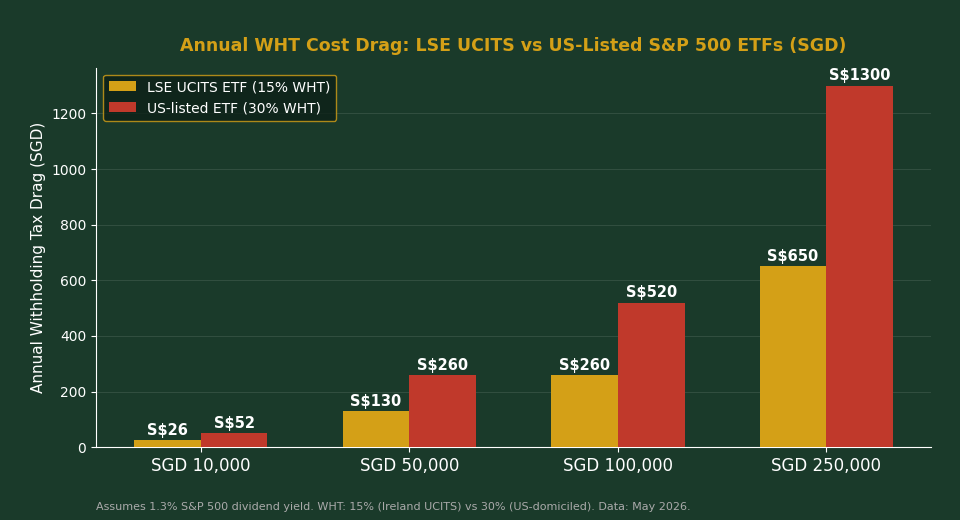
The S&P 500’s average dividend yield is approximately 1.3% per year. On a US-domiciled ETF, 30% of those dividends are withheld by the IRS before the fund receives them — an effective annual drag of 0.39% on the dividends. On an Ireland-domiciled UCITS ETF, that same dividend is withheld at only 15%, creating an effective drag of 0.195%. The difference — 0.195% per year — may look small, but it compounds significantly over time.
Here is what that difference looks like in SGD at various portfolio sizes (assuming 1.3% dividend yield and current SGD/USD exchange rate of approximately 1.34):
| Portfolio Size | LSE UCITS WHT Drag (15%, annual) |
US-listed WHT Drag (30%, annual) |
Annual Saving (LSE vs US) |
|---|---|---|---|
| SGD 10,000 | ~SGD 26 | ~SGD 52 | SGD 26 |
| SGD 50,000 | ~SGD 130 | ~SGD 260 | SGD 130 |
| SGD 100,000 | ~SGD 260 | ~SGD 520 | SGD 260 |
| SGD 250,000 | ~SGD 650 | ~SGD 1,300 | SGD 650 |
Illustrative only. Assumes 1.3% S&P 500 dividend yield. WHT applied at fund level before distributions reach the investor. Exchange rate: SGD/USD 1.34, May 2026.
On a SGD 100,000 portfolio held for 20 years, the WHT saving of SGD 260 per year — compounded at an assumed 8% annualised return — translates to roughly SGD 12,000 in additional wealth. This is why Singapore investors consistently favour LSE-listed UCITS ETFs over their US-listed counterparts, despite the slightly higher TERs in some cases.
How to Buy an S&P 500 ETF in Singapore (Step-by-Step)
All three ETFs — CSPX, SPYL, and VUAA — trade on the London Stock Exchange in USD. The process to buy them is identical regardless of which you choose.
Step 1: Choose a Broker
The most popular brokers for buying LSE-listed ETFs in Singapore are:
- Interactive Brokers (IBKR) — lowest commissions (USD 1.70 per trade minimum), best for larger portfolios. Access CSPX, SPYL, and VUAA directly on the LSE.
- Saxo Markets — clean interface, competitive spreads. Minimum SGD 2 commission per trade for LSE equities.
- MooMoo Singapore — beginner-friendly app, good for smaller starting amounts. See our moomoo Singapore review for full details on fees.
- Syfe Brokerage — simplest interface, ideal for new investors. Use our Syfe referral code to get a sign-up bonus when you open your account.
- FSMOne — CDP-linked broker, useful if you prefer holding in a CDP account. Our FSMOne referral code gives you a welcome bonus on first trade.
Step 2: Fund Your Account
Transfer SGD from your bank account. Most brokers auto-convert SGD to USD when you place an order on the LSE. IBKR allows you to hold USD directly and convert manually via their FX tool at tighter spreads — recommended if you trade regularly.
Step 3: Search for the ETF
Search by ticker: CSPX, SPYL, or VUAA. Select the London Stock Exchange (LSE) as the exchange. Confirm the ISIN if in doubt — CSPX: IE00B5BMR087, SPYL: IE0031442068, VUAA: IE00B3XXRP09.
Step 4: Place a Limit Order
Use a limit order rather than a market order when the LSE is open (9am–5:30pm London time, which is 5pm–1:30am SGT). Set your limit price within the current bid-ask spread. CSPX typically trades with a spread of USD 0.05–0.15 depending on market conditions.
CPF and SRS Compatibility
LSE-listed ETFs like CSPX, SPYL, and VUAA are not on the CPF Investment Scheme (CPFIS) approved list — you cannot use CPF OA or SA funds to buy them directly. However, they are SRS-compatible: if you transfer money into your Supplementary Retirement Scheme account and open an SRS brokerage account with a participating bank (DBS, UOB, or OCBC), you can buy LSE-listed ETFs with your SRS funds. This allows you to defer income tax on your SRS contributions while building S&P 500 exposure. For more on making the most of your retirement accounts, see our Singapore retirement calculator and our CPF investment strategy Singapore guide.
For investors who want S&P 500 exposure within their CPF, the closest option is an S&P 500 unit trust available through CPFIS — but these carry significantly higher fees (typically 1–1.5% TER) and are not as cost-efficient as CSPX or SPYL. Alternatively, the Endowus referral code gives access to Endowus’s CPF-investing platform, which offers low-cost fund options for CPF investing.
Who Should Buy an S&P 500 ETF?
CSPX, SPYL, or VUAA are ideal if you:
- Want long-term, diversified exposure to the 500 largest US companies in a single low-cost fund
- Prefer an accumulating structure (dividends reinvested automatically, no action needed)
- Want to minimise withholding tax and eliminate US estate tax risk on your portfolio
- Are investing for 10+ years and prioritise compound growth over income distributions
- Want to pair S&P 500 exposure with Singapore-focused assets like S-REITs for a balanced portfolio — see our guide to the best S-REITs in Singapore 2026 for the income-generating counterpart
Consider alternatives if you:
- Want global diversification beyond the US — look at VWRA (all-world) instead, which includes emerging markets alongside the US
- Prefer income distributions — all three ETFs are accumulating; for distributing options, VWRD or CSPX’s distributing share class may suit you better
- Need CPF compatibility — explore CPFIS-approved unit trusts or Endowus’s CPF platform
- Want Singapore REIT exposure for local passive income — see our Singapore REIT ETF guide as a complement to your S&P 500 position
Many Singapore investors hold both an S&P 500 ETF (for US growth) and a basket of quality S-REITs (for SGD income), building a balanced portfolio that captures both capital appreciation and regular distributions. Use our retirement calculator to model how an S&P 500 ETF combined with REIT distributions could accelerate your retirement timeline.
All investments carry risk, including loss of capital. Past performance of the S&P 500 is not indicative of future results. This article is for educational purposes only and does not constitute financial advice. Consult a licensed financial adviser before making investment decisions.
Frequently Asked Questions
What is the best S&P 500 ETF for Singapore investors in 2026?
For most Singapore investors, CSPX (iShares, TER 0.07%) remains the top pick due to its enormous AUM (USD ~80 billion), deep liquidity, and tight bid-ask spreads. Cost-conscious investors should consider SPYL (SPDR, TER 0.03%) — the lowest-TER S&P 500 UCITS ETF on the LSE. VUAA (Vanguard, TER 0.07%) is a solid alternative for those with a brand preference for Vanguard. All three are Ireland-domiciled, accumulating, and free from US estate tax risk.
Can I buy S&P 500 ETFs with my CPF in Singapore?
Not directly. LSE-listed ETFs like CSPX, SPYL, and VUAA are not on the CPF Investment Scheme (CPFIS) approved list. However, you can invest your SRS (Supplementary Retirement Scheme) funds in these ETFs via an SRS brokerage account at DBS, UOB, or OCBC. For CPF-eligible S&P 500 exposure, Endowus offers access to CPFIS-approved unit trusts that track the US market, though fees are higher than direct ETF purchases.
Why should Singapore investors avoid VOO and SPY?
VOO and SPY are US-domiciled ETFs, which creates two major problems for Singapore investors. First, they face a 30% US dividend withholding tax (vs 15% for Ireland-domiciled UCITS ETFs). Second, they are US-situs assets — Singapore residents holding more than USD 60,000 in these ETFs face potential US estate tax of up to 40% on the excess. Ireland-domiciled alternatives like CSPX and SPYL eliminate both risks while tracking the identical S&P 500 index.
What is the difference between CSPX, SPYL, and VUAA?
All three track the S&P 500, are Ireland-domiciled, accumulating, and listed on the LSE in USD. The main differences: SPYL has the lowest TER at 0.03% vs 0.07% for CSPX and VUAA. CSPX has the largest AUM (~USD 80bn) and deepest liquidity. VUAA is Vanguard’s offering and appeals to investors who prefer Vanguard’s fund philosophy. For most Singapore investors, the practical difference in returns is negligible — choose based on TER preference and broker availability.
Is CSPX or VWRA better for Singapore investors?
CSPX gives you pure S&P 500 exposure — 500 US large-cap companies only. VWRA gives you global exposure across ~3,700 companies in both developed and emerging markets (the US makes up ~65% of VWRA). If you believe the US will continue to outperform, CSPX is the more concentrated bet. If you prefer broader geographic diversification, VWRA is the better choice. Many Singapore investors hold both, or start with VWRA and add CSPX for additional US overweight as their portfolio grows.
How much does it cost to buy CSPX in Singapore?
CSPX itself costs around USD 530–560 per share (as at May 2026). Brokerage commissions vary: IBKR charges from USD 1.70 per trade, Saxo Markets from SGD 2 per trade, and MooMoo Singapore has competitive rates for frequent traders. There is also an FX conversion cost (SGD to USD) of typically 0.25–0.5% depending on your broker. The annual TER of 0.07% is deducted automatically from the fund’s NAV — you do not pay it separately.
Are S&P 500 ETFs a good investment for Singapore investors in 2026?
S&P 500 ETFs have historically delivered strong long-term returns — the index averaged approximately 10% per year over the past 30 years (in USD terms). For Singapore investors, the tax efficiency of UCITS ETFs (15% WHT, no US estate tax) makes them particularly attractive compared to direct US stock investing. However, they carry concentration risk (heavy US and tech weighting), currency risk (USD/SGD), and like all equity investments, can fall significantly in the short term. They are best suited to investors with a long time horizon of 10 years or more.
Ready to Buy Your First S&P 500 ETF?
Open a brokerage account and start investing in CSPX, SPYL, or VUAA today. Use our referral links for exclusive sign-up bonuses.
This article was researched with the help of AI. While we strive to keep all information accurate and up to date, there may be errors. If you notice any discrepancies, please contact us.