ETF Investing in Singapore: Best ETFs & How to Buy Them (2026 Guide)
A complete guide for Singapore investors — top ETFs by category, step-by-step broker instructions, tax advantages, and 2026 data.
ETF investing in Singapore is one of the most cost-effective ways for retail investors to build long-term wealth. The best ETFs for Singapore investors are Ireland-domiciled, London Stock Exchange-listed funds like CSPX (S&P 500) and VWRA (global equities) — they offer 15% withholding tax on US dividends versus 30% for US-domiciled ETFs, and zero US estate tax exposure. For local market exposure, the Nikko AM STI ETF and SPDR STI ETF track Singapore’s Straits Times Index at low cost.
Not financial advice. All figures are for educational reference only. Data as at May 2026 unless noted.
Table of Contents
Contents — Click to expand
- Why ETFs Are Ideal for Singapore Investors
- Best ETFs for Singapore Investors in 2026
- The LSE Tax Advantage Explained
- Full ETF Comparison Table
- How to Buy ETFs in Singapore (Step-by-Step)
- Broker Comparison for ETF Investing
- ETFs and CPF/SRS: What You Need to Know
- Getting Started: Which ETF Is Right for You?
- Frequently Asked Questions
Why ETFs Are Ideal for Singapore Investors
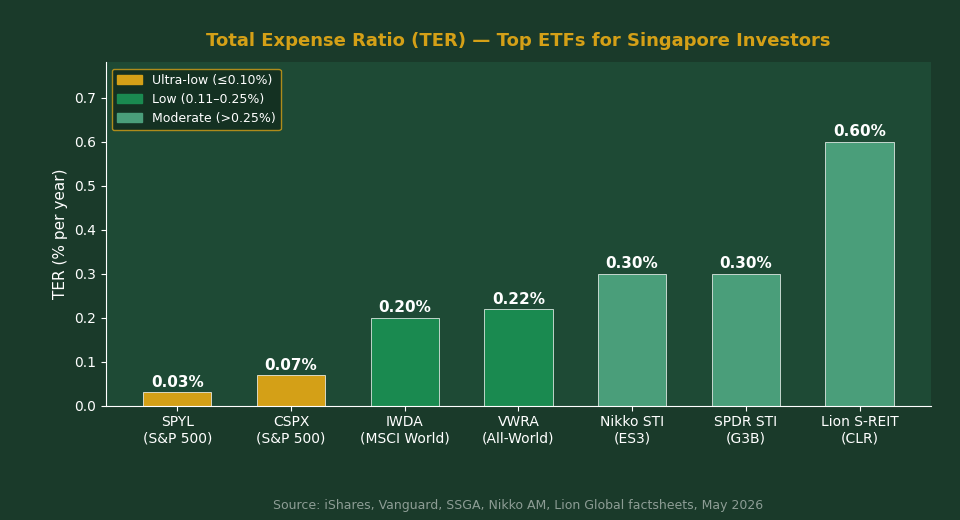
Exchange-traded funds (ETFs) have become the go-to investment vehicle for Singapore retail investors seeking broad market exposure at low cost. Unlike unit trusts sold through banks, ETFs trade on stock exchanges like shares, with total expense ratios (TERs) typically between 0.07% and 0.40% per year — a fraction of the 1–2% management fees charged by actively managed funds.
Singapore investors benefit from several structural advantages when using ETFs. First, Singapore has no capital gains tax, meaning any appreciation in your ETF holdings is tax-free upon sale. Second, Singapore has no dividend withholding tax at the investor level — though the ETF itself may incur withholding tax on dividends it receives from underlying holdings, depending on the ETF’s domicile. Third, Singapore investors have access to both SGX-listed local ETFs and internationally-listed ETFs on exchanges like the London Stock Exchange (LSE) and New York Stock Exchange (NYSE) — giving them a genuinely global investment toolkit.
For long-term passive income Singapore seekers, ETFs that reinvest dividends automatically (accumulating ETFs) are particularly powerful — they compound returns without the investor needing to take any action, and in Singapore’s tax environment, that compounding is entirely tax-free at the investor level.
Best ETFs for Singapore Investors in 2026
The best ETF for you depends on your investment objective — global diversification, S&P 500 exposure, Singapore market exposure, or dividend income. Here is a breakdown by category:
Best ETF for Global Diversification: VWRA
The Vanguard FTSE All-World UCITS ETF (ticker: VWRA on the London Stock Exchange) is the single most popular ETF among Singapore long-term investors. It tracks the FTSE All-World Index covering approximately 3,700 companies across 50+ countries, with a TER of just 0.22% per year. Being Ireland-domiciled, it benefits from the Ireland-US tax treaty — reducing US dividend withholding tax from 30% to 15%. For a Singapore investor, VWRA is the closest thing to a one-fund global portfolio.
Best ETF for S&P 500 Exposure: CSPX
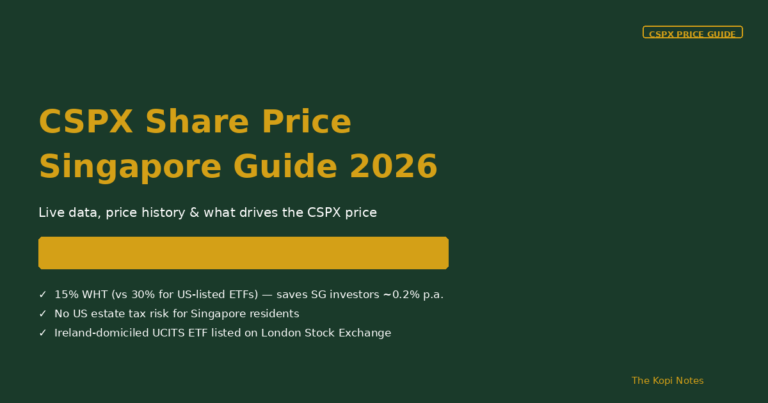
The iShares Core S&P 500 UCITS ETF (ticker: CSPX on the LSE) tracks the S&P 500 Index of 500 large-cap US companies. With a TER of 0.07% per year and AUM exceeding USD 80 billion, CSPX is one of the most liquid and cost-efficient ways to access US market growth. Like VWRA, it is Ireland-domiciled and accumulating — meaning dividends are automatically reinvested within the fund, with no action required from the investor. Use our Singapore retirement calculator to model how CSPX can grow your portfolio over 20–30 years.
Best ETF for Singapore Market Exposure: Nikko AM STI ETF / SPDR STI ETF
For exposure to Singapore’s 30 largest listed companies, the Nikko AM Singapore STI ETF (ES3) and SPDR STI ETF (G3B) both track the Straits Times Index (STI). Both are listed on the SGX, priced in SGD, and offer dividend distributions. The Nikko AM STI ETF has a TER of 0.30% and has paid consistent quarterly dividends with a trailing yield around 3.5–4.0% as at Q1 2026. These ETFs are also eligible for CPF Investment Scheme (CPFIS) investment — a key advantage over LSE-listed ETFs.
Best Broad-Market Alternative: IWDA
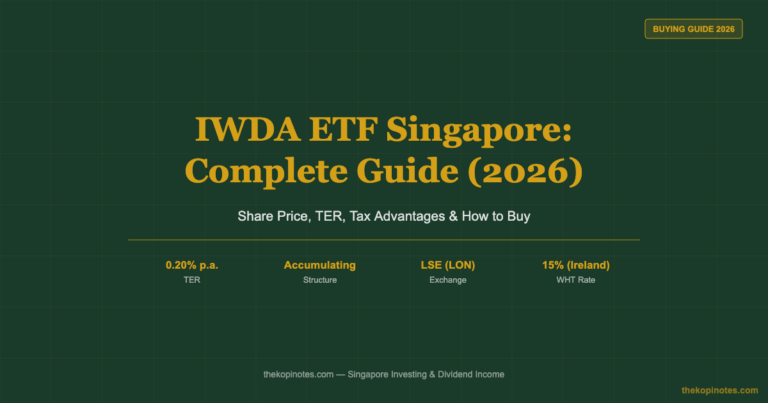
The iShares Core MSCI World UCITS ETF (ticker: IWDA) covers developed market equities across 23 countries with approximately 1,550 holdings and a TER of 0.20%. It excludes emerging markets, making it more concentrated in US and European large-caps than VWRA. For investors who want global developed-market exposure without emerging-market volatility, IWDA is a strong alternative. Read our full IWDA ETF Singapore guide for a deep dive.
The LSE Tax Advantage Explained
One of the most important decisions for Singapore ETF investors is choosing between US-listed ETFs (like VOO or VTI on NYSE) and Irish-domiciled ETFs listed on the London Stock Exchange (like CSPX or VWRA). The difference is significant and directly impacts your net return.
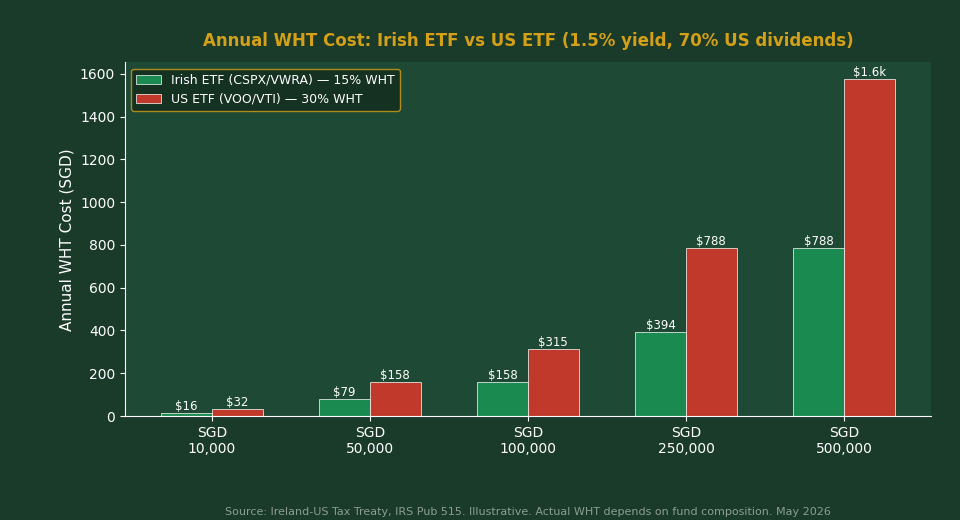
US-domiciled ETFs distribute dividends to foreign investors with a 30% withholding tax deducted at source. Irish-domiciled ETFs benefit from the Ireland-US tax treaty, which reduces the withholding tax on US-sourced dividends to 15%. For a Singapore investor with a SGD 100,000 portfolio in a fund yielding 1.5%, that tax saving is approximately SGD 788 per year — and it compounds over decades.
The second risk is US estate tax. Non-US persons who hold more than USD 60,000 in US-situs assets (which includes US-listed ETFs) may face US estate tax of up to 40% on the excess. Irish-domiciled ETFs like CSPX and VWRA are not US-situs assets, so Singapore investors face no US estate tax exposure regardless of portfolio size. For high-net-worth investors, this protection alone justifies the slightly higher TER of Irish ETFs over US equivalents.
| Factor | Irish-Domiciled ETF (LSE) | US-Domiciled ETF (NYSE) |
|---|---|---|
| US Dividend WHT | 15% | 30% |
| US Estate Tax Risk | None | Yes (above USD 60k) |
| CPF-Investable | No | No |
| Net Return (SG Investor) | Higher net return | Lower net return |
| Example ETFs | CSPX, VWRA, IWDA | VOO, VTI, QQQ |
Source: IRS Publication 515 (estate tax), Ireland-US Tax Treaty; data as at May 2026.
Full ETF Comparison Table
The table below compares the most popular ETFs for Singapore investors across key metrics. All data sourced from fund factsheets and SGX listings as at Q1–Q2 2026.
| ETF | Ticker | Exchange | Index | TER | Structure | AUM (approx) |
|---|---|---|---|---|---|---|
| iShares Core S&P 500 | CSPX | LSE | S&P 500 | 0.07% | Accumulating | USD 80B+ |
| Vanguard FTSE All-World | VWRA | LSE | FTSE All-World | 0.22% | Accumulating | USD 25B+ |
| iShares Core MSCI World | IWDA | LSE | MSCI World | 0.20% | Accumulating | USD 80B+ |
| SPDR S&P 500 UCITS | SPYL | LSE | S&P 500 | 0.03% | Accumulating | USD 10B+ |
| Nikko AM STI ETF | ES3 | SGX | Straits Times Index | 0.30% | Distributing | SGD 0.7B |
| SPDR STI ETF | G3B | SGX | Straits Times Index | 0.30% | Distributing | SGD 0.5B |
| Lion-Phillip S-REIT ETF | CLR | SGX | iEdge S-REIT Leaders | 0.60% | Distributing | SGD 0.5B+ |
Source: iShares, Vanguard, SSGA, Nikko AM, Lion Global fund factsheets and SGX listings, May 2026.
How to Buy ETFs in Singapore (Step-by-Step)
The process for buying ETFs in Singapore differs slightly depending on whether you are purchasing a SGX-listed ETF or an internationally-listed ETF on the London Stock Exchange. Here is a step-by-step guide for both.
Buying LSE-Listed ETFs (CSPX, VWRA, IWDA)
- Open a brokerage account with a broker that has LSE access — Interactive Brokers (IBKR), Saxo Markets, MooMoo Singapore, or Syfe Brokerage are the main options for Singapore investors.
- Fund your account in SGD (some brokers auto-convert; IBKR requires you to convert SGD to USD or GBP manually via Forex). IBKR has the most competitive FX conversion rates.
- Search for the ticker — for CSPX, search “CSPX” and select the LSE listing (denominated in USD). For VWRA, search “VWRA” on LSE. For IWDA, search “IWDA” on LSE.
- Place a limit order during LSE trading hours (3:00 PM – 11:30 PM SGT, Monday to Friday). Using a limit order rather than a market order avoids unexpected fill prices during low-liquidity windows.
- Monitor your portfolio via the broker app. Accumulating ETFs like CSPX and VWRA will show price appreciation over time — dividends are not paid out, they are reinvested within the fund automatically.
Buying SGX-Listed ETFs (ES3, G3B, CLR)
- Open a CDP account (Central Depository, via SGX) and a trading account with any SGX broker — DBS Vickers, OCBC Securities, Phillip Securities (POEMS), or MooMoo Singapore.
- Fund in SGD — all SGX ETFs are denominated in Singapore dollars, so no FX conversion is needed.
- Search by ticker — ES3 (Nikko AM STI ETF), G3B (SPDR STI ETF), CLR (Lion-Phillip S-REIT ETF). SGX trading hours are 9:00 AM – 5:30 PM SGT.
- Place your order in board lots of 100 units. At approximately SGD 3.30 per unit for ES3, the minimum purchase is around SGD 330 per lot.
- Dividends are credited to your designated bank account automatically, typically quarterly.
For investors building a CPF investment strategy Singapore, note that STI ETFs (ES3, G3B) are CPFIS-approved and can be purchased using your CPF Ordinary Account monies through selected CPFIS brokers.
Broker Comparison for ETF Investing
Choosing the right broker for ETF investing in Singapore affects both your ongoing costs and the universe of ETFs you can access. The comparison below focuses on LSE-listed ETF investing, which is where most long-term investors build their core portfolio.
| Broker | LSE Access | Commission (LSE) | Platform Fee | Best For |
|---|---|---|---|---|
| IBKR (Interactive Brokers) | Full | USD 3 min/trade | None | Active / large portfolios |
| Saxo Markets | Full | GBP 3 min/trade | 0.12% p.a. | Research & ease of use |
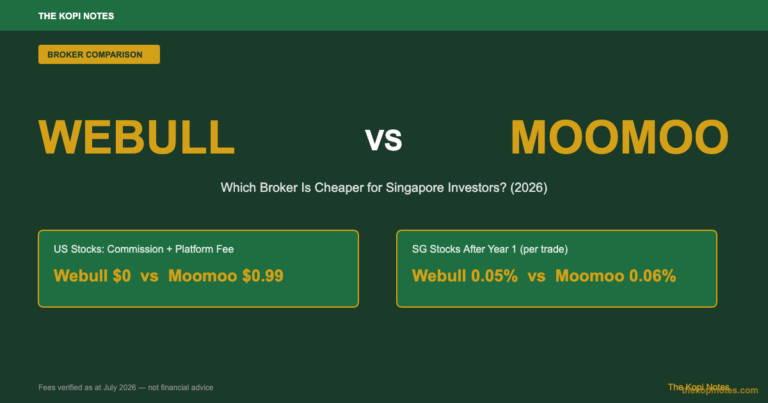
| MooMoo Singapore | Full | From USD 0.99/trade | None | Low-cost, beginners |
| Syfe Brokerage | LSE/NYSE | SGD 1.99 flat | None | Simple, app-based |
| FSMOne | LSE | 0.08% min SGD 10 | None | Fund & ETF combo |
Source: Broker fee schedules, May 2026. Fees subject to change — verify on broker websites before trading.
For most Singapore investors building a long-term ETF portfolio with regular monthly contributions, using a Syfe referral code offers a simple flat-fee structure with no minimum account balance. Larger investors (SGD 50,000+) will find FSMOne referral code competitively priced with a strong fund platform for building diversified portfolios.
ETFs and CPF/SRS: What You Need to Know
CPF and SRS are two important tax-advantaged schemes for Singapore investors, but not all ETFs are eligible under both.
CPF Investment Scheme (CPFIS): Only ETFs listed on the SGX that are CPFIS-approved can be purchased with CPF Ordinary Account (OA) monies. This includes the Nikko AM STI ETF (ES3) and SPDR STI ETF (G3B). LSE-listed ETFs like CSPX and VWRA are not CPFIS-eligible. The CPF OA interest rate of 2.5% p.a. is the benchmark — only invest your CPF OA in ETFs if you believe they can beat this rate over the long term after fees.
Supplementary Retirement Scheme (SRS): SRS funds can be used to buy any ETF accessible through an SRS-approved broker, including LSE-listed ETFs. Brokers like Saxo, FSMOne, and MooMoo accept SRS funding. Contributing to SRS reduces your taxable income dollar-for-dollar, making it an efficient way to invest in ETFs like CSPX or VWRA while saving on income tax. Use our retirement planning calculator Singapore to model the combined effect of SRS tax savings and ETF growth over your investment horizon.
For investors also considering dividend-focused assets alongside ETFs, our guide to the best S-REITs in Singapore 2026 covers the top picks that complement a core ETF portfolio with higher yield income.
Getting Started: Which ETF Is Right for You?
The right ETF depends on your investment goal, time horizon, and whether you prefer simplicity or granular control:
- I want one fund that does everything: VWRA. It covers global equities in a single accumulating UCITS ETF with broad diversification across 3,700+ holdings.
- I want maximum US market exposure: CSPX or SPYL. Both track the S&P 500 — SPYL has a lower TER (0.03% vs 0.07%) but significantly lower AUM and liquidity than CSPX.
- I want Singapore dividend income: Nikko AM STI ETF (ES3) or SPDR STI ETF (G3B), or the Lion-Phillip S-REIT ETF (CLR) for REIT-focused dividends. Read our Singapore REIT ETF guide for more on CLR and its peers.
- I want to use my CPF: ES3 or G3B — the only ETFs eligible for the CPF Investment Scheme among the options above.
- I want to minimise complexity: Open a Syfe account and buy CSPX monthly at SGD 1.99 flat commission. Set up automatic contributions and let it compound.
Whatever ETF you choose, the most important factor is consistency. Regular monthly investing (dollar-cost averaging) into a low-cost, diversified ETF is the simplest and most evidence-based wealth-building strategy available to Singapore retail investors in 2026. Consider pairing ETF investments with Singapore T-bills 2026 or Singapore Savings Bonds for the cash/fixed-income portion of your portfolio.
All investment decisions carry risk. ETF values can fall as well as rise. Past performance is not indicative of future results. This article is for educational purposes only and does not constitute financial advice.
Frequently Asked Questions
What is the best ETF to buy in Singapore in 2026?
For most Singapore investors seeking long-term wealth accumulation, VWRA (Vanguard FTSE All-World UCITS ETF, listed on the London Stock Exchange) is the most versatile choice — it provides diversified global exposure across 3,700+ companies in a single accumulating ETF with a TER of 0.22%. For pure S&P 500 exposure, CSPX (iShares Core S&P 500 UCITS ETF, TER 0.07%) is the most popular option. For Singapore dividend income, the Nikko AM STI ETF (ES3) offers SGX exposure with quarterly dividends and CPFIS eligibility.
How do I buy ETFs in Singapore as a beginner?
To buy ETFs in Singapore, you need a brokerage account. For LSE-listed ETFs like CSPX or VWRA, open an account with IBKR, Saxo, MooMoo, Syfe Brokerage, or FSMOne — all offer access to the London Stock Exchange. For SGX-listed ETFs like ES3 or G3B, open a CDP account and a trading account with any SGX broker. Fund your account in SGD, search for the ETF ticker, and place a limit order during exchange trading hours. There is no minimum investment beyond the cost of one share — CSPX trades at approximately USD 500–600 per share as at Q2 2026.
Can I buy ETFs using my CPF in Singapore?
Yes, but only CPF Investment Scheme (CPFIS)-approved ETFs can be purchased with CPF Ordinary Account monies. Approved ETFs listed on the SGX include the Nikko AM STI ETF (ES3) and SPDR STI ETF (G3B). LSE-listed ETFs like CSPX and VWRA are not CPFIS-eligible. SRS funds, on the other hand, can be used to buy a wider range of ETFs including LSE-listed ones through SRS-approved brokers like Saxo and FSMOne.
Why do Singapore investors prefer LSE-listed ETFs over US-listed ETFs?
Two main reasons: withholding tax and US estate tax. Irish-domiciled ETFs listed on the London Stock Exchange (like CSPX and VWRA) pay only 15% withholding tax on US dividends under the Ireland-US tax treaty, versus 30% for US-domiciled ETFs like VOO or VTI. Additionally, US-listed ETFs are considered US-situs assets, meaning Singapore investors holding more than USD 60,000 in US-listed ETFs face potential US estate tax of up to 40%. Irish ETFs are not US-situs assets and carry no estate tax risk for Singapore investors.
Is ETF investing safe in Singapore?
ETF investing carries market risk — the value of your ETF holdings will fluctuate with the markets they track. However, ETFs listed on major exchanges like the LSE and SGX are regulated financial products. LSE-listed UCITS ETFs are regulated under EU law and must meet strict diversification and reporting requirements. SGX-listed ETFs are regulated by MAS. The main risks are market risk, currency risk (for foreign-currency ETFs), and tracking error (minor deviation from the index). These risks apply to any market investment.
What is the minimum amount to invest in ETFs in Singapore?
For LSE-listed ETFs, the minimum is the cost of one share. CSPX trades at approximately USD 500–600, VWRA at approximately USD 100–120, and IWDA at approximately USD 80–100 per share as at Q2 2026. For SGX-listed ETFs, the minimum purchase is one board lot (100 units). At approximately SGD 3.30 per unit for the Nikko AM STI ETF (ES3), that is around SGD 330 minimum. There is no account minimum at most brokers — IBKR and MooMoo have no minimum account balance requirement for Singapore residents.
Should I invest in a Singapore ETF or a global ETF?
Most financial theory supports global diversification over concentration in a single country’s market. Singapore makes up approximately 0.3–0.4% of global equity market capitalisation, so limiting yourself to SGX-listed ETFs means 99%+ of global companies are excluded from your portfolio. A globally diversified ETF like VWRA provides broader exposure and historically stronger long-term returns than the STI. Many Singapore investors combine both: a core global ETF (CSPX or VWRA) for growth and a Singapore ETF (ES3) for local dividend income and CPF-investability.
Ready to Start Investing in ETFs?
Open a brokerage account and buy your first ETF today. Use our referral links for exclusive sign-up bonuses.
This article was researched with the help of AI. While we strive to keep all information accurate and up to date, there may be errors. If you notice any discrepancies, please contact us.