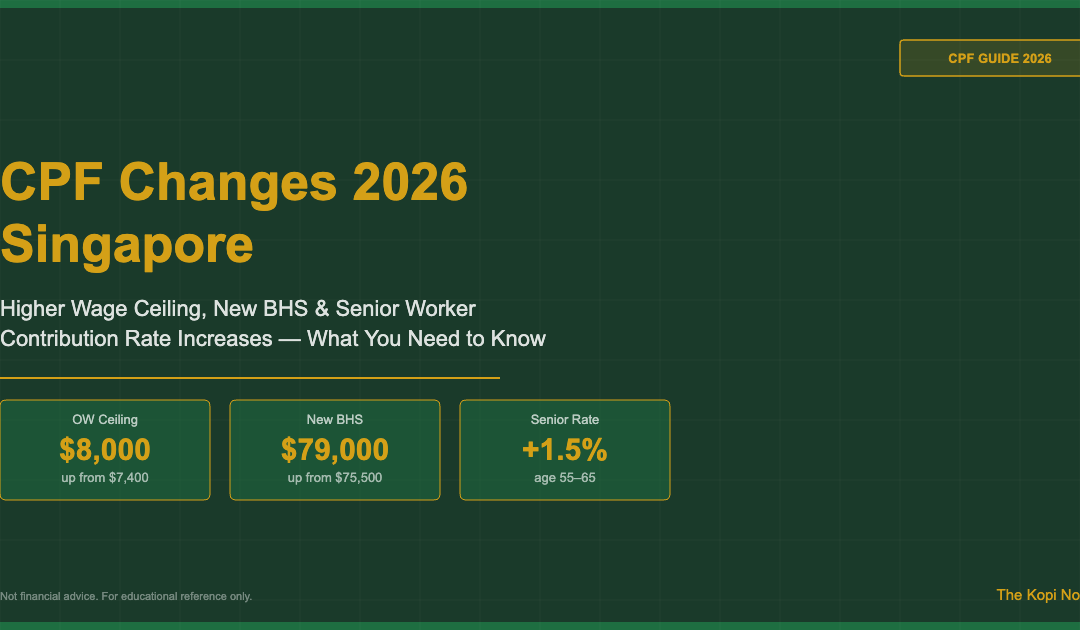
CPF Changes 2026 Singapore: Higher Wage Ceiling, New BHS & Senior Worker Rate Increases Explained
Updated May 2026 · CPF Board Confirmed · Essential Reading for All Singapore Workers
From 1 January 2026, Singapore’s CPF system introduced three major changes: the Ordinary Wage (OW) ceiling rose from $7,400 to $8,000 (the final scheduled increase), the Basic Healthcare Sum (BHS) increased from $75,500 to $79,000, and CPF contribution rates for workers aged 55–65 rose by up to 1.5 percentage points — with all extra contributions flowing into the Retirement Account first. These changes affect virtually every working Singaporean and require action if you are in the 55–65 age group.
Not financial advice. All figures are for educational reference only. Data as at May 2026 unless noted.
Table of Contents
Contents — Click to expand
Quick Summary of All 2026 CPF Changes
The CPF Board announced three significant changes effective from 1 January 2026, each targeting a different aspect of Singapore’s retirement and healthcare savings framework. Here is a snapshot of every change at a glance:
| Change | Before (2025) | After (2026) | Who Is Affected |
|---|---|---|---|
| OW Ceiling | $7,400/month | $8,000/month | All CPF members earning >$7,400/month |
| Basic Healthcare Sum (BHS) | $75,500 | $79,000 | All CPF members below age 65 |
| Contribution rate (age 55–60) | 32.5% total | 34% total | Workers aged above 55 to 60 |
| Contribution rate (age 60–65) | 23.5% total | 25% total | Workers aged above 60 to 65 |
| Annual Salary Ceiling | $102,000 | $102,000 (unchanged) | All CPF members |
Source: CPF Board (cpf.gov.sg), effective 1 January 2026
OW Ceiling Rise: $7,400 → $8,000 — The Final Scheduled Increase
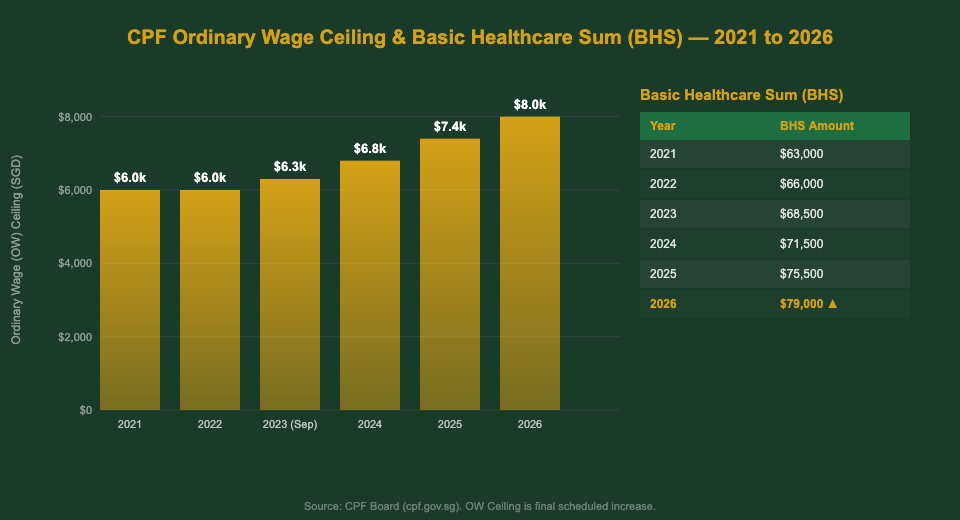
The Ordinary Wage (OW) ceiling determines the maximum monthly salary on which CPF contributions are calculated. From 1 January 2026, this ceiling rose from $7,400 to $8,000 per month — an increase of $600. Importantly, the CPF Board has confirmed this is the final planned increase in the current scheduled rollout that began in 2023.
What this means in practice: if you earn $8,000 or more per month, your CPF contributions are now calculated on the full $8,000 rather than capped at $7,400. For a worker aged 35 earning $9,000/month, the additional $600 exposed to CPF contributions translates to an extra $111 in employee CPF contributions and $153 in employer CPF contributions per month — a total of $264/month more flowing into your CPF accounts.
The OW ceiling increase is separate from the Annual Salary Ceiling of $102,000, which remains unchanged. The annual ceiling caps the total CPF contributions on all wages (ordinary and additional) received in a calendar year.
For higher earners already at or above $8,000/month, this change brings a modest increase to monthly CPF inflows. For workers between $7,400 and $8,000, the effect is proportionally larger relative to salary. If you are building your CPF investment strategy around maximising your OA balance for CPFIS or housing, this ceiling rise gives you more to work with — especially if you plan to invest via the CPFIS for dividend-generating assets.
Senior Worker Contribution Rate Increases (Age 55–65)
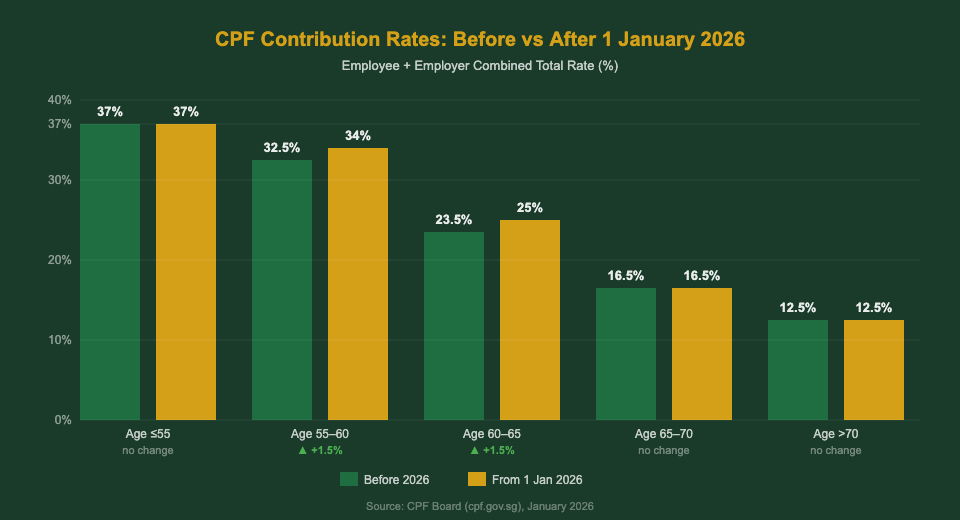
This is the most impactful 2026 CPF change for older workers. The government has been gradually raising CPF contribution rates for senior workers since 2022 to bring them closer to the 37% total rate applicable to workers aged 55 and below. From 1 January 2026, two age bands saw increases:
| Age Band | Employee Rate (Before) | Employee Rate (After) | Employer Rate (Before) | Employer Rate (After) | Total (After) |
|---|---|---|---|---|---|
| Age ≤55 | 20% | 20% (unchanged) | 17% | 17% (unchanged) | 37% |
| Age 55–60 | 17% | 18% | 15.5% | 16% | 34% ▲ |
| Age 60–65 | 11.5% | 12.5% | 12% | 12.5% | 25% ▲ |
| Age 65–70 | 7.5% | 7.5% (unchanged) | 9% | 9% (unchanged) | 16.5% |
| Age >70 | 5% | 5% (unchanged) | 7.5% | 7.5% (unchanged) | 12.5% |
Source: CPF Board, effective 1 January 2026. Age refers to age at last birthday.
To put this in dollar terms: a 58-year-old earning $6,000/month in 2026 will now have $60 more deducted from their salary each month (1% employee increase on $6,000) and their employer contributes an additional $30 (0.5% on $6,000) — totalling $90 more per month going into their CPF. Over a full year, that’s $1,080 of additional retirement savings.
The key rule governing where this extra money goes: all increased contributions for ages 55–65 are allocated to the Retirement Account (RA) first, up to the Full Retirement Sum (FRS) of $220,400 for 2026. Only once the FRS is met does the overflow channel into the Ordinary Account. This means senior workers who have not yet hit their FRS will see their RA grow faster — directly boosting their future CPF LIFE monthly payouts. Those who want to understand how CPF LIFE payouts work with a growing RA should read our CPF LIFE Singapore 2026 guide.
If you are an employer with staff in the 55–65 age band, the increased employer contribution rates take effect immediately. Payroll systems should have been updated by January 2026 — verify with your payroll vendor that the correct rates are applied to avoid underpayment penalties from the CPF Board.
New Basic Healthcare Sum (BHS) for 2026: $79,000
The Basic Healthcare Sum (BHS) is the target balance for your MediSave Account (MA). From 1 January 2026, the BHS increased from $75,500 to $79,000 — a rise of $3,500 or approximately 4.6%. The BHS is reviewed annually by the CPF Board to ensure it keeps pace with expected MediSave withdrawals during retirement.
Here is how the BHS affects you depending on your situation:
If you are below 65 and your MediSave balance is below $79,000: CPF contributions continue to flow into your MA until the new BHS is reached. Once the BHS is hit, any further contributions or interest that would push MA above the BHS are automatically redirected to your Special Account (SA) or Retirement Account (RA) instead.
If you turned 65 in 2026: your BHS is permanently fixed at $79,000. Your MediSave limit will not change in future years, giving you certainty over your healthcare savings target.
If you are already above 65: your BHS was fixed in the year you turned 65 and remains unchanged. The 2026 BHS only applies to members who are still below 65 as at 1 January 2026.
The BHS rise from $75,500 to $79,000 means members who were close to their old BHS limit will find their MA continues to receive contributions for longer before overflow kicks in. This slightly delays how quickly your SA or RA benefits from MediSave overflow — a consideration for those actively topping up CPF to maximise their RA for CPF LIFE. Use our Singapore retirement planning calculator to model how the new BHS affects your overall CPF projection.
How These Changes Impact Your Take-Home Pay
The OW ceiling rise and senior worker rate increases both reduce take-home pay slightly for affected workers — but the trade-off is higher CPF savings that earn a guaranteed 2.5% (OA) or 4% (SA/RA/MA) per annum. For most workers, this is a better risk-adjusted return than many short-term deposit products, especially now that Singapore T-bill yields have moderated from their 2023–2024 peaks. Check our Singapore T-bills 2026 guide for a comparison of current T-bill rates versus CPF interest.
Here is a worked example for three typical Singaporean workers in 2026:
| Profile | Monthly Salary | Extra CPF/month (Employee) | Take-Home Impact | Annual CPF Gain |
|---|---|---|---|---|
| Age 40, earns $9,000 | $9,000 | +$120 (OW ceiling) | –$120/month | +$1,440 |
| Age 57, earns $6,000 | $6,000 | +$60 (rate increase) | –$60/month | +$720 |
| Age 62, earns $7,000 | $7,000 | +$70 (rate increase) | –$70/month | +$840 |
Illustrative calculations based on CPF Board rates effective 1 January 2026. Assumes employee rate changes only; employer contributions are additive.
For workers in the 55–65 band, the employer also contributes more — meaning the total annual CPF gain (employee + employer) is roughly 2–3x the employee’s own contribution increase. This amplifies the retirement savings benefit significantly beyond the take-home pay reduction.
Retirement Account Allocation: Where Do the Extra Contributions Go?
One of the most important — and frequently misunderstood — aspects of the 2026 senior worker contribution rate increases is where the extra money actually lands. The CPF Board has specified a clear allocation rule: the additional contributions from the rate increases go directly to the Retirement Account (RA), up to the Full Retirement Sum (FRS).
The FRS for 2026 is $220,400. If your RA balance is below this amount, all extra contributions from the rate increase flow into your RA first. This directly increases the principal amount used to calculate your CPF LIFE monthly payout — which is determined at the time you start your payout (typically age 65). More RA principal means higher monthly income for life.
Once your RA hits the FRS ($220,400), any further contributions overflow into your Ordinary Account. At that point the extra contributions earn 2.5% p.a. OA interest instead of the 4% RA rate — still a solid guaranteed return, and the OA balance can be used for housing or CPFIS investments.
For members who want to build passive income in Singapore through CPF LIFE, the RA allocation rule means the 2026 rate increases are particularly beneficial for workers in their late 50s who still have 5–10 years of contributions before drawing down. The compounding effect of a higher RA balance over that period is substantial.
Note: the regular CPF allocation ratios (how contributions are split between OA, SA and MA) remain unchanged for 2026. Only the total contribution rates changed for the senior worker age bands. You can find the updated CPF allocation rates on the CPF Board website.
What You Should Do Now: A Practical Checklist
Whether you are an employee, employer, or self-employed individual, the 2026 CPF changes warrant a few practical steps. Here is what to do based on your situation:
If you are an employee aged below 55 earning above $7,400/month: your CPF contributions are now slightly higher due to the OW ceiling rise. Check your January 2026 payslip to confirm the new amounts. Consider whether your additional CPF inflows should be invested via the CPFIS — platforms like Endowus allow you to invest your OA and SA balances in low-cost funds. If you are building toward a passive income strategy, more OA capital creates more options.
If you are an employee aged 55–65: confirm your employer is using the correct 2026 rates. Check your payslip for the updated deduction amounts. If your RA is below the FRS of $220,400, all extra contributions are strengthening your CPF LIFE payout — no action needed unless you want to accelerate this further with a voluntary cash top-up to your RA. Cash top-ups to the SA or RA also qualify for tax relief of up to $8,000 per year.
If you are an employer: ensure your payroll system was updated before January 2026 payroll runs. The CPF Board does not offer a grace period for contribution rate errors. If you use a payroll software provider, confirm they have patched the senior worker rate tables. Employers who under-contribute face penalties and interest charges.
If you want to maximise your retirement savings beyond CPF: CPF alone is unlikely to fund a comfortable retirement for most Singaporeans. Consider diversifying into Singapore’s best-yielding S-REITs for an additional dividend income stream, or look at a Syfe income portfolio for a managed dividend approach. Our Singapore REIT ETF guide covers how to combine CPF with listed investments for a layered retirement income plan.
Frequently Asked Questions: CPF Changes 2026
What is the new CPF Ordinary Wage ceiling for 2026?
The CPF Ordinary Wage (OW) ceiling increased to $8,000 per month from 1 January 2026, up from $7,400 in 2025. This is the maximum monthly salary on which CPF contributions are computed. Wages above $8,000/month are not subject to CPF contributions on the excess. This is the final scheduled increase in the current rollout that began in 2023.
How much did CPF contribution rates increase for workers aged 55–65?
From 1 January 2026, workers aged above 55 to 60 saw their total CPF contribution rate rise from 32.5% to 34% (employee: 17% → 18%; employer: 15.5% → 16%). Workers aged above 60 to 65 saw total rates rise from 23.5% to 25% (employee: 11.5% → 12.5%; employer: 12% → 12.5%). Workers aged 65 and above, and those 55 and below, were unaffected by this change.
What is the CPF Basic Healthcare Sum (BHS) for 2026?
The BHS for 2026 is $79,000, up from $75,500 in 2025 — an increase of $3,500. Members below 65 years old will have their MediSave contributions capped at this new BHS. Members who turn 65 in 2026 will have their BHS permanently fixed at $79,000. Those already above 65 retain their BHS from the year they turned 65.
Does the 2026 CPF Annual Salary Ceiling change?
No. The Annual Salary Ceiling remains at $102,000 for 2026. This ceiling caps the total CPF contributions on all wages received in a calendar year, including both Ordinary Wages and Additional Wages (e.g. bonuses). The $102,000 annual cap is unchanged despite the rise in the monthly OW ceiling.
Where do the extra CPF contributions from the senior worker rate increase go?
The additional contributions arising from the 2026 rate increases for workers aged 55–65 are allocated entirely to the Retirement Account (RA), up to the Full Retirement Sum (FRS) of $220,400 for 2026. Once the RA reaches the FRS, any further contributions flow into the Ordinary Account instead. This rule maximises the benefit for members who have not yet reached the FRS.
How do the 2026 CPF changes affect my CPF LIFE payout?
Higher RA contributions mean a larger RA balance at the time you start CPF LIFE payouts. CPF LIFE monthly payouts are calculated based on your RA principal at the point of joining — so every dollar added to your RA before age 65 directly increases your lifelong monthly income. For a worker aged 57 earning $6,000/month, the 2026 rate increase adds approximately $720/year to their RA — compounding at 4% p.a. until they draw down, this can meaningfully increase their CPF LIFE payout.
Do Singapore Savings Bonds and T-bills still make sense alongside CPF in 2026?
Yes, but the calculus has shifted. CPF OA earns 2.5% p.a. and SA/RA earn 4% p.a. — both guaranteed. Singapore Savings Bonds currently offer yields that fluctuate month to month, while T-bills have moderated from their 2023 peaks. For most Singaporeans, CPF remains the most efficient risk-free vehicle for retirement savings, while SSBs and T-bills complement it for shorter-term liquid holdings. Diversifying into S-REITs or ETFs through non-CPF brokerage accounts can further boost your passive income over the long run.
This article was researched with the help of AI. While we strive to keep all information accurate and up to date, there may be errors. If you notice any discrepancies, please contact us.