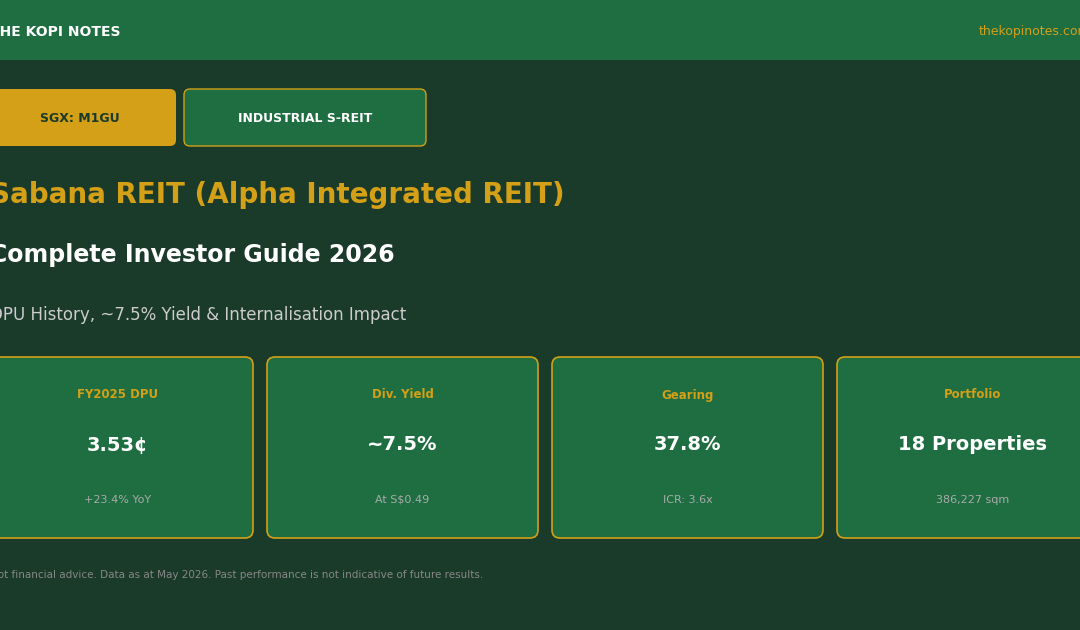
Sabana REIT (Alpha Integrated REIT) Investor Guide 2026: DPU History, ~7.5% Yield & Internalisation Impact
Sabana Industrial REIT — now rebranded as Alpha Integrated REIT (SGX: M1GU) — is Singapore’s only Shari’ah-compliant industrial S-REIT and one of the highest-yielding industrial REITs on the SGX. This guide covers the full FY2025 results, DPU history from FY2019 to FY2025, the internalisation story, portfolio breakdown, and a peer yield comparison to help you decide if AI-REIT deserves a place in your dividend portfolio.
Not financial advice. Data as at May 2026. Past performance is not indicative of future results.
Before we dive into the numbers, here’s a quick snapshot of where Alpha Integrated REIT (formerly Sabana REIT) stands as at May 2026:
| Metric | Value |
|---|---|
| SGX Ticker | M1GU (formerly ALPA) |
| Current Name | Alpha Integrated REIT (AI-REIT) |
| Share Price (May 2026) | ~S$0.49 |
| FY2025 DPU | 3.53 cents (+23.4% YoY) |
| Dividend Yield | ~7.5% (at S$0.49) |
| Distribution Frequency | Semi-annual (Feb & Aug) |
| Gearing Ratio | 37.8% |
| Interest Coverage Ratio | 3.6x |
| Portfolio Properties | 18 properties, ~386,227 sqm GFA |
| Portfolio Occupancy | ~87.0% (3Q 2025) |
| Shari’ah Compliant | Yes — Singapore’s only Shari’ah industrial REIT |
Table of Contents
Contents — Click to expand
- What Is Sabana REIT / Alpha Integrated REIT?
- The Internalisation Story: Why It Matters
- DPU History: FY2019 to FY2025
- FY2025 Full Year Results Breakdown
- Portfolio: 18 Properties Across 4 Industrial Sectors
- Financial Health: Gearing, ICR & Financing Costs
- Peer Comparison: Industrial REIT Yield Table (2026)
- Investment Thesis: Bull & Bear Case
- How to Invest in Alpha Integrated REIT
- Frequently Asked Questions
What Is Sabana REIT / Alpha Integrated REIT?
Sabana Industrial Real Estate Investment Trust was listed on the SGX in November 2010 as Singapore’s first Shari’ah-compliant industrial REIT. In October 2025, following the completion of its management internalisation, the trust was renamed Alpha Integrated REIT (AI-REIT), with the ticker remaining SGX: M1GU.
AI-REIT invests primarily in Singapore industrial real estate across four sub-sectors: high-tech industrial, warehouse and logistics, chemical warehouse and logistics, and general industrial. As at December 2025, the portfolio spans 18 properties with a total gross floor area (GFA) of approximately 386,227 square metres, making it a mid-cap industrial S-REIT with total assets exceeding S$1.6 billion.
The REIT remains Singapore’s only Shari’ah-compliant industrial REIT — a distinction that attracts a specific subset of investors while not precluding conventional investors from participating.
The Internalisation Story: Why It Matters
The single most important catalyst for Alpha Integrated REIT in recent years is the internalisation of its management. Previously, the REIT was externally managed — meaning it paid management fees to a third-party manager, which represented a direct drag on distributable income.
Unitholders approved the internalisation at an extraordinary general meeting in August 2023. The process was completed in October 2025, when Alpha Integrated REIT Management Pte. Ltd. took over as the new internalised manager. The incoming CEO had previously served as Deputy CEO of ESR-REIT, bringing deep industrial REIT operational expertise.
Why does this matter for DPU? Because an internalised manager eliminates the base fee and performance fee paid to the external manager — savings that flow directly into distributions to unitholders. This is the primary driver of the 23.4% DPU jump from 2.86 cents in FY2024 to 3.53 cents in FY2025. For Singapore income investors, internalisation is generally a strong structural positive, as it aligns management incentives directly with unitholder returns.
DPU History: FY2019 to FY2025
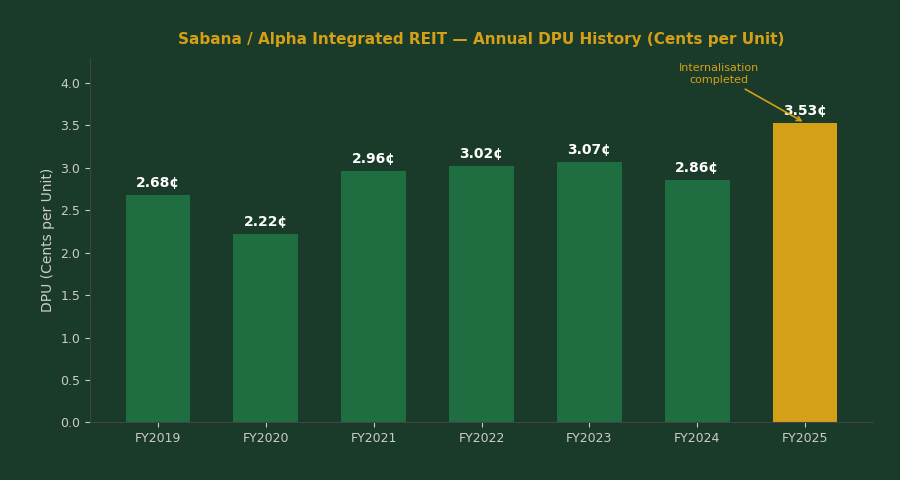
Alpha Integrated REIT pays distributions semi-annually — typically in February (for the 2H period) and August (for the 1H period). The table below shows the full annual DPU record from FY2019 to FY2025:
| Financial Year | 1H DPU (¢) | 2H DPU (¢) | Full Year DPU (¢) | YoY Change |
|---|---|---|---|---|
| FY2019 | 1.37 | 1.31 | 2.68 | — |
| FY2020 | 1.18 | 1.04 | 2.22 | −17.2% |
| FY2021 | 1.44 | 1.52 | 2.96 | +33.3% |
| FY2022 | 1.57 | 1.45 | 3.02 | +2.0% |
| FY2023 | 1.46 | 1.61 | 3.07 | +1.7% |
| FY2024 | 1.34 | 1.52 | 2.86 | −6.8% |
| FY2025 | 1.70 | 1.83 | 3.53 | +23.4% |
The FY2020 dip reflects COVID-19 disruptions to Singapore’s industrial sector and lower occupancy. FY2024 saw a temporary decline partly due to internalisation transition costs. The FY2025 rebound to 3.53 cents is the highest DPU in the REIT’s history, driven primarily by management cost savings from the completed internalisation and positive rental reversions across the portfolio. Use our Dividend Portfolio Yield Calculator to model how these distributions fit into your income portfolio.
FY2025 Full Year Results Breakdown
Alpha Integrated REIT delivered its strongest set of full-year results to date in FY2025. Here are the headline numbers:
| Metric | FY2025 | FY2024 | YoY Change |
|---|---|---|---|
| Full Year DPU | 3.53¢ | 2.86¢ | +23.4% |
| 2H DPU | 1.83¢ | 1.52¢ | +20.4% |
| 1H Gross Revenue | S$59.3m | S$55.1m | +7.6% |
| 1H NPI | S$33.5m | S$27.2m | +23.4% |
| All-in Financing Cost | 4.36% | 4.42% | −6 bps |
| Interest Coverage Ratio | 3.6x | ~3.0x | Improved |
The NPI margin improvement — from roughly 49% to over 56% in 1H — reflects the direct impact of eliminating external management fees. As financing costs edge lower, the ICR improvement to 3.6x provides further headroom. On the portfolio side, occupancy improved from 85.0% at end-2024 to 87.0% by 3Q 2025, with the high-tech park occupancy reaching a 12-year high of 94.7% in 3Q 2025.
Portfolio: 18 Properties Across 4 Industrial Sectors
As at December 2025, Alpha Integrated REIT holds 18 Singapore industrial properties with a total GFA of approximately 386,227 square metres (~4.2 million square feet). The portfolio is spread across four sub-sectors:
| Sub-Sector | Description |
|---|---|
| High-Tech Industrial | Modern flatted factories and tech parks for light manufacturing, R&D, and biomedical tenants. These command higher rents and attract stickier tenants — occupancy hit a 12-year high of 94.7% in 3Q 2025. |
| Warehouse & Logistics | Ramp-up warehouses and logistics facilities benefiting from e-commerce and supply chain activity in Singapore. |
| Chemical Warehouse & Logistics | Specialised facilities for chemical storage — a niche segment with higher barriers to entry and typically longer leases. |
| General Industrial | Conventional industrial space for manufacturing and assembly activities, largely concentrated in established industrial estates. |
92.2% of gross rental income in 1H 2025 came from multi-tenanted properties, which diversifies tenant concentration risk. The portfolio’s weighted average lease expiry (WALE) and the positive rental reversions seen in 2025 suggest management is successfully re-leasing maturing leases at higher market rents — a tailwind that should support further DPU growth in 2026.
For a broader look at how AI-REIT fits into the Singapore industrial REIT landscape, see our Best S-REITs 2026 guide and our S-REIT Outlook 2026 analysis.
Financial Health: Gearing, ICR & Financing Costs
Understanding a REIT’s balance sheet is just as important as its income statement. Here’s where Alpha Integrated REIT stands on key financial health metrics as at December 2025:
| Metric | Value | Commentary |
|---|---|---|
| Aggregate Leverage (Gearing) | 37.8% | Well below the MAS 50% regulatory limit. Adequate headroom for debt-funded acquisitions. |
| Interest Coverage Ratio | 3.6x | Comfortably above MAS’s minimum 1.5x threshold. Improved from ~3.0x in FY2024. |
| All-in Financing Cost | 4.36% | Marginally down from 4.42% in FY2024. Expected to decline further as global rates ease. |
| Total Assets | >S$1.6bn | Solid asset base for a mid-cap industrial REIT with 18 properties. |
With gearing at 37.8% and ICR improving, the financial position is healthy. As interest rates normalise in 2026, further reductions in all-in financing costs could provide an additional DPU uplift. Use our S-REIT Gearing Ratio & ICR Calculator to stress-test different interest rate and leverage scenarios, or the S-REIT Yield vs SGS Bond Spread Calculator to assess current value relative to risk-free rates.
Peer Comparison: Industrial REIT Yield Table (2026)
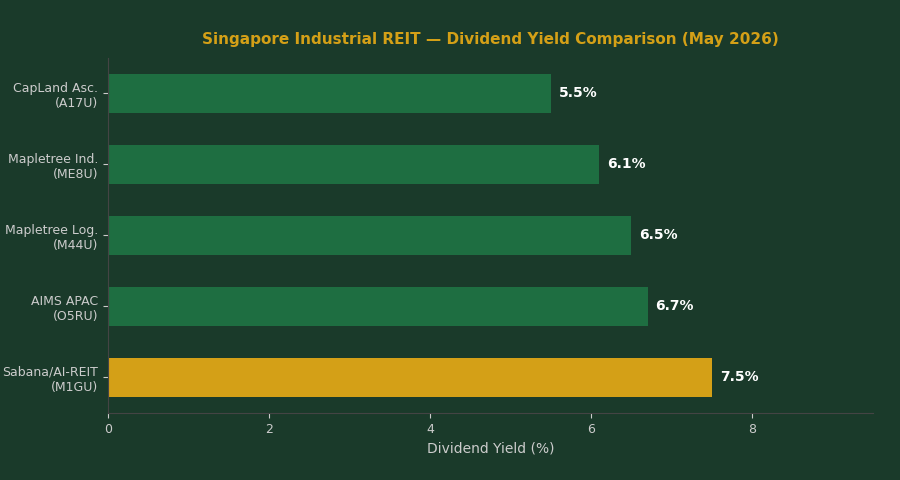
How does Alpha Integrated REIT stack up against its Singapore industrial REIT peers? The table below compares key metrics as at May 2026:
| REIT | SGX Code | Div. Yield | Gearing | Notes |
|---|---|---|---|---|
| Alpha Integrated REIT | M1GU | ~7.5% | 37.8% | Internalised; highest yield in peer group |
| AIMS APAC REIT | O5RU | ~6.7% | ~34% | Mid-cap industrial; strong logistics exposure |
| Mapletree Logistics Trust | M44U | ~6.5% | ~40% | Pan-Asia logistics; larger scale |
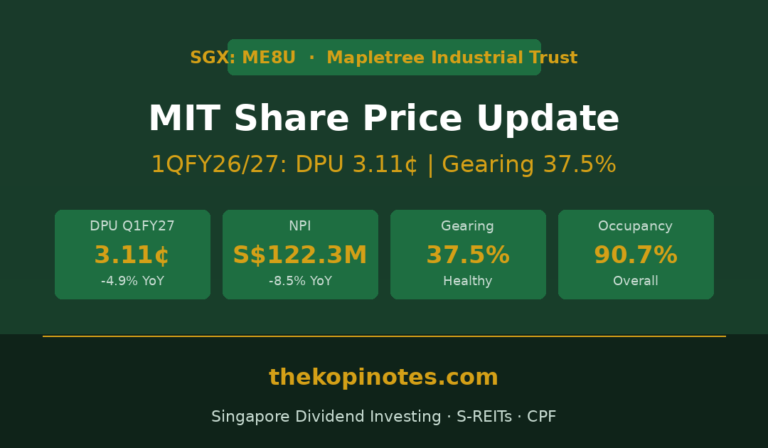
| Mapletree Industrial Trust | ME8U | ~6.1% | ~38% | Data centres + flatted factories |
| CapitaLand Ascendas REIT | A17U | ~5.5% | ~37% | Largest industrial S-REIT; blue-chip quality |
AI-REIT’s ~7.5% yield is the highest in the Singapore industrial REIT peer group. However, yield alone isn’t the whole story — investors should weigh this against its smaller scale, lower liquidity, and the execution risk of the internalised management model. For broader S-REIT comparisons, our REITs Dividend Yield Calculator lets you model scenarios across multiple S-REITs simultaneously.
Investment Thesis: Bull & Bear Case
Bull Case for AI-REIT
Internalisation dividend: The structural shift to an internalised manager eliminates the drag of external management fees. With the transition now complete, the full-year benefit is only beginning to be seen in FY2025 results — and should compound in 2026 and beyond as the new management team stabilises operations and potentially pursues accretive acquisitions.
Highest industrial REIT yield in Singapore: At ~7.5%, AI-REIT offers among the highest yields in the Singapore industrial REIT space. For income-focused investors — particularly those with a shorter investment horizon — this is a meaningful cash flow advantage.
Positive rental reversion momentum: The 12-year high in tech park occupancy (94.7% in 3Q 2025) and the overall occupancy improvement to 87% suggest positive leasing momentum. If this continues into 2026, revenue growth should support further DPU expansion.
Rate tailwind: As global interest rates trend lower, AI-REIT’s all-in financing costs (4.36% as at Dec 2025) should ease, providing an additional DPU tailwind through reduced interest expense.
Bear Case for AI-REIT
Execution risk of new management: The internalised manager is newly formed. While the CEO’s background (ex-ESR-REIT Deputy CEO) is encouraging, there is inherent execution risk when a new management team takes over a REIT. Integration of functions previously handled by the external manager takes time.
Smaller scale and lower liquidity: With total assets of ~S$1.6 billion and 18 properties, AI-REIT is significantly smaller than blue-chips like CapitaLand Ascendas REIT. Lower market cap means lower daily trading liquidity, which can impact entry/exit pricing for larger investors.
Portfolio occupancy still below peers: Overall occupancy at 87% compares less favourably to larger industrial REITs in the 92–97% range. Continued vacancies in general industrial properties could weigh on NPI if market conditions deteriorate.
Shari’ah constraints limit some financing options: As a Shari’ah-compliant REIT, financing must use Islamic finance instruments, which may limit flexibility and could be marginally more expensive than conventional financing in some market environments.
How to Invest in Alpha Integrated REIT
Alpha Integrated REIT (SGX: M1GU) is listed on the Singapore Exchange and can be bought or sold through any SGX-licensed broker. In Singapore, popular platforms include:
Note: Direct SGX stock purchases require a brokerage account (e.g., DBS Vickers, OCBC Securities, Tiger Brokers, Moomoo). CPF and SRS funds can be used to invest in S-REITs via platforms like Endowus. Always verify the current REIT eligibility under CPF Investment Scheme (CPFIS) before investing.
Frequently Asked Questions
Is Sabana REIT the same as Alpha Integrated REIT?
What is the current DPU and dividend yield of Sabana / AI-REIT?
Why did Sabana REIT's DPU jump so much in FY2025?
What is the gearing ratio of Alpha Integrated REIT?
Can CPF or SRS funds be used to invest in Sabana / AI-REIT?
Is Alpha Integrated REIT a good buy in 2026?
How does Sabana REIT compare to AIMS APAC REIT?
Disclaimer: This article is for informational purposes only and does not constitute financial advice. Data sourced from Alpha Integrated REIT investor relations, SGX announcements, and public financial databases. Always conduct your own due diligence before making investment decisions. The Kopi Notes is not a licensed financial adviser.
This article was researched with the help of AI. While we strive to keep all information accurate and up to date, there may be errors. If you notice any discrepancies, please contact us.