Singapore T-Bills 2026: How to Buy, Latest Yields & Complete Guide
Everything Singapore investors need to know about 6-month and 1-year T-bills — yields, how to apply, and how they compare to SSBs and fixed deposits.
Singapore T-bills (Treasury Bills) are short-term Singapore government securities with tenors of 6 months or 1 year, offering risk-free yields currently in the 3.0–3.5% p.a. range as at May 2026. They are issued by the Monetary Authority of Singapore (MAS) and can be purchased by any Singapore resident via ATM, internet banking, or through CPF Investment Scheme (CPFIS) using Ordinary Account funds. T-bills are one of the safest fixed-income instruments available to retail investors in Singapore.
Not financial advice. All figures are for educational reference only. Data as at May 2026 unless noted.
What Are Singapore T-Bills?
Singapore Treasury Bills (T-bills) are short-term debt securities issued by the Singapore government through MAS. Unlike Singapore Savings Bonds (SSBs), which are long-term and step up in yield over 10 years, T-bills have fixed short tenors — either 6 months (26 weeks) or 1 year (52 weeks).
When you buy a T-bill, you purchase it at a discount to its face value. At maturity, you receive the full face value. The difference between what you paid and the face value is your return — equivalent to the annualised yield.
For example, if a 6-month T-bill has a cut-off yield of 3.20% p.a., a $10,000 investment would cost approximately $9,841, and you’d receive $10,000 at maturity — a gain of ~$159 over 6 months.
T-bills are considered risk-free for practical purposes: the Singapore government has a AAA credit rating (by S&P, Moody’s, and Fitch), and there has never been a default on SGS securities.
Key Facts About Singapore T-Bills
| Feature | Details |
|---|---|
| Issuer | Singapore Government (via MAS) |
| Tenors Available | 6 months, 1 year |
| Minimum Investment | S$1,000 (in multiples of S$1,000) |
| Purchase Method | ATM (DBS/POSB, OCBC, UOB), Internet Banking, CPF Agent Banks |
| Pricing | Discount basis (buy below face value, receive face value at maturity) |
| Tax Treatment | Tax-exempt for individuals in Singapore |
| Tradeable? | Yes, on the secondary market (though most hold to maturity) |
| Credit Rating | AAA (S&P, Moody’s Aaa, Fitch AAA) |
Source: MAS Singapore Government Securities, May 2026
Latest Singapore T-Bill Yields 2026
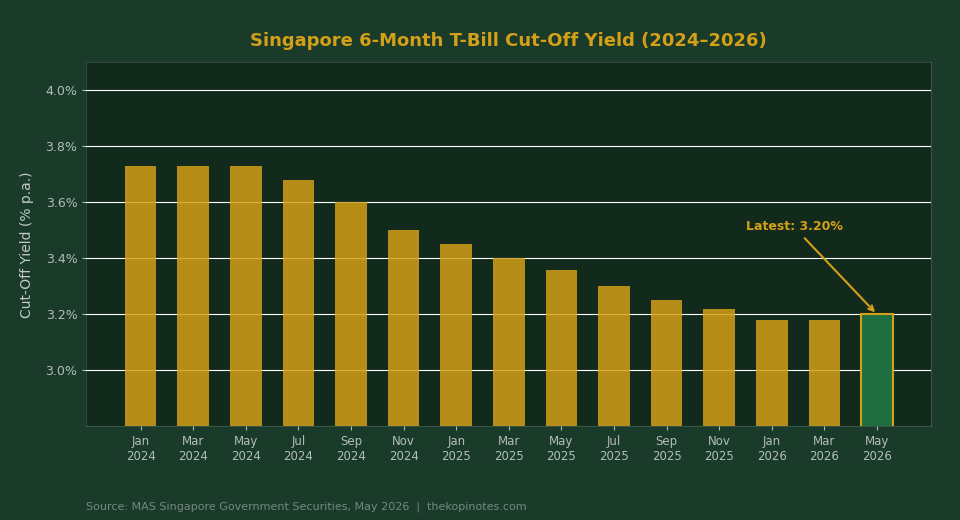
T-bill yields in Singapore have moderated from the highs of 2023 (when 6-month bills briefly touched 4.0%+) but remain competitive relative to most bank savings accounts and fixed deposits. As at May 2026, yields are holding in the 3.0–3.5% p.a. range, supported by MAS’s managed float exchange rate policy and global rate dynamics.
Below are the recent auction cut-off yields for Singapore T-bills:
| Auction Date | Tenor | Cut-Off Yield (p.a.) | Amount Issued (S$M) |
|---|---|---|---|
| Apr 2026 | 6-month | 3.20% | ~S$5,800M |
| Mar 2026 | 6-month | 3.18% | ~S$5,800M |
| Feb 2026 | 6-month | 3.15% | ~S$5,800M |
| Q1 2026 | 1-year | 3.30% | ~S$4,500M |
Source: MAS Singapore Government Securities auction results, Q1–Q2 2026. Yields are indicative; always check the latest results at MAS.gov.sg.
The 1-year T-bill typically offers a slightly higher yield than the 6-month bill, reflecting the additional holding period. However, this spread has been narrow in 2026, making the 6-month bill attractive for investors who prefer shorter lock-up periods.
Practical yield example: A Singapore investor placing S$50,000 in a 6-month T-bill at 3.20% p.a. would receive approximately S$800 in interest at maturity — equivalent to S$1,600 annualised. The same sum in a typical savings account earning 1.5% would yield only S$375 over 6 months — less than half the T-bill return.
How to Buy Singapore T-Bills (Step-by-Step)
Buying T-bills in Singapore is straightforward but requires a CDP (Central Depository) account linked to a participating bank. Here is the step-by-step process:
Step 1: Open a CDP Account
If you don’t already have one, open a CDP Securities account via SGX CDP. This is where your T-bills will be held at maturity. Approval typically takes 3–5 business days.
Step 2: Link Your Bank Account
Your CDP account must be linked to a DBS/POSB, OCBC, or UOB bank account. This is the account from which funds will be debited when you apply, and into which the maturity proceeds will be credited.
Step 3: Check the Auction Schedule
MAS auctions 6-month T-bills approximately every two weeks, and 1-year T-bills about once a month. Check the MAS issuance calendar for upcoming auction dates. Applications typically open 3–5 business days before the auction date.
Step 4: Apply via ATM or Internet Banking
You can submit a non-competitive bid (most retail investors use this) through:
- DBS/POSB ATM or iBanking — under “Invest” → “SSB/T-Bills”
- OCBC ATM or Online Banking — under “Investments” → “Singapore Government Securities”
- UOB ATM or UOB Personal Internet Banking — under “Invest/Insure” → “Government Securities”
A non-competitive bid means you accept whatever cut-off yield is set at the auction. You are guaranteed allotment as long as the total non-competitive demand does not exceed the non-competitive tranche limit (typically 40% of total issuance).
Step 5: Receive Your T-Bill
If successful, funds are debited from your bank account on the auction date, and the T-bill is credited to your CDP account. At maturity, the face value is automatically credited back to your linked bank account — no action needed.
Step 6: Check Results
Singapore T-bill auction results are published on the MAS website within hours of the auction closing. You can also check via your bank’s internet banking platform.
Using CPF (CPFIS-OA) to Buy T-Bills
One of the most powerful features of Singapore T-bills is that you can use your CPF Ordinary Account (OA) funds to purchase them via the CPF Investment Scheme (CPFIS). This is particularly attractive because CPF OA normally earns 2.5% p.a. — and T-bills have been yielding well above this floor in recent years.
How CPFIS T-Bill Purchases Work
To buy T-bills with CPF OA funds, you must first open a CPFIS agent bank account with DBS, OCBC, or UOB. Your CPFIS account holds the CPF investment funds separately from your regular bank account.
The process mirrors the cash T-bill application, but you select “CPF” as the funding source at the ATM or internet banking portal. Important constraints to note:
- Only CPF OA funds above $20,000 are investable (the first $20,000 is protected and cannot be invested)
- At maturity, proceeds return to your CPF OA — not your bank account
- Minimum $1,000 per application, same as cash T-bills
For investors with substantial CPF OA savings sitting idle at 2.5%, locking into T-bills at 3.0–3.5% provides a meaningful uplift. On a S$100,000 CPF OA balance above the $20,000 floor, the difference between 2.5% and 3.2% is approximately S$700 per year — risk-free.
For a deeper dive into making your CPF funds work harder, read our guide on CPF investment strategy and explore the Singapore CPFIS Calculator to model your potential returns.
Singapore T-Bills vs SSBs vs Fixed Deposits (2026)
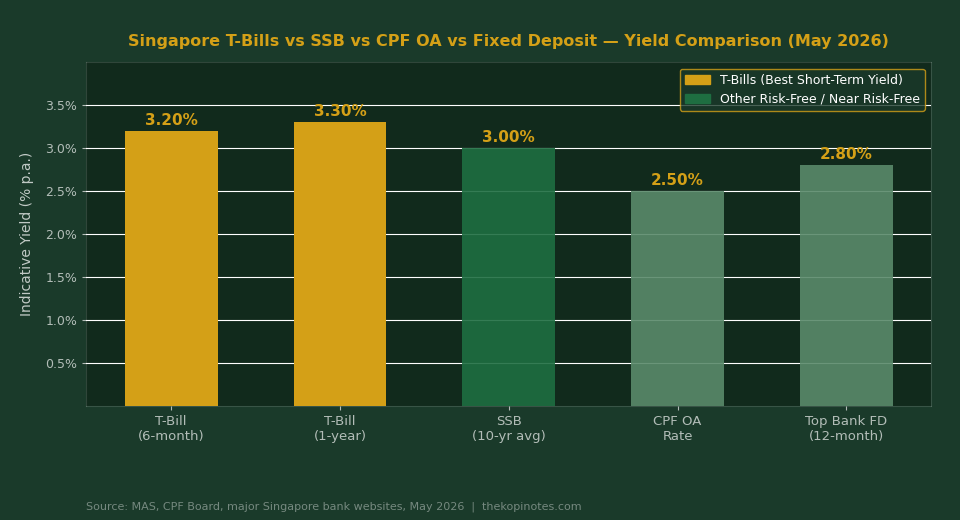
T-bills are not the only risk-free or near-risk-free option for Singapore investors. Here’s how they compare to Singapore Savings Bonds (SSBs) and bank fixed deposits (FDs):
| Feature | T-Bills | SSBs | Fixed Deposits |
|---|---|---|---|
| Issuer / Guarantor | Singapore Government | Singapore Government | Bank (SDIC up to $100k) |
| Tenor | 6 months / 1 year | Up to 10 years | 1 month to 3 years |
| Indicative Yield (May 2026) | ~3.20% p.a. (6-month) | ~3.00% avg (10-yr) | ~2.50–3.00% p.a. |
| Minimum Investment | S$1,000 | S$500 | Varies (S$500–S$10,000) |
| Maximum Investment | No limit (competitive bid) | S$200,000 per person | Varies by bank |
| Early Redemption | Secondary market (market price) | Yes, penalty-free (monthly) | Early breakage fee applies |
| CPF-investable? | Yes (CPFIS-OA) | Yes (CPFIS-OA) | Some banks, some products |
| Tax (for individuals) | Tax-exempt | Tax-exempt | Tax-exempt |
| Best For | Short-term parking, CPF OA boost | Emergency fund, flexible withdrawal | Specific term commitments |
Source: MAS, Singapore Savings Bonds, major Singapore bank websites. Data as at May 2026. SSB yield based on latest issuance 10-year average. FD rates are indicative across DBS, OCBC, UOB.
Which should you choose? For investors who need flexibility, SSBs are unbeatable — you can redeem anytime without penalty. For investors who want the highest short-term yield with a defined end date, T-bills typically win. For investors who want a bank relationship benefit (bonus interest, credit card perks), an FD with their primary bank may make sense despite lower headline rates.
You can model your T-bill and SSB returns side-by-side using our T-Bill, SSB & Fixed Deposit Comparison Calculator and our Singapore retirement calculator to see how these fixed income instruments fit your long-term plan.
Pros and Cons of Singapore T-Bills
T-bills are one of the best tools in a Singapore investor’s fixed-income toolkit, but they are not perfect for every situation. Here’s an honest assessment:
Advantages
- Risk-free returns: Backed by the Singapore government (AAA-rated) — your capital is fully protected at maturity.
- Competitive yields: At 3.0–3.5% p.a. in 2026, T-bills meaningfully outperform most savings accounts and beat the CPF OA rate of 2.5%.
- Short lock-up period: 6 months or 1 year — far shorter than most fixed income alternatives.
- No withholding tax for Singapore residents: Returns are tax-exempt for individual investors.
- CPF-investable: One of the few instruments where you can deploy idle CPF OA funds above the $20,000 floor to earn above 2.5%.
- No application fees: Free to apply via ATM or internet banking.
Disadvantages
- No liquidity before maturity (easily): Unlike SSBs, T-bills cannot be redeemed early without going through the secondary bond market, which has limited liquidity for retail investors.
- Auction risk: In high-demand auctions, the cut-off yield may be lower than expected if too many investors bid. Non-competitive bids are guaranteed allotment but not guaranteed yield.
- Yield variability: The cut-off yield changes every auction. If rates fall, reinvesting at maturity may produce a lower return than expected.
- Not suitable for emergency funds: If you may need the cash urgently, SSBs or a high-yield savings account are more appropriate.
For investors building a passive income portfolio, T-bills work best as a low-risk anchor alongside higher-yielding assets like S-REITs and dividend stocks. A typical Singapore investor seeking passive income might allocate 20–30% of their fixed-income sleeve to T-bills for stability.
Singapore T-Bill 2026 Auction Schedule
MAS auctions 6-month T-bills approximately every two weeks, and 1-year T-bills once a month. The exact 2026 schedule is published by MAS and can change — always verify at MAS.gov.sg.
General pattern for 2026:
- 6-month T-bills: Approximately every 2 weeks (alternating Tuesdays/Thursdays for announcement, Thursdays/Fridays for auction day)
- 1-year T-bills: Approximately monthly
- Application window: Opens roughly 3–5 business days before auction day
- Results: Published same day as auction, usually by late afternoon
Tip: Set a reminder for the application window opening — the most common mistake is missing the application deadline by confusing the “announcement date” with the “auction date.” Applications must be submitted before the auction, not on it.
For the latest SGS T-bill auction results and upcoming auction dates, check MAS’s T-bill information for individuals page.
You can also explore how fixed income instruments like T-bills fit into a broader retirement plan using our Singapore Savings Bonds 2026 guide and consider complementing them with REIT ETFs via the Singapore REIT ETF guide.
For investors looking to open a brokerage account to diversify beyond T-bills into equities and REITs, consider platforms like Syfe or FSMOne. Check the latest Syfe referral code and sign-up bonus or the FSMOne referral code for promotions available to new account holders.
Compare All Your Fixed Income Options
Use our free Singapore T-Bill, SSB & Fixed Deposit calculator to compare returns side-by-side at your investment amount.
Frequently Asked Questions
What is the current Singapore T-bill interest rate?
How do I buy Singapore T-bills?
What is the minimum investment for Singapore T-bills?
Can I use CPF to buy T-bills?
Can I redeem T-bills before maturity?
Are Singapore T-bill returns taxable?
What happens if my T-bill application is unsuccessful?
Are T-bills better than Singapore Savings Bonds?
Disclaimer: This article is for informational purposes only and does not constitute financial advice. Past yields do not guarantee future results. Always verify the latest T-bill auction results at MAS.gov.sg and consult a qualified financial adviser before making investment decisions.
This article was researched with the help of AI. While we strive to keep all information accurate and up to date, there may be errors. If you notice any discrepancies, please contact us.