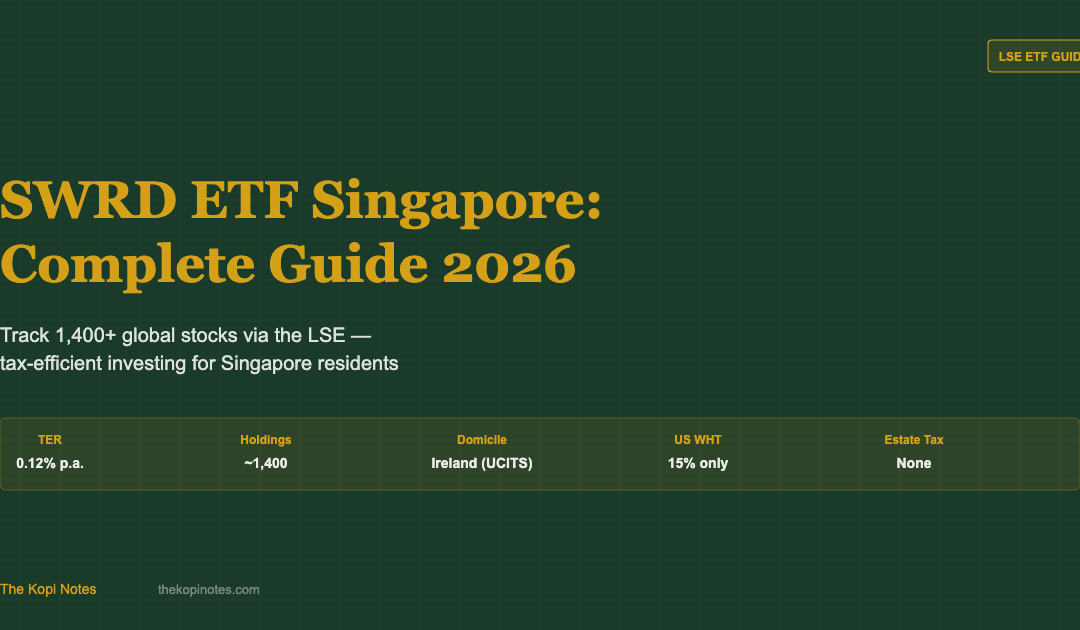
SWRD ETF Singapore: Complete Guide 2026
Your step-by-step guide to buying the SWRD ETF in Singapore — tax advantages, broker comparison, and 2026 cost data.
SWRD is an Ireland-domiciled UCITS ETF listed on the London Stock Exchange (LSE) that tracks the MSCI World Index, giving Singapore investors exposure to over 1,400 large and mid-cap companies across 23 developed markets. Managed by SPDR (State Street), it charges just 0.12% p.a. TER. Singapore investors prefer LSE-listed ETFs like SWRD over US-domiciled alternatives because they benefit from a 15% (vs 30%) US dividend withholding tax rate and face zero US estate tax exposure.
Not financial advice. All figures are for educational reference only. Data as at May 2026 unless noted.
What Is the SWRD ETF?
The SPDR MSCI World UCITS ETF (ticker: SWRD) is a passively managed exchange-traded fund issued by State Street Global Advisors. It tracks the MSCI World Index, one of the most widely followed global equity benchmarks, which covers approximately 1,400 large and mid-cap stocks across 23 developed-market countries including the United States, Japan, the United Kingdom, France, Germany, Canada, and Australia.
SWRD is domiciled in Ireland and structured as a UCITS fund — the European regulatory standard for collective investment schemes. This Irish domicile is not merely administrative; it determines the withholding tax rate applied to dividends from US companies held within the ETF, which has a significant impact on net returns for Singapore investors (explained fully in the section below).
The ETF is listed on the London Stock Exchange (LSE) and priced in USD, making it accessible through international brokerages available in Singapore. It launched in 2019 and had accumulated approximately USD 9 billion in assets under management as at Q1 2026, according to the SPDR factsheet. SWRD uses physical replication — it actually holds the underlying stocks rather than using synthetic derivatives — which adds a layer of transparency and reduces counterparty risk.
As an accumulating ETF, SWRD automatically reinvests dividends back into the fund rather than distributing them to investors. For Singapore investors, this is generally preferable: there is no dividend withholding tax event triggered in Singapore on accumulated dividends, and compounding occurs automatically without the friction of manually reinvesting distributions.
Key Facts at a Glance
| Metric | Detail |
|---|---|
| Full Name | SPDR MSCI World UCITS ETF |
| Ticker (LSE) | SWRD |
| Index Tracked | MSCI World Index |
| Domicile | Ireland (UCITS) |
| Structure | Accumulating |
| TER (Expense Ratio) | 0.12% p.a. |
| AUM | ~USD 9 billion (as at Q1 2026) |
| Number of Holdings | ~1,400 |
| Replication Method | Physical (full replication) |
| Exchange | London Stock Exchange (LSE) |
| Currency | USD |
Source: SPDR MSCI World UCITS ETF factsheet, Q1 2026
Why Singapore Investors Buy ETFs on the London Stock Exchange
The choice between a US-listed ETF (like VT or URTH) and an LSE-listed Irish-domiciled ETF like SWRD is not a minor technicality — for Singapore investors, it can mean thousands of dollars difference over a long investment horizon. There are two key tax advantages to buying SWRD on the LSE instead of a comparable US-domiciled fund.
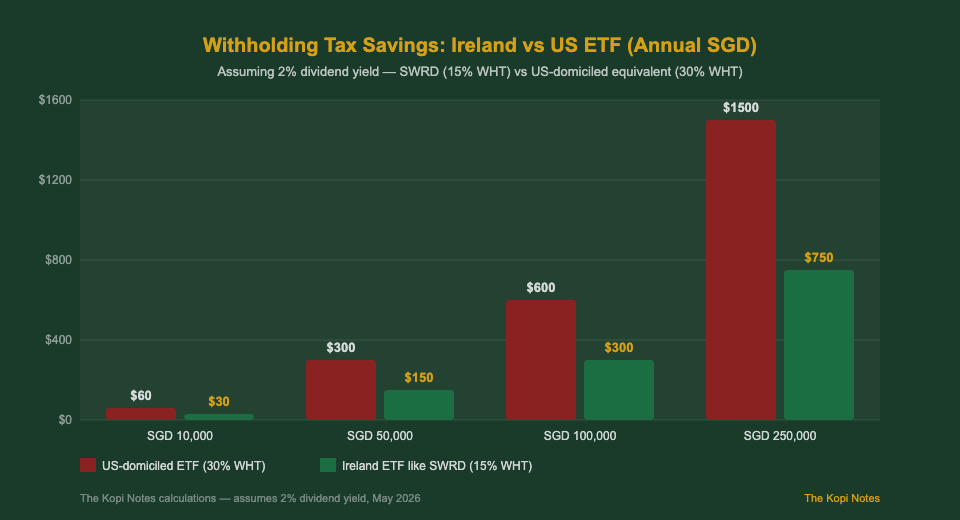
1. Lower withholding tax on US dividends. Approximately 70% of the MSCI World Index is US equities. When US companies pay dividends to a fund, withholding tax is deducted at source. For a US-domiciled ETF (like VT), this rate is 30% for non-US investors. For an Ireland-domiciled ETF like SWRD, the Ireland-US tax treaty reduces this rate to 15%. On a SGD 100,000 portfolio with a 2% dividend yield, this saves approximately SGD 300 per year — a significant drag reduction that compounds over decades.
2. No US estate tax exposure. Under US tax law, non-US persons holding US-situs assets (including US-listed ETFs) above USD 60,000 are subject to US estate tax of up to 40% upon death. Ireland-domiciled ETFs like SWRD are not US-situs assets, so this risk does not apply. This is one of the most important reasons Singapore investors consistently prefer LSE-listed UCITS ETFs over their US-listed counterparts, according to MAS financial planning guidance.
| ETF Type | Domicile | US Dividend WHT | US Estate Tax Risk |
|---|---|---|---|
| SWRD (LSE) | Ireland | 15% | None |
| VT / URTH (NYSE) | USA | 30% | Yes (above USD 60k) |
Source: IRS Publication 515, Ireland-US Tax Treaty, SPDR factsheet — May 2026
It is worth noting that Singapore itself levies no capital gains tax and no personal income tax on dividends received by residents. This means the only tax friction for a Singapore investor holding SWRD is the withholding tax applied inside the fund — and SWRD minimises this through its Irish domicile. You can use our Singapore retirement calculator to model the long-term impact of these cost differences on your retirement portfolio.
Expense Ratio and Total Costs
SWRD charges a Total Expense Ratio (TER) of 0.12% per annum, according to the SPDR MSCI World UCITS ETF factsheet. This is the all-in annual cost deducted from the fund’s NAV — it covers management fees, custody, administration, and audit costs. You do not pay this separately; it is reflected in the daily price of the ETF.
For a Singapore investor holding SGD 50,000 in SWRD, the annual TER cost is approximately SGD 60 per year (0.12% × SGD 50,000). On SGD 100,000, that rises to SGD 120 per year — highly competitive by any standard.
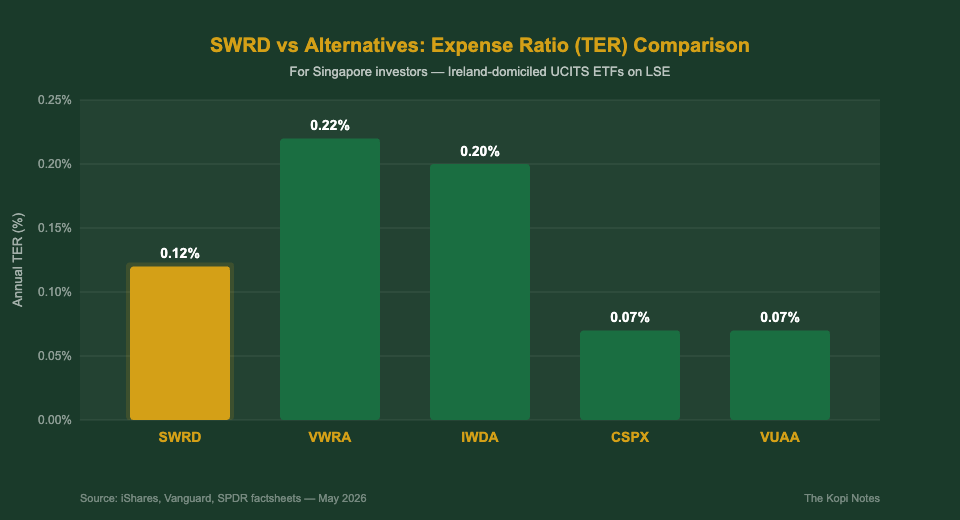
How does SWRD’s TER compare to alternatives? CSPX (S&P 500 only) charges 0.07% p.a. — cheaper, but covers only US stocks. VWRA (all-world including emerging markets) charges 0.22% p.a. IWDA (developed markets, same as SWRD’s scope) charges 0.20% p.a. SWRD therefore offers a meaningful cost advantage over IWDA for essentially identical market exposure, at 0.12% vs 0.20% — a saving of 0.08% p.a., or SGD 80 per year on a SGD 100,000 portfolio.
Beyond the TER, investors should factor in transaction costs: brokerage commissions per trade, the bid-ask spread (typically 0.01–0.03% for a liquid ETF like SWRD), and any FX conversion fees if funding the account in SGD. Interactive Brokers (IBKR) offers among the lowest commissions for LSE-listed ETFs in Singapore.
How to Buy SWRD in Singapore (Step-by-Step)
SWRD is listed on the London Stock Exchange and is not available on the Singapore Exchange (SGX). To buy it, you need an international brokerage account. Here is a step-by-step guide for the most popular options among Singapore investors.
Interactive Brokers (IBKR) — Best for Cost-Conscious Investors
IBKR is widely considered the most cost-effective platform for buying LSE-listed ETFs in Singapore. Commissions are as low as USD 1–3 per trade for LSE stocks, and the platform supports multi-currency accounts with competitive FX rates. Steps: open an IBKR account → fund in SGD or USD → search for “SWRD” and select LSE as the exchange → place a limit order in USD. IBKR is best suited to investors with SGD 10,000+ to invest and who are comfortable with a more complex interface.
Syfe Brokerage — Best for Beginners
Syfe offers a straightforward brokerage platform with a clean mobile app, making it a popular choice for first-time ETF investors in Singapore. You can use our Syfe referral code to get a sign-up bonus when you open an account. Syfe supports LSE-listed ETFs and allows you to invest in SGD with auto-conversion. Commission rates are slightly higher than IBKR but the user experience is significantly simpler.
Saxo Markets Singapore — Best for Active Traders
Saxo provides access to LSE-listed ETFs with a professional-grade trading platform. It is popular among more experienced investors who want advanced order types and in-depth market data. Saxo’s minimum account funding requirement is higher than Syfe’s, and commissions vary by account tier. Search “SWRD” in the LSE category and select the USD-denominated version.
moomoo Singapore — Good for Beginners with Cashback Promotions
moomoo frequently runs promotions for new account holders, making it attractive if you want to offset initial transaction costs. You can find the latest offers via our moomoo Singapore review. The platform supports LSE-listed ETFs and is mobile-first. Commission rates are competitive but slightly higher than IBKR for larger trades.
SRS-Compatibility Note
LSE-listed ETFs like SWRD are generally compatible with Supplementary Retirement Scheme (SRS) investments when purchased through eligible SRS-linked brokerages such as DBS Vickers, OCBC Securities, and UOB Kay Hian. However, SWRD is not eligible for CPF Investment Scheme (CPFIS) — CPFIS is restricted to SGX-listed products and approved unit trusts. If you are looking to invest via CPF, refer to our guide on CPF investment strategy Singapore.
SWRD vs Alternatives
SWRD is one of several Ireland-domiciled, LSE-listed ETFs popular with Singapore investors. The right choice depends on your geographic exposure preference, cost sensitivity, and whether you want developed markets only or global coverage including emerging markets.
| ETF | Ticker | TER | Coverage | Structure | AUM |
|---|---|---|---|---|---|
| SPDR MSCI World | SWRD | 0.12% | 23 developed markets | Acc | ~USD 9B |
| iShares MSCI World | IWDA | 0.20% | 23 developed markets | Acc | ~USD 25B |
| Vanguard FTSE All-World | VWRA | 0.22% | Developed + Emerging | Acc | ~USD 15B |
| iShares Core S&P 500 | CSPX | 0.07% | US only (S&P 500) | Acc | ~USD 75B |
| Vanguard S&P 500 UCITS | VUAA | 0.07% | US only (S&P 500) | Acc | ~USD 12B |
Source: iShares, Vanguard, SPDR factsheets — May 2026
The key distinction between SWRD and IWDA is cost: both track the MSCI World Index with physical replication, but SWRD charges 0.12% vs IWDA’s 0.20%. For most Singapore investors choosing between the two, SWRD is the better value option today. VWRA adds emerging market exposure at a higher TER — whether that premium is worth paying depends on your view of EM growth. CSPX and VUAA are US-only funds: lower TER, but concentrated in one country.
Who Should Buy SWRD?
SWRD is ideal if you: want broad developed-market exposure in a single low-cost ETF, prefer accumulating (auto-reinvesting) structure for compound growth, want to avoid US estate tax and benefit from the 15% WHT rate, are investing via an international brokerage like IBKR or Syfe, and are comfortable with USD-denominated holdings on the LSE.
Consider alternatives if you: want global coverage including emerging markets (consider VWRA instead), prefer a fund with a longer track record and larger AUM (IWDA has been around longer and has ~USD 25B AUM vs SWRD’s ~USD 9B), are investing via CPF (LSE ETFs are not CPFIS-eligible — see our CPF investment strategy Singapore guide), or want S-REIT exposure alongside global equities (see our best S-REITs in Singapore 2026 guide for the property income angle).
For investors building a long-term passive income portfolio, SWRD pairs well with a dividend-focused S-REIT sleeve or Singapore T-bills for stability. Use our Singapore retirement calculator to model how a SWRD position fits into your overall retirement plan. If you are also considering fixed income, our Singapore T-bills 2026 guide covers the current yield environment.
Disclaimer: This article is for educational purposes only and does not constitute financial advice. Always conduct your own research and consider consulting a licensed financial adviser before making investment decisions. Past performance is not indicative of future results.
Frequently Asked Questions
What is the SWRD ETF and why do Singapore investors buy it?
SWRD is the SPDR MSCI World UCITS ETF, listed on the London Stock Exchange. It tracks approximately 1,400 large and mid-cap stocks across 23 developed markets. Singapore investors favour it over US-listed equivalents because it is Ireland-domiciled, which means only 15% withholding tax applies to US dividends (vs 30% for US-domiciled funds) and there is no US estate tax exposure — a significant advantage for portfolios above USD 60,000.
Is SWRD the same as IWDA?
SWRD and IWDA both track the MSCI World Index and are Ireland-domiciled UCITS ETFs listed on the LSE. The main difference is cost and issuer: SWRD is issued by SPDR (State Street) at 0.12% TER, while IWDA is issued by iShares (BlackRock) at 0.20% TER. IWDA has a longer track record and significantly larger AUM (~USD 25B vs ~USD 9B), but SWRD offers essentially the same exposure at a 0.08% lower annual cost. For most Singapore investors starting today, SWRD is the better value choice.
Can I buy SWRD using CPF or SRS funds?
SWRD is not eligible for the CPF Investment Scheme (CPFIS), as CPFIS is restricted to SGX-listed products and approved unit trusts. However, SWRD may be purchased using Supplementary Retirement Scheme (SRS) funds through eligible SRS-linked brokerages such as DBS Vickers, OCBC Securities, or UOB Kay Hian. Check with your SRS bank operator for the latest list of approved instruments.
Which broker is best for buying SWRD in Singapore?
Interactive Brokers (IBKR) is generally the most cost-effective option for buying SWRD in Singapore, with commissions as low as USD 1–3 per LSE trade. Syfe Brokerage is better for beginners due to its simpler interface and SGD funding options. Saxo Markets suits active investors wanting advanced trading tools. For casual investors making smaller regular purchases, moomoo Singapore is worth considering, especially during promotional periods.
What is the minimum investment for SWRD?
SWRD trades as individual units on the LSE. As at May 2026, one unit is priced at approximately USD 40–50 (price fluctuates with the market). Most brokers require a minimum account funding of SGD 1,000–5,000, but you can technically buy a single share once your account is funded. For regular monthly investing, building a position of at least SGD 1,000–2,000 at a time is advisable to keep transaction costs as a percentage of investment low.
Is SWRD a safe investment? What are the risks?
SWRD tracks over 1,400 companies across 23 countries, making it one of the most diversified ETFs available. However, it carries equity market risk: during bear markets, the NAV will fall, sometimes significantly. Approximately 70% of the MSCI World Index is US equities, so SWRD has considerable concentration in one country. Currency risk also applies — the ETF is priced in USD, so a stronger SGD reduces returns when converted back. SWRD does not include emerging market exposure, unlike VWRA. As with all equity investments, it is suited for long investment horizons of 10 years or more.
Ready to Start Investing in ETFs?
Open a brokerage account and buy your first ETF today. Use our referral links for exclusive sign-up bonuses.
This article was researched with the help of AI. While we strive to keep all information accurate and up to date, there may be errors. If you notice any discrepancies, please contact us.