LON:VWRA — How to Buy VWRA on the London Stock Exchange (2026 Guide)
A complete guide for Singapore investors — why LON:VWRA beats US-listed alternatives, step-by-step broker instructions, and 2026 cost data.
LON:VWRA is the London Stock Exchange ticker for the Vanguard FTSE All-World UCITS ETF (Accumulating), an Ireland-domiciled fund tracking 3,700+ global stocks across 47 countries. Singapore investors buy it on the LSE rather than US equivalents like VT because it attracts only 15% dividend withholding tax (vs 30%) and carries zero US estate tax exposure — a critical advantage for non-US investors holding above USD 60,000.
Not financial advice. All figures are for educational reference only. Data as at May 2026 unless noted.
What Is LON:VWRA?
LON:VWRA is the ticker code used on stock screening and brokerage platforms to identify VWRA listed on the London Stock Exchange (LSE). The “LON:” prefix is simply a market identifier — it tells your broker or data platform that you want the LSE-listed version of the fund, not a fund with a similar ticker on another exchange.
The underlying fund is the Vanguard FTSE All-World UCITS ETF (USD) Accumulating, domiciled in Ireland and regulated under the EU’s UCITS framework. It tracks the FTSE All-World Index, which covers approximately 3,700 large- and mid-cap stocks across 47 developed and emerging markets — giving investors broad global diversification in a single ticker.
As an accumulating ETF, VWRA automatically reinvests dividends back into the fund rather than distributing them as cash. This is tax-efficient for Singapore investors because there is no dividend income to report, and Singapore does not impose capital gains tax, making the accumulation structure entirely tax-free at the investor level under current MAS regulations.
The fund launched in July 2019 and has grown to over USD 8 billion in assets under management as at Q1 2026, making it one of the most liquid Ireland-domiciled global equity ETFs available to Singapore investors on the LSE. Its distributing counterpart, VWRD (also on the LSE), pays out dividends quarterly for investors who prefer cash income.
Key Facts at a Glance
| Metric | Detail |
|---|---|
| Full Name | Vanguard FTSE All-World UCITS ETF (USD) Accumulating |
| LSE Ticker (LON:) | VWRA |
| Index Tracked | FTSE All-World Index (~3,700 stocks, 47 countries) |
| Domicile | Ireland (UCITS) |
| Structure | Accumulating (dividends auto-reinvested) |
| TER (Expense Ratio) | 0.22% p.a. |
| AUM | ~USD 8 billion (as at Q1 2026) |
| Number of Holdings | ~3,700 |
| Trading Currency | USD (on LSE) |
| Exchange | London Stock Exchange (LSE) |
| Distributing Counterpart | VWRD (LON:VWRD) |
Source: Vanguard FTSE All-World UCITS ETF factsheet, Q1 2026
Why Singapore Investors Use the LON: Prefix
When Singapore investors search for VWRA on platforms like Interactive Brokers, Saxo Markets, or financial data sites, they often see the ticker displayed as LON:VWRA. This is simply shorthand meaning “VWRA listed on the London Stock Exchange.” The “LON:” prefix has no bearing on the fund itself — it is purely a market routing identifier.
The more important question is why Singapore investors deliberately choose the LSE-listed version over similar US-listed funds. There are three compelling reasons:
1. Lower Withholding Tax (15% vs 30%)
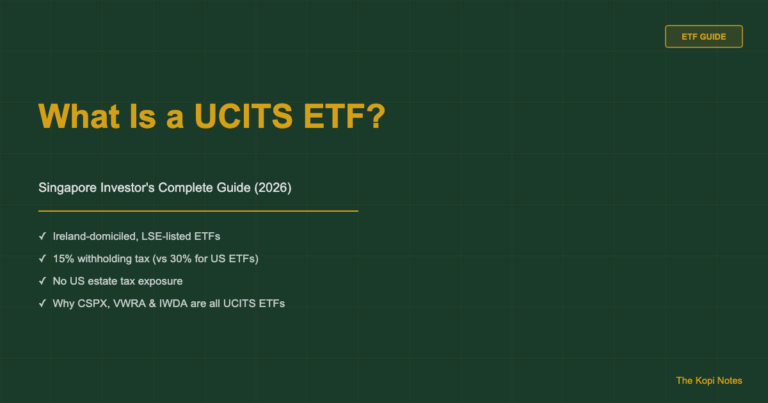
Ireland has a favourable tax treaty with the United States that caps dividend withholding tax at 15% for Ireland-domiciled funds. US-listed ETFs like VT (Vanguard Total World Stock ETF) are subject to a 30% withholding tax on US-sourced dividends for non-US investors. For a Singapore investor holding a global ETF with roughly 60% US equity exposure, this 15-percentage-point difference translates to a meaningful drag on net returns over time.
2. No US Estate Tax Exposure
Non-US persons face a USD 60,000 estate tax threshold on US-situs assets, including US-listed ETFs. Above this threshold, US estate tax rates can reach 40%. By holding VWRA on the LSE — an Ireland-domiciled fund — Singapore investors completely sidestep this exposure. Ireland-domiciled ETFs are not classified as US-situs assets.
3. UCITS Regulatory Framework
VWRA is a UCITS fund, regulated under EU law and available to retail investors globally. UCITS ETFs must meet strict diversification and liquidity requirements, offering an additional layer of investor protection compared to some US-domiciled structures.
| ETF | Domicile | US Dividend WHT | US Estate Tax Risk | Exchange |
|---|---|---|---|---|
| LON:VWRA | Ireland | 15% | None | LSE |
| VT (Vanguard) | USA | 30% | Yes (above USD 60k) | NYSE Arca |
| LON:CSPX | Ireland | 15% | None | LSE |
Source: IRS Publication 515, Vanguard fund factsheets, May 2026
Expense Ratio and Total Costs
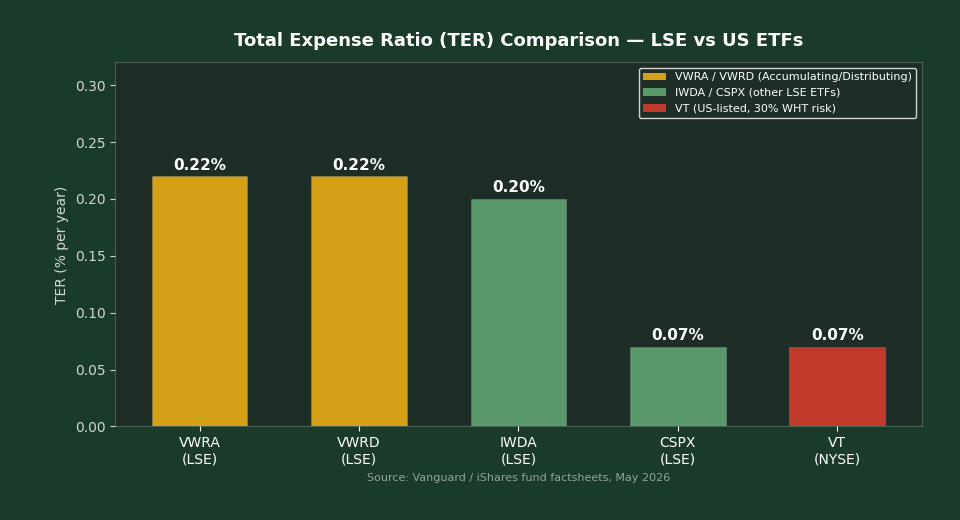
VWRA charges a Total Expense Ratio (TER) of 0.22% per annum. This covers all fund management, administration, and custody costs. There are no entry or exit fees charged by the fund itself — broker transaction costs apply separately.
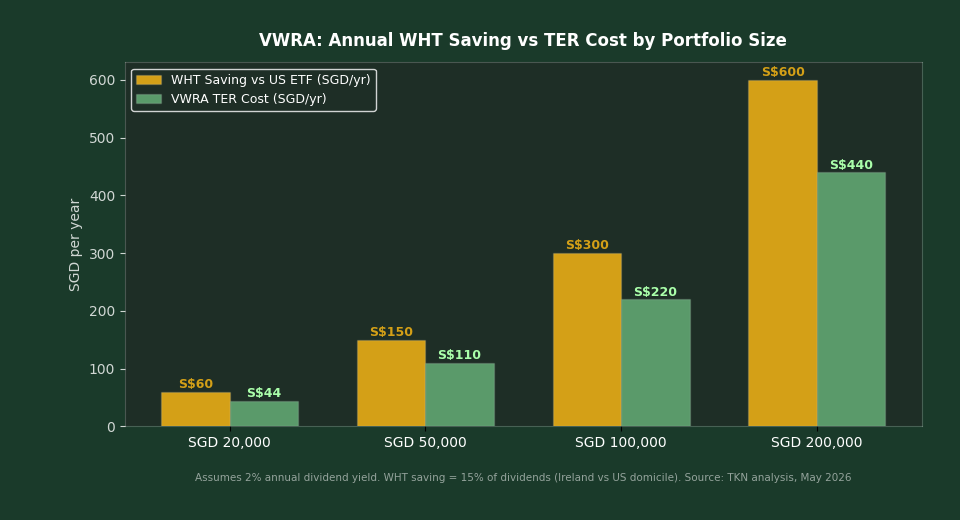
For comparison, Vanguard’s US-listed equivalent, VT, has a lower TER of 0.07% per annum. However, this apparent cost advantage is more than offset by the 15-percentage-point difference in withholding tax on US dividends. Consider a Singapore investor with SGD 100,000 in a global ETF with a 2% annual dividend yield and 60% US equity exposure:
| Cost Component | LON:VWRA (Ireland) | VT (US-listed) |
|---|---|---|
| TER on SGD 100,000 | SGD 220/yr | SGD 70/yr |
| WHT on dividends (2% yield, 60% US exposure) | SGD 180/yr (15%) | SGD 360/yr (30%) |
| Total estimated drag | SGD 400/yr | SGD 430/yr |
Illustrative calculation. Assumes SGD 100,000 portfolio, 2% dividend yield, 60% US equity exposure. Actual costs vary. Source: TKN analysis, May 2026
On a SGD 100,000 portfolio, VWRA costs approximately SGD 30 less per year than VT when both TER and WHT are combined — and eliminates US estate tax exposure entirely. The gap widens further for larger portfolios, making VWRA the more cost-efficient choice for most Singapore investors building long-term wealth.
How to Buy LON:VWRA in Singapore (Step-by-Step)
Any broker that provides access to the London Stock Exchange can be used to buy LON:VWRA. Here are the main options for Singapore investors, ordered from most cost-effective for large portfolios to most beginner-friendly:
Interactive Brokers (IBKR)
IBKR is generally the most cost-effective choice for investors with larger portfolios (SGD 20,000+). Commission is USD 1.70 minimum per LSE trade, with no platform or custody fees above USD 100,000 AUM. To buy: fund your account in USD or SGD → search “VWRA” and select the LSE venue → choose “LON” or “LSE” from the exchange dropdown → place a market or limit order in USD.
Saxo Markets
Saxo offers access to LSE-listed ETFs with a minimum commission of USD 8 per trade. Slightly higher cost than IBKR but with a more polished interface. Search “VWRA” → select LSE → trade in USD. No FX conversion needed if your account is USD-denominated.
MooMoo Singapore
MooMoo provides access to Hong Kong and US markets natively, and LSE access is available through their international markets feature. Check current fee schedules as these are updated periodically. Suitable for investors who already use MooMoo for US stocks and want to consolidate platforms. You can find more details in our moomoo Singapore review.
Syfe Brokerage
Syfe’s brokerage platform offers a simplified experience for beginners, with fractional investing available on selected ETFs. For investors who prefer a managed approach, Syfe’s Core Global ETF portfolio includes VWRA exposure. Use our Syfe referral code for a sign-up bonus when opening your account.
FSMOne
FSMOne (by iFAST) provides access to LSE-listed ETFs with a Regular Savings Plan (RSP) option, allowing automatic monthly investments from as little as SGD 50. This makes it one of the most accessible platforms for dollar-cost averaging into VWRA. Use our FSMOne referral code when signing up.
Note on CPF and SRS: LON:VWRA is not eligible for CPF investment (CPFIS only covers SGX-listed instruments and approved unit trusts). However, VWRA can be purchased using SRS (Supplementary Retirement Scheme) funds through eligible brokers such as FSMOne, if your account is SRS-linked. Consider your CPF investment strategy carefully before deciding whether to invest discretionary funds or SRS funds.
LON:VWRA vs Alternatives
VWRA competes with several other globally diversified ETFs available to Singapore investors. The choice often comes down to whether you prefer accumulating or distributing structure, your target index, and your cost sensitivity. Below is a comparison of the main alternatives:
| ETF | TER | Index | Structure | Domicile | Best For |
|---|---|---|---|---|---|
| VWRA (LON) | 0.22% | FTSE All-World | Accumulating | Ireland | Long-term growth, no dividend admin |
| VWRD (LON) | 0.22% | FTSE All-World | Distributing | Ireland | Dividend income seekers |
| IWDA (LON) | 0.20% | MSCI World (developed only) | Accumulating | Ireland | Slightly cheaper, developed markets only |
| CSPX (LON) | 0.07% | S&P 500 (US only) | Accumulating | Ireland | US equity concentration, lowest TER |
| VT (NYSE) | 0.07% | FTSE All-World | Distributing | USA | US investors only — 30% WHT + estate tax risk for SG |
Source: Vanguard / iShares fund factsheets, May 2026
Key distinction between VWRA and IWDA: IWDA tracks the MSCI World Index, which covers only 23 developed markets and excludes emerging markets like China, India, and Brazil. VWRA’s FTSE All-World Index includes approximately 10–11% emerging market exposure. If you want a one-fund solution covering the entire global market, VWRA is the more comprehensive choice. For a pure emerging-market tilt strategy, some investors pair IWDA with a separate EM ETF — but for simplicity, VWRA does the job in a single holding.
For investors focused purely on passive income, our passive income Singapore guide and Singapore REIT ETF guide cover complementary income-generating strategies alongside global equity ETFs like VWRA.
Who Should Buy LON:VWRA?
VWRA is ideal if you:
- Want broad global diversification in a single ETF (3,700+ stocks across 47 countries)
- Are investing for long-term wealth accumulation (10+ year horizon) and do not need regular dividend income
- Have a portfolio above USD 60,000 and want to avoid US estate tax exposure entirely
- Prefer to minimise tax drag — the accumulating structure avoids dividend income altogether under current Singapore tax rules
- Want access through a low-cost international broker like IBKR or through an RSP on FSMOne
Consider alternatives if you:
- Want quarterly dividend cash flow — consider VWRD (distributing counterpart, same index and TER)
- Prefer US-only exposure with the absolute lowest TER — consider LON:CSPX (S&P 500, 0.07% TER)
- Need CPF-investable options — VWRA is not CPFIS-eligible; consider SGX-listed ETFs instead
- Are investing very small amounts and want fractional investing — some robo-advisors like Syfe offer VWRA exposure without needing to buy full units
For retirement planning context, plug your target portfolio size into our Singapore retirement calculator to see how a VWRA-based portfolio could grow over time relative to your retirement goals. You may also want to compare VWRA with Singapore T-bills or Singapore Savings Bonds as part of a balanced portfolio approach.
Disclaimer: This article is for educational purposes only and does not constitute financial advice. Always conduct your own research and consult a licensed financial adviser before making investment decisions.
Frequently Asked Questions
What does LON:VWRA mean?
LON:VWRA is the stock market ticker for the Vanguard FTSE All-World UCITS ETF (Accumulating) as listed on the London Stock Exchange. The “LON:” prefix is a market identifier used by brokerage platforms and financial data sites to distinguish LSE-listed securities from those on other exchanges. The underlying fund is Ireland-domiciled and tracks approximately 3,700 global stocks across 47 countries.
Is LON:VWRA the same as VT?
Both VWRA and VT track the FTSE All-World Index and offer near-identical global diversification, but they are different funds with different domiciles. VWRA is Ireland-domiciled and listed on the LSE; VT is US-domiciled and listed on NYSE Arca. For Singapore investors, VWRA is significantly more tax-efficient: it incurs only 15% dividend withholding tax (vs 30% for VT) and carries no US estate tax exposure, whereas VT exposes investors to US estate tax on holdings above USD 60,000.
Can I buy LON:VWRA using CPF or SRS funds?
LON:VWRA cannot be purchased using CPF funds — the CPF Investment Scheme (CPFIS) only covers SGX-listed instruments and selected approved unit trusts, and LSE-listed ETFs are not included. However, VWRA may be purchasable using SRS (Supplementary Retirement Scheme) funds through eligible brokers such as FSMOne if your brokerage account is SRS-linked. Always verify current SRS eligibility directly with your broker.
What is the minimum investment for LON:VWRA?
VWRA trades in whole units on the LSE. One unit of VWRA was priced at approximately USD 110–120 as at May 2026 (check your broker for the live price). There is no minimum number of units required to purchase, so the practical minimum is roughly USD 110–120 plus your broker’s minimum commission. FSMOne’s Regular Savings Plan allows VWRA exposure from as little as SGD 50 per month in fractional units, making it accessible to investors at any portfolio size.
What is the difference between VWRA and VWRD?
VWRA and VWRD are two share classes of the same Vanguard FTSE All-World UCITS ETF, both listed on the LSE and both Ireland-domiciled. The sole difference is how they handle dividends: VWRA is accumulating (dividends are automatically reinvested within the fund, increasing the NAV), while VWRD is distributing (dividends are paid out quarterly in cash). Both have the same TER of 0.22%. Long-term investors who do not need regular income typically prefer VWRA for its compounding efficiency.
Is LON:VWRA safe? What are the risks?
VWRA is a regulated UCITS ETF domiciled in Ireland and managed by Vanguard, one of the world’s largest asset managers. It holds physical positions in approximately 3,700 stocks globally, meaning your investment is backed by actual shares rather than derivatives. Key risks include: equity market risk (global stocks can fall significantly in a downturn), currency risk (the fund is denominated in USD, so SGD investors are exposed to USD/SGD exchange rate fluctuations), and concentration risk (the US market represents roughly 60% of the index). VWRA is not capital-guaranteed. Past performance does not guarantee future returns.
Ready to Start Investing in ETFs?
Open a brokerage account and buy your first ETF today. Use our referral links for exclusive sign-up bonuses.
This article was researched with the help of AI. While we strive to keep all information accurate and up to date, there may be errors. If you notice any discrepancies, please contact us.