Sabana REIT Share Price 2026 (Alpha Integrated REIT, SGX: M1GU): DPU History, ~7% Yield & Industrial Portfolio Analysis
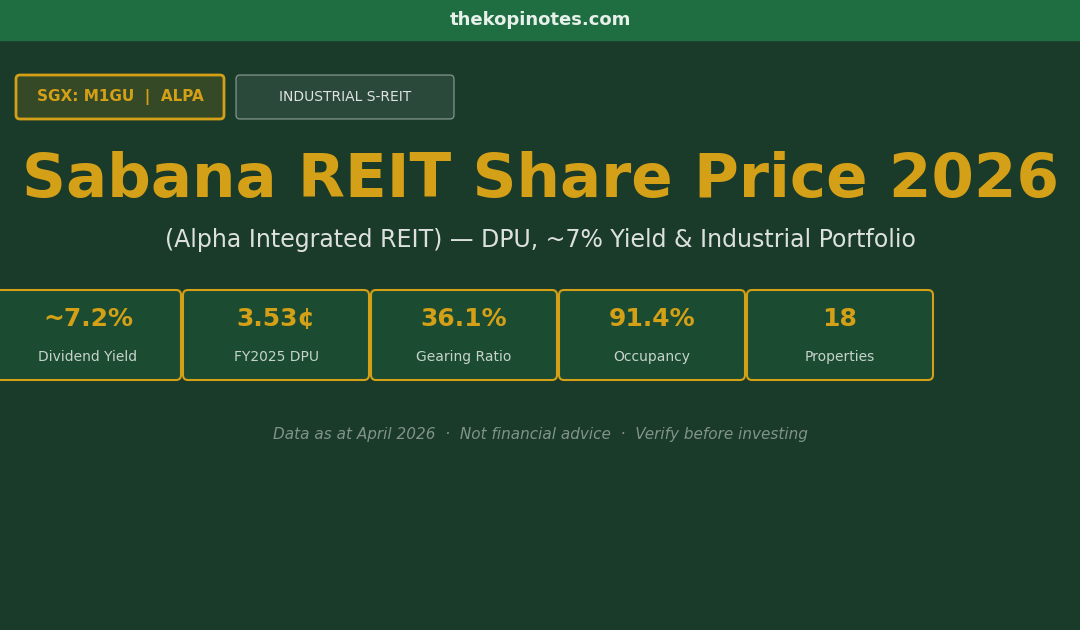
Sabana Industrial REIT rebranded to Alpha Integrated REIT (SGX: M1GU / ALPA) in November 2025 — becoming Singapore’s first internally-managed REIT. Here is everything you need to know about its share price, DPU history, ~7.2% dividend yield, 18-property industrial portfolio, and what the internalisation means for unitholders in 2026.
Data as at April 2026. This article is for informational purposes only and does not constitute financial advice. Always verify data and consult a licensed financial adviser before investing.
Table of Contents
Contents — Click to expand
- Sabana REIT / Alpha Integrated REIT Overview
- The Rebrand: Why Sabana Became Alpha Integrated REIT
- Share Price Performance 2025–2026
- DPU History: FY2020 to FY2025
- Dividend Yield Analysis
- The 18-Property Industrial Portfolio
- Key Financial Metrics: Gearing, Occupancy, ICR
- Peer Comparison: Industrial S-REITs
- Risks to Watch
- Frequently Asked Questions
Sabana REIT / Alpha Integrated REIT Overview
Alpha Integrated REIT (formerly Sabana Industrial REIT) is a Singapore-listed industrial real estate investment trust that owns and manages a diversified portfolio of 18 industrial properties across Singapore. Listed on the SGX-ST under the ticker M1GU (and alternatively ALPA post-rebrand), it operates across four industrial sub-sectors: high-tech industrial, warehouse and logistics, chemical warehouse and logistics, and general industrial.
With a total portfolio gross floor area of approximately 386,227 sqm and assets under management exceeding S$1.6 billion (as at 31 December 2025), Alpha Integrated REIT offers Singapore investors exposure to the resilient industrial real estate sector at a trailing dividend yield of approximately 7.2% — among the more attractive yields in the industrial S-REIT space.
| Metric | Value (April 2026) |
|---|---|
| SGX Ticker | M1GU / ALPA |
| Share Price | ~S$0.49 |
| 52-Week Range | S$0.33 – S$0.50 |
| FY2025 DPU | 3.53 cents (+23.4% YoY) |
| Dividend Yield | ~7.2% (trailing) |
| Gearing Ratio | 36.1% (1Q 2026) |
| Portfolio Occupancy | 91.4% (as at 31 March 2026) |
| Number of Properties | 18 Singapore industrial properties |
| Total GFA | ~386,227 sqm |
| Interest Coverage (ICR) | 4.0x |
| All-in Financing Cost | 3.85% |
| Management Model | Internalised (first in Singapore) |
The Rebrand: Why Sabana Became Alpha Integrated REIT
On 23 October 2025, Sabana Industrial REIT formally changed its name to Alpha Integrated Real Estate Investment Trust, with the SGX listing updating on 4 November 2025. This was not merely cosmetic — the rebrand coincided with the completion of Singapore’s first-ever REIT internalisation of management.
Under the old model, Sabana’s manager was an external entity that charged management fees regardless of performance. Internalisation replaced this with an internally-employed management team (Alpha Integrated REIT Management Pte. Ltd.) — effectively bringing the asset managers in-house and aligning their incentives directly with unitholder returns.
The practical impact has been measurable. Management fees previously paid to the external manager are now retained within the REIT, contributing to the 23.4% DPU surge in FY2025. Financing costs have also dropped significantly from 4.57% to 3.85% as the new management renegotiated debt facilities, while the ICR improved from 3.2x to 4.0x — a meaningful margin of safety improvement.
For Singapore investors searching for “Sabana REIT share price” or “M1GU SGX”, note that the REIT now trades under the ALPA ticker code. Both M1GU and ALPA resolve to the same security on SGX brokerage platforms.
Share Price Performance 2025–2026
Sabana REIT’s share price has been on a strong recovery trajectory since late 2024. After bottoming at around S$0.33 in mid-2024 (its 52-week low), the stock rallied to a 52-week high of approximately S$0.50 as the internalisation thesis played out and DPU growth materialised. As at April 2026, it trades around S$0.49.
The recovery reflects three converging tailwinds. First, the internalisation eliminated the drag from external management fees, directly boosting distributable income. Second, occupancy surged from 86.4% (1Q 2025) to 91.4% (1Q 2026), well above the broader Singapore industrial market average of 89.1%. Third, positive rental reversion of 12.0% in 1Q 2026 — though slightly below the 15.3% in 1Q 2025 — confirms continued pricing power on lease renewals.
The share is trading at a discount to net asset value (NAV), which, combined with the ~7.2% yield, positions it as a value play for yield-seeking investors comfortable with smaller-cap industrial REITs.
DPU History: FY2020 to FY2025
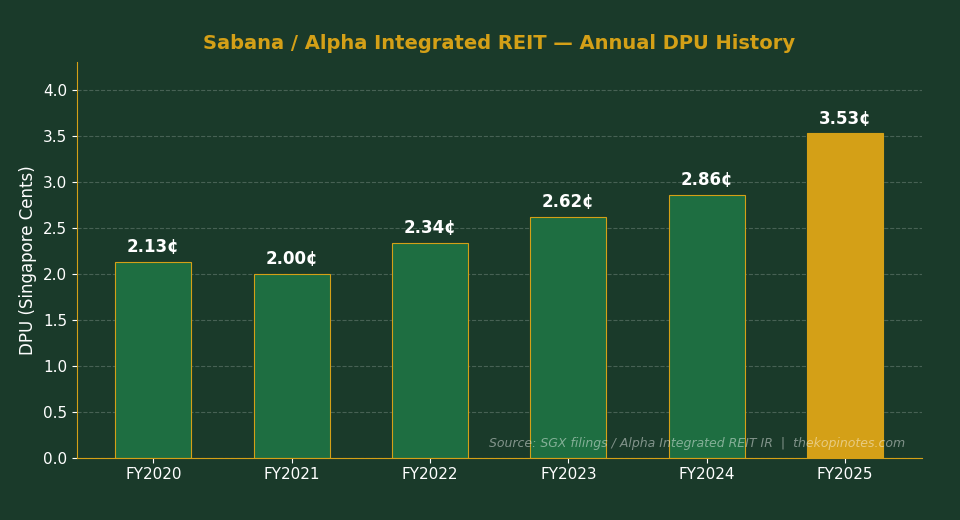
Sabana REIT’s distribution per unit has followed an inconsistent path over the past five years, reflecting the challenges of managing an ageing industrial portfolio under an external management structure. FY2021 saw a dip to 2.00 cents as COVID-19 disrupted tenants. Recovery was gradual through FY2022 (2.34¢) and FY2023 (2.62¢), accelerating in FY2024 (2.86¢) as occupancy improved.
The transformational jump came in FY2025: 3.53 cents, a 23.4% surge year-on-year. This was primarily driven by three factors: (1) savings from internalising management (eliminating external fees), (2) meaningful improvement in gross revenue — the first nine months of FY2025 saw net property income surge 20.8% to S$50.4 million — and (3) lower financing costs after debt refinancing at better rates.
| Financial Year | DPU (Singapore Cents) | YoY Change |
|---|---|---|
| FY2020 | 2.13¢ | — |
| FY2021 | 2.00¢ | -6.1% |
| FY2022 | 2.34¢ | +17.0% |
| FY2023 | 2.62¢ | +12.0% |
| FY2024 | 2.86¢ | +10.7% |
| FY2025 | 3.53¢ | +23.4% |
The REIT pays distributions semi-annually, historically in February and August. For the second half of 2025, Alpha Integrated REIT declared 1.83 cents per unit (paid August 2025). Investors targeting the semi-annual income should monitor ex-dividend dates carefully — typically announced 4–6 weeks ahead of payment.
Dividend Yield Analysis
At a share price of approximately S$0.49 and FY2025 DPU of 3.53 cents, Alpha Integrated REIT’s trailing dividend yield works out to approximately 7.2%. The forward yield consensus estimate points to approximately 7.4–7.5%, assuming continued DPU growth from further management savings and occupancy improvements.
For Singapore retail investors, this yield is particularly attractive for several reasons. First, S-REIT distributions are tax-exempt for individual investors in Singapore — you receive the full 7.2% without any withholding deduction (unlike US REITs which face 30% WHT for non-US investors). Second, the REIT is CPF Investment Scheme (CPFIS) eligible, meaning you can use OA funds to buy units and earn REIT distributions against CPF’s 2.5% interest cost — an effective yield spread of nearly 5 percentage points.
You can model this spread and calculate your own REIT dividend yield scenarios using our S-REIT Dividend Yield Calculator or check how the gearing stacks up with our S-REIT Gearing Ratio Calculator.
The 18-Property Industrial Portfolio
Alpha Integrated REIT’s portfolio spans 18 Singapore industrial properties with a combined GFA of approximately 386,227 sqm. The properties are geographically concentrated in established industrial estates across the island — including Toa Payoh, Tai Seng, Pandan Crescent, Buona Vista, and Changi — giving tenants good access to major transport nodes and the CBD.
The portfolio is diversified across four industrial sub-sectors:
| Sub-Sector | Description |
|---|---|
| High-Tech Industrial | R&D, precision engineering, electronics manufacturing |
| Warehouse & Logistics | Conventional warehousing and third-party logistics |
| Chemical Warehouse & Logistics | Specialised hazardous/chemical storage (higher barriers to entry) |
| General Industrial | Light manufacturing, assembly, workshops |
One of the REIT’s flagship assets is New Tech Park in Lorong Chuan, a mixed-use industrial development with significant value-add potential. Management is currently undertaking Phase 3 of asset enhancement initiatives (AEI) there, which is expected to unlock additional NPI and support future DPU growth once completed. This AEI pipeline is a key differentiator versus peers with more mature, stable portfolios.
The Shariah-compliant nature of the original Sabana REIT (it was Singapore’s first Shariah-compliant REIT) has been retained under the Alpha Integrated REIT structure, maintaining appeal to ESG and Islamic finance-focused investors.
Key Financial Metrics: Gearing, Occupancy, ICR
Alpha Integrated REIT’s balance sheet has improved materially since the internalisation. As at 1Q 2026:
| Metric | 1Q 2026 | 1Q 2025 | Change |
|---|---|---|---|
| Aggregate Leverage | 36.1% | 37.8% | ▼ Improved |
| All-in Financing Cost | 3.85% | 4.57% | ▼ -72 bps |
| Interest Coverage Ratio (ICR) | 4.0x | 3.2x | ▲ +0.8x |
| Portfolio Occupancy | 91.4% | 86.4% | ▲ +5.0pp |
| Rental Reversion | +12.0% | +15.3% | ▼ Moderated |
The gearing at 36.1% sits comfortably below MAS’s 50% regulatory cap (or 60% with a credit rating), giving the REIT debt headroom of approximately S$220–250 million for acquisitions or AEIs before approaching the limit. Management has indicated a preference for organic growth and inorganic AEI opportunities in Singapore rather than overseas acquisitions at this stage.
The ICR improvement to 4.0x is particularly significant for distribution sustainability. MAS requires a minimum 1.5x ICR for distributions — at 4.0x, Alpha Integrated REIT has a very wide buffer, suggesting distributions are well-covered even if NPI softens temporarily.
To compare how this gearing and ICR stacks up against other S-REITs, try our S-REIT Gearing Ratio & ICR Calculator. You can also use the S-REIT Yield vs SGS Bond Spread Calculator to assess whether the ~7.2% yield offers adequate compensation over Singapore Government Securities.
Peer Comparison: Industrial S-REITs
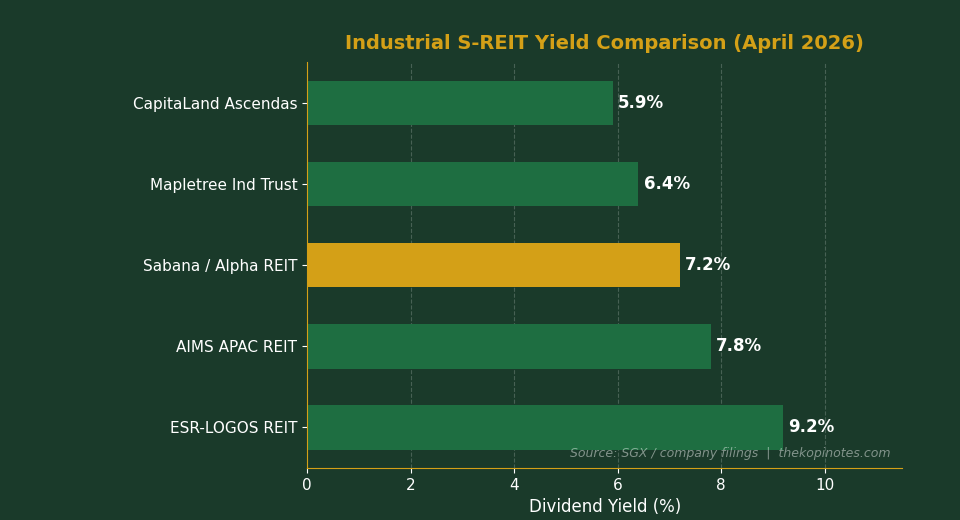
Alpha Integrated REIT competes in the industrial S-REIT segment alongside much larger players. Here’s how it stacks up on key investor metrics as at April 2026:
| REIT | Yield | Gearing | Key Angle |
|---|---|---|---|
| Alpha Integrated REIT (M1GU) | ~7.2% | 36.1% | Internalised mgmt, value-add AEI pipeline |
| AIMS APAC REIT (O5RU) | ~7.8% | ~34% | SG + Australia portfolio, high yield |
| ESR-LOGOS REIT (J91U) | ~9.2% | ~40% | Largest pan-Asia industrial, data centre play |
| Mapletree Industrial Trust (ME8U) | ~6.4% | ~38% | Blue-chip, data centres + flatted factories |
| CapitaLand Ascendas REIT (A17U) | ~5.9% | ~36% | Largest industrial S-REIT, global diversification |
Alpha Integrated REIT sits at a yield premium versus the large-caps (MIT, CLAR), reflecting its smaller scale, less diversified portfolio, and concentration in Singapore-only assets. However, the premium is partially justified by the internalisation tailwind — a structural improvement not available in externally-managed peers. Investors in the Best S-REITs 2026 comparison should weigh this higher yield against the higher concentration risk.
Risks to Watch
Alpha Integrated REIT is not without risks. Investors should weigh the following before committing capital:
1. Smaller market cap and lower liquidity. With a market cap significantly smaller than large-cap industrial S-REITs, daily trading volumes can be thin. This increases bid-ask spreads and makes it harder to establish or exit large positions quickly.
2. Singapore-only concentration. Unlike Mapletree Industrial Trust or CapitaLand Ascendas REIT, Alpha Integrated REIT has no overseas diversification. A local Singapore industrial downturn — driven by a manufacturing slump, weaker trade volumes, or oversupply — would hit the portfolio hard with no geographic offset.
3. Tariff and trade war exposure. As explored in our Singapore REIT tariff impact analysis, industrial tenants involved in manufacturing and logistics face indirect exposure to US-China trade tensions and tariff regimes. Tenants serving export-oriented industries could see demand weaken if global trade volumes contract.
4. AEI execution risk at New Tech Park. Phase 3 of the New Tech Park AEI is expected to deliver meaningful yield uplift — but AEIs carry construction timelines, cost overrun risk, and leasing risk post-completion. If the AEI takes longer than expected or the new space is slow to lease up, DPU growth could disappoint.
5. Internalisation execution remains to be proven. While the early numbers are positive, Alpha Integrated REIT’s internally-managed model is untested over a full market cycle. There is no blueprint in Singapore — if management quality deteriorates or internal costs balloon, unitholders lose the buffer of an external manager holding accountability.
6. Interest rate sensitivity. Despite the improvement in financing costs to 3.85%, Alpha Integrated REIT’s distributions remain sensitive to interest rate movements. A material rise in Singapore benchmark rates (SORA) could push refinancing costs higher and compress the ICR.
Invest Smarter with TKN Tools
Before adding Alpha Integrated REIT to your portfolio, run the numbers with our free Singapore investing calculators:
- S-REIT Dividend Yield Calculator — model your income at different share prices
- S-REIT Gearing Ratio & ICR Calculator — check balance sheet safety
- S-REIT Yield vs SGS Bond Spread — is 7.2% enough premium over risk-free?
- Dividend Portfolio Yield Calculator — model a mixed REIT portfolio income
Frequently Asked Questions
What is Sabana REIT called now?
What is Sabana REIT's dividend yield in 2026?
How many properties does Sabana REIT / Alpha Integrated REIT have?
What is Sabana REIT's gearing ratio?
Is Sabana REIT Shariah-compliant?
Can I buy Sabana REIT using CPF?
How do I buy Alpha Integrated REIT (M1GU) in Singapore?
This article was researched with the help of AI. While we strive to keep all information accurate and up to date, there may be errors. If you notice any discrepancies, please contact us.